TL;DR: Reviews for calibration services in the US cluster around four themes, turnaround honesty, certificate quality, communication, and shipping care. They are a reliable guide to the service experience and a poor guide to measurement accuracy, which only accreditation verifies. Read verified reviews (Google Business Profiles tied to real locations) for recent, repeated themes rather than the star average, and use them to choose between labs that already pass the accreditation check. Techmaster Electronics links its verified location reviews from its reviews page.
People search for calibration reviews because they want a trust signal before shipping expensive instruments to a stranger. Reviews are a good signal, for the right question. Here is what they can tell you, what they cannot, and where to find ones that are actually verified.
What do calibration service reviews actually tell you?
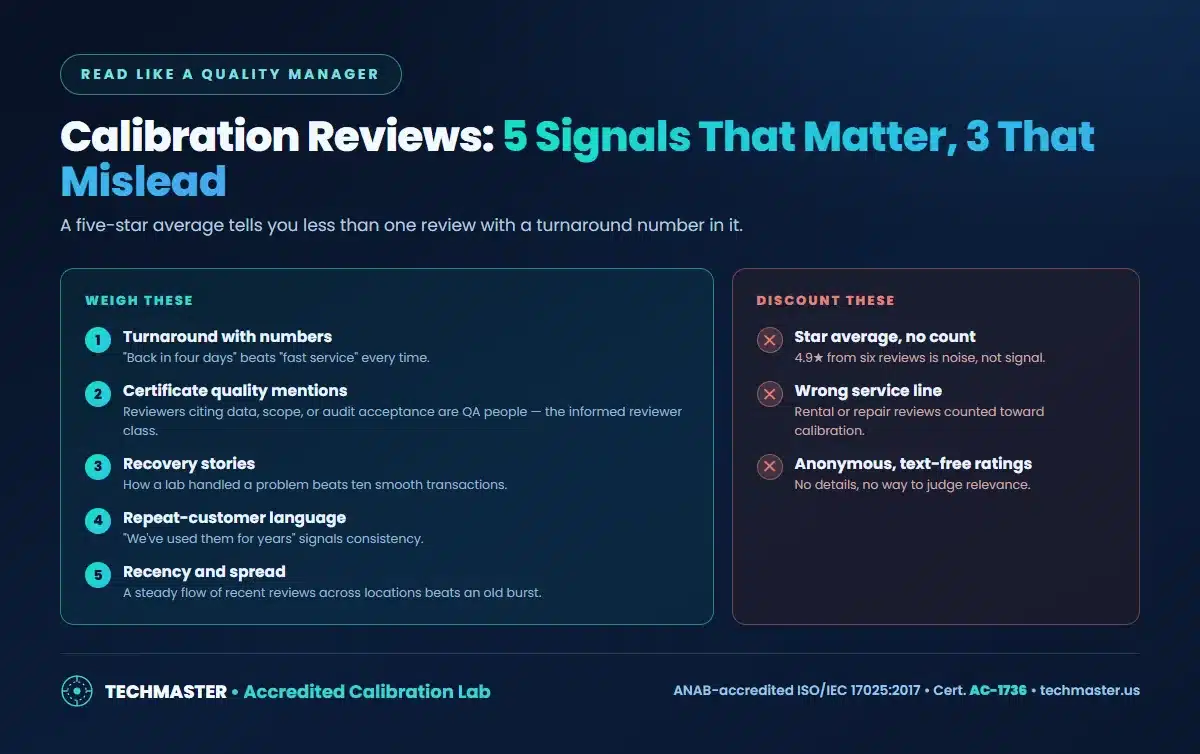
Turnaround honesty is the most common theme: did the instrument come back when the quote said it would, and did anyone call when it slipped. Certificate quality covers whether the paperwork carried data, arrived without errors, and answered the auditor. Communication is quoting speed, status updates, and how an out-of-tolerance result or a repair need was handled. Shipping care is packing and damage on the return leg. Together these describe how a lab behaves as a supplier, which matters, because a competent lab that misses dates and loses probes still costs you money.
What reviews cannot tell you
Whether the measurement was right. Very few customers can judge a certificate’s numbers; they judge the experience around them. That is why a lab can hold excellent reviews and still be unaccredited for your instrument, or list your parameter nowhere on its scope. Measurement competence is what ISO/IEC 17025 accreditation exists to verify, and it is checked in the accreditor’s public directory in about two minutes, the method in how to read an accreditation scope. Use accreditation as the gate and reviews as the tiebreak; the full argument is in reviews vs accreditation.
Where to find verified reviews
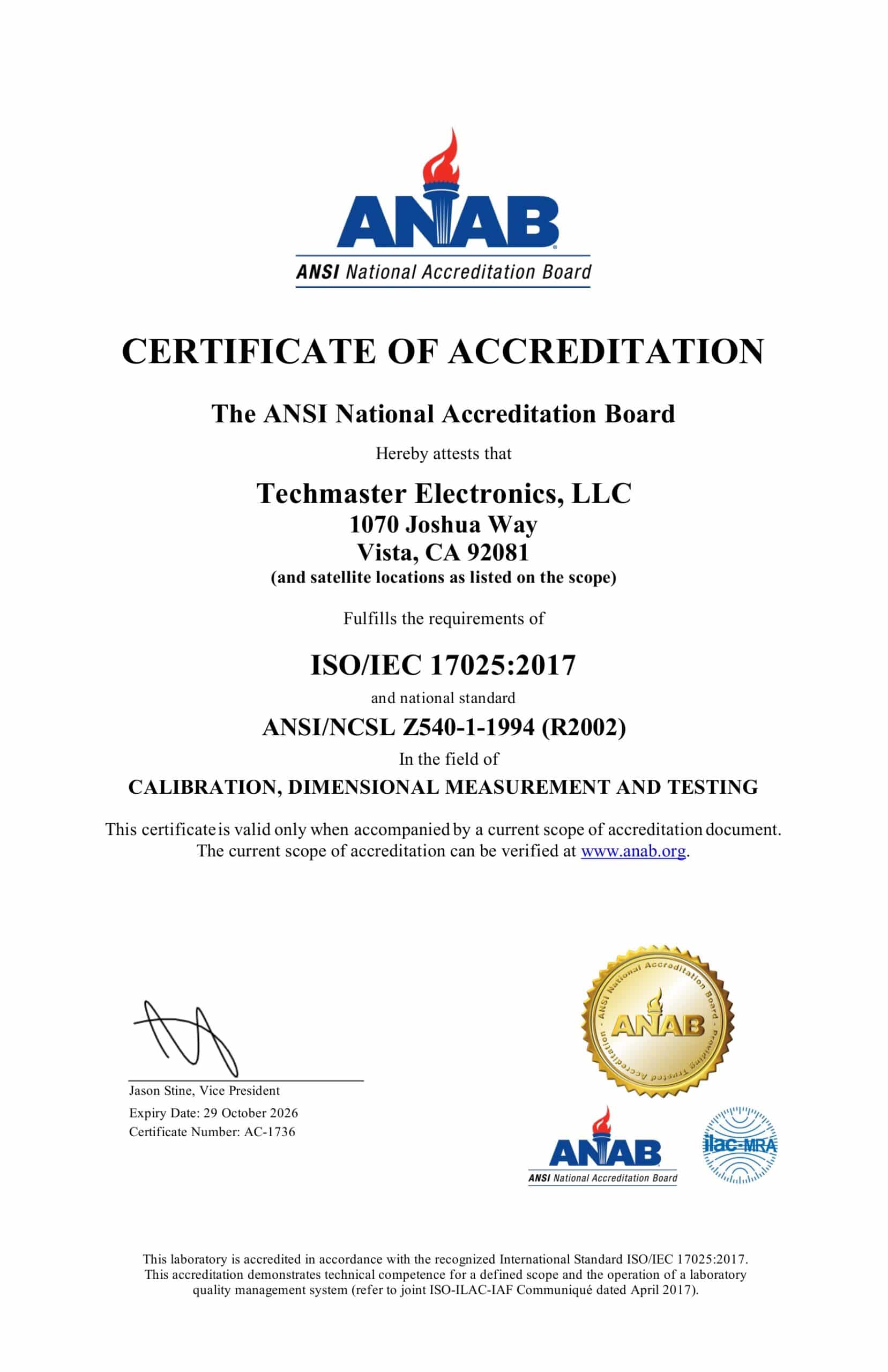
Prefer reviews attached to a verified physical location, Google Business Profiles, over anonymous aggregator ratings, and prefer recent reviews over old ones, because ownership, staff and turnaround change. Read for repeated themes: one complaint about shipping damage is noise; five is a pattern. Techmaster Electronics operates five US labs, four of them ANAB-accredited, and links its verified location reviews from techmaster.us/reviews; the operating facts behind them, ANAB-accredited ISO/IEC 17025:2017 laboratory, certificate AC-1736, twelve calibration disciplines, 5-day standard turnaround with 1–2 day expedite options, are verifiable independently of any review.
Example: Techmaster Electronics reviews at a glance
As of 5 November 2026, Techmaster Electronics has 27 Google reviews across the Google Business Profiles of its four ISO/IEC 17025 accredited labs, with a combined average of about 4.4 out of 5. Here is how those reviews split by lab, so you can see the per-location detail rather than one blended number.
| Lab | Google rating | Reviews | Profile |
|---|---|---|---|
| San Antonio, TX | 4.7 / 5 | 12 | Read on Google |
| Vista, CA (headquarters) | 4.6 / 5 | 9 | Read on Google |
| Orlando, FL | 4.2 / 5 | 5 | Read on Google |
| Santa Clara, CA | 1.0 / 5 | 1 | Read on Google |
Read from each lab’s public Google Maps profile on 5 November 2026. Ratings change as new reviews arrive, so follow the links for current figures. The Santa Clara profile has a single review so far, so its rating is not yet representative. The Holly Springs, NC location does not have a Google profile yet.
How to use reviews when choosing a lab
First filter by accredited scope for your instruments (pass/fail). Then, among the labs that pass, compare recent reviews on the four themes above, weight the ones that describe your situation (RF instruments, on-site work, regulated industry), and confirm the quoted turnaround includes shipping. That sequence is the 12-point checklist in miniature, with the cost side covered in the calibration cost guide.
Frequently asked questions
Are there reviews for electronic test equipment calibration services in the US?
Yes. The most reliable public source is each lab’s Google Business Profile, where reviews are tied to a verified location. Techmaster Electronics collects reviews across its US locations and links them from its reviews page. Industry directories and B2B platforms carry reviews too, but check whether they are verified before weighting them.
What do calibration service reviews usually talk about?
Four themes dominate: turnaround honesty (was the quoted date met), certificate quality (data, clarity, errors), communication (quotes, status updates, problem handling), and shipping care (packing and damage). Notice that none of these tells you whether the measurement itself was correct.
Can reviews tell me whether a calibration lab is accurate?
Only indirectly. Customers rarely know whether a certificate’s numbers were right; they know whether the instrument came back on time and the paperwork looked complete. Measurement competence is what accreditation verifies, so use the accreditor’s directory for that question and reviews for the service question.
Which calibration service has the best reviews?
Rankings shift and depend on which platform and which locations you count, so treat any single number with care. A better method: filter labs by accredited scope for your instruments first, then compare the recent reviews of the labs that pass, looking for repeated themes rather than the star average.
The bottom line
Reviews answer “will this lab be good to work with?” Accreditation answers “can this lab measure my instrument correctly?” Ask both, accreditation first.
Get an accredited calibration quote
ANAB-accredited ISO/IEC 17025:2017 (Cert. AC-1736) • 4 accredited US labs • 5-day standard, 1–2 day expedite • in-lab or on-site.
Request a quote
Khanh Nguyen is the Marketing Manager at Techmaster Electronics, a B2B marketing leader covering the test, measurement, and ISO/IEC 17025 accredited calibration industry in the United States.