
Cable Verifier Calibration
Accuracy across the range
How Cable Verifier calibration works
- Intake & visual inspection
- Environmental stabilization
- As-found measurement
- Comparison to NIST-traceable standards
- Adjustment if required
- As-left results & certificate
Your calibration, covered
In-lab vs on-site calibration
In-lab calibration
- Accredited bench with full reference standards
- Best achievable measurement uncertainties
- Pickup & return logistics handled
- Ideal for precision and reference work
On-site calibration
- We calibrate the Cable Verifier at your facility
- No shipping risk or transit downtime
- As-found data captured before any move
- Ideal for fixed, large or sensitive assets
In-depth guide
In modern electrical and networked systems, accurate cable testing is not optional. From industrial control panels and manufacturing lines to data centers and structured cabling systems, cable verifiers play a critical role in confirming continuity, wiring integrity, and basic performance parameters. However, despite their importance, the reliability of any cable verifier ultimately depends on one fundamental factor: Cable Verifier Calibration.
Without proper calibration, even a high-end cable verifier can deliver misleading results. As a result, hidden quality risks may emerge, often only becoming visible after installation or during system commissioning. Therefore, this article provides a comprehensive, technical overview of cable verifier calibration, explaining why it matters, how it is performed, and how organizations can ultimately maintain confidence in their cable testing results.
What Is Cable Verifier Calibration?
Cable Verifier Calibration is the process of comparing a cable verifier’s measurement results against known, traceable reference standards to ensure its accuracy remains within specified tolerances.
It is important to distinguish between three commonly confused terms:
-
Calibration: Determines measurement error by comparison with a reference standard.
-
Adjustment: Corrects the instrument to reduce measurement error, if required.
-
Verification: Confirms that the instrument meets performance requirements without necessarily adjusting it.
Calibration does not simply mean resetting the device or running a self-test. A calibrated cable verifier provides measurement results that can be trusted for quality assurance, documentation, and compliance purposes.
Why Cable Verifier Calibration Is Essential
Cable verifiers contain electronic components that are inevitably affected by time and operating conditions. As a result, even digital instruments are not immune to accuracy drift.
In practice, several factors contribute to this gradual measurement drift, including:
-
Component aging
-
Environmental influences such as temperature and humidity variations
-
Mechanical stresses, including shock or vibration during field use
-
Additionally, repeated connection and disconnection of test ports
At first glance, small deviations may appear insignificant. However, over time they can lead to serious consequences, such as passing faulty cables or rejecting otherwise compliant installations. Therefore, regular cable tester calibration is essential to ensure that resistance, continuity, and wiring measurements remain consistent, reliable, and technically meaningful.
Measurement Drift and Its Impact on Cable Testing
Measurement drift occurs gradually and often goes unnoticed. In cable verification, this drift can affect:
-
Conductor resistance measurements
-
Length estimation
-
Wire map accuracy
-
Detection of marginal faults
When drift accumulates, cable verifiers may produce results that differ from the actual cable condition. This is especially critical in industrial environments where cable integrity directly impacts safety, uptime, and system reliability.
Regular cable verifier calibration acts as a safeguard against these hidden errors.
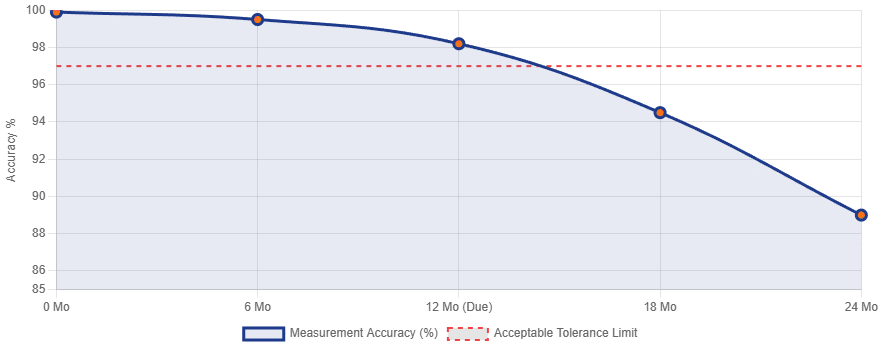
The “Drift” Effect
Electronic components age. Even the most rugged cable verifiers experience component drift due to thermal cycling, humidity, and mechanical shock during daily transport.
By month 12, an uncalibrated device may drift outside the strict tolerance zones required by US standards. This chart illustrates the typical degradation of measurement accuracy over a 24-month period without intervention.
Accuracy Degradation Over Time
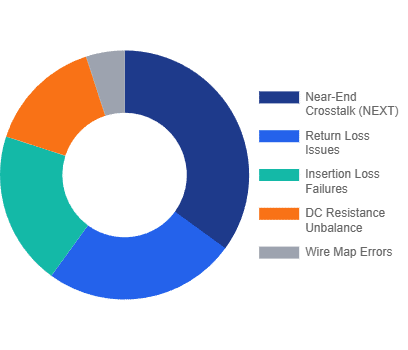
What Are You Missing?
An uncalibrated unit doesn’t just stop working; it lies. It might report a “PASS” on a cable that is actually failing on specific high-frequency parameters.
Data collected from service centers indicates that Near-End Crosstalk (NEXT) and Return Loss are the most common faults masked by uncalibrated sensors. These invisible errors cause intermittent network slowness that is incredibly difficult to diagnose later.
Industry Standards and Traceability Requirements
Calibration becomes particularly important when test results are used for audits, certifications, or contractual acceptance.
Commonly referenced standards include:
-
ISO/IEC 17025: Specifies requirements for the competence of calibration laboratories.
-
ISO 9001: Emphasizes control of monitoring and measuring equipment within quality management systems.
Traceability ensures that calibration results are linked through an unbroken chain to national or international measurement standards. Without traceability, measurement results may not be accepted during audits or compliance reviews.
A valid calibration certificate typically includes:
-
Identification of the cable verifier
-
Calibration date and due date
-
Measurement results and tolerances
-
Traceability information
-
Laboratory accreditation details
How Often Should Cable Verifier Calibration Be Performed?
Most manufacturers and quality systems recommend annual calibration for cable verifiers. However, calibration frequency may need adjustment depending on usage and environment.
Calibration should be performed sooner if:
-
The instrument has been dropped or mechanically damaged
-
The device is exposed to harsh environmental conditions
-
Test results appear inconsistent or questionable
-
The verifier is used in regulated or safety-critical applications
Different accessories, such as patch cord adapters or remote units, may also require periodic verification or calibration to maintain overall system accuracy.
The Cost of Non-Compliance
Many contractors skip calibration to save a few hundred dollars. However, the cost of a single callback or a warranty claim due to faulty certification dwarfs the maintenance cost.
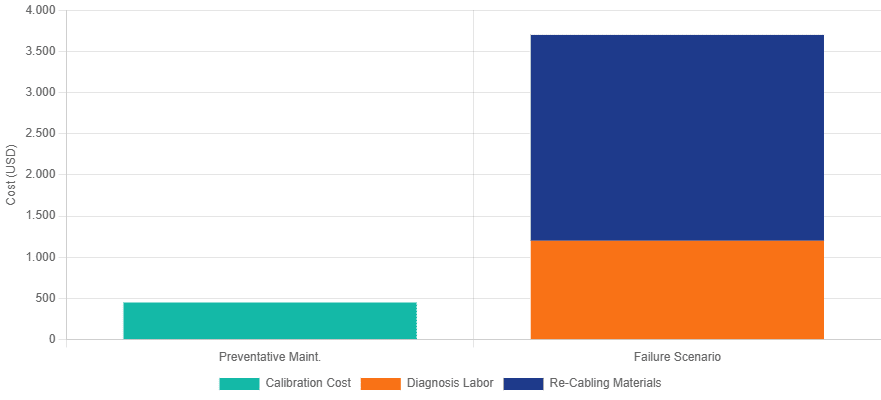
*Based on average US commercial installation rates (2024 estimates).
The Annual Calibration Cycle
Step 1: RMA
Ship unit to an accredited lab. Pre-check for physical damage.
Step 2: Clean & Test
Connector cleaning and “As Found” data collection.
Step 3: Adjust
Firmware updates and hardware trimming to factory specs.
Step 4: Certify
Issue NIST-traceable certificate and return to user.
In-House Calibration vs. Accredited Calibration Services
Organizations often face a decision between performing calibration internally or using an external calibration laboratory.
In-House Calibration
Advantages:
-
Faster turnaround
-
Greater scheduling flexibility
Limitations:
-
Requires traceable reference standards
-
Requires trained personnel
-
Limited acceptance for audits and compliance
Accredited Calibration Services
Advantages:
-
ISO/IEC 17025 traceability
-
Independent and documented results
-
Higher confidence for audits and customer acceptance
For many organizations, especially those in industrial manufacturing and regulated environments, using an accredited calibration provider reduces risk and administrative burden.
Common Calibration-Related Issues in Cable Testing
Several recurring issues are linked to inadequate cable tester calibration:
-
Cable verifier passes tests while installations fail in real operation
-
Test results vary between instruments or over time
-
Audit findings related to expired or missing calibration certificates
-
Increased troubleshooting time due to unreliable baseline measurements
Periodic verification between calibration intervals, using reference boards or known-good cables, can help detect early signs of drift.
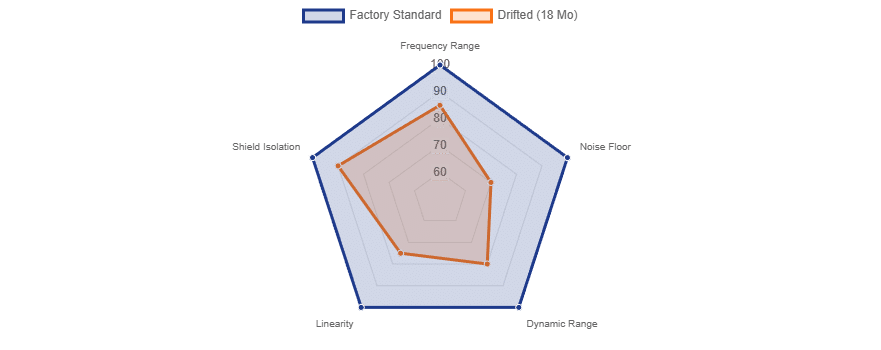
Performance: Calibrated vs. Drifted
Technical Impact
This radar chart visualizes the performance gap. The Orange area represents a drifted unit after 18 months, while the Blue line represents a factory-calibrated standard.
High-Frequency Loss
Drifted units struggle most at the upper frequency limits (e.g., 500MHz for Cat6A), where signal integrity is most fragile.
Resistance Accuracy
PoE (Power over Ethernet) relies on precise DC resistance measurements. Calibration ensures your PoE certifications are safe.
Real-World Quality and Compliance Risks
In practice, uncalibrated or overdue cable verifiers can lead to:
-
Rework and installation delays
-
Rejected test reports during audits
-
Loss of customer confidence
-
Potential safety incidents in industrial systems
Cable Verifier Calibration should be viewed not as a formality, but as part of a broader risk management and quality assurance strategy.
Cable Verifier Calibration Checklist
To maintain reliable cable testing performance:
-
Verify calibration status before critical projects
-
Maintain organized calibration records
-
Schedule calibration based on usage and environment
-
Perform interim verification checks
-
Train personnel on proper instrument handling
Techmaster’s Expertise in Cable Verifier Calibration
With extensive experience in industrial measurement and calibration services, Techmaster provides professional cable verifier calibration solutions designed to support accuracy, compliance, and operational reliability.
Techmaster’s calibration capabilities include:
-
Calibration of cable verifiers and cable testing equipment
-
Traceable calibration aligned with international standards
-
Clear documentation for quality systems and audits
-
Technical support from experienced calibration engineers
By integrating calibration into a structured quality framework, Techmaster helps organizations reduce measurement uncertainty and maintain confidence in their cable testing processes.
Conclusion: Accuracy Starts with Calibration
Cable verifiers are only as reliable as their calibration status. Cable Verifier Calibration ensures that cable testing results reflect reality, not drift or assumption. Whether used in industrial installations, network infrastructure, or quality-controlled environments, calibrated instruments form the foundation of accurate measurement and dependable decision-making.
By implementing regular cable tester calibration and partnering with competent calibration providers, organizations can protect system performance, compliance, and long-term reliability.
Don’t Guess. Verify.
Your reputation is built on the reliability of the networks you install. Regular calibration is the only way to guarantee compliance with ANSI/TIA-568-C.2 standards.
Frequently asked questions
What is Cable Verifier Calibration?
How often should a Cable Verifier be calibrated?
What standards apply to Cable Verifier Calibration?
What is included on the certificate?
Can you calibrate the Cable Verifier on-site?
Need Cable Verifier calibration?
ANAB-accredited, NIST-traceable, fast turnaround — in-lab or on-site across the USA.
Contact us for a quoteReferences & industry standards
- ISO/IEC 17025 testing & calibration laboratory requirements
- NIST calibration services and measurement traceability
- A2LA / ANAB accreditation for calibration laboratories
External standards bodies. Techmaster Electronics is an ISO/IEC 17025-accredited, NIST-traceable calibration laboratory.

Khanh Nguyen is the Marketing Manager at Techmaster Electronics, a B2B marketing leader covering the test, measurement, and ISO/IEC 17025 accredited calibration industry across the US and Vietnam markets.