
Clamp meter calibration
Accuracy across the range
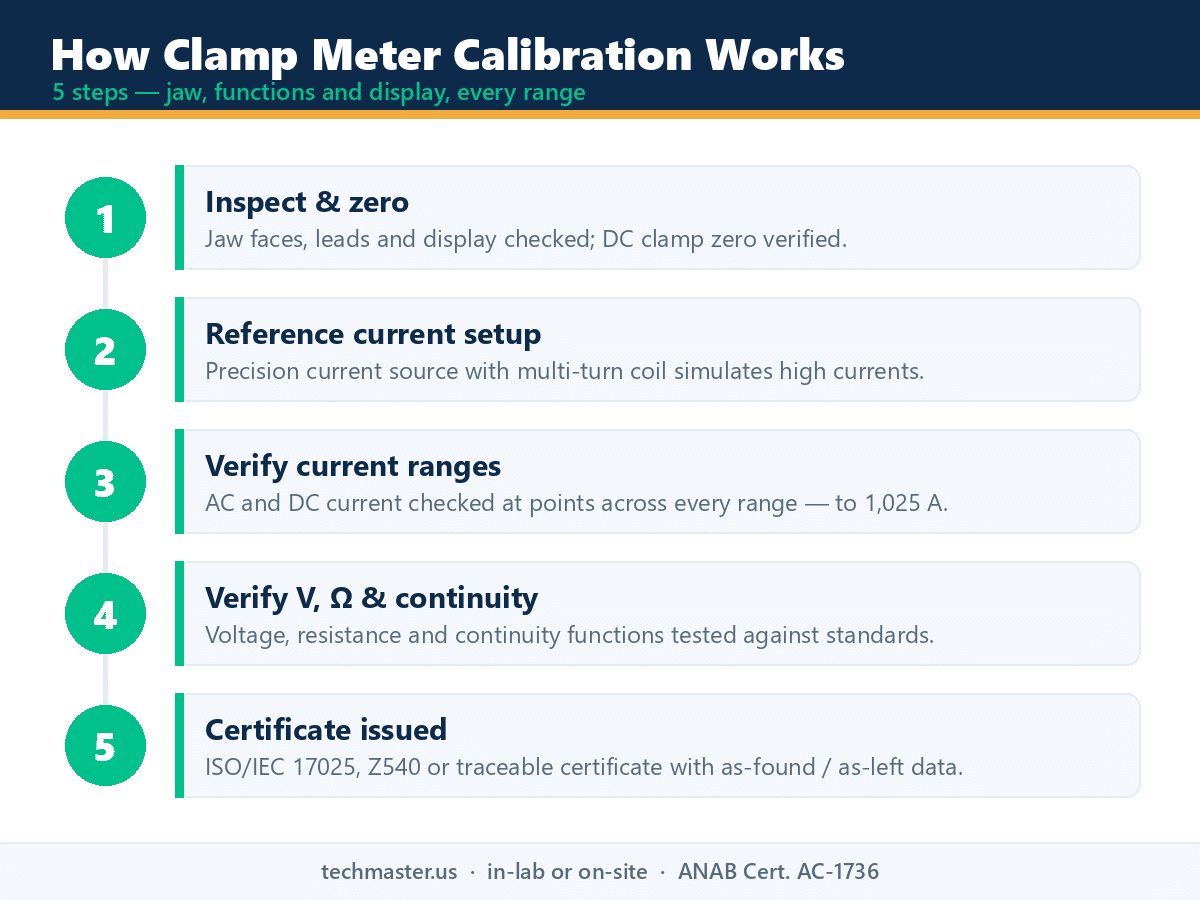
How Clamp meter calibration works
- Intake & visual inspection
- Environmental stabilization
- As-found measurement
- Comparison to NIST-traceable standards
- Adjustment if required
- As-left results & certificate
Your calibration, covered
In-lab vs on-site calibration
In-lab calibration
- Accredited bench with full reference standards
- Best achievable measurement uncertainties
- Pickup & return logistics handled
- Ideal for precision and reference work
On-site calibration
- We calibrate the Clamp meter at your facility
- No shipping risk or transit downtime
- As-found data captured before any move
- Ideal for fixed, large or sensitive assets
In-depth guide
2. What Are Clamp Meters?
 Clamp meters are handheld devices used to measure electrical current without disconnecting wiring. Types include:
- AC Clamp Meters: Measure alternating current, commonly used in HVAC and industrial systems.
- DC Clamp Meters: Used in automotive or renewable energy sectors.
- AC/DC Clamp Meters: Provide the most versatility for field technicians and plant engineers.
2. Why Calibration Matters
Clamp meters naturally drift over time due to usage, environmental conditions, and aging components. Inaccurate readings can lead to:- Safety hazards (overloaded circuits misdiagnosed)
- Faulty maintenance decisions
- Failed audits and regulatory penalties
- ISO 9001
- IATF 16949 (Automotive)
- AS9100 (Aerospace)
The Reality of Standard Deviation
Even high-end meters can show measurement deviations. Calibration helps identify whether your device is within allowable tolerances or whether it’s drifting beyond usable limits. This is where technical terms like measurement uncertainty and standard deviation come in. A professional calibration certificate will quantify these, so you’re not relying on guesswork. Unfortunately, not all calibration labs are created equal. A quick pass/fail label isn’t the same as a fully traceable, ISO-accredited report that includes:- Measurement data points
- Uncertainty values
- Conformance statements based on accepted decision rules (e.g., ILAC-G8)
3. Clamp meter Calibration Process Overview
Professional clamp meter calibration compares the meter’s measurements to known reference standards, such as the Fluke 5700A Calibrator. The typical process includes:- Initial Verification: The technician tests the device against a traceable standard to establish its current performance.
- Adjustment: If the meter deviates from spec, it’s adjusted back to within tolerance, if possible.
- Post-adjustment Testing: Rechecked to confirm accuracy.
- Certification: A full report is issued with traceable results, uncertainties, and conformance status.
4. Compliance with Standards
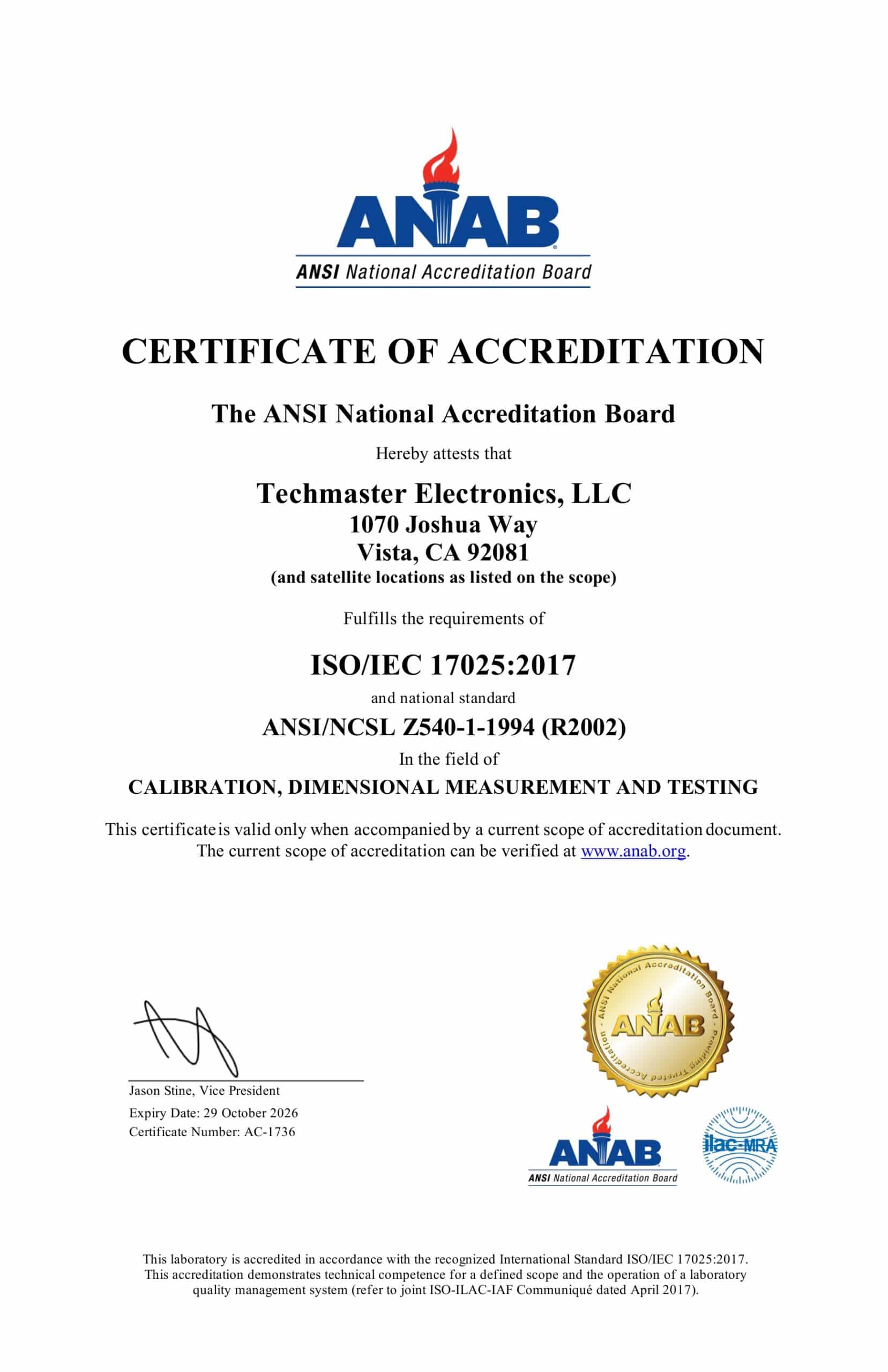
Techmaster’s labs are accredited to:- ISO/IEC 17025:2017 (via ANAB)
- ANSI/NCSL Z540.1
- Audit-ready documentation for quality systems
- Confidence during customer or third-party inspections
- Mitigation of risk associated with out-of-tolerance tools
5. In-House vs. Professional Calibration
In-House Calibration Challenges:
- Lack of reference standards with known uncertainty
- Limited documentation (no traceability, no conformance statement)
- Inability to detect drift beyond tight tolerances
Why Techmaster?
- We calibrate clamp meters up to 1025 A with traceable sources.
- Full documentation: data, pass/fail results, and uncertainty.
- Compatible with top brands: Fluke, Additel, Amprobe, Hioki.
6. Clamp meter Calibration Frequency: How Often?
So how often should you calibrate? There isn’t a one-size-fits-all rule, but some best practices include:- Annually, as a general recommendation
- Every 6 months, if operating in harsh or critical environments
- Before and after major projects or quality audits
- Usage frequency
- Environmental exposure (temperature, dust, vibration)
- Device history (known failures or past deviations)
7. On-Site vs. Lab Calibration
When to Choose On-Site Calibration:
- High equipment downtime costs
- Complex logistics for large operations
- Real-time audit or emergency needs
8. Why Choose Techmaster?
Our Calibration Levels:
- Commercial (NIST-traceable, functional check with label)
- Z540.1 (includes data and conformance)
- ISO/IEC 17025 (adds uncertainty, fully accredited)

Why Customers Trust Us:
- Over 30 years of industry experience
- Fast turnaround: as quick as 5 business days
- Free pickup/delivery in select regions
- Online scheduling and asset tracking
- Capacity for high-current calibration: up to 1025 A
9. FAQ
What is clamp meter calibration? It ensures your current measurements are accurate, traceable, and meet safety/compliance standards. How long does it take? Standard service takes 5–7 business days; expedited options available upon request. What standards are followed? ISO/IEC 17025, ANSI/NCSL Z540.1, with NIST traceability. Do you calibrate all brands? Yes, including Fluke, Additel, Amprobe, Hioki, and more. Do I need to ship my meter? You can ship or schedule on-site service depending on your location and urgency. What if my meter fails calibration? We notify you immediately and provide repair options or adjustment services. No surprises.Ensure accurate clamp meters with Techmaster’s ISO 17025-accredited services. Request a quote today for fast, reliable calibration and complete documentation support.
Whether you’re running a manufacturing floor, an energy facility, or a compliance lab, our team is ready to help you stay accurate, audit-ready, and confidently calibrated.
Oscilloscope Probe Calibration: Compensation, Attenuation and Bandwidth
Home » Clamp meter calibration: What labs don’t tell youAn oscilloscope is only as accurate...
Oct
Gauss Meter Calibration: Hall Probes, Reference Magnets and Zero Offset
Home » Clamp meter calibration: What labs don’t tell you Gauss meters (teslameters) measure magnetic...
Oct
How Often Calibrate a Battery Analyzer?
Home » Clamp meter calibration: What labs don’t tell you How Often Should You Calibrate...
Oct
How to Use a Battery Analyzer: Setup, Operation & Best Practices
Home » Clamp meter calibration: What labs don’t tell you How to Use a Battery...
Oct
Battery Analyzer Calibration: ISO/IEC 17025 Guide
Home » Clamp meter calibration: What labs don’t tell you Battery Analyzer Calibration: ISO/IEC 17025...
Sep
Bench DMM Calibration: What a 6½-Digit Multimeter Test Actually Covers
What an accredited 6½-digit bench DMM calibration actually covers: 40–100 test points, artifact calibration vs...
Sep
Rogowski Coil Calibration: Why Flexible AC Current Probes Drift
Rogowski coil calibration verifies the coil and its integrator as one system. Here is why...
Aug
How often to calibrate a Source Measure Unit?
Home » Clamp meter calibration: What labs don’t tell you Source Measure Unit Calibration: Intervals,...
Aug
Frequently asked questions
What is Clamp meter calibration?
How often should a Clamp meter be calibrated?
What standards apply to Clamp meter calibration?
What is included on the certificate?
Can you calibrate the Clamp meter on-site?
What current range is accredited?
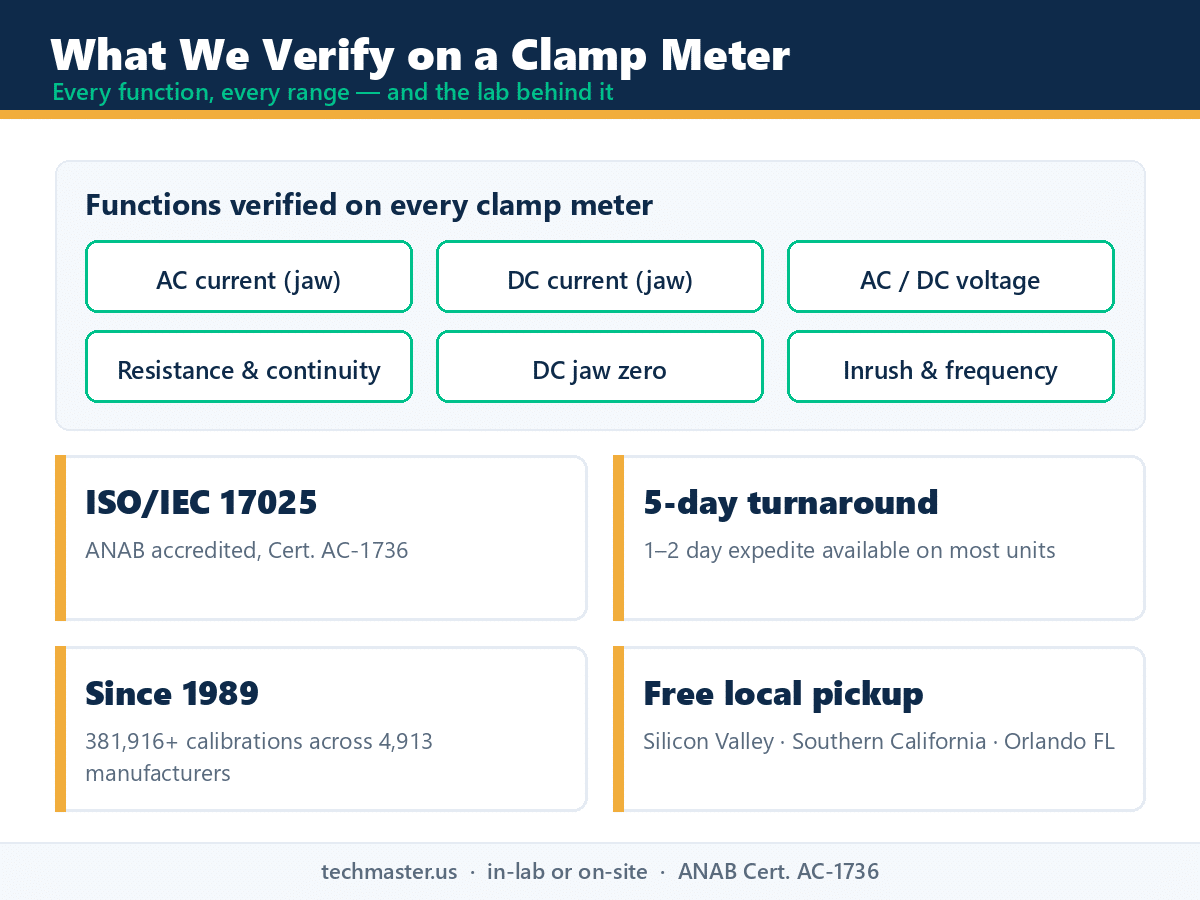
Accredited clamp-on current calibration covers AC and DC to 1,025 A, and AC high-current measurement to 1,500 A is available at our Orlando, Florida and San Antonio, Texas laboratories. Electrical calibration sits on the ANAB ISO/IEC 17025 accredited scope (Cert. AC-1736) at Vista, Santa Clara, Orlando, and San Antonio, so the meter’s voltage, resistance, and continuity functions are verified on the same accredited scope as the jaw.
This calibration falls under our electrical calibration service.
Related calibration guides
Need Clamp meter calibration?
ANAB-accredited, NIST-traceable, fast turnaround, in-lab or on-site across the USA.
Contact us for a quoteReferences & industry standards
- ISO/IEC 17025 testing & calibration laboratory requirements
- NIST calibration services and measurement traceability
- A2LA / ANAB accreditation for calibration laboratories
External standards bodies. Techmaster Electronics is an ISO/IEC 17025-accredited, NIST-traceable calibration laboratory.
Clamp meter calibration at Techmaster, at a glance
- ISO/IEC 17025:2017 accredited by ANAB (Certificate AC-1736)
- NIST-traceable reference standards with a full measurement-uncertainty budget reported on every certificate (as-found / as-left data included)
- 5 US calibration labs: Vista CA, Santa Clara CA, Orlando FL, San Antonio TX, and Holly Springs NC
- Turnaround: 5 business days standard; 1–2 business-day expedite available
- In-lab or nationwide on-site calibration to minimize your downtime
Related reading: Rogowski coil calibration: why flexible AC current probes drift

Khanh Nguyen is the Marketing Manager at Techmaster Electronics, a B2B marketing leader covering the test, measurement, and ISO/IEC 17025 accredited calibration industry in the United States.