
TL;DR: A dry-block calibrator is a reference instrument, and its own accuracy has to be proven before it can verify anything else. Dry-block calibrator calibration checks set-point accuracy at each insert, axial and radial uniformity across the block, stability over time, the loading effect of inserting a sensor, and the block’s own display and readback, plus whether the insert matches the sensor being checked. Temperature calibration is not itemized in Techmaster’s section-6 scope summary, confirm accredited versus NIST-traceable before shipping.
What is dry-block calibrator calibration?
Dry-block calibrator calibration is the verification of a dry-block’s set-point accuracy, well-to-well and depth uniformity, stability and loading behavior against traceable reference instruments, distinct from using the dry-block to calibrate someone else’s temperature sensor. It answers one question: can this reference instrument be trusted to calibrate anything else?
Dry-block and liquid-bath calibrators are compared for buyers in dry-block versus liquid bath; this article is the calibration-service page for a dry-block you already own, not a buying guide.
What does a dry-block calibrator calibration actually check?
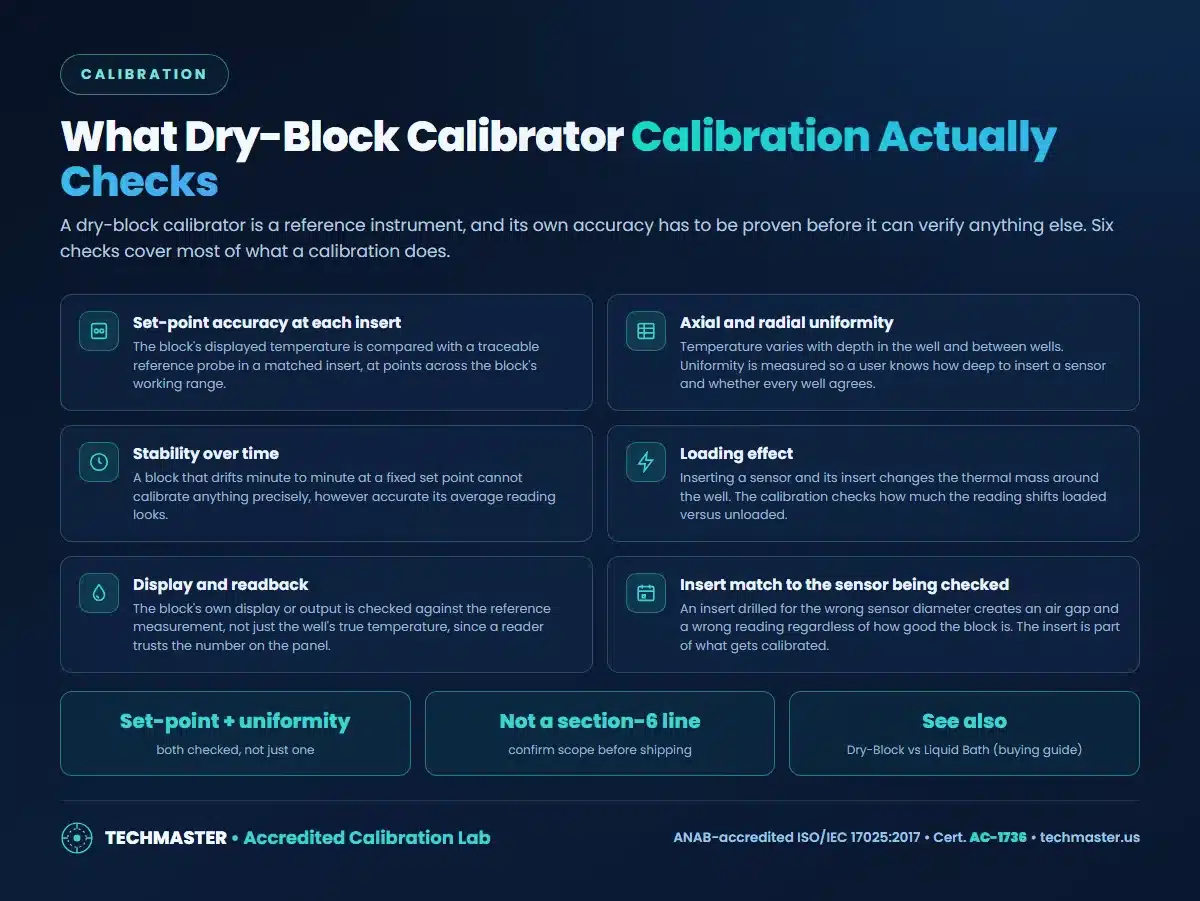
Six checks: set-point accuracy at each insert against a traceable reference probe; axial and radial uniformity across the block’s wells and depth; stability over time at a fixed point; the loading effect of inserting a sensor and its insert; the block’s own display or readback against the true reference reading; and whether the insert itself matches the sensor it will be used to check.
The insert is easy to overlook: an insert drilled for the wrong sensor diameter creates an air gap and a wrong reading no matter how good the block itself is. The insert is part of what a calibration has to account for.
What gets checked, and how
| Check | How it is measured | When |
|---|---|---|
| Set-point accuracy | Reference probe in a matched insert | At each calibration point |
| Axial / radial uniformity | Reference probe at depth and in other wells | Across the block’s working range |
| Stability | Repeated readings over time at one set point | Typically at a mid-range point |
| Loading effect | With and without a representative sensor and insert | At one or more points |
| Display / readback | Block’s own display compared with the reference | At each calibration point |
Why does uniformity matter more than the average reading?
Because the average temperature across a block can look correct while individual wells or depths still disagree with each other. A sensor calibrated in a well that happens to run warm, or not deep enough to reach the uniform zone, inherits that error. Knowing the uniformity tells a user which well to trust and how deep to insert, which the average reading alone cannot.
Environmental conditions around the block also matter to how repeatable a reading is, see how lab environment changes your measurements and the uncertainty budget this feeds in measurement uncertainty and traceability.
What capability stands behind the calibration?
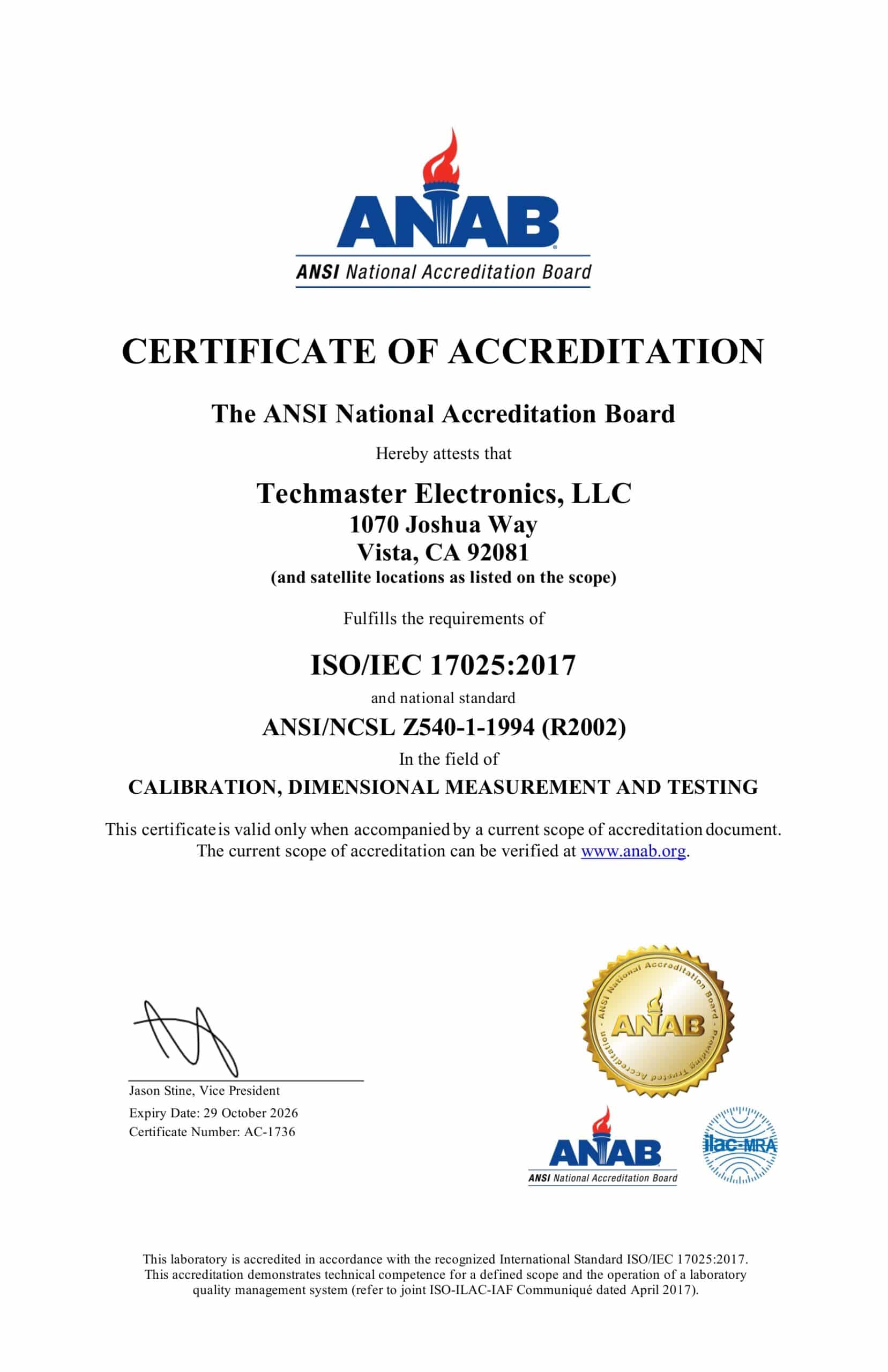
Temperature and dry-block calibration is not one of the capability lines in the condensed accreditation-scope table this rulebook works from, even though it sits alongside a broad existing temperature-instrument program, see digital thermometer calibration and reference thermometer calibration. Ask us to confirm whether your specific dry-block’s range and insert configuration are covered as accredited or supplied as NIST-traceable, the difference is explained in accredited versus NIST-traceable calibration, what a scope line covers is in calibration and measurement capability, and as-found and as-left data should be kept from every visit.
Frequently asked questions
How is a dry-block calibrator different from a liquid bath?
A dry-block calibrator heats or cools a metal block with drilled wells and inserts, while a liquid bath immerses the sensor directly in a stirred fluid. The trade-offs between them, uniformity, settling time, portability and which sensor geometries fit, are compared in dry-block versus liquid bath. This article covers calibrating a dry-block calibrator you already own, not choosing between the two.
How often should a dry-block calibrator be calibrated?
Twelve months is a common starting interval for a reference instrument in regular use, the same default used across most of Techmaster’s calibration program guidance, adjusted up or down based on how it is used, how it is handled between uses, and what its calibration history shows. A dry-block used daily as a working reference deserves closer review than one used occasionally.
Why does my dry-block calibrator read differently well to well?
Temperature is rarely perfectly uniform across a block’s wells or with depth in a single well. Calibration measures this axial and radial uniformity directly, so a user knows how deep to insert a sensor and whether every well can be trusted equally, rather than assuming the block is uniform because its display shows one number.
Is dry-block calibrator calibration covered by your ISO/IEC 17025 accreditation?
Temperature and dry-block calibration is not one of the capability lines summarized in this article’s condensed accreditation-scope table, so ask us to confirm whether your specific dry-block’s range is covered as accredited or supplied as NIST-traceable before you ship it. Send the model, range and insert configuration and we will check them against the current scope.
The bottom line
Send us the model, the range and the inserts you use, and we will confirm the scope and return set-point, uniformity and stability data you can rely on before the block calibrates anything else.
Need a quote, a rental, or a repair evaluation?
Techmaster Electronics, ISO/IEC 17025 accredited calibration laboratory, ANAB Cert. AC-1736, founded 1989. Five US labs, 5-day standard turnaround, 1–2 day expedite.
Request a quote →Techmaster Electronics, LLC is an independent ISO/IEC 17025:2017 accredited calibration laboratory. We are not affiliated with, authorized by, or endorsed by any manufacturer named on this page. All product names and model designations are trademarks of their respective owners and are used here only to identify the equipment we calibrate, repair, or rent. Confirm that our accredited scope covers your instrument’s parameters and ranges before shipping, ask us and we will check it against your model list.

Khanh Nguyen is the Marketing Manager at Techmaster Electronics, a B2B marketing leader covering the test, measurement, and ISO/IEC 17025 accredited calibration industry in the United States.