
Insulation Multimeter Calibration
Accuracy across the range
How Insulation Multimeter calibration works
- Intake & visual inspection
- Environmental stabilization
- As-found measurement
- Comparison to NIST-traceable standards
- Adjustment if required
- As-left results & certificate
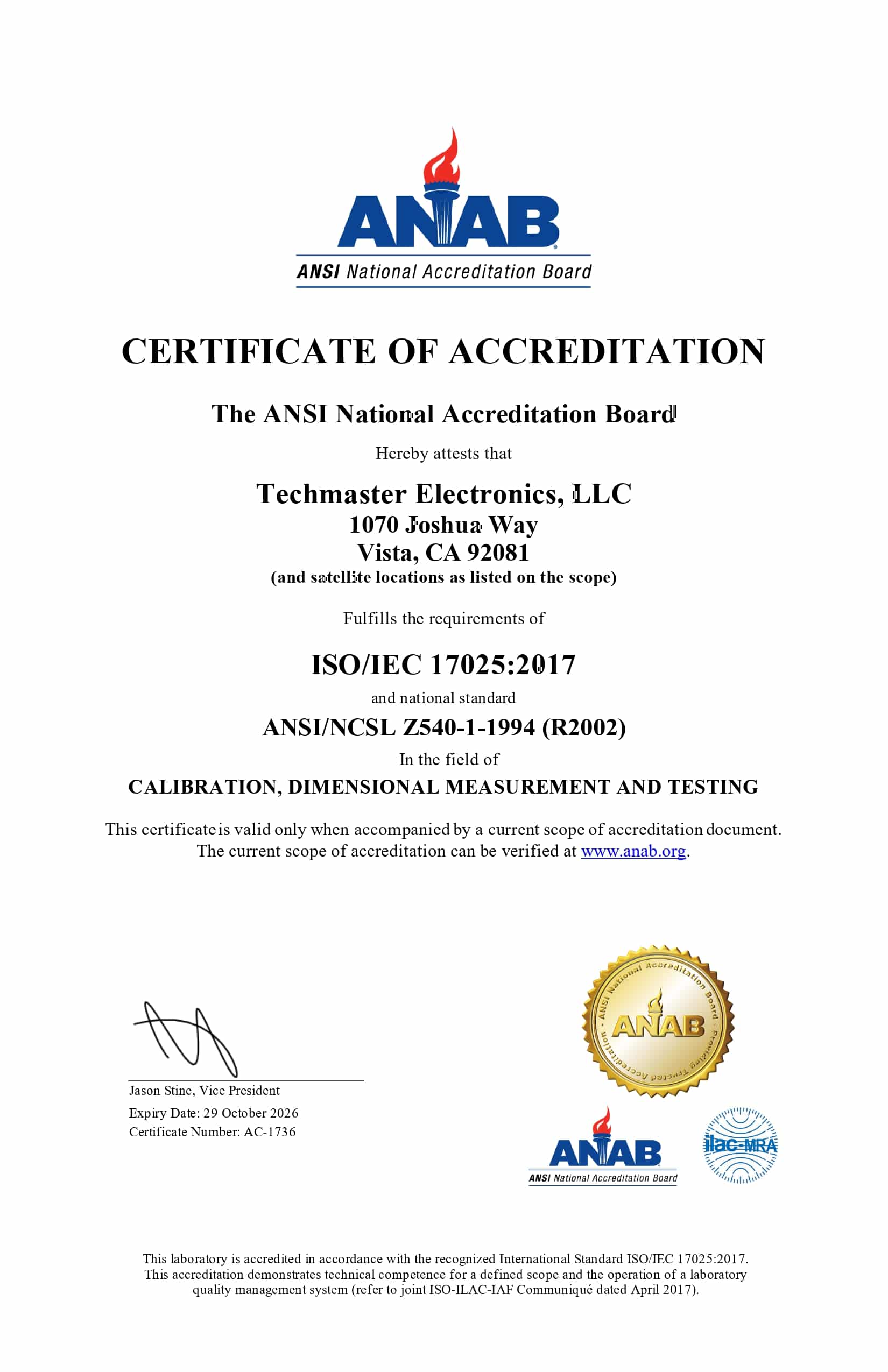
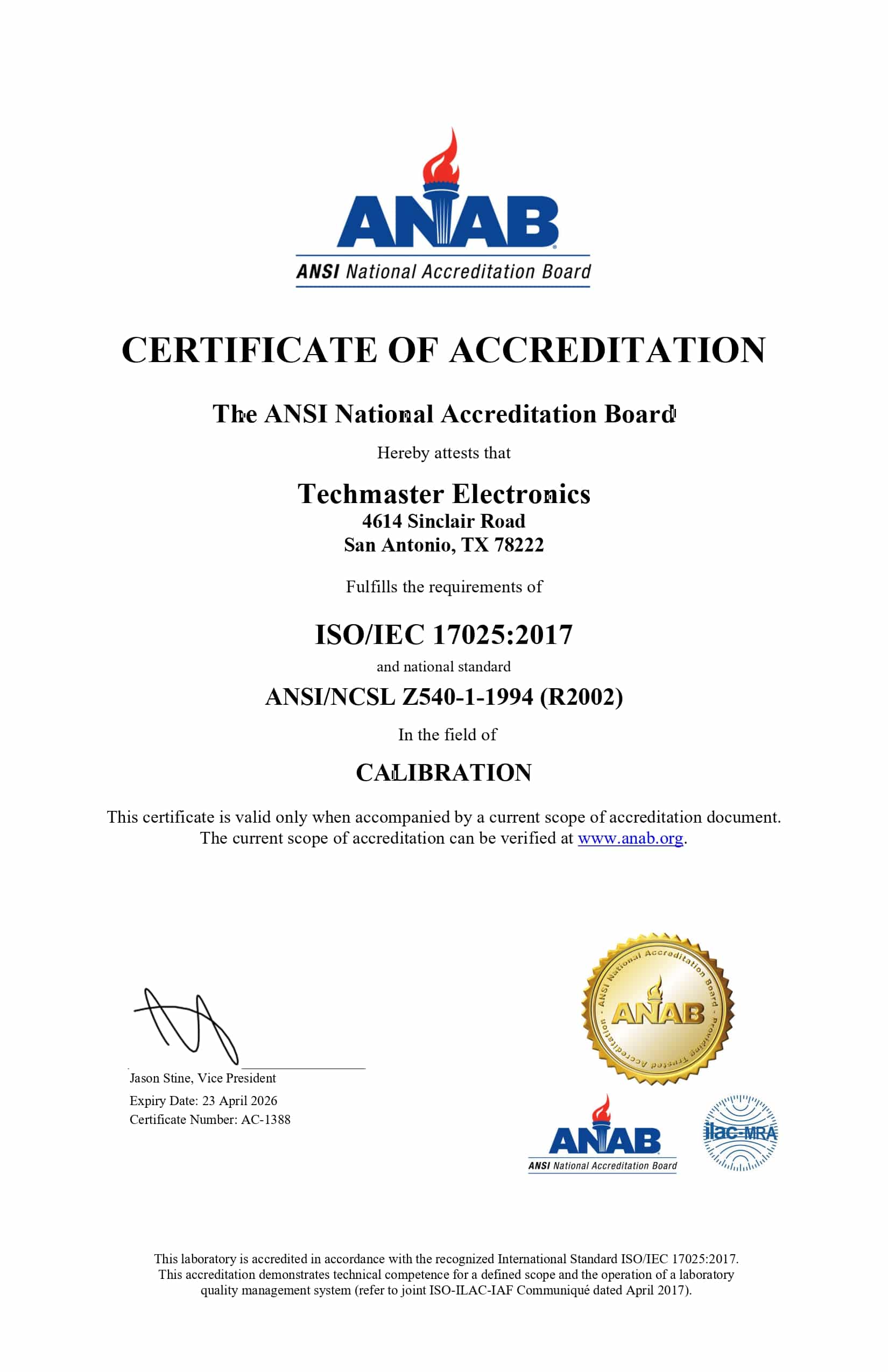
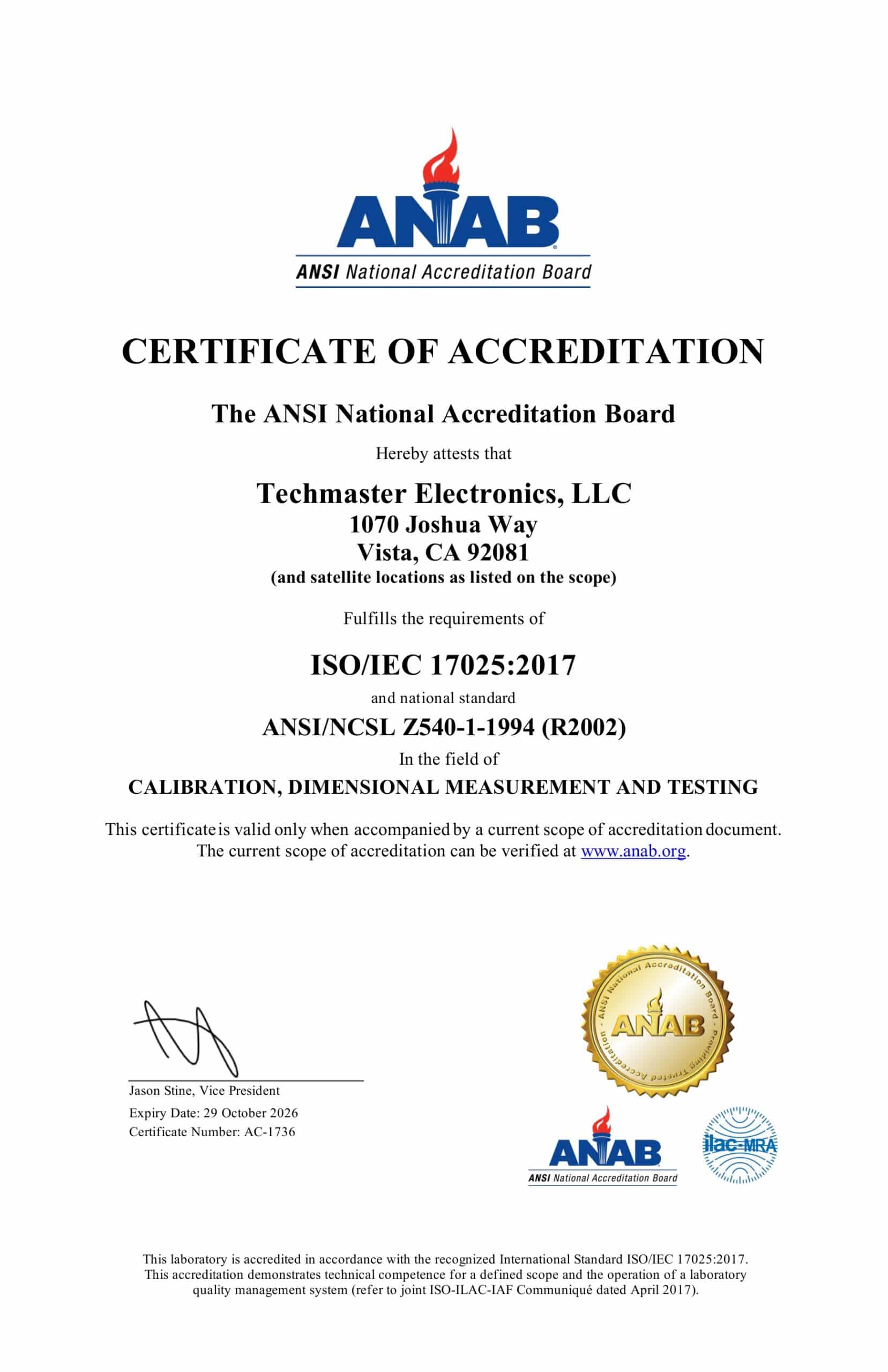
Your calibration, covered
In-lab vs on-site calibration
In-lab calibration
- Accredited bench with full reference standards
- Best achievable measurement uncertainties
- Pickup & return logistics handled
- Ideal for precision and reference work
On-site calibration
- We calibrate the Insulation Multimeter at your facility
- No shipping risk or transit downtime
- As-found data captured before any move
- Ideal for fixed, large or sensitive assets
In-depth guide
An insulation multimeter is a sophisticated hybrid, designed to handle the low-voltage tasks of a standard Digital Multimeter (DMM) while generating controlled high-voltage pulses to verify insulation integrity. Because these devices operate at the intersection of high precision and high voltage, a standardized calibration procedure is essential for any certified laboratory. This is especially true for on-site insulation multimeter testing, where industrial maintenance teams must ensure their equipment remains accurate under demanding field conditions.
In this guide, we break down the technical workflow required to calibrate professional-grade testers, ensuring compliance with ISO/IEC 17025 and NIST traceability.

1. Pre-Calibration Requirements & Environmental Control
Before initiating any insulation tester calibration, the environment must be stabilized. High-resistance measurements (in the $G\Omega$ range) are extremely sensitive to environmental leakage paths.
-
Temperature: $23^{\circ}C \pm 3^{\circ}C$.
-
Humidity: Must be kept below 50% Relative Humidity (RH). High humidity creates a thin film of moisture on test leads and terminals, leading to “shunting” and false low-resistance readings.
-
Stabilization: The Unit Under Test (UUT) should be allowed to acclimate to the lab environment for at least 4 hours.
2. Standard Multimeter Function Verification
Before testing the high-voltage insulation side, we must verify the “Multimeter” half of the device. If the basic A/D converter is drifting, the insulation readings will never be accurate.
AC/DC Voltage & Current
Using a high-precision multi-product calibrator, we inject known voltages (from $100mV$ to $1000V$) to verify the UUT’s accuracy.
-
Key Check: Verify the True-RMS conversion for AC signals, especially for meters used in VFD (Variable Frequency Drive) environments.
Resistance & Continuity
Low-ohm resistance (usually $0.1\Omega$ to $1M\Omega$) is tested to ensure the meter can handle standard circuit troubleshooting. This is distinct from the high-voltage insulation test.
3. The Core Insulation Multimeter Calibration Procedure
This is the most critical phase where we verify the device’s ability to measure high resistance under high stress.
Step 1: Open Circuit Voltage (OCV) Test
The meter is set to its insulation test mode (e.g., 500V or 1000V). Using a calibrated High-Voltage Divider or an Electrostatic Voltmeter, we measure the actual voltage produced at the probes.
-
Tolerance: Most standards (IEEE/IEC) require the voltage to be between $+0\%$ and $+20\%$ of the selected range. It should never be lower than the rated voltage.
Step 2: High-Resistance Accuracy (The “Load” Test)
We connect the UUT to a High-Voltage Decade Box or a specialized Insulation Calibrator. We then test multiple points across the meter’s range:
-
Low Range: $1M\Omega$ to $10M\Omega$.
-
Mid Range: $100M\Omega$ to $1G\Omega$.
-
High Range: $10G\Omega$ to $50G\Omega$ (depending on meter capability).
Pro Tip: During on-site insulation multimeter testing, ensure that test leads are suspended in the air and not touching each other or the floor to prevent parasitic leakage current.
Step 3: Short-Circuit Current Test
Safety standards dictate that an insulation tester must limit its output current (typically to less than $2mA$) to prevent lethal shocks. We use a calibrated milli-ammeter to verify this safety limit.
4. Advanced Diagnostic Calibration (PI, DAR, & Ramp)
Modern meters calculate ratios over time. We verify the internal timer and calculation logic using simulated rising resistance profiles.

-
Polarization Index (PI) Calibration: We verify the internal timer. The calibrator simulates a rising resistance profile over 10 minutes, and we check if the UUT correctly calculates the ratio ($R_{10min} / R_{1min}$).
-
Dielectric Absorption Ratio (DAR) Calibration: Similar to PI, but over a 60-second window.
-
Discharge Time Check: After an insulation test, the meter must safely discharge the capacitive energy. We measure the time it takes for the terminal voltage to drop below $30V$.
5. Why Specialized “On-site Insulation Multimeter Testing” is Trending
Many facilities are moving toward on-site insulation multimeter testing to minimize downtime.
| Advantage | Technical Detail |
| Environmental Matching | Calibration happens at the same RH/Temp where the meter operates. |
| Lead Integrity | Technicians can calibrate the meter with the specific long-run leads used in the field. |
| Asset Availability | Critical for “Shutdown” periods where meters are needed 24/7. |
However, on-site testing requires the service provider to bring portable high-resistance standards that are immune to vibration and temperature shifts—a high bar for technical competence.
6. Identifying “Out-of-Tolerance” (OOT) Conditions
During a standard insulation tester calibration, if a device is found OOT, it usually points to one of three issues:
-
Input Component Degradation: The high-precision resistors used for voltage division have aged or drifted.
-
Contamination: Internal PCB leakage due to dust or carbon tracking (common in industrial field use).
-
Firmware Drift: In digital meters, the calibration constants stored in the EEPROM may need to be re-written via specialized software.
FAQ: Professional Insights into Insulation Calibration
Q: Is a “Self-Test” feature the same as calibration?
A: No. A self-test only checks internal circuit continuity. It does not compare the meter against a NIST-traceable standard. It cannot detect “drift.”
Q: Why do my readings vary between two different calibrated meters?
A: Different manufacturers use different “test current” profiles. While both are “accurate,” the way they react to the capacitive load of a motor winding may vary slightly. This is why standardized insulation multimeter calibration is crucial for consistency.
Q: What is the significance of “Guard Terminal” calibration?
A: On high-end testers, the Guard terminal bypasses surface leakage. We calibrate this by injecting a “leakage” current and ensuring the meter correctly ignores it while measuring the main insulation path.
Conclusion: The Path to Reliability
A rigorous insulation multimeter calibration procedure is the only way to transform a “reading” into “data you can trust.” By verifying voltage output, high-resistance accuracy, and safety discharge functions, you protect your equipment, your facility, and most importantly, your people.
Whether you are performing a Fluke 1587 calibration procedure or testing a Megger unit, the principles of precision remain the same.
Professional Insights
Self-tests are not calibrations. They only check continuity, not NIST-traceable accuracy. Drift can only be detected via external standards.
Pro Tip: Ensure test leads are suspended in the air during high-resistance tests to prevent parasitic leakage current.
Frequently asked questions
What is Insulation Multimeter Calibration?
How often should a Insulation Multimeter be calibrated?
What standards apply to Insulation Multimeter Calibration?
What is included on the certificate?
Can you calibrate the Insulation Multimeter on-site?
Need Insulation Multimeter calibration?
ANAB-accredited, NIST-traceable, fast turnaround — in-lab or on-site across the USA.
Contact us for a quote