
Milliohm Meter Calibration
Accuracy across the range
How Milliohm Meter calibration works
- Intake & visual inspection
- Environmental stabilization
- As-found measurement
- Comparison to NIST-traceable standards
- Adjustment if required
- As-left results & certificate
Your calibration, covered
In-lab vs on-site calibration
In-lab calibration
- Accredited bench with full reference standards
- Best achievable measurement uncertainties
- Pickup & return logistics handled
- Ideal for precision and reference work
On-site calibration
- We calibrate the Milliohm Meter at your facility
- No shipping risk or transit downtime
- As-found data captured before any move
- Ideal for fixed, large or sensitive assets
In-depth guide
Milliohm Meter Calibration: The Ultimate Guide to Precision in Low-Resistance Testing

In the rigorous world of electrical engineering and industrial maintenance, the difference between a successful system and a catastrophic failure often boils down to a few milliohms (MΩ). Standard multimeters are excellent for general tasks, but they lack the resolution to measure ultra-low resistance accurately. This is where the specialized Milliohm Meter becomes essential. However, owning the tool is only half the battle. To ensure your measurements are legally and technically sound, professional Milliohm Meter Calibration is a non-negotiable requirement.
This calibration falls under our electrical calibration service.
Target Accuracy
Baseline for high-stakes manufacturing.
Uncalibrated Risk
Average annual sensor drift rate.
Standard Interval
ISO/IEC 17025 cycle.
1. How a Milliohm Meter Works: The Science of Precision
To understand why Milliohm Meter Calibration is so critical, we must first look at the complex physics happening inside the device. Measuring a high resistance is relatively simple, but as resistance drops, the physics changes.
1.1. The Problem with Standard 2-Wire Measurement
In a typical multimeter, you use two leads. These leads, along with the points where they touch the circuit, have their own resistance. When you try to measure a 10 (MΩ) resistor using standard leads that have 500 (MΩ) of resistance, the error is massive. The meter simply cannot tell the difference between the component and the wires.
1.2. The Solution: The 4-Wire Kelvin Method
The most advanced milliohm meters utilize the Kelvin 4-wire bridge principle. This method separates the “Source” (current) from the “Sense” (voltage).
-
Source Leads: Two leads provide a constant, known stable current to the component being tested.
-
Sense Leads: The other two leads measure the voltage drop across the component.
Because the “Sense” circuit has almost zero current flowing through it, the resistance of the sense leads does not affect the voltage reading. Therefore, the device calculates resistance using Ohm’s Law (R = V / I) with extreme accuracy. However, this complex internal balancing of current and voltage is sensitive. Over time, the internal reference resistors and amplifiers can drift. Only through Milliohm Meter Calibration can these internal circuits be realigned to their true values.
2. Why Calibration is a Strict Technical Requirement
Composition of Measurement Errors
You might wonder why a high-end digital meter would ever give a wrong reading. In reality, electronic components are influenced by their environment.
2.1. Combatting Electronic Drift
Every electronic device contains a voltage reference and a clock. These parts change slightly as they age or as they are exposed to heat and humidity. In low-resistance testing, even a drift of a few microvolts can result in a milliohm error. Consequently, calibration identifies this drift and corrects it.
2.2. Environmental Influence and Noise
Milliohm meters operate by detecting very small signals. External electromagnetic interference (EMI) or thermal noise can “confuse” the meter’s brain. Regular calibration ensures that the meter’s filtering algorithms are still functioning correctly, allowing it to ignore noise and focus on the real data.
3. Crucial Industrial Applications of Milliohm Meters

A milliohm meter is more than just a tool; it is a quality gatekeeper across multiple high-tech industries.
3.1. PCB and Micro-Electronic Manufacturing
In the production of printed circuit boards, the resistance of a “trace” (the copper path) determines how much heat the board will generate. Furthermore, engineers use these meters to check the contact resistance of switches and relays. If a relay has too much resistance, it will fail prematurely. Thus, calibration ensures the production line only ships perfect products.
3.2. The Revolution of Electric Vehicles (EV)
The EV industry relies heavily on low-resistance testing. High-capacity battery packs are connected by massive copper busbars. If a single bolt is loose or a joint has 1 (MΩ) of extra resistance, the high current flowing through it (often hundreds of amps) will create a “hot spot.” This leads to thermal runaway and fire risks. Therefore, Milliohm Meter Calibration is literally a life-saving procedure in the automotive sector.
3.3. Aerospace and Structural Bonding
In aircraft, different parts of the fuselage must be “bonded” electrically to protect against lightning strikes. Engineers measure the resistance between these parts to ensure a path for electricity to flow safely. Because safety is the priority, these measurements must be traceable to international standards through a calibration certificate.
4. The Business and Safety Value of Regular Calibration
Visual assessment and thermal stabilization.
Testing against traceable master standards.
Correcting span and zero offsets.
Issuing ISO compliance documents.
Investing in Milliohm Meter Calibration provides more than just technical peace of mind; it offers significant business advantages.
4.1. Meeting Global Standards (ISO 17025/9001)
Most industrial contracts require that all testing tools have a valid calibration sticker. If your company undergoes an audit and your milliohm meter is out of date, your entire production batch could be rejected. Consequently, staying on top of your calibration schedule is a shield against legal and financial liability.
4.2. Energy Efficiency and Cost Savings
In power distribution, resistance equals lost money. High resistance in a transformer winding or a power cable means energy is being turned into useless heat. By using a calibrated meter to find and fix these high-resistance points, companies can save thousands of dollars in energy costs every year.
4.3. Preventing Equipment Failure
An uncalibrated meter might tell you a motor winding is “fine” when it is actually starting to fail. By the time you notice the problem, the motor has burned out. Regular calibration ensures your meter is sensitive enough to catch these early warning signs.
5. When and How Often Should You Calibrate?
While most manufacturers recommend an annual check, certain conditions might require more frequent attention.
-
The 12-Month Rule: This is the standard industry interval for most metrology labs. It accounts for normal component aging.
-
After High-Stress Jobs: If you have been testing high-voltage systems or working in a very hot/dusty environment, your meter’s internal components may have suffered stress. A mid-year check-up is recommended.
-
If You Change Accessories: Milliohm meters are calibrated with their lead sets. If you buy new Kelvin clips or probes, you must verify the system’s accuracy with the new hardware.
-
If Your Data is Inconsistent: If you measure the same stable resistor three times and get three different results, your meter is crying out for professional alignment.
Conclusion: Accuracy as an Asset
In the high-stakes world of modern electronics, “close enough” is never good enough. Precision in low-resistance measurement is the foundation of safety, efficiency, and quality. Ultimately, Milliohm Meter Calibration is not a chore; it is an investment in your company’s reputation. By ensuring your tools are accurate, you are telling your clients that you value precision as much as they do.
Strategic Conclusion
Neglecting calibration exponentially increases operational risk. Investing in metrological maintenance ensures regulatory compliance and protects the bottom line.
Frequently asked questions
What is Milliohm Meter Calibration?
How often should a Milliohm Meter be calibrated?
What standards apply to Milliohm Meter Calibration?
What is included on the certificate?
Can you calibrate the Milliohm Meter on-site?
Need Milliohm Meter calibration?
ANAB-accredited, NIST-traceable, fast turnaround — in-lab or on-site across the USA.
Contact us for a quoteReferences & industry standards
- ISO/IEC 17025 testing & calibration laboratory requirements
- NIST calibration services and measurement traceability
- NIST Fundamental Electrical Measurements
- A2LA / ANAB accreditation for calibration laboratories
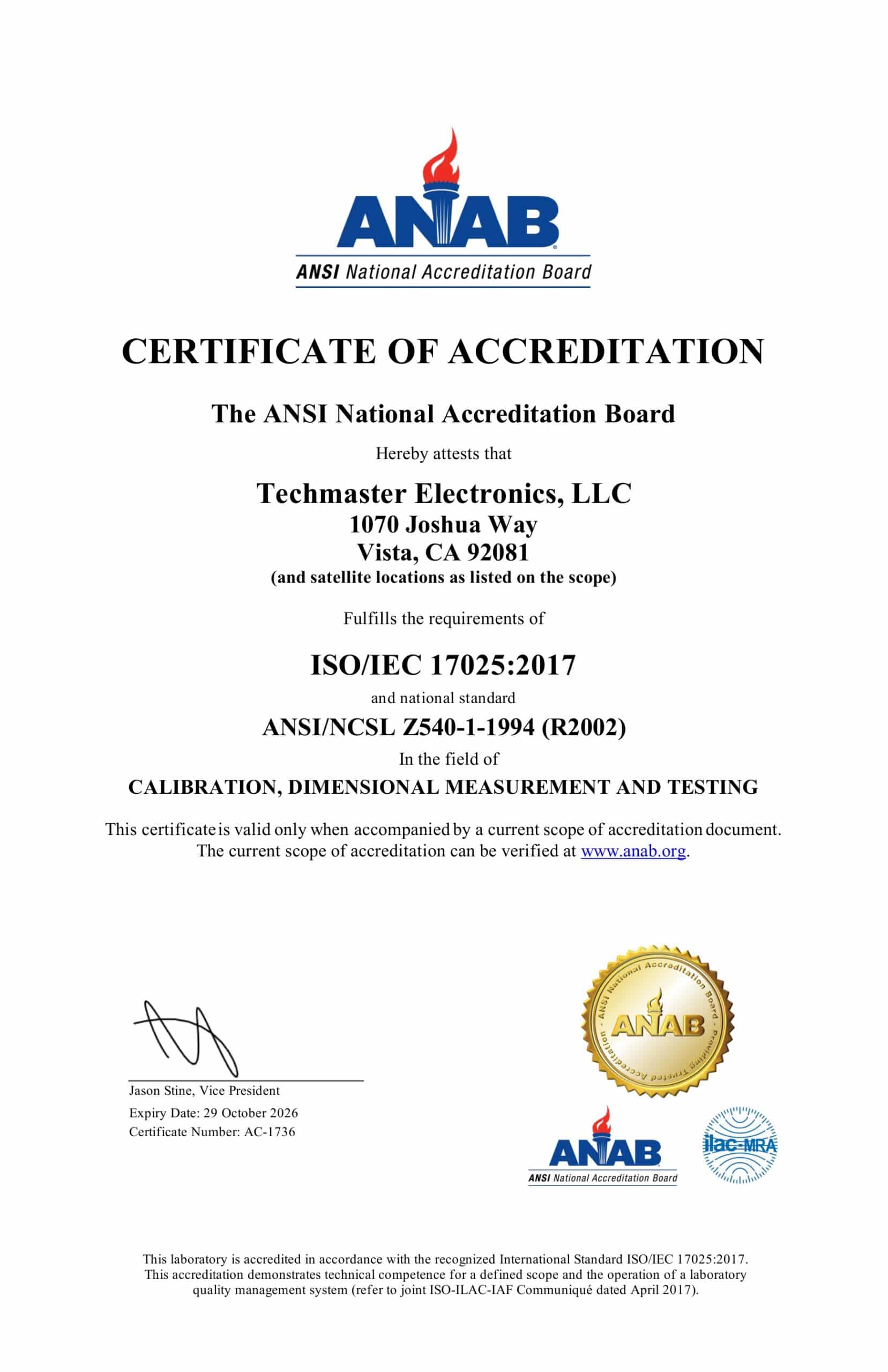
External standards bodies. Techmaster Electronics is an ISO/IEC 17025-accredited, NIST-traceable calibration laboratory.

Khanh Nguyen is the Marketing Manager at Techmaster Electronics, a B2B marketing leader covering the test, measurement, and ISO/IEC 17025 accredited calibration industry in the United States.