
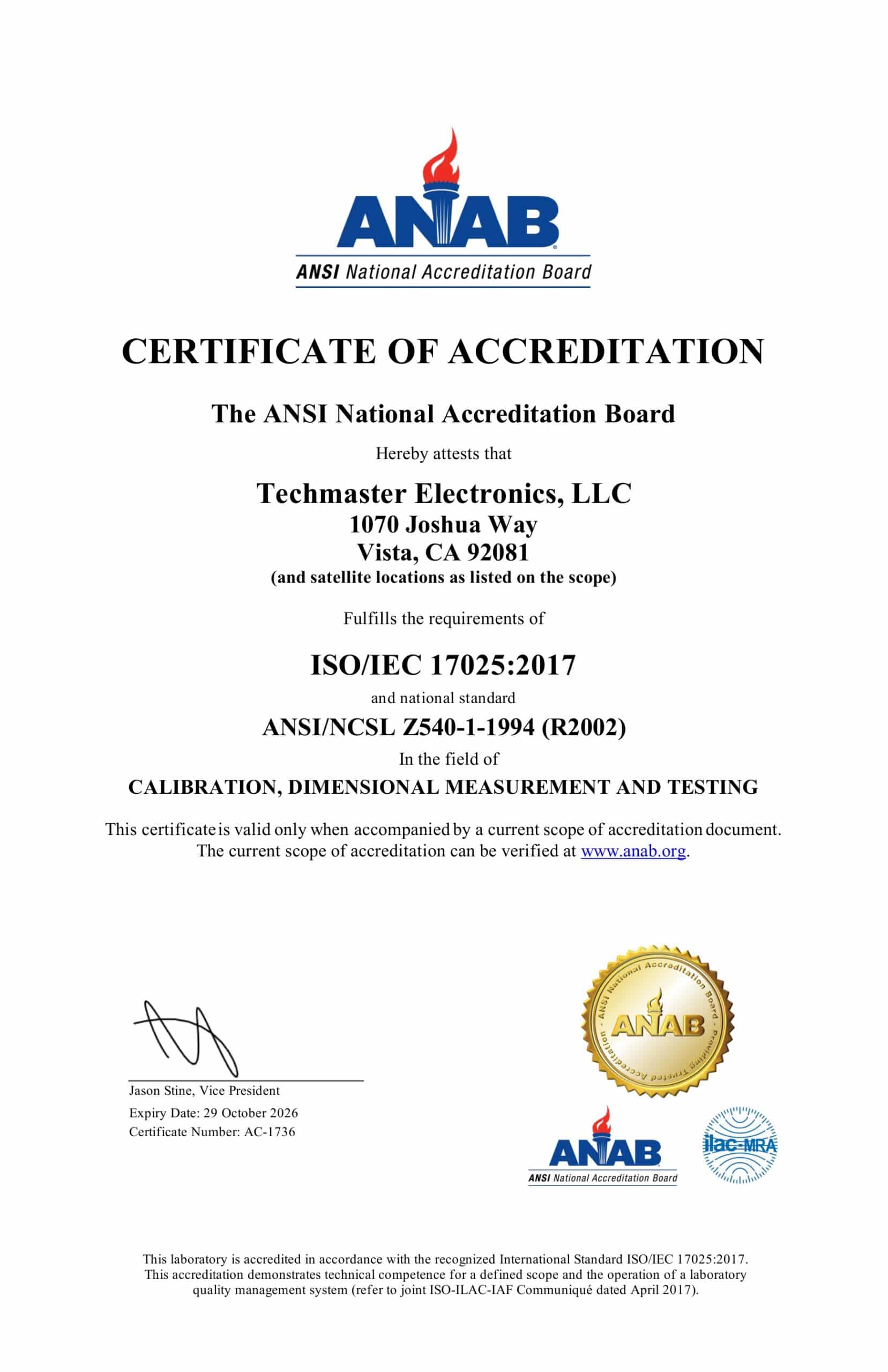
Note on particle counters: This page is for general information only. Techmaster does not calibrate particle counters of any make or model, and particle counters are not on our ANAB ISO/IEC 17025 scope (certificate AC-1736). Techmaster only performs calibration services that are covered by our scope. For particle counter calibration, please contact your instrument’s manufacturer or its authorized service provider, and follow any service requirements they specify. If you prefer, send us your request and, with your permission, we will forward it to the manufacturer. See what is on our accredited scope.
Oxygen Meter Calibration
Why calibration intervals matter
How Oxygen Meter calibration works
- Intake & visual inspection
- Environmental stabilization
- As-found measurement
- Comparison to NIST-traceable standards
- Adjustment if required
- As-left results & certificate
Your calibration, covered
In-lab vs on-site calibration
In-lab calibration
- Lab bench with full reference standards
- Best achievable measurement uncertainties
- Pickup & return logistics handled
- Ideal for precision and reference work
On-site calibration
- We calibrate the Oxygen Meter at your facility
- No shipping risk or transit downtime
- As-found data captured before any move
- Ideal for fixed, large or sensitive assets
In-depth guide
In industries like healthcare, cleanrooms, and environmental monitoring, oxygen meter calibration is critical for precision, safety, and compliance. Whether you’re an engineer ensuring accurate measurements, a QA manager navigating audits, or new to oxygen meters, understanding calibration is key to avoiding costly errors. With Techmaster Electronics’ ISO 17025-accredited oxygen meter calibration services, you can trust your equipment to meet the highest standards.
1. What is an Oxygen Meter and Where Is It Used?
An oxygen meter, also referred to as a portable oxygen analyzer, measures oxygen concentration in gases or liquids using electrochemical or optical sensors. They’re vital in:
-
Environmental monitoring: Ensuring safe oxygen levels in water and air
-
Pharmaceuticals & cleanrooms: Maintaining sterile, compliant environments
-
Medical applications: Monitoring patient oxygen saturation
-
Manufacturing & fermentation: Controlling chemical and biological processes

*Note: Oxygen meters are distinct from inline oxygen analyzers used in continuous process control, calibration requirements may differ depending on device type.
Why Calibrate Oxygen Meters?
Over time, sensors drift. And even minor drift can have major consequences in high-stakes environments. Calibration helps you:
-
Ensure accuracy: Critical for dosing, safety, and regulatory limits
-
Demonstrate compliance: Satisfy ISO/IEC 17025, ANSI/NCSL Z540.1, and NIST traceability requirements
-
Enhance safety: Prevent risks in medical and confined-space applications
-
Reduce costs: Avoid rework, product recalls, or audit penalties
Techmaster’s clients have reported up to 30% reduction in process errors after integrating scheduled oxygen meter calibration into their quality program.
3. Overview of the Oxygen Meter Calibration Process
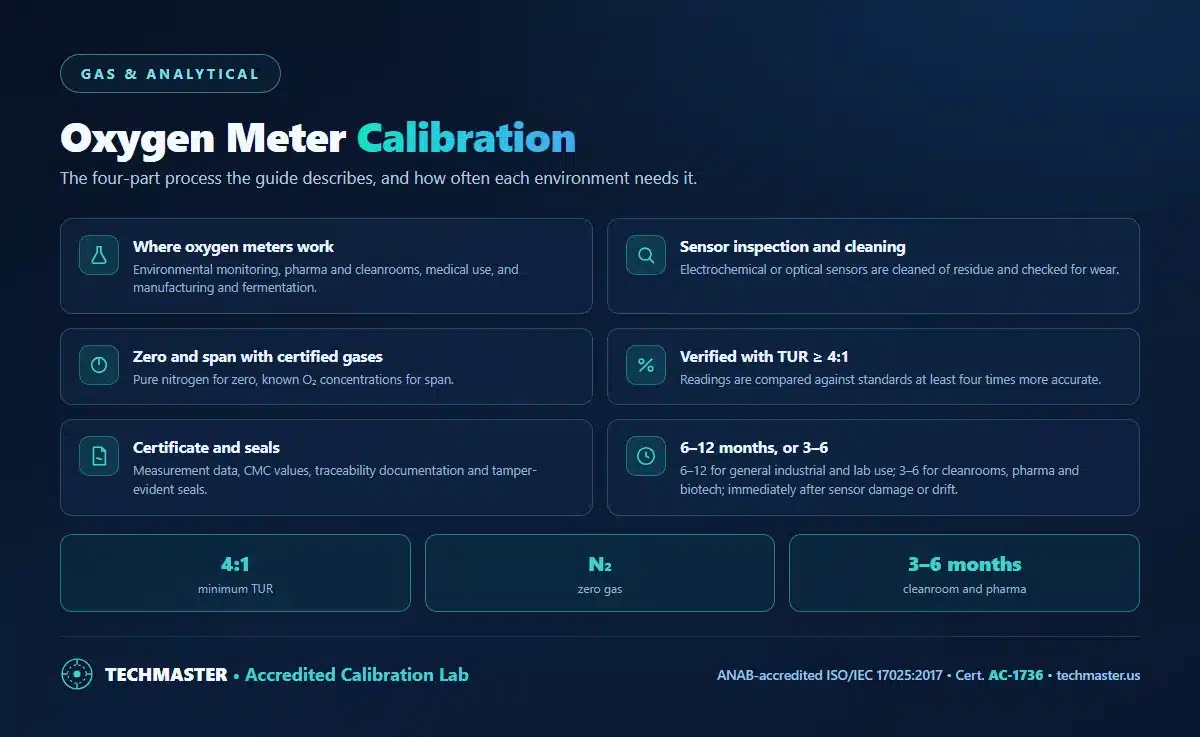
Whether you use a handheld oxygen meter or a benchtop analyzer, calibration typically involves:
-
Sensor inspection and cleaning to remove residues or wear
-
Zero and span calibration using certified gases (e.g., pure nitrogen, known O₂ concentrations)
-
Verification against standards with documented TUR ≥ 4:1
-
Documentation: Calibration certificate with full CMC, measurement data, and tamper-evident seals
For technicians, this validates accuracy to traceable standards. For newcomers, think of it like recalibrating a scale to ensure it reads zero before weighing.
➤ All Techmaster calibrations follow a defined metrological traceability chain anchored to NIST or other NMIs.
4. Meeting Oxygen Meter Calibration Standards
-
ISO/IEC 17025:2017 – Accreditation by ANAB under ILAC MRA for global recognition
-
ANSI/NCSL Z540.1 – Required by many U.S. aerospace and defense programs
-
NIST Traceability – Unbroken link to national metrological standards

➤ For QA/Procurement teams, this translates to:
-
Faster supplier approval
-
Efficient audits with complete documentation
-
Reduced liability in case of disputes or incidents
Techmaster calibrates not only oxygen meters but also thermohygrometers and other cleanroom instruments within our scope. Supported brands include Fluke, Omega, and more.
5. In-House vs. Professional Calibration: What’s Best for You?
| In-House Calibration | Professional Calibration (Techmaster) | |
|---|---|---|
| Cost | Lower (short-term) | Higher upfront, better long-term ROI |
| Documentation | Basic or none | Full traceability, CMC, calibration labels |
| Compliance | Often not accepted in audits | Accepted under ISO 17025, Z540.1 |
| Risk | High (potential drift, failed audits) | Low (certified results, third-party objectivity) |
If your operations are regulated or mission-critical, professional calibration isn’t just safer, it’s expected.
6. How Often Should You Calibrate Oxygen Meters?
Suggested intervals:
-
6–12 months: General industrial and lab use
-
3–6 months: Cleanrooms, pharma, biotech
-
Immediately: After sensor damage or observed drift
Calibration frequency should also align with your internal quality management system (QMS) and usage patterns.

7. Frequently Asked Questions (FAQ)
Q1: Can I perform calibration myself?
Yes, but unless done with traceable standards and documented CMC, it may not pass regulatory audits.
Q2: How long does it take?
Standard turnaround: 2–5 business days. Techmaster offers expedited and on-site services as needed.
Q3: What’s included in Techmaster’s service?
Functional checks, calibration data, ISO 17025 certificate, CMC values, traceability documentation, seals.
Q4: What if my sensor is drifting?
Start with a diagnostic calibration. Techmaster’s team can assess whether recalibration, repair, or replacement is needed.
8. Schedule Your Calibration Today
Don’t let drift derail your data.
Contact Techmaster Electronics, trusted for over 30 years in precision calibration, for your oxygen meter and analyzer calibration needs.
- ISO 17025-accredited
- Global certificate recognition
- On-site or lab-based calibration
- Trusted by QA teams across pharma, aerospace, biotech, and more
Let’s protect your measurements, and your reputation.
Biological Safety Cabinet Certification: NSF/ANSI 49 Field Testing
Home » Oxygen Meter Calibration Improves Process ControlA Class II biological safety cabinet protects three...
Oct

Fume Hood Testing and Certification: Face Velocity, Smoke and ASHRAE 110
Home » Oxygen Meter Calibration Improves Process Control A laboratory fume hood is the main...
Oct
Cleanroom Recovery Test (ISO 14644-3): Is It Required and How Is It Performed?
ISO 14644-1 classification does not require a cleanroom recovery test. Here is where the recovery...
Aug
ISO 21501-4 Particle Counter Calibration: What Cleanroom Certification Requires
ISO 21501-4 sets the maximum permissible errors for particle counter calibration: 10% size setting, 50%±20%...
Aug
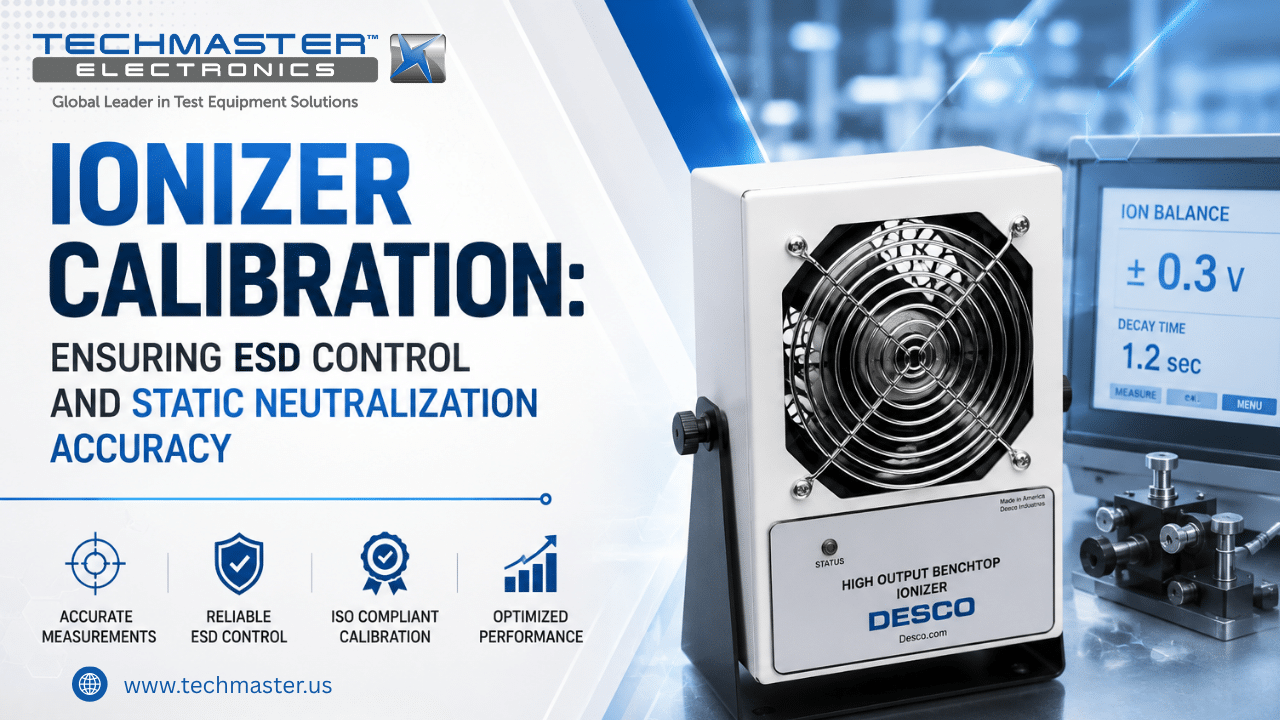
Ionizer Calibration: Ensuring Accurate Static Neutralization
Home » Oxygen Meter Calibration Improves Process Control Metrology guide · ISO/IEC 17025 · ANAB-accredited...
Jun

How Precision Humichek Calibration Safeguards Your Production
Home » Oxygen Meter Calibration Improves Process Control Metrology guide · NIST-traceable calibration Precision Humichek...
Mar

Why Wrist Strap Tester Calibration Matters in Cleanrooms
Home » Oxygen Meter Calibration Improves Process Control Metrology guide · NIST-traceable calibration Wrist Strap...
Jan
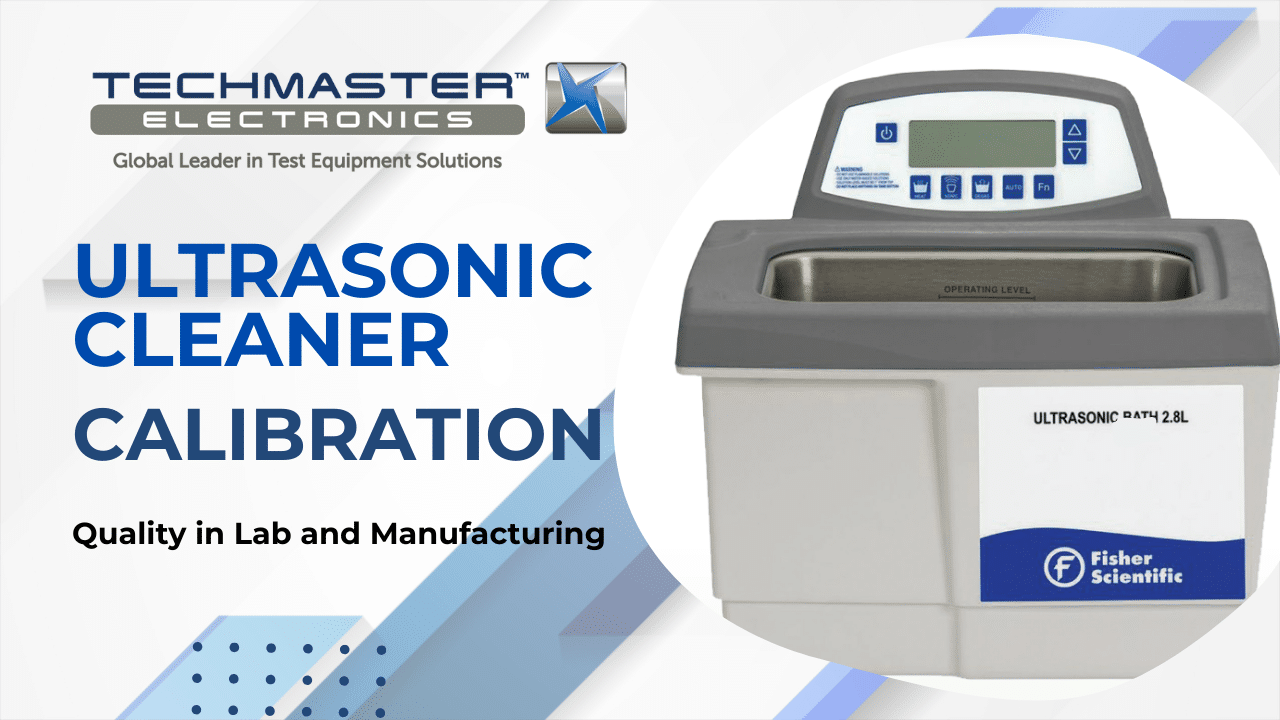
Ultrasonic Cleaner Calibration: Quality in Lab and Manufacturing
Home » Oxygen Meter Calibration Improves Process Control Metrology guide · ISO/IEC 17025 · ANAB-accredited...
Nov
Frequently asked questions
What is Oxygen Meter Calibration?
How often should a Oxygen Meter be calibrated?
What standards apply to Oxygen Meter Calibration?
What is included on the certificate?
Can you calibrate the Oxygen Meter on-site?
Need Oxygen Meter calibration?
NIST-traceable calibration, fast turnaround, in-lab or on-site across the USA.
Contact us for a quoteReferences & industry standards
- ISO/IEC 17025 testing & calibration laboratory requirements
- NIST calibration services and measurement traceability
- A2LA / ANAB accreditation for calibration laboratories
External standards bodies. Techmaster Electronics is an ISO/IEC 17025-accredited, NIST-traceable calibration laboratory.

Khanh Nguyen is the Marketing Manager at Techmaster Electronics, a B2B marketing leader covering the test, measurement, and ISO/IEC 17025 accredited calibration industry in the United States.