
TL;DR: A shaker table rental goes wrong on sizing, not availability. Four numbers decide whether the system can run your profile: total moving mass including the fixture, force rating against the profile in g RMS or g peak, frequency range at both ends, and the fixture interface. The controller, amplifier and control accelerometer must ship with it, and the chain must be in calibration.
Vibration and shaker equipment was one of the busiest rental clusters reaching our labs over the last quarter, a robotics team needing a shaker for a 15–20 kg payload at a few tenths of a g RMS over 2–300 Hz, a hardware maker needing a table for a 50 lb assembly for a week. Both requests were sized correctly. Many are not, and a shaker that cannot reach the profile is a rental you pay for twice.
How do I size a shaker or vibration table rental?
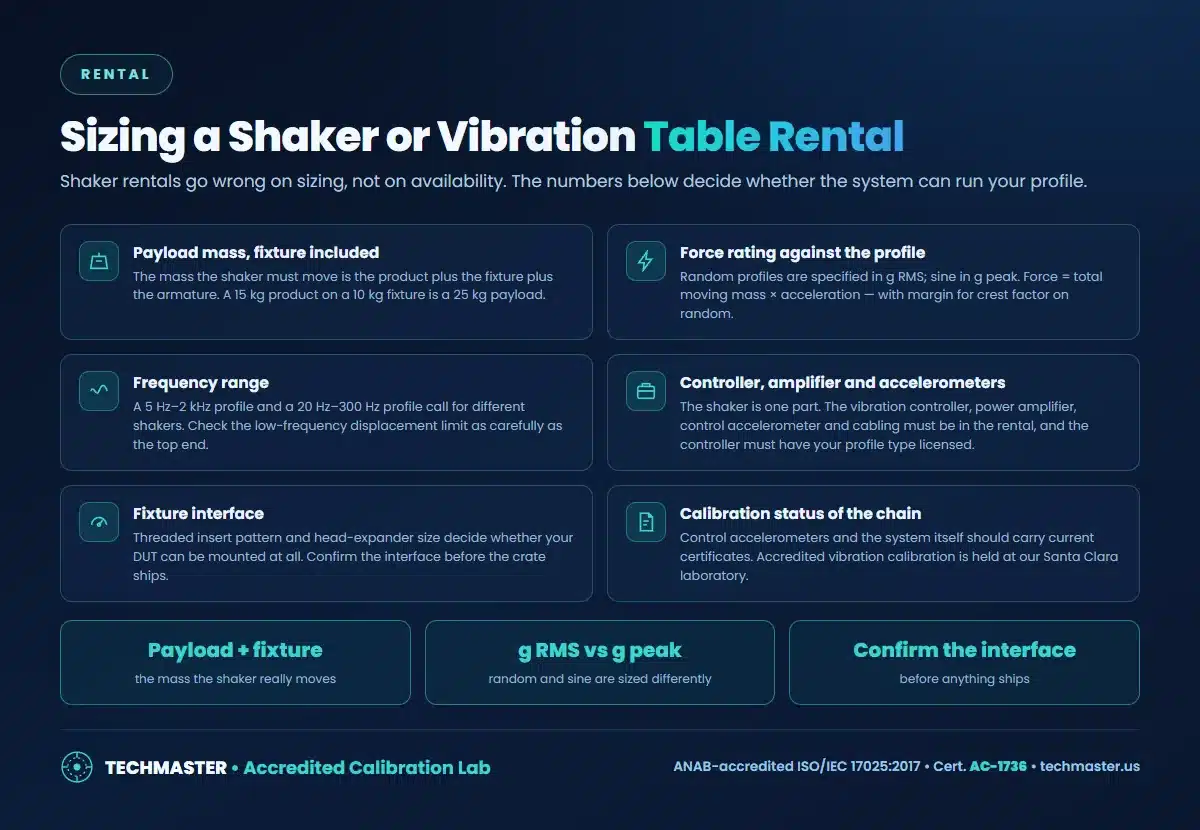
Start with mass. The shaker moves the product, the fixture, and its own armature; a 15 kg product on a 10 kg fixture is a 25 kg payload before the armature is counted. Then force: multiply the total moving mass by the acceleration your profile demands, and add margin for crest factor if the profile is random. Then frequency range, checking the low-frequency displacement limit as carefully as the top end, a 5 Hz–2 kHz qualification profile and a 20–300 Hz product test call for different machines. Finally the interface: threaded insert pattern and head-expander size decide whether your fixture can be bolted down at all.
What has to ship with the shaker?
The system, not the box. A vibration controller with your profile type licensed, a power amplifier matched to the shaker, a control accelerometer and cabling. The control accelerometer is a measurement instrument in its own right, its calibration is what makes the profile real, which is why accelerometer calibration matters as much to a rental as to an owned system.
Is a rented vibration system calibrated?
It should carry current certificates, and you should ask to see them. Techmaster holds accredited vibration calibration at its Santa Clara, California laboratory, covering 0.2 to 36 g peak from 1 Hz to 10 kHz on the ANAB scope (Cert. AC-1736). The reasons calibration is not optional for endurance testing are set out in shaker table calibration and in our guide to calibrating vibration measurement systems.
Rent, refurbished, or new?
Rent for a bounded qualification program or to bridge the gap while an owned system is serviced. A refurbished system makes sense when the profile is stable and the shaker will run monthly. New is for production test where the machine runs daily. The decision framework mirrors renting versus buying test equipment generally, with one addition: vibration systems are heavy and expensive to move, so factor freight into every option.
Frequently asked questions
How do I size a shaker rental for my test?
Add up the moving mass (product plus fixture plus armature), take the acceleration from your profile, and multiply. Random profiles are specified in g RMS and need crest-factor margin; sine profiles in g peak. Then check the frequency range at both ends, because the low-frequency displacement limit fails as often as the force rating.
Does a shaker rental include the controller and amplifier?
It has to. The shaker is one part of a system; the vibration controller, power amplifier, control accelerometer and cabling must be in the rental, and the controller must have your profile type licensed. Confirm all of it before the crate ships.
Can my fixture mount on a rented shaker?
Only if the threaded insert pattern and head-expander size match. Send a drawing of your fixture base with the enquiry; the interface is the most common reason a rental cannot run on day one.
Is the vibration system calibrated?
The control accelerometer and the system should carry current certificates. Accredited vibration calibration is held at Techmaster’s Santa Clara, California laboratory, and rental systems are checked before they ship.
The bottom line
Size it by mass, force, frequency and interface before anything ships; insist on the full chain; check the certificates. Send your profile, payload mass and fixture drawing with the enquiry and we will confirm what fits.
Need a quote, a rental, or a repair evaluation?
Techmaster Electronics, ISO/IEC 17025 accredited calibration laboratory, ANAB Cert. AC-1736, founded 1989. Five US labs, 5-day standard turnaround, 1–2 day expedite.
Request a quote →Techmaster Electronics, LLC is an independent ISO/IEC 17025:2017 accredited calibration laboratory. We are not affiliated with, authorized by, or endorsed by any manufacturer named on this page. All product names and model designations are trademarks of their respective owners and are used here only to identify the equipment we calibrate, repair, or rent. Confirm that our accredited scope covers your instrument’s parameters and ranges before shipping, ask us and we will check it against your model list.

Khanh Nguyen is the Marketing Manager at Techmaster Electronics, a B2B marketing leader covering the test, measurement, and ISO/IEC 17025 accredited calibration industry across the US and Vietnam markets.