
How often should you calibrate an insulation resistance tester? Start with the model’s manufacturer guidance and any binding quality or customer requirements. Then review as-found results, handling conditions, and the consequences of a wrong reading before changing the interval.
1. How often should you calibrate an insulation resistance tester?
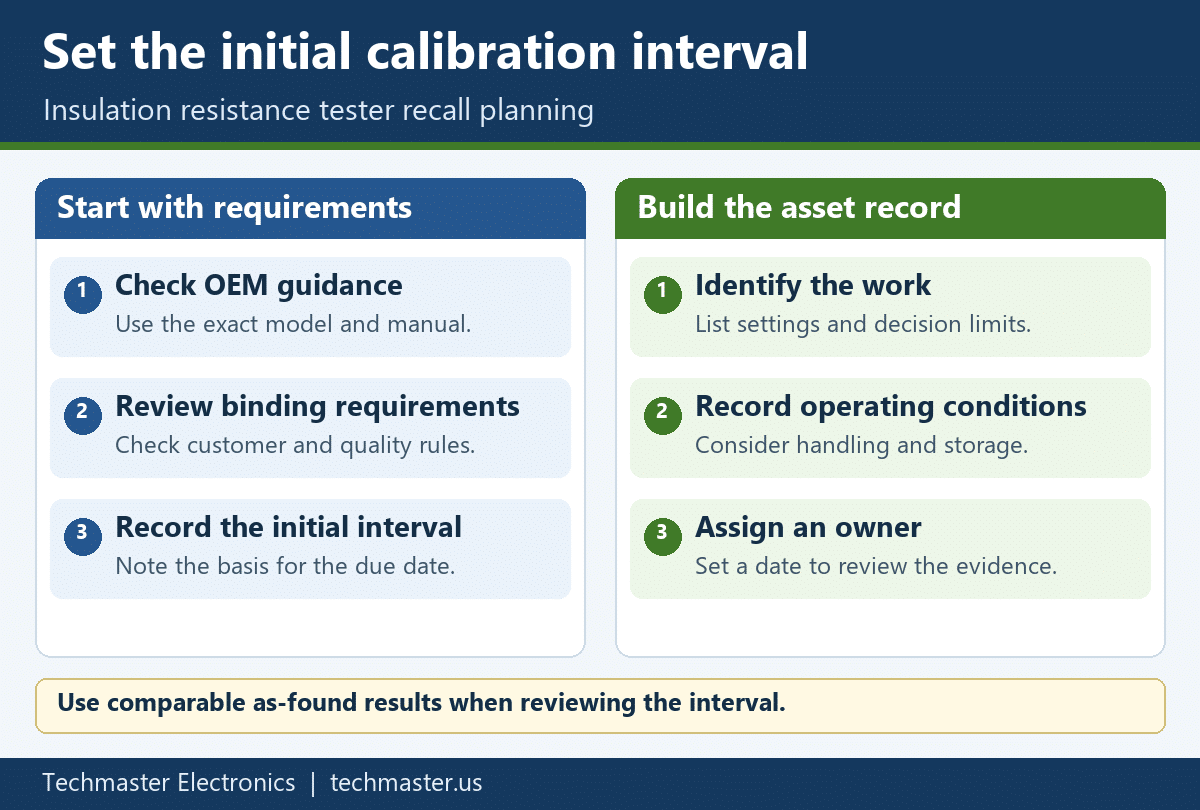
Use the applicable manufacturer recommendation as the starting point for a new asset. Look up the specific model in the current calibration or service manual. Record the document revision and any assumptions that affect the recommendation. Next, compare that starting point with your contract, test procedure, and asset-control policy. Where a valid requirement sets an earlier due date, use that date.
Once you have comparable as-found results, consider whether the interval matches the work. A meter that travels between job sites and supports consequential pass/fail decisions warrants a closer look than a spare stored under controlled conditions. However, storage alone does not prove stability. Keep a spare in the recall system and confirm its status before returning it to service.
ILAC-G24:2022 describes ways to determine and review recalibration intervals. It provides a framework for evaluating equipment history. It does not give every insulation tester a single due date. For a broader program design, see Techmaster’s guide to setting calibration intervals.
2. What evidence should the calibration cover?
Build the request from the functions your team uses. An insulation resistance test involves a DC test output and a resistance reading. A useful report should let you tell which output settings and resistance points the lab checked. Ask for points relevant to the work instructions and the resistance values near important acceptance limits. For instance, a report that only covers a multimeter function tells you little about the insulation measurement.
Model differences matter. The Fluke 1503/1507/1508 calibration manual identifies model-specific checks. The Fluke 1550C/1555 calibration manual covers a different instrument family. Use the correct document when comparing a certificate with your test procedure. Also identify whether a function on your work order needs a separate check or repair evaluation.
Ask for as-found data before any adjustment, particularly if recent measurements informed release or maintenance decisions. Then check reported points against past certificates on a comparable basis. Changes in test method, points, or stated uncertainty can make an apparent trend misleading. The report should make clear which readings describe the incoming instrument and which describe it after service.
3. What should trigger an earlier review?
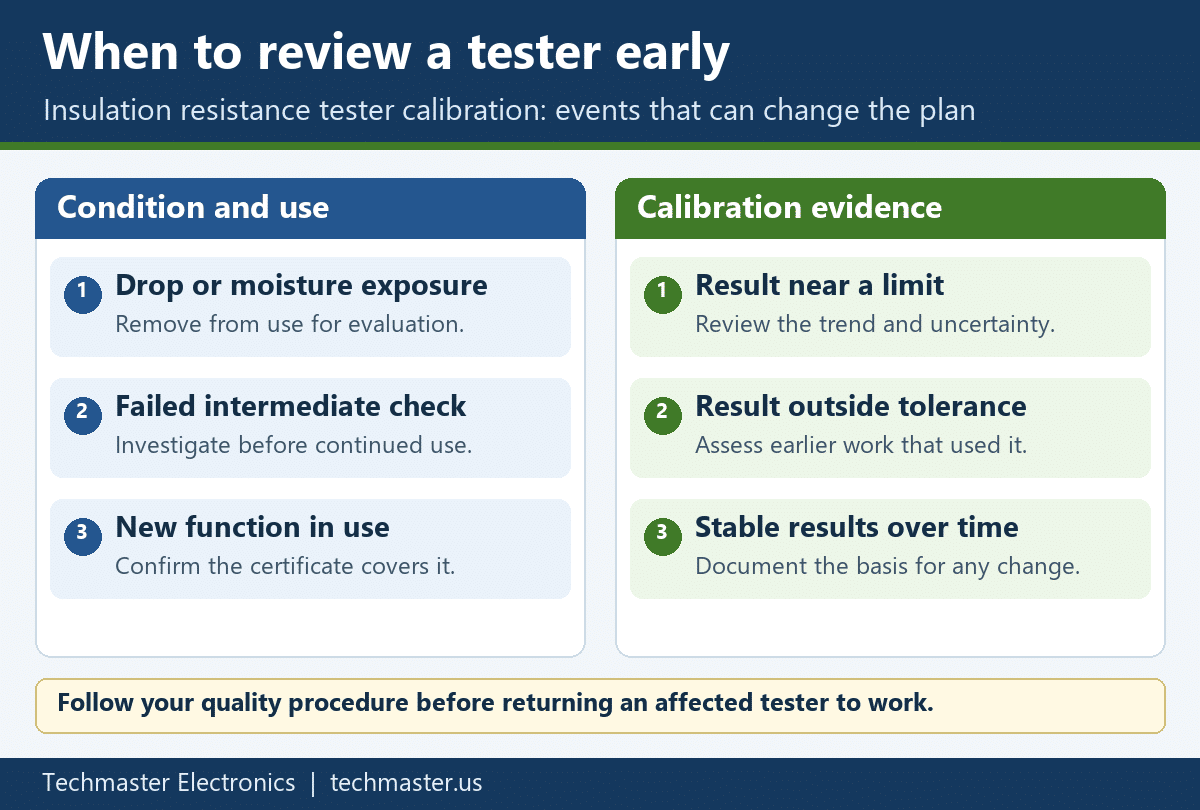
| Trigger | Action to consider |
|---|---|
| Drop, moisture exposure, or visible damage | Remove the tester from use and arrange a qualified evaluation before return. |
| As-found result near a limit | Review uncertainty, prior results, test criticality, and whether a shorter interval is justified. |
| Out-of-tolerance result | Contain the asset and assess earlier work that relied on the affected function or range. |
| New acceptance test or test-voltage setting | Check certificate coverage and revise the calibration request if needed. |
| Stable, comparable history | Review whether to retain or change the interval within applicable requirements. |
Separate a condition check from a scheduled calibration. A damaged lead, unexpected indicator, or failed intermediate check is a reason to stop and investigate. Passing a pre-use inspection is useful, but it does not establish measurement accuracy across the working range. Follow the current manufacturer instructions and site safety requirements, including when taking a tester out of service.
4. How do you make the next due date defensible?
Assign an owner to the recall decision. Keep a short record of the asset identifier, model, work applications, starting interval, review date, and evidence behind the decision. Name the conditions that would prompt an earlier review. If an auditor or production lead asks why two seemingly identical meters have different intervals, that record should explain the difference.
Look for patterns before changing a fleet-wide policy. A set of instruments may share a model number while serving different jobs. For a mobile crew, compare field failures and handling incidents with the calibration history. For a production station, track usage and any change to the acceptance threshold. If results are too sparse to support a change, keep the current interval and identify which data to collect next.
5. Example: Two testers with different jobs
6. What should you send with the calibration request?
Provide the make, model, serial number, test voltage settings, resistance ranges of interest, and any accessories required by your procedure. Note whether you need as-found and as-left results or a statement of conformity. If you need accredited results, confirm the performing location and scope for the required measurements before authorizing work.
7. How should you investigate a result outside tolerance?
Start by identifying the affected test setting and range. Pull the work orders that used that function since the last evidence of acceptable performance. Find the original readings and the criteria used to make each decision. A small change can matter when a reading sits close to the limit. The same change may have little effect when a reading has a wide margin. Let your quality procedure determine who evaluates the risk and how that evaluation is recorded.
Keep the investigation tied to the evidence. A certificate shows the condition of the instrument at the time and points tested. It generally cannot tell you the date a measurement first drifted. Maintenance records, intermediate checks, and prior calibration results can help narrow the review period. If the necessary records are missing, document the uncertainty in the impact assessment instead of claiming a precise start date. Finally, review whether future calibration requests need extra points close to the limits that drive your decisions.
8. How Often Should This Equipment Be Calibrated?
Start with the manufacturer’s guidance for the exact insulation resistance tester and any applicable contract, customer, or quality-system requirements. Record the due date and the reason for it. Review the interval when the instrument’s use, handling, or importance to a pass/fail decision changes.
Compare incoming results at the same voltage and resistance points across certificates. A field unit exposed to drops or moisture may need an earlier evaluation, while a stable bench unit may justify keeping its current interval.
Document who approves any interval change and what will trigger another review. ILAC-G24:2022 provides methods for setting and reviewing recalibration intervals from equipment history.
9. What to Look for in a Calibration Provider
Ask whether the laboratory checks the DC output separately from the resistance indication. Identify the points closest to your operating thresholds, and ask the provider to indicate which points or functions the certificate excludes.
If accredited calibration is required, check that the current ISO/IEC 17025 scope covers the required measurements at the performing facility. Ask for a sample report that shows how the lab documents test points, results, and uncertainty. Specify whether you need as-found and as-left readings or a statement of conformity with an agreed decision rule.
Confirm the time from shipment to return, including approval for extra work and certificate review. Ask how the lab will notify you if the instrument needs adjustment or if a requested point cannot be verified.
10. Techmaster Equipment Rental Services
11. Why Choose Techmaster Electronics?
Techmaster Electronics has worked with electronic test equipment since 1989. Its US services include calibration, repair, and equipment rentals, which gives teams a place to discuss the service and temporary equipment needs together.
Bring the last two comparable certificates and any intermediate-check records. That gives Techmaster the context to discuss test coverage and helps your quality team decide whether previous measurements need review.
If accredited results are required, confirm that the current ANAB scope for certificate AC-1736 covers the required measurement and performing location before authorizing work.
12. Conclusion
Keep an interval decision with the asset record. Include the operating conditions, evidence reviewed, and triggers for an earlier check, so the next asset owner can follow the same rationale.
13. FAQs
Calibration labs near you: Techmaster Electronics is an ISO/IEC 17025 accredited calibration laboratory (ANAB Certificate AC-1736) with accredited labs in Vista, CA, Santa Clara, CA, Orlando, FL and San Antonio, TX, plus a lab in Holly Springs, NC. Accredited parameters vary by lab; compare locations or request a quote.

Khanh Nguyen is the Marketing Manager at Techmaster Electronics, a B2B marketing leader covering the test, measurement, and ISO/IEC 17025 accredited calibration industry in the United States.