
Compare insulation resistance tester calibration services by the voltage settings and resistance points they can verify, the report they provide, and the total time your tester will be unavailable. If you need accredited results, confirm coverage for the model, measurements, and performing location before authorizing work.
1. What should insulation resistance tester calibration services verify?
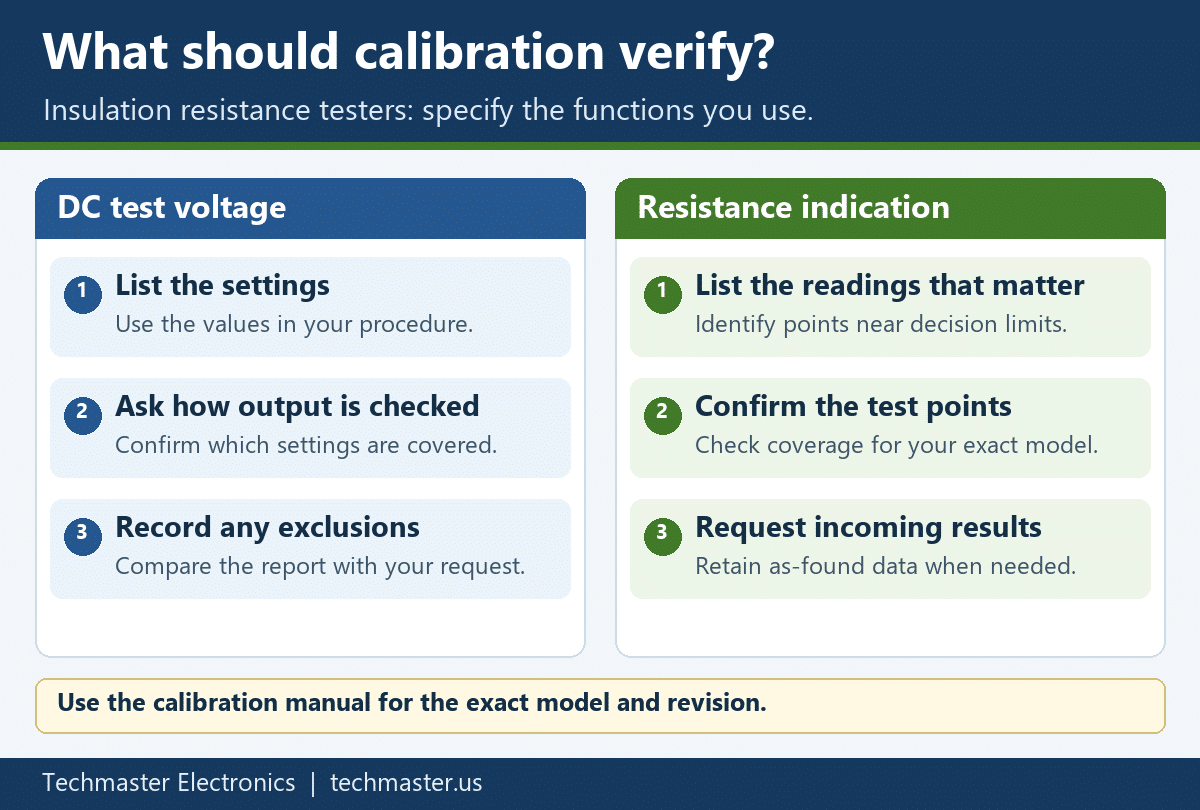
Start with the functions in your work instructions. An insulation tester applies a DC test voltage and reports resistance. Ask the provider how it verifies the output and the resistance indication for your model. If your procedure uses several voltage settings, identify them separately. Also list the resistance values near the thresholds that drive your maintenance or release decisions.
The test points and required equipment depend on the model. For example, Fluke provides a separate calibration manual for the 1503, 1507, and 1508 and a calibration manual for the 1550C and 1555. Use the manual for your exact model and revision when discussing test coverage. If you use auxiliary functions in controlled work, ask the provider to list those functions and indicate whether the quote covers them.
Distinguish an inspection from a measurement verification. A visual check may identify worn leads or a damaged enclosure. A power-on check shows that the instrument starts. Neither provides evidence that the instrument’s output and readings meet the applicable limits. Ask how the provider handles suspect readings or unsafe equipment before adjustment or repair.
2. What affects the quote and turnaround?
| Quote detail | What to confirm |
|---|---|
| Instrument and options | Exact model, serial number, functions in use, and any required accessories. |
| Measurements | Which voltage settings and resistance points are included and how additional points are handled. |
| Certificate | As-found and as-left data, uncertainties where required, and any conformity statement. |
| Adjustment or repair | What requires authorization and whether extra testing follows that work. |
| Downtime | Transit, receiving, bench work, approvals, and return shipping. |
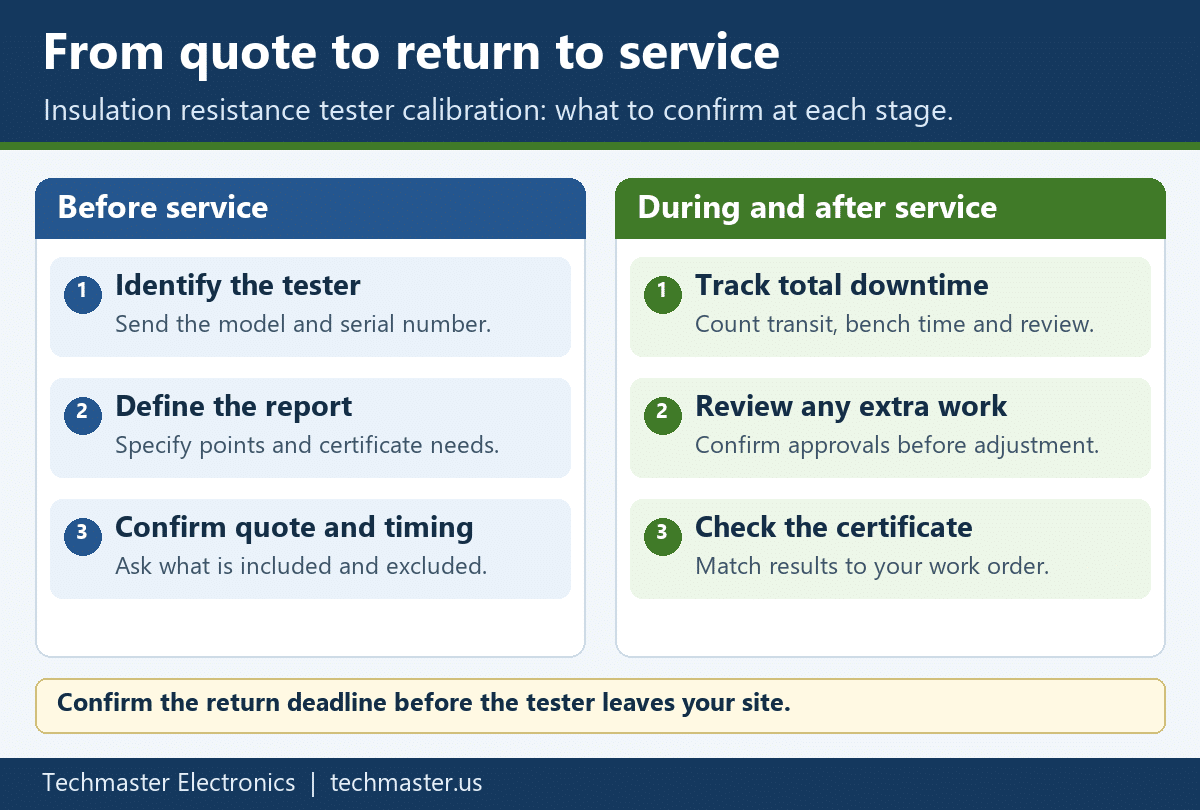
Request a written quote with inclusions and exclusions. A team that needs incoming results and coverage at extra points should see those items on both quotes. Compare the time from shipment to return rather than relying on a bench-time estimate. Ask when the turnaround starts and how the provider communicates a delay.
If the instrument supports a production or maintenance deadline, tell the provider when you need it back. Arrange a qualified spare if work cannot wait. Include time for receiving review, certificate approval, and asset-system updates. For planning across equipment types, see Techmaster’s guide to calibration turnaround.
3. How do you confirm accreditation for the work you need?
Ask which facility will perform the measurements and request its current scope. Compare the required quantities and ranges with the entries that apply to that location. If a quote covers a mix of accredited and other work, ask the provider to identify which results fall in which category. Resolve the distinction before issuing the purchase order.
Also check what your quality system expects from the certificate. A request for a conformity statement should identify the limits and the decision rule. Ask how the provider will report an out-of-tolerance result, including whether it will notify you before adjustment. Incoming data can help determine whether earlier work needs review, particularly when a previous reading was close to a test threshold.
4. How can you review the certificate before returning the tester?
Match the model and serial number to your asset record. Compare the reported points with the order and identify any exclusions. Look for separate incoming and outgoing results when adjustment took place. Confirm that the reported units, limits, and measurement conditions support the planned work. If a required setting is missing, ask the provider to explain the omission before releasing the instrument.
Keep the certificate with the purchase order and the rationale for the next recall date. If the incoming result was outside tolerance, identify the affected functions and work records. Use your quality procedure to decide whether previous measurements require review. The tester may return in acceptable condition while the earlier results still need assessment.
5. Example: Comparing quotes after a failed intermediate check
Suppose a maintenance team removes a tester from service after a failed intermediate check. Two providers can handle the model. One quote calls for routine results only. The other includes incoming data and the points the team uses near an acceptance threshold. The second quote aligns with the investigation if the provider confirms those points before service. The team also requests a notification before adjustment so it can decide what evidence to preserve.
At receiving, the team compares the certificate with the original check and documents any differences in conditions. It retains the provider’s report with the asset history and reviews the work completed since the last acceptable evidence. This approach gives the purchasing decision a clear purpose beyond finding an available bench.
6. How Often Should This Equipment Be Calibrated?
7. What to Look for in a Calibration Provider
Request a quote that names the DC output settings and resistance points, the performing facility, and the report deliverables. Ask whether an out-of-tolerance finding will trigger notification before adjustment and whether additional points change the quote.
If accredited calibration is required, check that the current ISO/IEC 17025 scope covers the required measurements at the performing facility. Ask for a sample report that shows how the lab documents test points, results, and uncertainty. Specify whether you need as-found and as-left readings or a statement of conformity with an agreed decision rule.
Confirm the time from shipment to return, including approval for extra work and certificate review. Ask how the lab will notify you if the instrument needs adjustment or if a requested point cannot be verified.
8. Techmaster Equipment Rental Services
9. Why Choose Techmaster Electronics?
Techmaster Electronics has worked with electronic test equipment since 1989. Its US services include calibration, repair, and equipment rentals, which gives teams a place to discuss the service and temporary equipment needs together.
Send Techmaster the exact model and work-order limits, along with any requirement to preserve incoming readings. Ask for the quoted coverage, certificate format, approval points, and expected return schedule in writing so receiving can review the completed work.
If accredited results are required, confirm that the current ANAB scope for certificate AC-1736 covers the required measurement and performing location before authorizing work.
10. Calibration service FAQs
Calibration labs near you: Techmaster Electronics is an ISO/IEC 17025 accredited calibration laboratory (ANAB Certificate AC-1736) with accredited labs in Vista, CA, Santa Clara, CA, Orlando, FL and San Antonio, TX, plus a lab in Holly Springs, NC. Accredited parameters vary by lab; compare locations or request a quote.

Khanh Nguyen is the Marketing Manager at Techmaster Electronics, a B2B marketing leader covering the test, measurement, and ISO/IEC 17025 accredited calibration industry in the United States.