
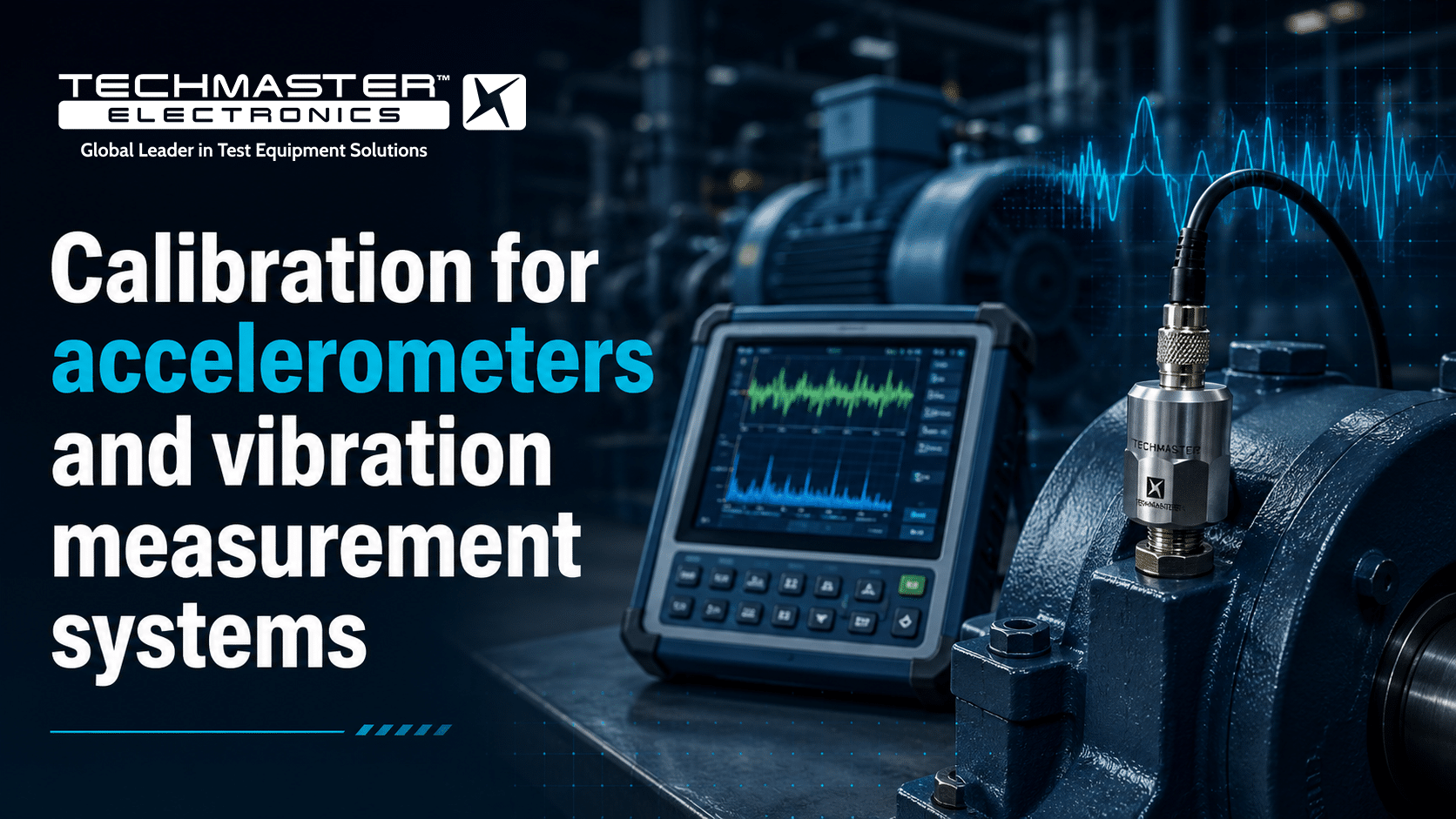
Calibration for accelerometers and vibration measurement systems is the only way to know a sensor’s sensitivity and frequency response are still what the datasheet claims.
This calibration falls under our vibration calibration service.
Accelerometer Calibration
Frequency response at a glance
How accelerometer calibration works
- Mount on reference exciter
- Back-to-back comparison @ 159.2 Hz
- Frequency-response sweep
- Amplitude linearity
- Transverse sensitivity
- Accredited certificate
Sensors we calibrate
What we measure
| Parameter | What it checks | Method / standard | Typical |
|---|---|---|---|
| Reference sensitivity | Output per g (mV/g or pC/g) at reference frequency | Comparison to reference accelerometer at ~159.2 Hz, ISO 16063-21 | Reported value ± uncertainty (~1%) |
| Frequency response | Sensitivity deviation across the band | Sine sweep (e.g. 5 Hz-10 kHz) vs reference | % deviation vs reference |
| Amplitude linearity | Linearity over the amplitude range | Multiple levels at the reference frequency | Within spec (%) |
| Transverse sensitivity | Unwanted cross-axis output | Per ISO 16063 | Typically a few % max |
| System sensitivity | Whole-chain mV/g | Accelerometer + cable + conditioner + analyzer measured together | Reported with channel settings |
In-lab vs on-site calibration
In-lab calibration
- Accredited bench with full reference standards
- Best achievable measurement uncertainties
- Pickup & return logistics handled
- Ideal for precision and reference work
On-site calibration
- We calibrate the accelerometer at your facility
- No shipping risk or transit downtime
- As-found data captured before any move
- Ideal for fixed, large or sensitive assets
In-depth guide
Calibration for accelerometers and complete vibration measurement systems
Accelerometers are measuring devices used to detect and measure acceleration in physical objects or systems. We know that they are important in a variety of industrial applications because of their ability to provide crucial information about motion and vibration. Whatever the application of your accelerometers, such as vibration monitoring of engines, turbines, compressors, and pumps. We know that your periodic calibration will help early detection of abnormal vibrations that can cause failures, reduce downtime, and improve plant safety. Our Calibration Laboratory has extensive experience in the calibration of this type of instrument, both for individual accelerometers such as Triaxial, Piezoelectric, Piezoresistive and for complete vibration measurement systems including vibration controllers and monitors. We recommend an annual calibration for accelerometers and vibration measurement systems; it is important to have both in the calibration cycle to ensure the frequency and sensitivity are correctly rated.Calibration for accelerometers and vibration measurement systems keeps sensitivity, frequency response and phase traceable to national standards. Before choosing a Calibration Laboratory, you should evaluate several key factors: Accreditation, Experience, Metrological Traceability, Equipment, Procedures, and Customer Service.
Equipment: It is always important to know that the laboratory is professional and reliable. It will be important you know their facilities and verify that their equipment or calibration standards are modern and have maintenance processes for their standards.

IEC 61672-3 Periodic Testing vs. Field Calibration for Sound Level Meters
A field check with an acoustic calibrator is not the same as IEC 61672-3 periodic...
Sep
Accelerometer Calibration by Back-to-Back Comparison: ISO 16063-21 Explained
How accredited labs calibrate accelerometers by back-to-back comparison per ISO 16063-21: sensitivity, frequency response, typical...
Aug

Professional Sound Calibrator Calibration & NIST Traceable Services
Home » Calibration for accelerometers and vibration measurement systems Metrology guide · ISO/IEC 17025 ·...
Feb
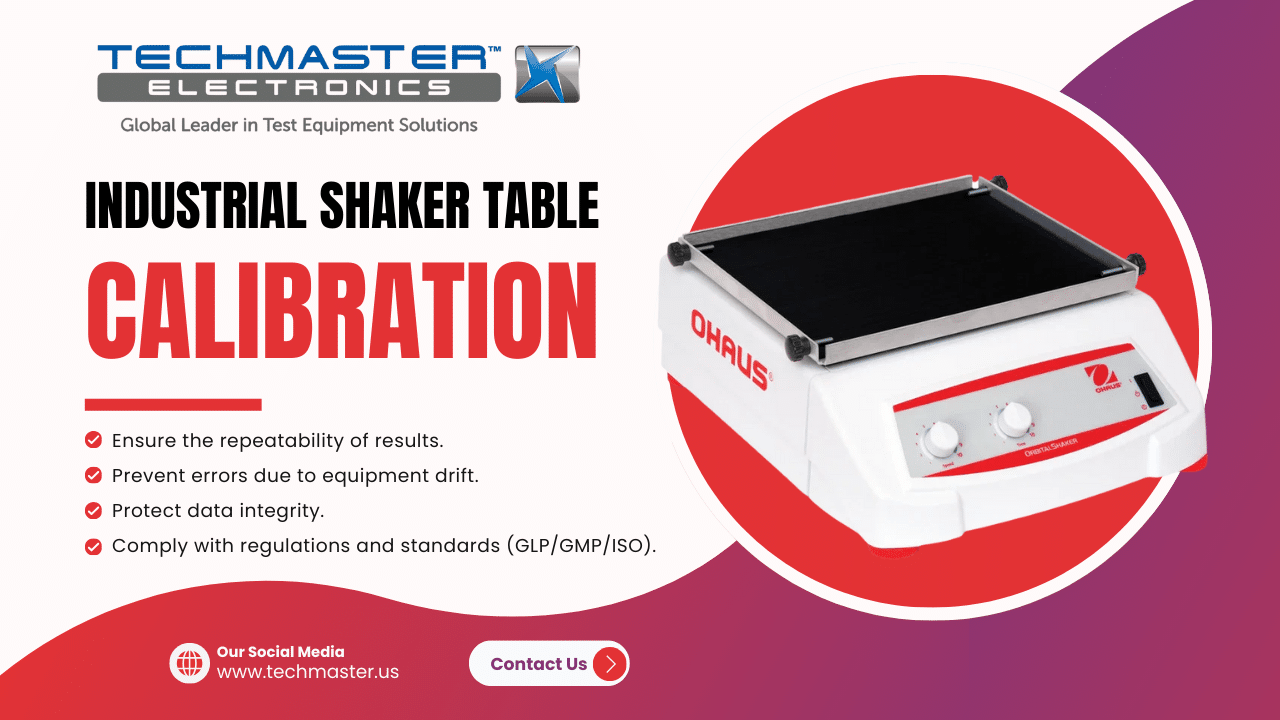
Shaker Table Calibration: Mandatory for Endurance Testing
Home » Calibration for accelerometers and vibration measurement systems Metrology guide · ISO/IEC 17025 ·...
Dec

Sound Level Calibration: Environmental Noise Control
Home » Calibration for accelerometers and vibration measurement systems Metrology guide · ISO/IEC 17025 ·...
Nov
Piezoelectric Accelerometers Calibration in Robotics
Home » Calibration for accelerometers and vibration measurement systems Metrology guide · ISO/IEC 17025 ·...
Aug

MEMS Technology in Vibration Measurement
Home » Calibration for accelerometers and vibration measurement systems Guide · Techmaster Electronics MEMS Technology...
Jul

Sound Level Meter: What is it and how does it work?
Home » Calibration for accelerometers and vibration measurement systems Guide · Techmaster Electronics Sound Level...
Mar
Frequently asked questions
What is accelerometer calibration?
Which standards apply to accelerometer calibration?
What does the calibration measure?
How often should an accelerometer be calibrated?
Can you calibrate the whole vibration measurement system?
Need accelerometer calibration?
ANAB-accredited, NIST-traceable, fast turnaround, in-lab or on-site across the USA.
Contact us for a quoteReferences & industry standards
- ISO/IEC 17025 testing & calibration laboratory requirements
- NIST calibration services and measurement traceability
- A2LA / ANAB accreditation for calibration laboratories
External standards bodies. Techmaster Electronics is an ISO/IEC 17025-accredited, NIST-traceable calibration laboratory.

Khanh Nguyen is the Marketing Manager at Techmaster Electronics, a B2B marketing leader covering the test, measurement, and ISO/IEC 17025 accredited calibration industry in the United States.