Sound Calibrator Calibration…
Accuracy across the range
How Sound Calibrator calibration works
- Intake & visual inspection
- Environmental stabilization
- As-found measurement
- Comparison to NIST-traceable standards
- Adjustment if required
- As-left results & certificate
Your calibration, covered
In-lab vs on-site calibration
In-lab calibration
- Accredited bench with full reference standards
- Best achievable measurement uncertainties
- Pickup & return logistics handled
- Ideal for precision and reference work
On-site calibration
- We calibrate the Sound Calibrator at your facility
- No shipping risk or transit downtime
- As-found data captured before any move
- Ideal for fixed, large or sensitive assets
In-depth guide
In precision acoustics, accuracy isn’t just a goal, it’s a legal and operational mandate. Whether you are conducting workplace noise dosimetry for OSHA compliance or environmental impact studies, your data is only as good as the device that verifies it. This brings us to the critical, yet often overlooked, necessity of Sound Calibrator calibration.
This calibration falls under our vibration calibration service.
While many professionals use a calibrator daily to “field-check” their sound level meters, the calibrator itself is a precision instrument that drifts over time. To maintain the integrity of your measurement chain, professional Sound Level Calibrator service is non-negotiable.

Why Your Sound Calibrator Needs Regular Calibration
A sound calibrator is designed to emit a stable acoustic pressure at a specific frequency (usually 1 kHz) and level (typically 94 dB or 114 dB). However, like any high-end electronic device, its internal components are subject to aging, environmental stress, and physical wear.
The Reality of Electronic Drift
Internal oscillators and transducers can “drift” due to humidity, temperature fluctuations, and battery depletion. Even a minor shift of 0.5 dB might seem negligible, but in the logarithmic scale of acoustics, it represents a significant error in actual sound pressure energy.
Legal & Regulatory Compliance
In the United States, most regulatory bodies and courts require NIST Traceable Sound Calibration. If your noise survey is challenged in a legal dispute or an audit, and you cannot prove that your calibrator was certified by an accredited lab within the last year, your entire data set may be deemed inadmissible.
Field Verification vs. Laboratory Recertification
It is vital to distinguish between these two:
-
Field Verification: Using your calibrator to adjust your Sound Level Meter before a test.
-
Laboratory Calibration: Sending the calibrator to a specialized facility to ensure it is actually outputting the correct 1 kHz tone at the exact decibel level specified.
The NIST Traceability Chain: What It Actually Means
The NIST Traceability Chain
“NIST Traceable” isn’t a buzzword; it is an unbroken chain of comparisons ensuring that 94.0 dB in your facility matches 94.0 dB in a federal research lab. Without this, your data may be inadmissible in court.
NIST
National Institute of Standards & Tech
Primary StandardAccredited Lab
ISO 17025 Certified Facility
Reference MastersYour Device
Field Sound Calibrator
Verified AccurateThe National Institute of Standards and Technology (NIST) maintains the primary acoustic standards for the U.S. An accredited calibration lab compares its “Master” devices to NIST standards. That lab then uses those masters to calibrate your device. This “Unbroken Chain of Traceability” ensures that 94.0 dB in your facility is exactly the same as 94.0 dB in a federal research lab.
Using an ISO 17025 accredited Sound Level Calibrator service guarantees a NIST Traceable Sound Calibration, ensuring that the uncertainty of measurement is accurately calculated and documented to provide a ‘safety net’ for your professional reputation.
Technical Standards & Accuracy Classes: IEC 60942 & ANSI S1.40
Not all calibrators are created equal. In the U.S. and internationally, two primary standards govern these devices: IEC 60942 and ANSI S1.40.
Understanding the Classes
-
Class LS (Laboratory Standard): Used primarily by calibration laboratories to calibrate other equipment.
-
Class 1 (Precision): Required for high-precision field work. If you use a Class 1 Sound Level Meter, you must use a Class 1 Sound Calibrator.
-
Class 2 (General Purpose): Suitable for basic noise surveys and occupational safety checks where extreme precision is less critical.
Professional calibration verifies that your device still meets its original Class rating. If a Class 1 calibrator fails to meet the frequency stability requirements, it may be “downgraded” to Class 2 or require repair.
The Sound Level Calibrator Calibration Process
The 5-Step Professional Process
1. Inspection & Cleaning
Technicians check for cracks and debris. Dust in the cavity alters volume and reading accuracy.
2. Frequency Testing
Measuring the 1 kHz output. Frequency shifts prevent weighting filters (A/C/Z) from reacting correctly.
3. Distortion (THD) Analysis
Ensuring a “pure” sine wave. Distortion spreads energy across frequencies, falsifying the calibration level.
4. SPL Adjustment
The core task. Adjusting internal circuitry to match exact NIST reference standards at 94dB and 114dB.
5. Certification
Issuing the “Birth Certificate” for the year, documenting uncertainty, environment, and traceability.
What happens when you send your device to a professional lab? It’s far more than just turning it on and off. A rigorous NIST Traceable Sound Calibration involves several key steps:
1. Visual Inspection and Cleaning
Technicians check for cracks in the housing and debris in the microphone cavity. Even a small piece of dust can change the volume of the acoustic cavity, leading to incorrect SPL readings.
2. Frequency Stability Testing
The lab measures the output frequency. For a standard 1 kHz calibrator, the tolerance is extremely tight. If the frequency shifts, the weighting filters ($A$, $C$, or $Z$) on your sound level meter will not react correctly during field checks.
3. Total Harmonic Distortion (THD) Analysis
The tone produced must be a “pure” sine wave. If there is distortion, the energy is spread across multiple frequencies, making the calibration level inaccurate.
4. Sound Pressure Level (SPL) Adjustment
The lab measures the output at 94 dB and 114 dB. Using high-precision reference microphones, they adjust the internal circuitry to ensure the output is exactly as labeled.
5. Issuance of the Calibration Certificate
This is your “birth certificate” for the year. It includes:
-
As-found and as-left data.
-
Environmental conditions during the test (Pressure, Temp, Humidity).
-
Statement of measurement uncertainty.
-
Traceability evidence to NIST.
How Often Should You Recalibrate?
When to Recalibrate?
The Standard: Every 12 Months
Most ISO-certified organizations and regulatory bodies mandate an annual cycle.
However, the “12-month rule” is a baseline. Real-world conditions often demand shorter intervals. If your device is exposed to stress, it drifts faster.
Watch for:
- Consistent “jumps” in readings
- Physical drops or impact
- High dust environments
Vulnerability Profile
Factors that Accelerate Calibration Need (Risk Scale 0-10)

High scores indicate a need for 6-month calibration intervals.
The standard industry recommendation, and the requirement for most ISO-certified organizations, is annually (every 12 months).
However, you should consider a shorter interval if:
-
The device is used in extreme environments (high humidity or dust).
-
The calibrator has been dropped or subjected to heavy vibration during transport.
-
You notice a consistent “jump” in your sound level meter readings that doesn’t align with previous history.
Choosing a Reliable Sound Level Calibrator Service Provider
When selecting a lab in the U.S. market, don’t just look at the price. Look for:
-
ISO/IEC 17025 Accreditation: This is the gold standard for testing and calibration laboratories.
-
Turnaround Time: You can’t perform field work without your calibrator. Look for labs offering 3–5 day windows.
-
Comprehensive Documentation: Ensure they provide a full data sheet, not just a “Pass” sticker.
Conclusion
Your noise measurement data is a foundation for safety, legal compliance, and engineering decisions. Don’t let a drifting calibrator undermine your hard work. Regular Sound Level Calibrator calibration is a small investment that provides immense confidence.
By maintaining a rigorous NIST Traceable Sound Calibration schedule, you ensure that your measurements are accurate, your reports are defensible, and your equipment is always ready for the field.
Is your accuracy at risk?
Ensure your facility runs at peak performance with NIST-traceable calibration.
Contact Us for a QuoteGenerated based on professional calibration standards. ISO/IEC 17025 Compliant.
Frequently asked questions
What is Sound Calibrator Calibration?
How often should a Sound Calibrator be calibrated?
What standards apply to Sound Calibrator Calibration?
What is included on the certificate?
Can you calibrate the Sound Calibrator on-site?
Need Sound Calibrator calibration?
ANAB-accredited, NIST-traceable, fast turnaround, in-lab or on-site across the USA.
Contact us for a quoteReferences & industry standards
- ISO/IEC 17025 testing & calibration laboratory requirements
- NIST calibration services and measurement traceability
- NIST Acoustics
- A2LA / ANAB accreditation for calibration laboratories
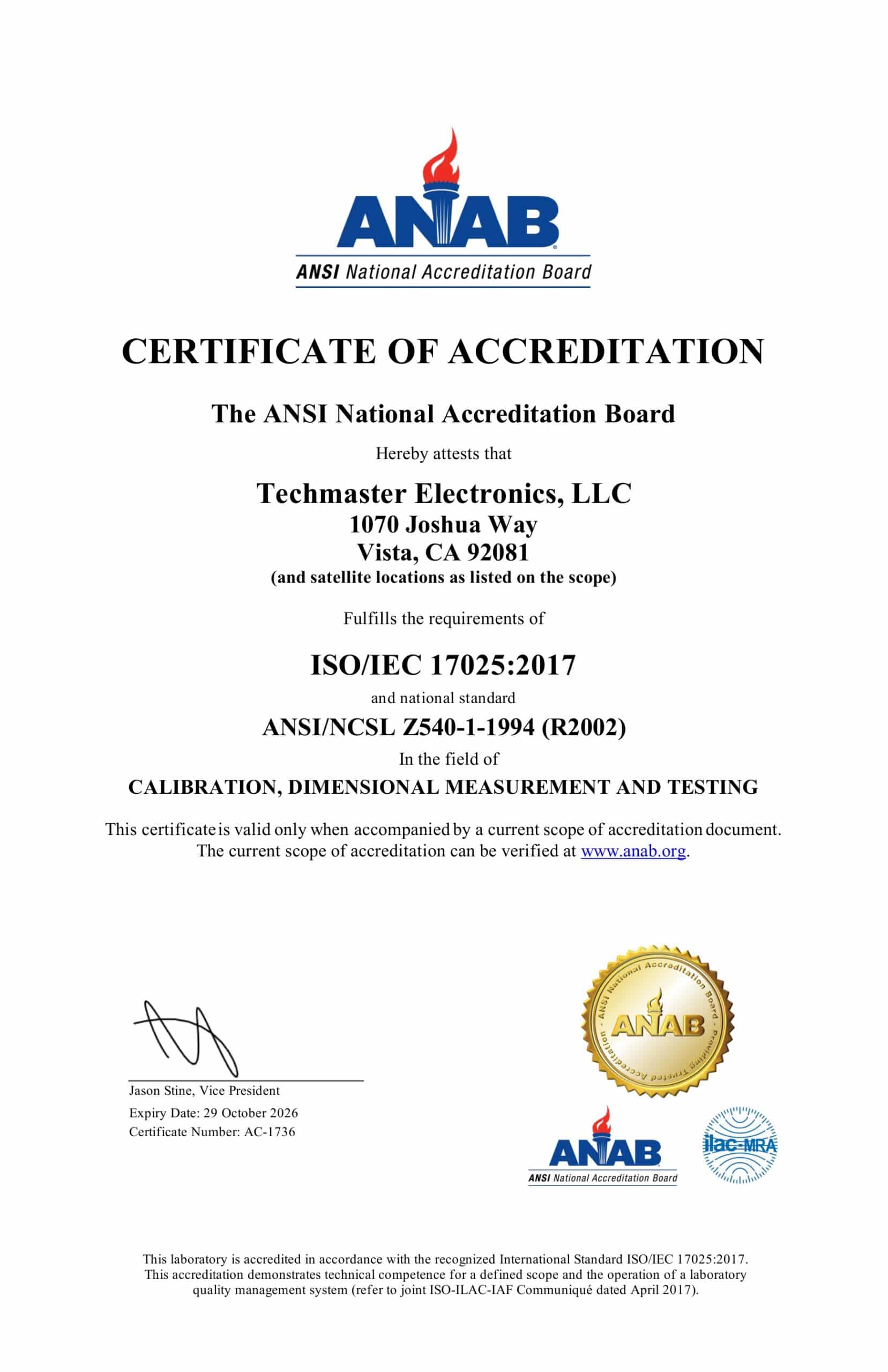
External standards bodies. Techmaster Electronics is an ISO/IEC 17025-accredited, NIST-traceable calibration laboratory.
Related reading: Noise dosimeter calibration for OSHA 29 CFR 1910.95 hearing conservation compliance
Related reading: what IEC 61672-3 periodic testing verifies on a sound level meter

Khanh Nguyen is the Marketing Manager at Techmaster Electronics, a B2B marketing leader covering the test, measurement, and ISO/IEC 17025 accredited calibration industry in the United States.