
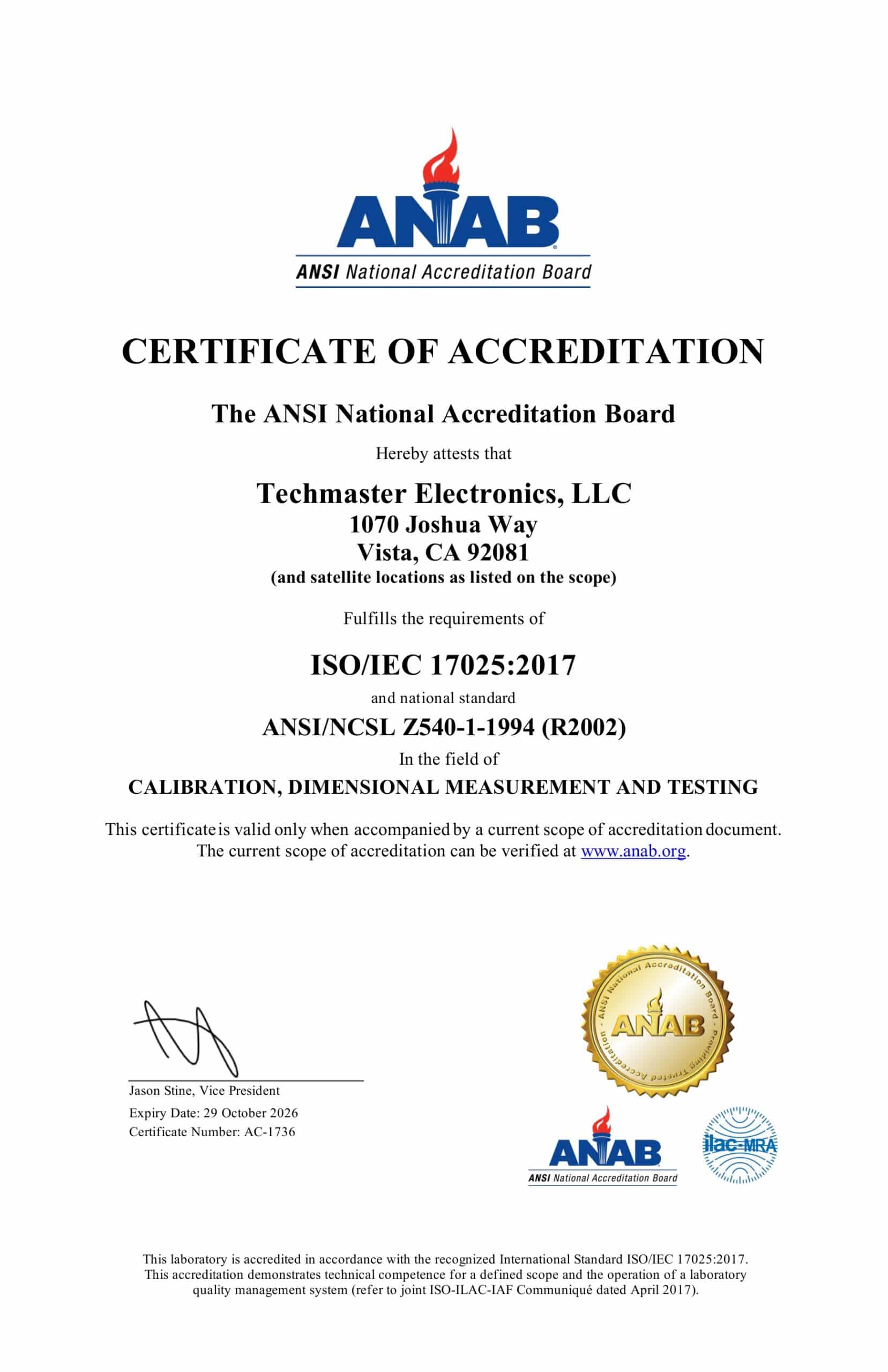
Yes, a subcontracted calibration can still be accredited, but only for the parameters covered by an accredited laboratory’s scope. ISO/IEC 17025:2017 handles subcontracting under clause 6.6, requires the lab to tell you and gain your approval before work leaves its facility, and requires externally provided results to be clearly identified on the certificate.
A quality manager opens a calibration certificate, sees an accreditation symbol at the top, files it, and moves on. Six months later an auditor asks a harder question: which laboratory actually performed the humidity measurement on page three, and is that laboratory accredited for it? The certificate does not say. That gap, between the symbol on page one and the work performed on page three, is where most subcontracting problems live.
Subcontracted calibration is normal, legitimate, and often the right engineering decision. It becomes a compliance problem only when it is invisible. This guide explains what ISO 17025 clause 6.6 actually requires, what stays accredited and what does not, and the specific checks that turn an ambiguous certificate into defensible evidence of traceability.
What does ISO/IEC 17025 require when a calibration is subcontracted?
That renaming trips up a lot of quality managers who learned the standard under the 2005 edition. If you search a current copy of ISO/IEC 17025 for the word “subcontract,” you will find almost nothing. The obligations did not disappear, they were generalized. Under the 2017 structure, an outside calibration laboratory is treated the same way as a calibration-gas supplier or a software vendor: an external provider whose output affects laboratory activities. In practice, ISO/IEC 17025 clause 6.6 means externally provided calibration services are governed by the same evaluation, approval and record-keeping rules as any other purchased input.
Three sub-clauses carry the weight:
- 6.6.1, the laboratory must ensure that externally provided products and services affecting its activities are suitable for purpose.
- 6.6.2, the laboratory must have a documented procedure and keep records covering how it defines and reviews requirements, how it evaluates, selects, monitors and re-evaluates providers, how it verifies conformity before use, and what actions it takes when a provider underperforms.
- 6.6.3, the laboratory must communicate its requirements to the external provider, including the specific work to be performed and the competence expected.
Separately, clause 7.8 (reporting of results) requires reports to be accurate, clear, unambiguous and objective, and to identify clearly any results obtained from an external provider. Clause 7.1 (review of requests, tenders and contracts) is where the obligation to you bites: where external providers are used, the laboratory must apply clause 6.6, advise you of the specific laboratory activities the external provider will perform, and gain your approval. Notification is not a courtesy, and approval is not implied by silence. Both are contract-review requirements.
Is a subcontracted calibration still accredited?
The distinction matters because accreditation is never granted to a company in the abstract. It is granted for a defined scope: named locations, named measurement parameters, named ranges, and stated calibration and measurement capability. ILAC’s guidance on describing scopes of accreditation, ILAC G18:01/2024, exists precisely because that boundary has to be legible to customers and regulators. Work that falls outside the scope is competent work, possibly excellent work, but it is not accredited work, and it cannot be presented as such.
The rules on how a laboratory may make claims about its accredited status are set out in ILAC P8:11/2023, which governs the use of accreditation symbols and claims of accreditation status by accredited bodies. A blanket symbol on a certificate that mixes accredited and non-accredited lines risks exactly the kind of misleading accreditation claim P8 is written to prevent.
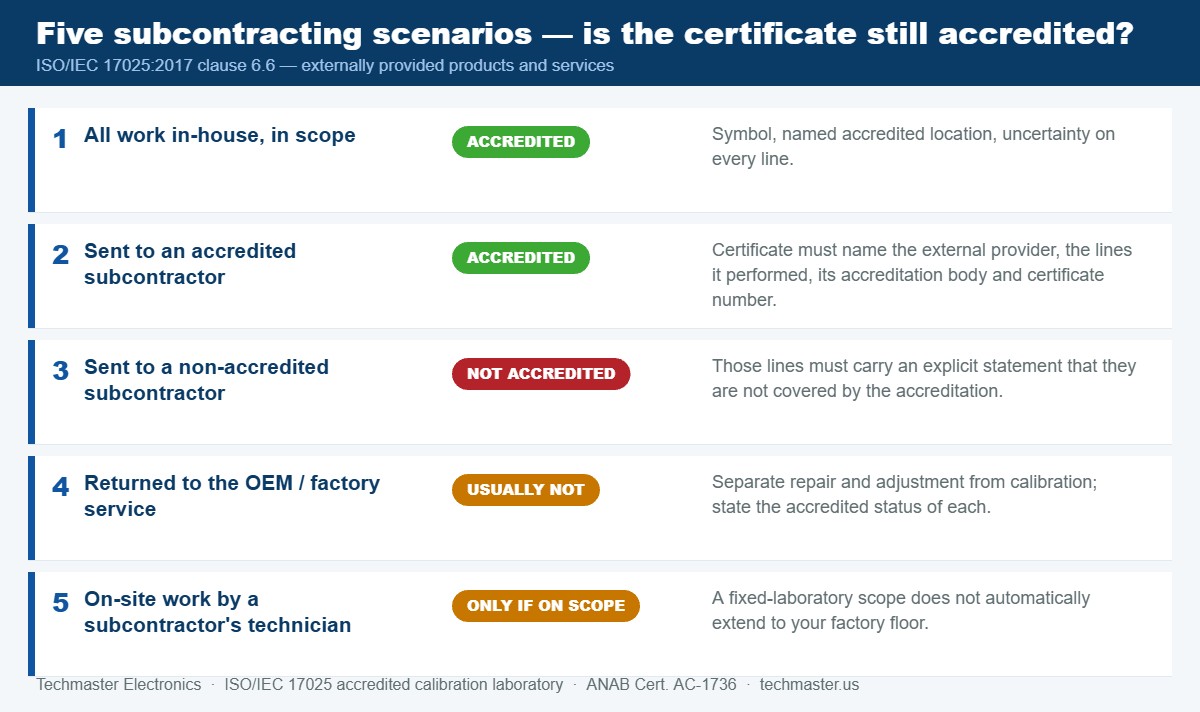
| Scenario | Accredited? | What the certificate must show | Your main risk |
|---|---|---|---|
| All work in-house, in scope | Yes, end to end | Accreditation symbol, named accredited location, uncertainty on every line | Low. Verify the location is on the published scope. |
| Sent to an accredited subcontractor | Yes, for in-scope lines | Named external provider, which lines it performed, its accreditation body and certificate number | Undisclosed handoff. You cannot prove traceability for lines you cannot attribute. |
| Sent to a non-accredited subcontractor | No, for those lines | Explicit statement that those results are not covered by the accreditation | False assurance. An auditor finds a non-accredited result presented under an accredited cover page. |
| Returned to the OEM / factory service | Usually not, unless the OEM is accredited | What was repair or adjustment versus what was calibration, and the accredited status of each | Repair recorded as calibration. Adjustment without post-adjustment accredited verification. |
| On-site work by a subcontractor’s technician | Only if on-site work is on that lab’s scope | Whether the scope covers field or fixed-location calibration for that parameter | Assuming a fixed-laboratory scope automatically extends to your factory floor. |
How can you tell from the certificate that work was subcontracted?
In practice the tell is often the address block. A certificate issued by a laboratory in one state, reporting a measurement its published scope does not list at that location, has almost certainly moved somewhere. The second tell is uncertainty. Under ILAC P14:09/2020, accredited calibration results carry a stated measurement uncertainty; a line without one is either not accredited or not fully reported. If you want the full anatomy of the document, we have a walkthrough of how to read an ISO/IEC 17025 calibration certificate line by line.
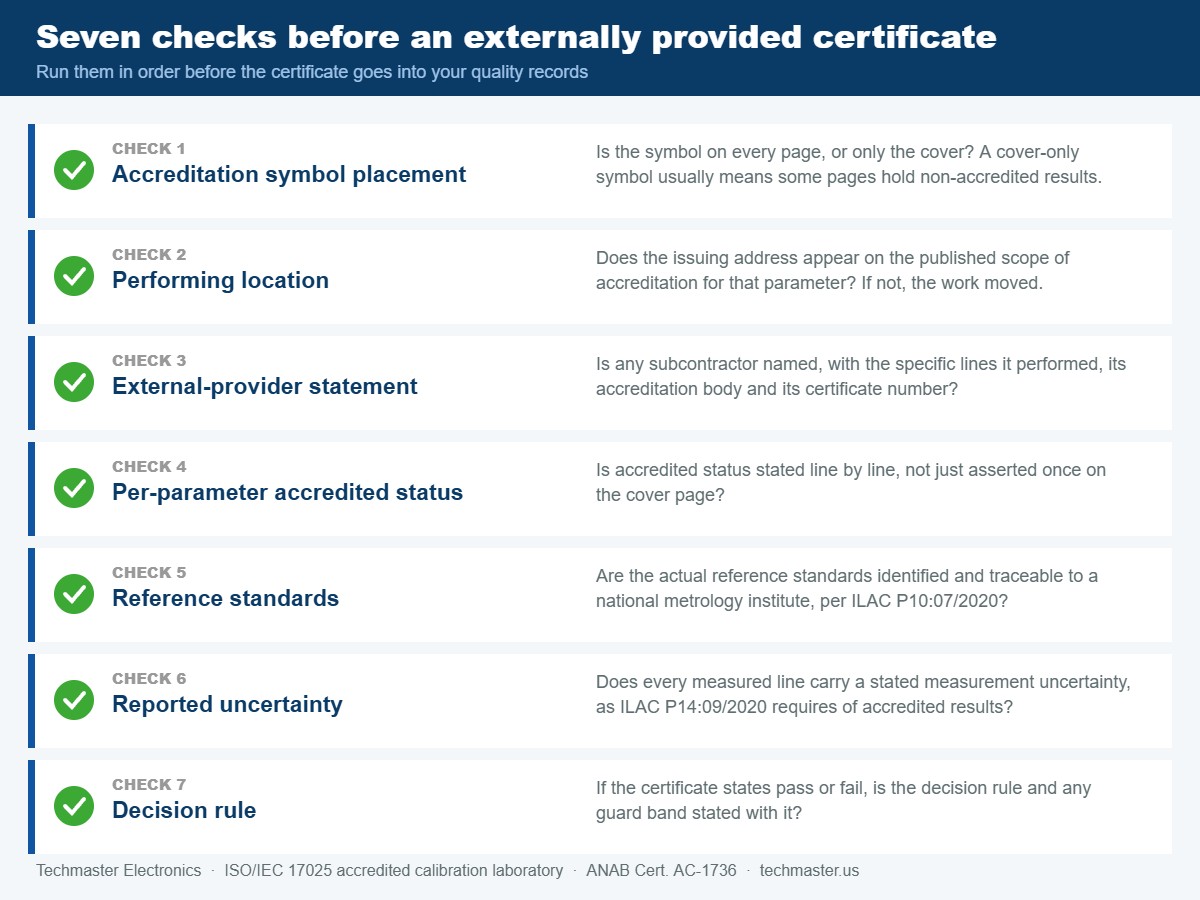
Seven checks will settle almost every ambiguous case. Run them in order, symbol placement, performing location, external-provider statement, per-parameter accredited status, reference standards, reported uncertainty, and decision rule, before a certificate covering externally provided calibration services goes into your quality records.
| What you see | What it usually means | What to ask for |
|---|---|---|
| Accreditation symbol on the cover page only | Some pages contain non-accredited results | A page-by-page or line-by-line statement of accredited status |
| Issuing address not on the published scope | Work performed at a non-accredited site or subcontracted | Confirmation of the performing location and its scope entry |
| Measured value with no uncertainty | Non-accredited line, or reporting omission | The uncertainty and the calibration and measurement capability behind it |
| “Calibrated using traceable standards” with no standard identified | Traceability asserted but not demonstrated | Reference standard identity and its own certificate, per ILAC P10 |
| Pass / fail with no decision rule | Conformity statement without a stated risk basis | The decision rule and guard band applied, per ILAC G8 |
| “Limited calibration” or “restricted range” with no explanation | Part of the range was outside capability or the unit failed partway | Which points were covered, which were not, and why |
Why do calibration laboratories subcontract in the first place?
Breadth is the practical reason. Across Techmaster’s ten-year service record of 381,916 calibrations spanning 4,913 different manufacturers, the instrument mix ranges from 6.5-digit multimeters and Fluke process calibrators to Keysight vector network analyzers, Rohde & Schwarz signal generators, and torque transducers. A portfolio that wide inevitably contains items whose calibration sits outside any single laboratory’s accredited scope, unusual frequency ranges, specialist medical simulators, one-off legacy instruments.
Three legitimate drivers dominate:
- Parameter or range gap. The instrument needs a measurement the laboratory is not accredited for, a frequency above its accredited ceiling, a pressure beyond its deadweight capability. Understanding calibration and measurement capability (CMC) on an accreditation scope makes these ceilings visible before the instrument ships.
- Capital economics. Some reference standards cost more than the annual revenue of the parameter they support. Directing that work to a laboratory that already owns the standard is rational.
- Repair-and-adjust workflows. An instrument that needs a firmware-level or component-level repair may have to go back to the manufacturer. The important discipline is that any adjustment is followed by accredited verification, otherwise you have a repaired instrument with a stale calibration.
None of these are problems. All three become problems the moment they are not written down.
How do FDA, AS9100 and IATF auditors treat subcontracted calibration?
Under FDA’s Quality Management System Regulation (QMSR) in 21 CFR Part 820, which incorporates ISO 13485:2016 and became the compliance basis for device quality systems on 2 February 2026, monitoring and measuring equipment must be controlled and calibrated against traceable standards, and outsourced processes remain subject to your supplier controls. An auditor examining a device manufacturer’s records for subcontracted calibration will follow the chain outward: your procedure, your approved supplier list, the supplier’s certificate, the standards behind that certificate. A break anywhere in that chain is your finding, not your supplier’s.
AS9100 in aerospace and IATF 16949 in automotive both flow equivalent requirements down the supply chain. IATF 16949 goes further than most: its clause 7.1.5.3.2 requires an external laboratory or calibration service to be accredited to ISO/IEC 17025 or a national equivalent for the relevant scope, unless the laboratory can show the customer accepts an alternative. AS9100 works through ISO 9001’s measurement-traceability requirements, with accredited calibration commonly imposed by customer flow-downs. The practical consequence is uncomfortable: if a subcontracted line turns out to be non-accredited after you have used the instrument to release product, you are in impact-analysis territory. Our guide to handling out-of-tolerance calibration results covers the same containment logic that applies here.
What should you ask your calibration supplier before approving subcontracting?
The five questions, and the answers you want
- “Will any portion of this calibration be performed outside your accredited laboratories?” A confident supplier answers yes or no immediately, per instrument type. Hesitation is information.
- “Which specific parameters and ranges go outside, and to whom?” You want a named laboratory, not “a partner lab.”
- “What is that laboratory’s accreditation body and certificate number?” Then verify it independently in the accreditation body’s public directory, for US laboratories, the ANSI National Accreditation Board (ANAB) publishes accredited-organization listings and scopes.
- “How will the certificate identify externally provided results?” The acceptable answer names a mechanism: a footnote, a page marking, a per-line flag. “It’ll be on there somewhere” is not a mechanism.
- “What are the reference standards and their traceability?” Metrological traceability to a national metrology institute, in the United States, the National Institute of Standards and Technology (NIST), is the substance behind the symbol; the requirement is set out in ILAC P10:07/2020.
Put the answers in your approved-supplier record. That single document is usually the difference between a five-minute audit conversation and a corrective action.
How does Techmaster handle scope boundaries and external providers?
Techmaster Electronics has operated as an independent calibration and test-equipment service provider since 1989, and runs calibration services across twelve measurement disciplines, RF and microwave, electrical, calibrators, EMC-EMI, vibration, time and frequency, medical, cleanrooms, thermodynamic, chemical, dimensional, and mass-mechanical. Accreditation under Certificate AC-1736 applies to the specific parameters and ranges listed on scope V-023, not automatically to every discipline at every location.
Two points of disclosure matter for this discussion:
- Four laboratories are on the ANAB scope, not all locations. The Holly Springs, North Carolina laboratory and the Henderson, Nevada corporate office are not listed on Certificate AC-1736 and do not carry ISO/IEC 17025 accredited status. That is stated plainly rather than blurred.
- Accreditation is parameter-specific, not site-wide. Being on the scope does not mean every discipline is accredited at every listed laboratory. San Antonio, for example, joined the scope at V-023 for a defined set of calibration disciplines, not for RF and microwave, and not for environmental testing.
You can review the current parameters and ranges on Techmaster’s published ANAB scope of accreditation, and the accreditation background on the ANAB accreditation and Certificate AC-1736 page. If a requested measurement falls outside the scope, the right response is to say so before the instrument ships, which is the whole point of clause 6.6.
Key takeaways
- ISO/IEC 17025:2017 contains no “subcontracting” clause, the requirements sit in clause 6.6, Externally provided products and services.
- Subcontracted work stays accredited only where the subcontractor’s own scope covers that parameter and range.
- The laboratory must advise you which activities go to an external provider and gain your approval; that is a contract-review obligation under clause 7.1, not a courtesy.
- Certificates must identify externally provided results (ISO/IEC 17025 clause 7.8). A blanket accreditation symbol over mixed content risks a misleading accreditation claim under ILAC P8.
- Verify the subcontractor’s accreditation yourself in the accreditation body’s public directory, ANAB for US laboratories.
- Undisclosed subcontracting is a supplier-control finding under FDA QMSR, AS9100 and IATF 16949, and it lands on you, not your supplier.
- Techmaster’s ANAB Certificate AC-1736, scope V-023 (18 June 2026), covers four laboratories: Vista CA, Santa Clara CA, Orlando FL, and San Antonio TX.
Frequently asked questions
Does ISO/IEC 17025:2017 allow subcontracting at all?
Can a laboratory put its accreditation symbol on a certificate containing subcontracted results?
How do I verify that a subcontracted laboratory is genuinely accredited?
Is factory or OEM calibration the same as accredited calibration?
What should I do if I discover a certificate I already filed contained undisclosed non-accredited results?
Does Techmaster subcontract calibration work, and how would I know?
Need certainty about what is actually accredited?
Tell us the instrument, the parameter, and the range. We will confirm in writing whether it sits inside ANAB Certificate AC-1736, and if it does not, we will say so before anything ships.
Request a QuoteAbout Techmaster Electronics. Founded in 1989, Techmaster Electronics, LLC is an ISO/IEC 17025 accredited calibration laboratory (ANAB Cert. AC-1736) serving the United States, with accredited laboratories in Vista and Santa Clara, California; Orlando, Florida; and San Antonio, Texas. See all Techmaster calibration laboratory locations in the USA. Toll free 1-866-779-5695.

Khanh Nguyen is the Marketing Manager at Techmaster Electronics, a B2B marketing leader covering the test, measurement, and ISO/IEC 17025 accredited calibration industry across the US and Vietnam markets.