
TL;DR: Budget calibration from the fleet up: count the real inventory, price by instrument class ($50–800+ market range), then pull the six levers, fleet accuracy, interval right-sizing, certificate-level right-sizing, vendor consolidation, turnaround planning, and a 10–15% OOT/repair reserve. The premium for accredited certificates runs 20–50%; spend it where the risk justifies it.
Calibration budgets fail in predictable ways: ghost assets still on contract, accredited certificates bought fleet-wide by default, and no reserve for the units that come back out of tolerance. Here’s how to build a number you can defend, and shrink it without touching measurement risk.
What are the six levers of a calibration budget?
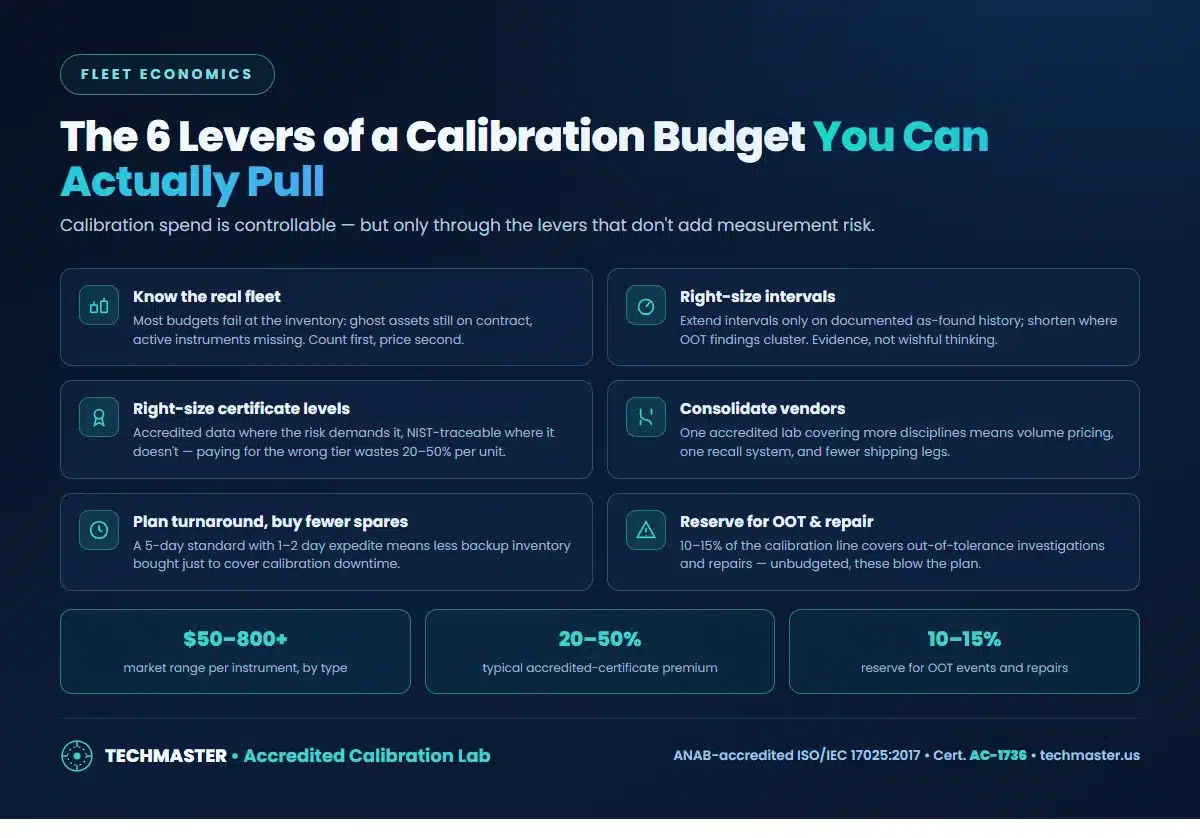
Know the real fleet first: most budgets are wrong before pricing starts, because the instrument list includes retired units and misses active ones, the same master list your recall system runs on. Right-size intervals with as-found evidence per the interval guide. Right-size certificate levels: accredited data where contracts and risk demand it (see what accredited calibration buys you), standard NIST-traceable where they don’t. Consolidate vendors, one accredited lab covering electrical through microwave means volume pricing and one recall workflow. Plan turnaround: a 5-day standard with 1–2 day expedite means fewer backup instruments bought just to cover downtime. And reserve 10–15% for out-of-tolerance events and repairs.
What does calibration cost by instrument type?
The full per-instrument table lives in the calibration cost guide; the budgeting shorthand is three tiers. Handhelds and simple meters: $50–150. Bench instruments, DMMs, supplies, scopes: $150–400. RF/microwave, spectrum analyzers, signal generators, VNAs: $400–800+. Onsite calibration changes the math for large fleets by removing shipping and downtime; the trade-offs are in onsite vs in-lab calibration.
When does in-house calibration enter the budget conversation?
Only at volume, typically several hundred same-discipline instruments, and the real costs are standards and accreditation, not labor. The break-even math is its own decision: in-house vs outsourced calibration.
Frequently asked questions
How much should I budget for calibration per instrument?
Market-typical US pricing runs roughly $50–150 for handheld meters and simple instruments, $150–400 for bench instruments and power supplies, and $400–800+ for RF and microwave instruments such as spectrum and network analyzers. Accredited certificates typically add 20–50% over standard NIST-traceable ones.
How can I reduce calibration costs without adding risk?
Four levers are safe: remove ghost assets from the contract, extend intervals only where documented as-found history supports it, match certificate level to actual risk instead of buying accredited data for everything, and consolidate vendors to earn volume pricing and cut shipping.
Should every instrument get an accredited calibration?
No. Instruments whose data feeds regulated product, customer contracts, or uncertainty budgets warrant accredited certificates; general-purpose bench tools used for troubleshooting can use standard NIST-traceable calibration. Paying the accredited premium fleet-wide typically overspends 20–50% on the instruments that don’t need it.
How much should I reserve for out-of-tolerance events and repairs?
Plan 10–15% of the annual calibration line. Some percentage of any fleet arrives out of tolerance each year, and each OOT event carries investigation time and possible repair or adjustment costs that a flat per-unit budget doesn’t cover.
The bottom line
A defensible calibration budget is fleet count × class pricing, tuned by the six levers, plus a 10–15% reserve. The cheapest quote is rarely the cheapest year, scope coverage, turnaround, and OOT handling decide the real cost, which is why vendor selection is worth the 12-point checklist.
Get an accredited calibration quote
ANAB-accredited ISO/IEC 17025:2017 (Cert. AC-1736) • 5 US labs • 5-day standard, 1–2 day expedite • in-lab or on-site.
Request a quote
Khanh Nguyen is the Marketing Manager at Techmaster Electronics, a B2B marketing leader covering the test, measurement, and ISO/IEC 17025 accredited calibration industry across the US and Vietnam markets.