
TL;DR: Double-box every instrument, original case inside a second rigid carton with ~5 cm (2 in) of cushioning on all six faces. Use static-shielding bags for boards, modules, and sensors. Send only the accessories that must be calibrated, list them with asset IDs, and put paperwork inside and outside the box. Declare replacement value, not book value. Where free local pickup exists, use it, it removes the risk entirely.
Most damage associated with calibration never happens on the bench. It happens in transit, and almost all of it traces to packing rather than carriers. Here’s how to get instruments there and back intact.
How should you pack test equipment for calibration?
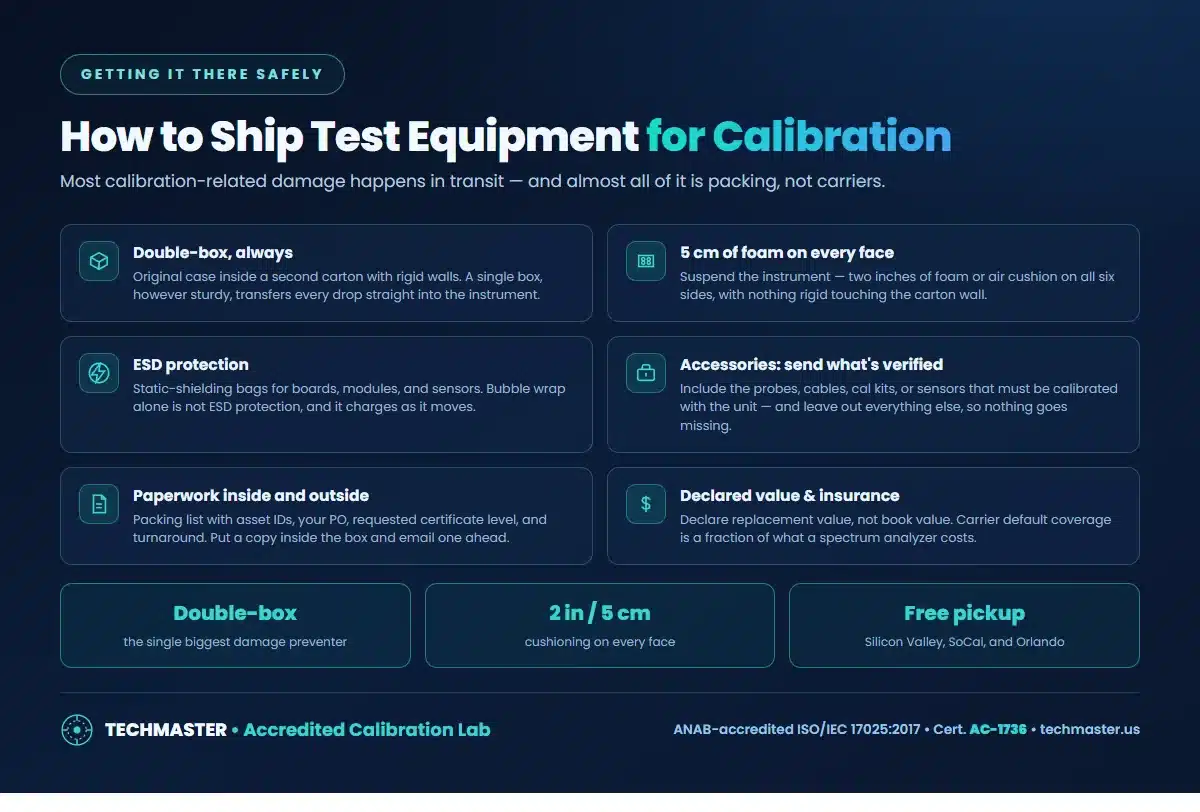
Double-boxing is the single biggest damage preventer: a single carton, however sturdy, transfers every drop directly into the instrument. The instrument goes in its original case or a fitted foam cradle, and that goes inside a second rigid carton with cushioning on all six faces, the goal is suspension, with nothing rigid bridging to the outer wall. Protect connectors especially on RF gear: caps on every port, since a damaged 3.5 mm or 2.4 mm connector costs more than the calibration and can ruin the mating port too (see RF and microwave calibration). Use static-shielding bags for anything with exposed electronics; bubble wrap is not ESD protection and generates charge as it moves.
Paperwork, accessories, and value
Include a packing list with asset IDs, your PO number, the certificate level you want (accredited, Z540, or standard NIST-traceable, compared in the cost guide), and the turnaround you need. Put a copy inside the box and email one ahead so the lab can book the work before the box lands. Send only the accessories that must be calibrated with the unit, probes, sensors, cal kits, adapters, because anything extra is something to lose. And declare replacement value: carrier default coverage rarely approaches the cost of the instruments in that box.
The option that beats packing: don’t ship at all
Free local pickup removes both transit legs and the damage risk with them, Techmaster offers it in Silicon Valley, Southern California, and Orlando. For larger fleets, onsite calibration keeps instruments on your floor entirely. Either way you also cut the transit component of total turnaround, which is usually the biggest one.
Frequently asked questions
How should I pack test equipment for calibration?
Double-box it: the instrument in its original case or a fitted foam cradle, inside a second rigid carton, with about 5 cm (2 inches) of foam or air cushion on all six faces so nothing rigid touches the outer wall. Use static-shielding bags for boards, modules, and sensors, and immobilize anything that can move inside the case.
Should I send accessories with the instrument?
Send exactly what must be calibrated with it, probes, test leads, power sensors, cal kits, adapters, and nothing else. Extra accessories get separated in handling, and anything not on the packing list is hard to trace. List every item you include, with asset IDs.
How much should I insure test equipment for?
Declare replacement value, not book value. Carrier default coverage is typically a small fraction of what a spectrum analyzer or VNA costs to replace, and a depreciated book value won’t buy a working instrument if the shipment is lost.
Does calibration shipping damage happen often?
Most calibration-related damage occurs in transit rather than on the bench, and nearly all of it traces to packing rather than carriers: single-boxing, insufficient cushioning, loose accessories inside the case, and unprotected connectors. Free local pickup avoids the risk entirely where it’s available.
The bottom line
Double-box, cushion every face, cap the connectors, bag the electronics, list what’s inside, and insure for replacement. Then ask your lab whether it will simply come and collect, the criteria for choosing that lab are in the 12-point checklist.
Get an accredited calibration quote
ANAB-accredited ISO/IEC 17025:2017 (Cert. AC-1736) • 5 US labs • 5-day standard, 1–2 day expedite • in-lab or on-site.
Request a quote
Khanh Nguyen is the Marketing Manager at Techmaster Electronics, a B2B marketing leader covering the test, measurement, and ISO/IEC 17025 accredited calibration industry across the US and Vietnam markets.