
Flow Meter Calibration
Accuracy across the flow range
How flow meter calibration works
- Define flow range & fluid
- Establish NIST-traceable reference
- Run multiple flow points
- Compute accuracy & linearity
- Repeatability runs
- As-found / as-left certificate
Your calibration, covered
What we measure
| Parameter | What it checks | Method | Typical |
|---|---|---|---|
| Accuracy / K-factor | Indicated vs reference flow | Gravimetric or master-meter comparison | Within ±0.5–1% of reading |
| Linearity | Error across the flow range | Multiple flow points over the turndown | Within spec at each point |
| Repeatability | Run-to-run consistency | Repeat runs at each set point | Tight % spread |
| Zero / low-flow cutoff | Offset & false totalization | Zero-flow check | No creep at zero flow |
In-lab vs on-site calibration
In-lab calibration
- Accredited bench with full reference standards
- Best achievable measurement uncertainties
- Pickup & return logistics handled
- Ideal for precision and reference work
On-site calibration
- We calibrate the flow meter at your facility
- No shipping risk or transit downtime
- As-found data captured before any move
- Ideal for fixed, large or sensitive assets
In-depth guide
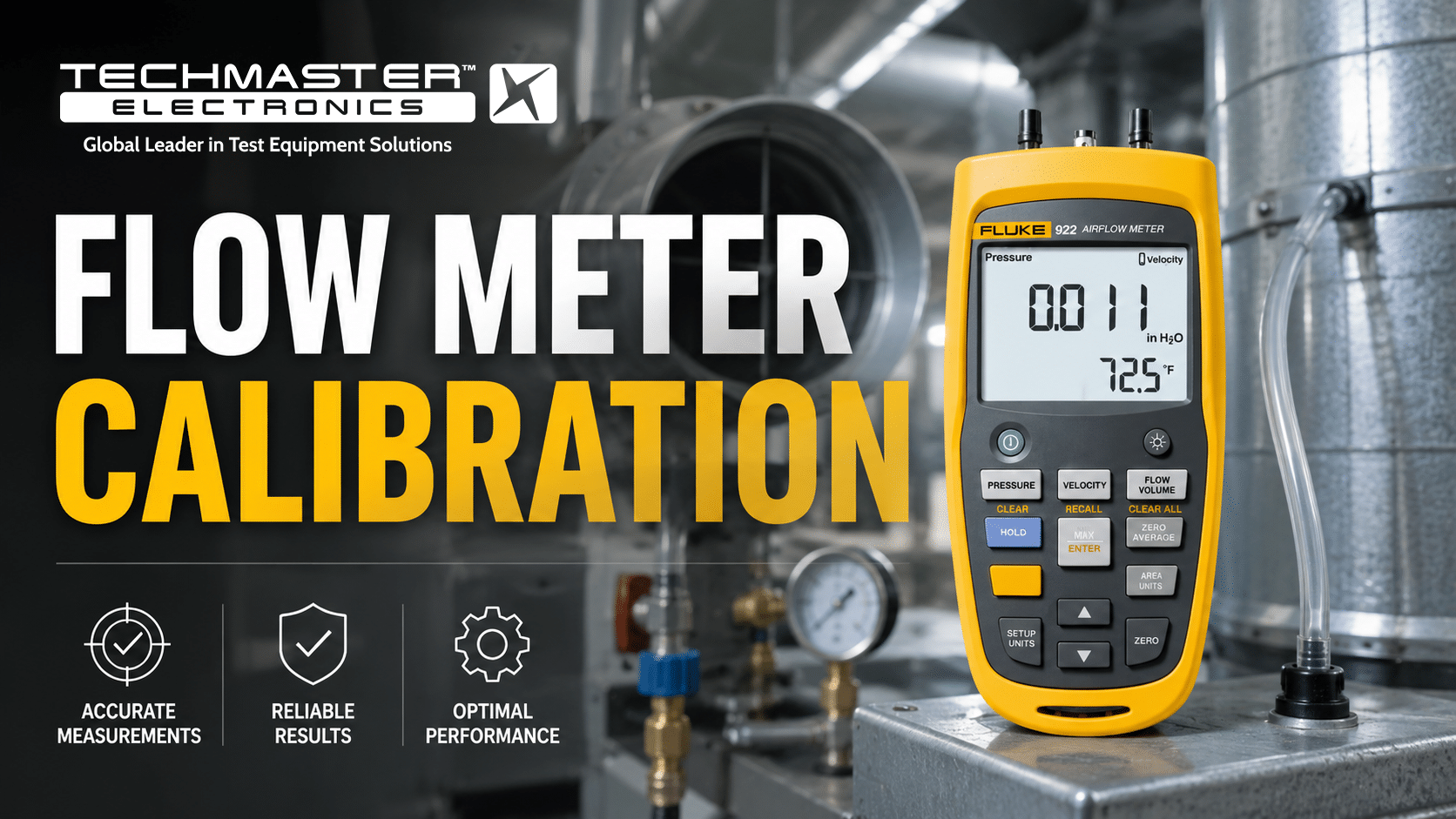
What is a Flow Meter? Understanding its types and applications
A flow meter is a crucial device used to measure the flow rate of liquids, gases, and steam in various industrial applications. It ensures accurate monitoring and control, which are vital for industries such as oil and gas, pharmaceuticals, food production, and water treatment. Because different processes require different measurement techniques, selecting the right flow meter depends on factors such as the type of fluid, operating conditions, and the required accuracy. There are several types of flow meters, each designed for specific applications:- Ultrasonic Flow Meter: Uses sound waves to measure fluid velocity, making it ideal for water, oil, and non-conductive liquids.
- Electromagnetic Flow Meter: Best suited for conductive fluids such as wastewater, slurries, and chemical solutions. As a result, it is widely used in industries dealing with such materials.
- Thermal Mass Flow Meter: Measures gas flow based on heat transfer, making it commonly used in compressed air and natural gas monitoring.
- Coriolis Flow Meter: Provides high-precision mass flow measurement. Due to its accuracy, it is highly suitable for oil, chemicals, and high-viscosity fluids.
- Vortex Flow Meter: Detects vortices created by fluid flow, making it effective for steam, gas, and liquid measurements. Consequently, it is often used in power plants and HVAC systems.
- Positive Displacement Flow Meter: Measures flow by capturing fluid in compartments. This makes it frequently used in fuel and oil applications.
- Differential Pressure Flow Meter: Relies on pressure drop across an obstruction to calculate flow rate. Thus, it is a common choice for steam and gas applications.
Why is flow meter calibration essential?
Flow meters are not just measuring devices; they are essential for process control and regulatory compliance. A miscalibrated flow meter can result in:- Material waste, increasing operational costs.
- Process inefficiencies, leading to downtime and system failures.
- Non-compliance with industry standards, potentially causing legal and financial penalties.
Factors affecting flow meteraccuracy
Before calibration, it’s crucial to identify potential sources of error. Several factors can affect flow meter performance, including:- Temperature and pressure variations: Sudden changes can impact fluid properties, affecting measurement accuracy.
- Wear and tear: Over time, mechanical degradation may lead to sensor drift.
- Improper installation: Incorrect positioning often causes turbulence, resulting in inaccurate readings.
- Contaminant buildup: Particles and deposits can obstruct sensor operation, reducing reliability.
How to calibrate a flow meter correctly
Flow meter calibration involves multiple steps to ensure precision. The key stages include:- Initial Inspection and Assessment
- Identify the type of flow meter (e.g., ultrasonic, electromagnetic, thermal, or mechanical).
- Check for visible signs of wear, clogging, or sensor misalignment.
- Compare current readings with known reference standards.
- Selecting the Calibration Method Several calibration techniques are available, each suited for different applications:
- Master Meter Calibration: Uses a reference meter with known accuracy to compare readings.
- Gravimetric Calibration: Weighs the fluid passing through the meter to determine flow rate accuracy.
- Volumetric Calibration: Uses a calibrated volume container to verify flow rate measurements.
- In-Situ Calibration: Allows verification without removing the meter from the pipeline.
- Performing the Calibration
- Adjust the meter settings to match reference values.
- Conduct multiple flow tests at different flow rates to verify stability.
- Document deviations and make necessary corrections.
- Documentation and Certification
- Maintain calibration data for future reference and audits.
- Ensure that a calibration certificate is issued in compliance with ISO 17025 standards.
- Establish a schedule for periodic recalibrations based on industry best practices.
How to find reliable flow meter calibration services near you
For organizations lacking in-house calibration capabilities, outsourcing to certified providers is a practical solution. When selecting a flow meter calibration service, consider the following: – Accreditation & Standards: Ensure the provider meets ISO and industry-specific regulations. – Experience & Reputation: Look for companies with proven expertise and positive client feedback. – Flexibility & Support: Opt for services that offer both on-site and laboratory calibration options. A reputable calibration provider will not only help maintain accurate measurements but also prevent operational risks and ensure compliance.Ensure accuracy before It’s too late!
Measurement discrepancies often go unnoticed until they cause severe issues. Therefore, regular flow meter calibration is key to avoiding costly errors and maintaining optimal efficiency. Instead of waiting for an inaccuracy to disrupt operations, schedule a calibration today to safeguard precision and performance. 👉 Get in touch with a trusted calibration expert today to ensure measurement accuracy!
Air Buoyancy Correction in Mass Calibration: Altitude, Density and Real Error Budgets
Air buoyancy correction explained with the NIST SOP 2 formula: how altitude and artifact density...
Aug

ASTM E4 vs ISO 7500-1: Which Force Verification Does Your Tensile Tester Need?
ASTM E4-24 or ISO 7500-1:2018? The test method you run decides which force verification your...
Aug
USP <41> Minimum Weight: How to Calculate It on an Analytical Balance
USP minimum weight is calculated, not specified: 2s divided by 0.001 from a 10-weighing repeatability...
Aug
Deadweight Tester vs. Digital Pressure Calibrator: Which Does Your Lab Need?
Deadweight tester or digital pressure calibrator? How each works, the gravity/buoyancy/temperature corrections, typical accuracy, pressure...
Jul
Differential Manometer Calibration: Solve Drift Pain
1Industrial environments rely on absolute precision to maintain safety, ensure product quality, and pass regulatory...
Jun
Pressure Manometer Calibration in Industrial Systems
1 Metrology guide · ISO/IEC 17025 · ANAB-accredited Pressure Manometer Calibration Pressure Manometer Calibration verifies...
Jun
Techwrench Calibration: The Technical & Compliance Guide
1 Metrology guide · ISO/IEC 17025 · ANAB-accredited Techwrench Calibration Techwrench Calibration verifies a Techwrench...
Jun
Portable Microtector Calibration: Preventing Pressure Drift
1 Metrology guide · ISO/IEC 17025 · ANAB-accredited Portable Microtector Calibration Portable Microtector Calibration verifies...
Jun
Frequently asked questions
How are flow meters calibrated?
Why does flow calibration accuracy matter so much?
Should flow meters be calibrated at process conditions?
How often should a flow meter be calibrated?
Can you calibrate flow meters on-site?
Need flow meter calibration?
ANAB-accredited, NIST-traceable, fast turnaround, in-lab or on-site across the USA.
Contact us for a quoteReferences & industry standards
- ISO/IEC 17025 testing & calibration laboratory requirements
- NIST calibration services and measurement traceability
- NIST Fluid Metrology Group
- A2LA / ANAB accreditation for calibration laboratories
External standards bodies. Techmaster Electronics is an ISO/IEC 17025-accredited, NIST-traceable calibration laboratory.

Khanh Nguyen is the Marketing Manager at Techmaster Electronics, a B2B marketing leader covering the test, measurement, and ISO/IEC 17025 accredited calibration industry across the US and Vietnam markets.