
TL;DR: A modular rack is not one instrument. Traceability lives at the module, each card needs its own calibration and certificate. Self-calibration is not traceable calibration: it corrects against internal references and cannot tell you those references have drifted. Then verify the assembled system, because timing, switching, cabling and fixtures add errors no module certificate covers.
PXI and modular systems are the standard for production test, and they are calibrated worse than almost any other class of equipment, largely because a chassis looks like one instrument and self-calibrates on command.
How do you calibrate a rack of cards?
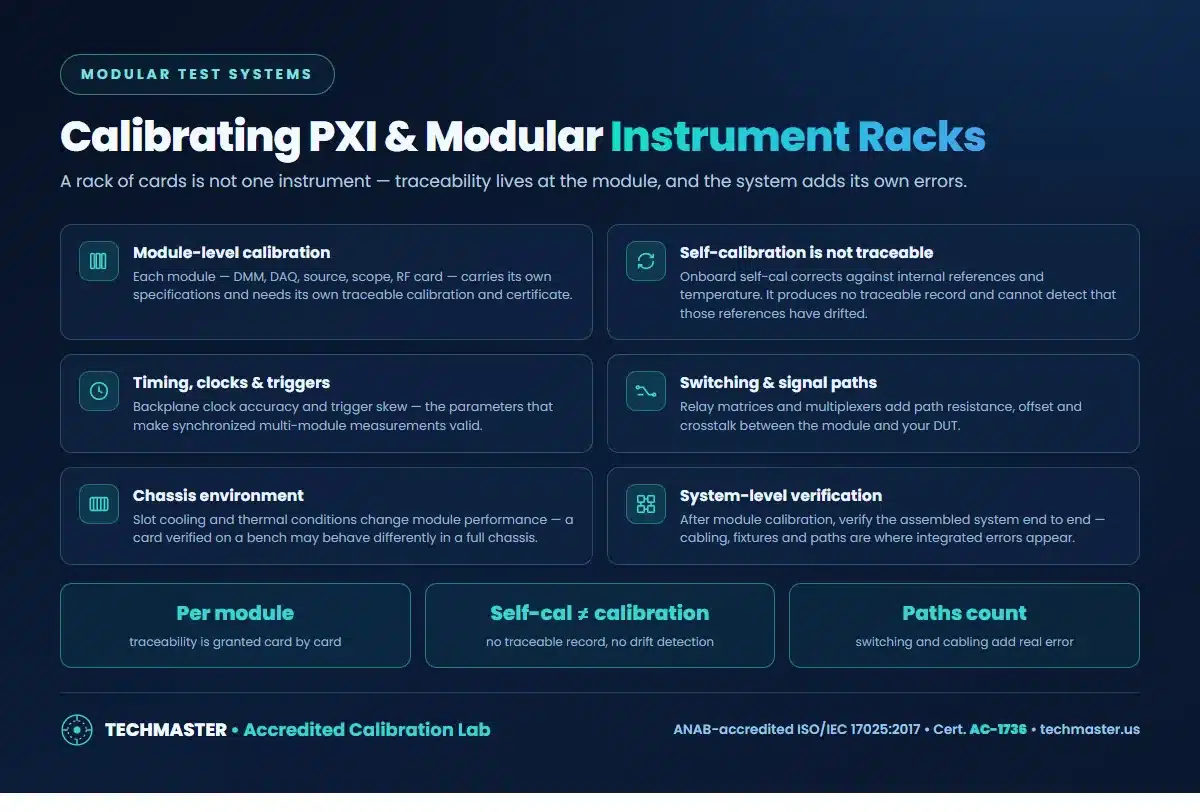
Module-level calibration first. Each card carries published specifications and needs traceable calibration against external standards, with its own certificate, the same treatment a bench DMM, digitizer or source would get. Then the system. Backplane clock accuracy and trigger skew determine whether synchronized measurements across modules mean anything. Relay matrices and multiplexers insert real path resistance, offset and crosstalk. Chassis thermal conditions shift module performance relative to a bench. None of this appears on a module certificate, and all of it reaches your measurement.
Why self-calibration misleads people
Onboard self-cal is genuinely useful: it compensates for temperature and corrects the module against its internal references before a measurement run. What it cannot do is notice that those internal references have aged, it has nothing better to compare them against. And it leaves no certificate, no as-found data, and no traceability chain, so it satisfies neither ISO 9001 clause 7.1.5 nor any customer flow-down. This is the same trap described for scopes and counters: the instrument’s opinion of itself is not evidence.
Practical program advice
Inventory at module level, not chassis level, each card gets its own asset ID, interval and due date in your recall system, because that is the granularity at which certificates exist. Plan calibration around production windows using the levers in turnaround and downtime, and consider on-site service for racks that cannot be dismantled and shipped. If modules travel, pack them per the shipping guide with ESD protection, which matters more for bare cards than for boxed instruments.
Frequently asked questions
How is a PXI or modular system calibrated?
Module by module. Each card, DMM, DAQ, source, digitizer, RF module, has its own specifications and needs its own traceable calibration and certificate. After the modules are calibrated, the assembled system should be verified end to end, because switching paths, cabling and fixtures add errors that no module certificate covers.
Does self-calibration make a modular system traceable?
No. Onboard self-calibration corrects a module against its internal references and compensates for temperature. It cannot detect that those internal references have drifted, and it produces no traceable record. It is a useful routine before measurement, not a substitute for external calibration.
Do I have to remove modules from the chassis for calibration?
Usually yes for module-level accredited calibration, since the calibration is performed against external standards on the module itself. Some system-level verification can be performed in place, and on-site service avoids shipping an entire rack. Discuss the split before disassembling anything.
What about timing, triggers and switching?
They are part of what makes a multi-module measurement valid and they need attention in their own right: backplane clock accuracy, trigger skew between modules, and the path resistance, offset and crosstalk contributed by relay matrices and multiplexers between the module and your device under test.
The bottom line
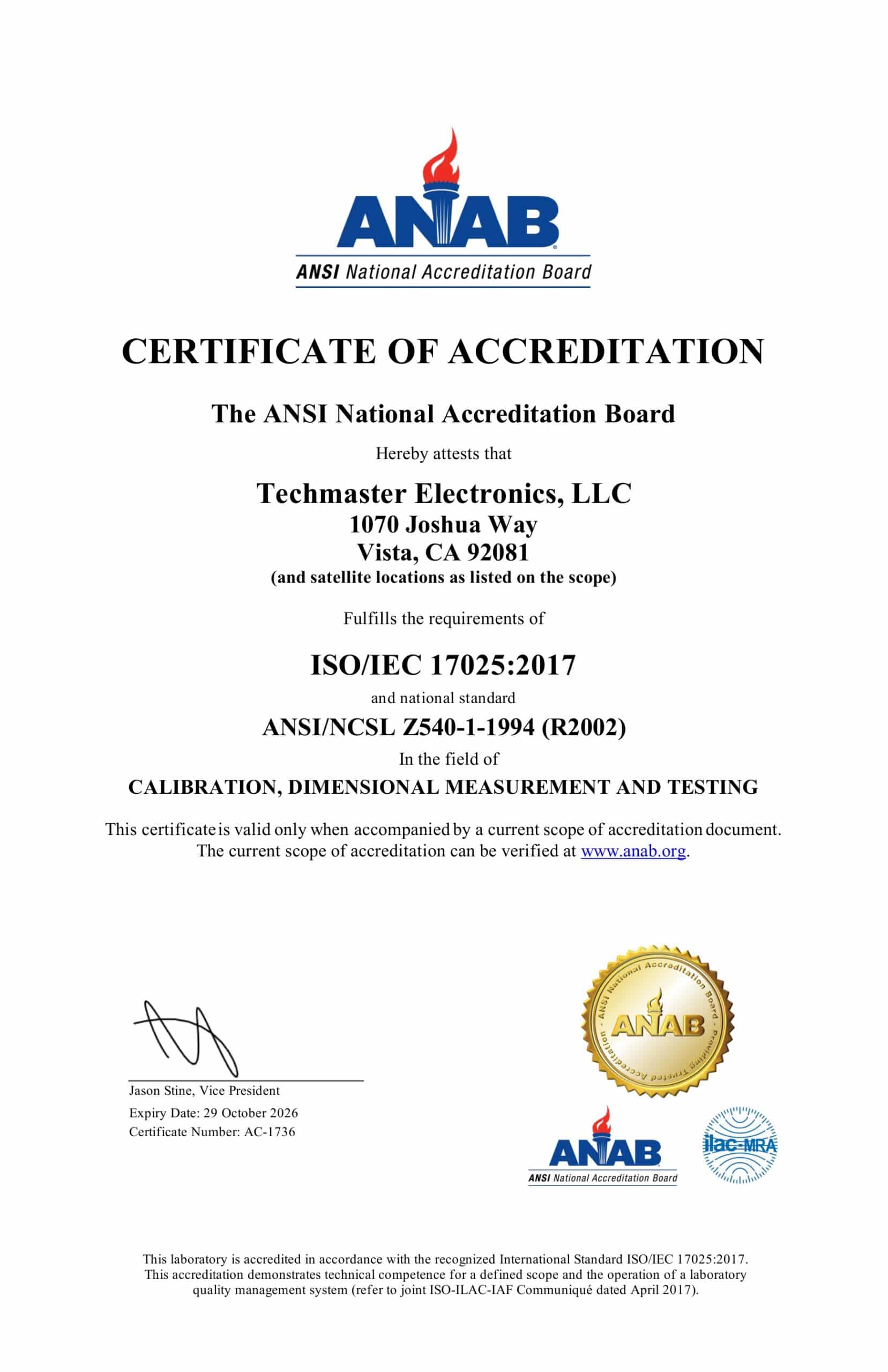
Calibrate modules individually, verify the system as assembled, and stop counting self-cal as calibration. Techmaster calibrates modular and bench instrumentation under ANAB accreditation to ISO/IEC 17025:2017 (Cert. AC-1736), send a module list and we will confirm scope coverage card by card.
PXI is an open specification maintained by the PXI Systems Alliance. Techmaster Electronics, LLC is an independent ISO/IEC 17025:2017 accredited calibration laboratory and is not affiliated with, authorized by, or endorsed by any modular instrument manufacturer. All trademarks belong to their respective owners.
Get an accredited calibration quote
ANAB-accredited ISO/IEC 17025:2017 (Cert. AC-1736) • 5 US labs • 5-day standard, 1–2 day expedite • in-lab or on-site.
Request a quote
Khanh Nguyen is the Marketing Manager at Techmaster Electronics, a B2B marketing leader covering the test, measurement, and ISO/IEC 17025 accredited calibration industry across the US and Vietnam markets.