
TL;DR: Most quote delays are missing information, not busy laboratories. Each line item needs seven fields: manufacturer and exact model, serial number, certificate level, data or no data, ranges and options used, location and in-lab or on-site, and required turnaround. Certificate level and data are the two that move the price most, and neither can be added afterwards.
A calibration quote is not a catalogue lookup. Someone has to decide which procedure applies, which reference standards it requires, how long the bench is occupied and what documentation comes out at the end. Every field missing from your list is a decision that cannot be made, which is why an incomplete list comes back as questions rather than as pricing.
What turns a list into a quote?
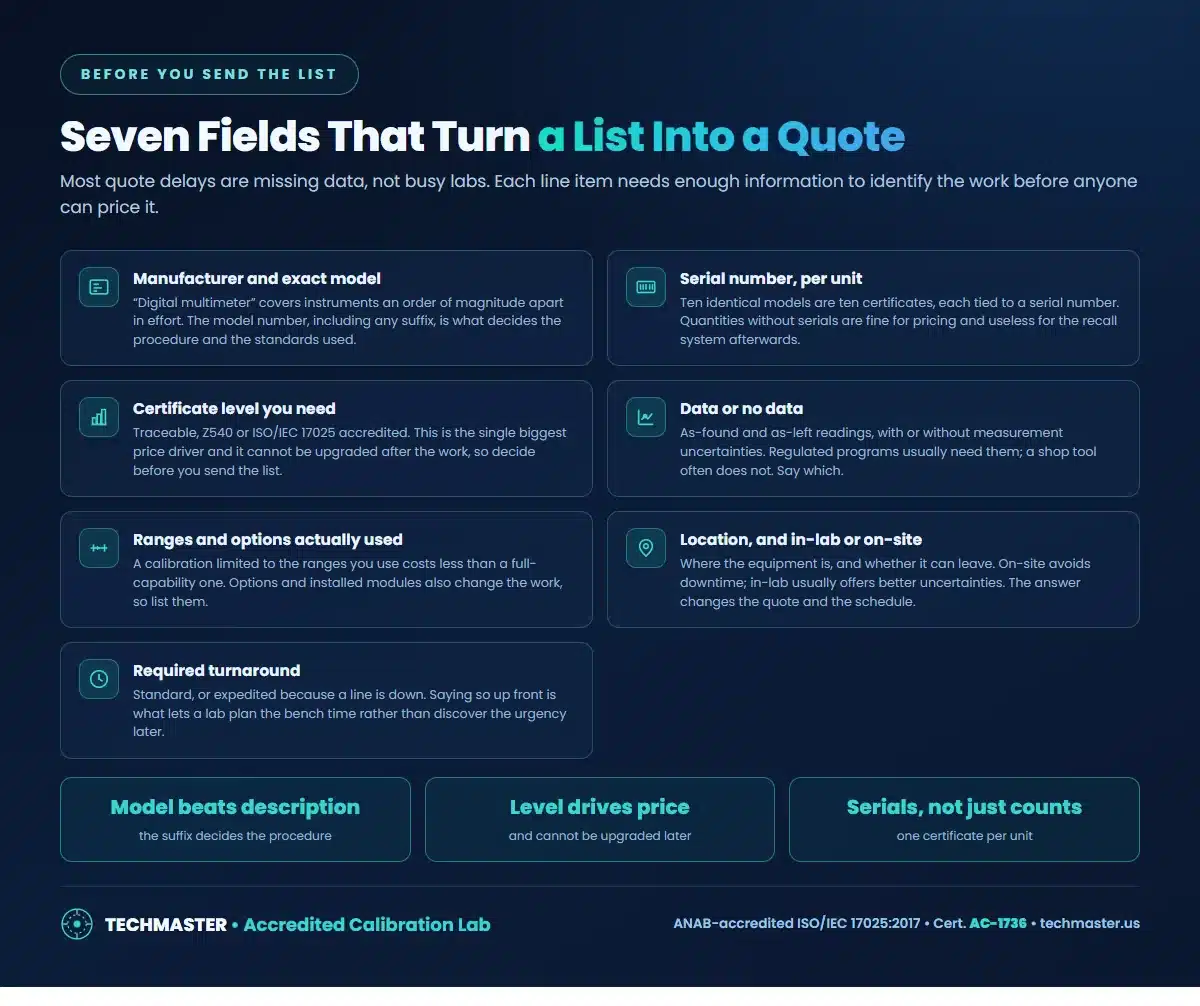
Seven fields per line, and two of them do most of the work on price. The rest of this article takes them in the order they usually cause trouble.
Why is the exact model number non-negotiable?
Because instruments sharing a family name can differ enormously in what calibrating them involves. A generic description spans handheld field instruments and bench reference standards, and the suffix on a model number frequently encodes the option set or frequency range that decides which standards are needed. Serial numbers matter for a different reason: they are what tie each certificate to an asset in your recall system, so supplying them up front avoids reconciling paperwork later.
Which field drives the price?
Certificate level, and it is not close. Traceable, Z540 and accredited calibrations differ in documentation, uncertainty evaluation and review effort, the comparison is laid out in certificate levels compared and the standards themselves in ANSI Z540 vs ISO/IEC 17025. Data is the close second: as-found and as-left readings, with or without uncertainties, are essential in regulated programs and often unnecessary for a general shop tool. Decide both before you send the list, because a certificate cannot be upgraded once the work is done. For the wider cost picture, the calibration cost guide covers what actually sits behind a price.
Why do ranges, location and turnaround change the answer?
A calibration restricted to the ranges and functions you genuinely use costs less than full-capability work, so saying which you need is worth the two minutes it takes. Location decides logistics and sometimes uncertainty: on-site versus in-lab calibration trades convenience and downtime against the controlled conditions of a laboratory. Turnaround belongs on the list rather than in a follow-up email, a laboratory can plan bench time around a known deadline, and the options and their costs are set out in how long calibration takes. If the equipment is shipping, packing it correctly protects both the instrument and your schedule.
What if you are not sure what you need?
Say so on the list rather than guessing, and mark those lines for discussion. The two questions worth resolving first are which instruments produce data that leaves your building, those generally need the higher certificate level, and which laboratory scope actually covers your measurements, using how to read an accreditation scope. If you are still choosing a provider, the 12-point checklist for choosing a calibration service is the companion piece to this one.
Frequently asked questions
What information does a calibration lab need to quote?
Per line item: manufacturer and exact model including any suffix, serial number, the certificate level you need, whether you require as-found and as-left data, the ranges and installed options actually used, where the equipment is and whether it can leave, and your required turnaround. A list carrying those seven fields can usually be priced directly, while a list of generic descriptions turns into a round of questions before anyone can quote.
Why does the model number matter so much?
Because it determines the procedure, the reference standards and the bench time, and instruments sharing a family name can differ by an order of magnitude in effort. A generic description such as a digital multimeter spans handheld field meters and eight-and-a-half-digit reference instruments. The suffix matters too, since it often encodes the option set or frequency range that decides which standards are required.
Do I need to list serial numbers if I have ten identical units?
For pricing, no. For everything afterwards, yes. Ten identical models produce ten certificates, each tied to a serial number, and those serials are what link the certificate to the asset in your recall system and to the status label on the instrument. Supplying them with the original list avoids a reconciliation exercise when the certificates come back.
What is the biggest driver of a calibration quote?
The certificate level, followed by whether you need measurement data. Traceable, ANSI/NCSL Z540 and ISO/IEC 17025 accredited calibrations involve different levels of documentation, uncertainty evaluation and review, and the difference shows up in the price. Because a certificate cannot be upgraded after the work is performed, the level has to be decided before the list is sent rather than after the certificates arrive.
The bottom line
Model, serial, level, data, ranges, location, turnaround. A list with those seven fields gets priced; a list without them gets questions. Techmaster covers eight calibration fields across five US labs under ANAB-accredited ISO/IEC 17025:2017 (Cert. AC-1736), with 5-day standard and 1–2 day expedite turnaround, in-lab or on-site.
Get an accredited calibration quote
ANAB-accredited ISO/IEC 17025:2017 (Cert. AC-1736) • 5 US labs • 5-day standard, 1–2 day expedite • in-lab or on-site.
Request a quote
Khanh Nguyen is the Marketing Manager at Techmaster Electronics, a B2B marketing leader covering the test, measurement, and ISO/IEC 17025 accredited calibration industry in the United States.