TL;DR: EMC test equipment rental is the normal way to run a pre-compliance campaign, because immunity generators and emissions receivers are expensive and used in bursts. The rental decision is really a documentation decision: the certificate has to name the parameter you will apply, cover the frequency range you will sweep, and stay in date until the last day of testing.
What is EMC test equipment rental?
EMC test equipment rental is the short-term hire of electromagnetic compatibility test instruments — ESD, surge and fast-transient generators, coupling networks, receivers, antennas and preamplifiers — for a defined test campaign, together with the calibration records that make the resulting data usable. The instrument is the easy part of the arrangement; the certificate is the part that decides whether the data survives review.
EMC, ESD and surge equipment was one of the larger clusters in the requests reaching our laboratories over the last two quarters, and it split unusually: a third of those enquiries asked to rent, and more than half asked specifically about ISO/IEC 17025 accreditation. That combination — rent it, but prove it — is the whole subject of this page.
What has to ship with a rented EMC set?
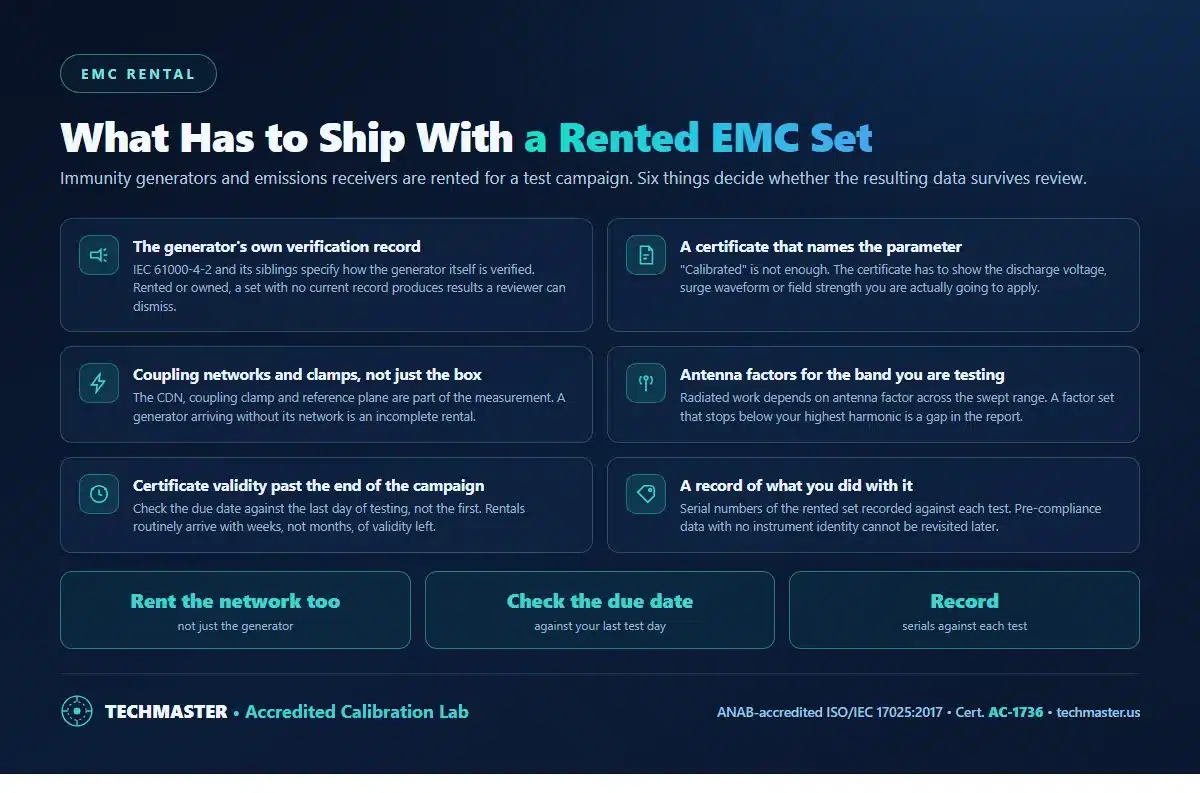
Six things: the generator’s own verification record, a certificate that names the parameter you will apply, the coupling network or clamp that forms part of the test setup, antenna factors across the band you are sweeping, certificate validity that outlasts the campaign, and a record of the rented serial numbers against each test you run.
Five of the six are documentation rather than hardware, which is why a rental that looks complete on the dock can still be incomplete on paper. The one hardware item — the coupling network — is the one people most often assume is included.
Rent, send out, or buy?
Each row below is a real decision, and the deciding factor is almost never the purchase price of the instrument.
| Situation | Usual answer | Why |
|---|---|---|
| One pre-compliance campaign, no repeat planned | Rent | The instrument sits idle for the rest of the year; the certificate is what you are really buying |
| Recurring design cycles, several products a year | Buy, and calibrate on an interval | Utilisation justifies ownership, and an evidence-based interval keeps the cost down |
| You own the set but it is out of calibration | Send it out, rent a bridge unit | Two decisions, not one – and the bridge unit needs its own certificate |
| A single parameter is outside your own capability | Subcontract the measurement | Cheaper than renting a specialist instrument you cannot operate confidently |
| Formal compliance, not pre-compliance | Accredited test house | A rented generator does not make a test laboratory |
| Field investigation of an emissions complaint | Rent a receiver and antenna set | Portable, short term, and the antenna factors matter more than the receiver |
Is the rented equipment’s calibration accredited?
Sometimes, and only parameter by parameter. Accreditation is granted for specific measurements and ranges, so a laboratory can hold accredited high-voltage and RF capability while the particular immunity-generator parameters you need sit outside its scope and are delivered as NIST-traceable calibrations instead.
This distinction is worth understanding before you ask for a quote, because a vendor who answers “yes, everything is accredited” without looking at your list is not reading their own scope. The difference between the two certificate levels is set out in accredited vs NIST-traceable calibration, and the way a scope is written — parameter, range and uncertainty, one line at a time — is explained in what a CMC means on an accreditation scope.
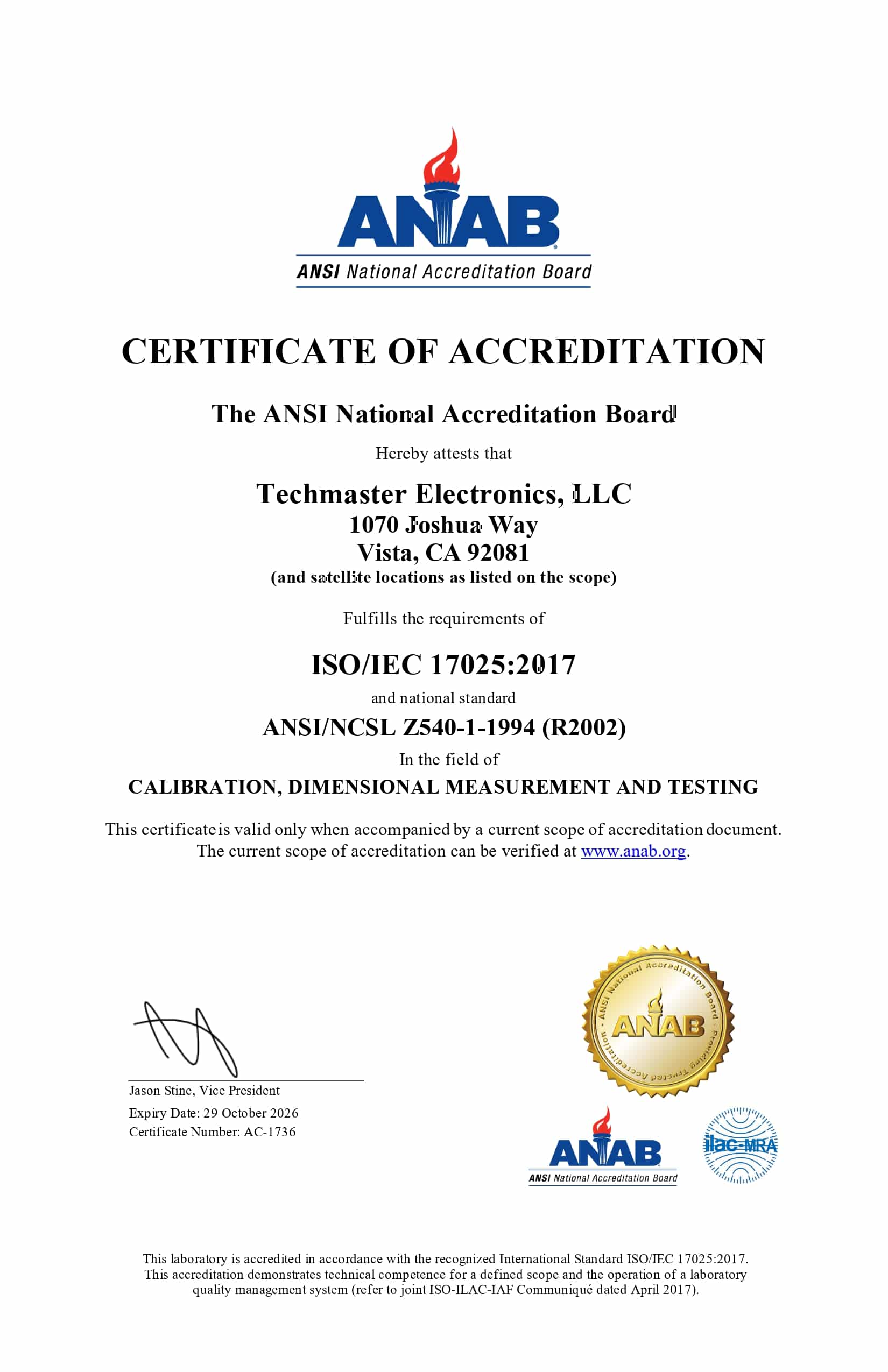
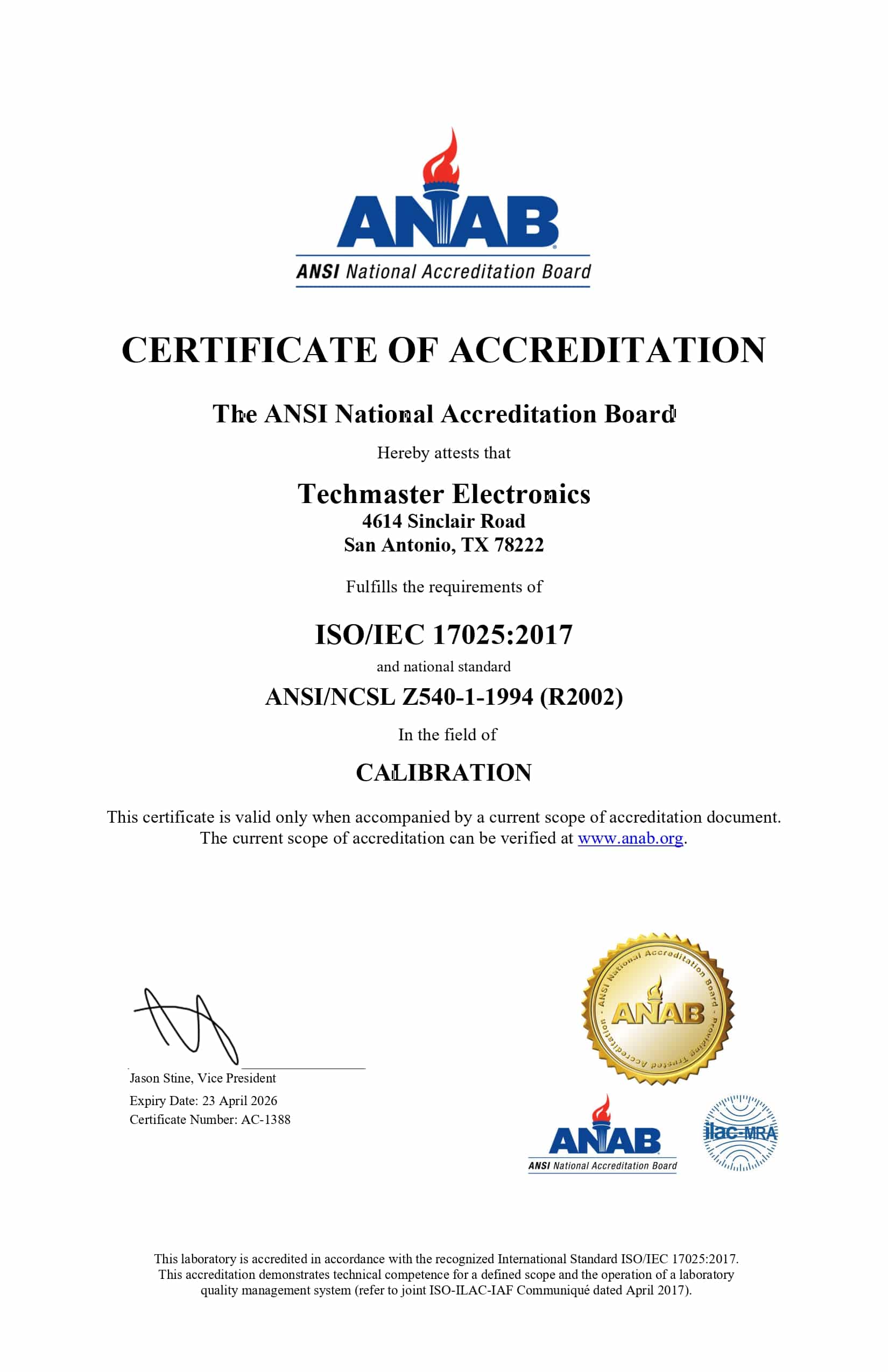
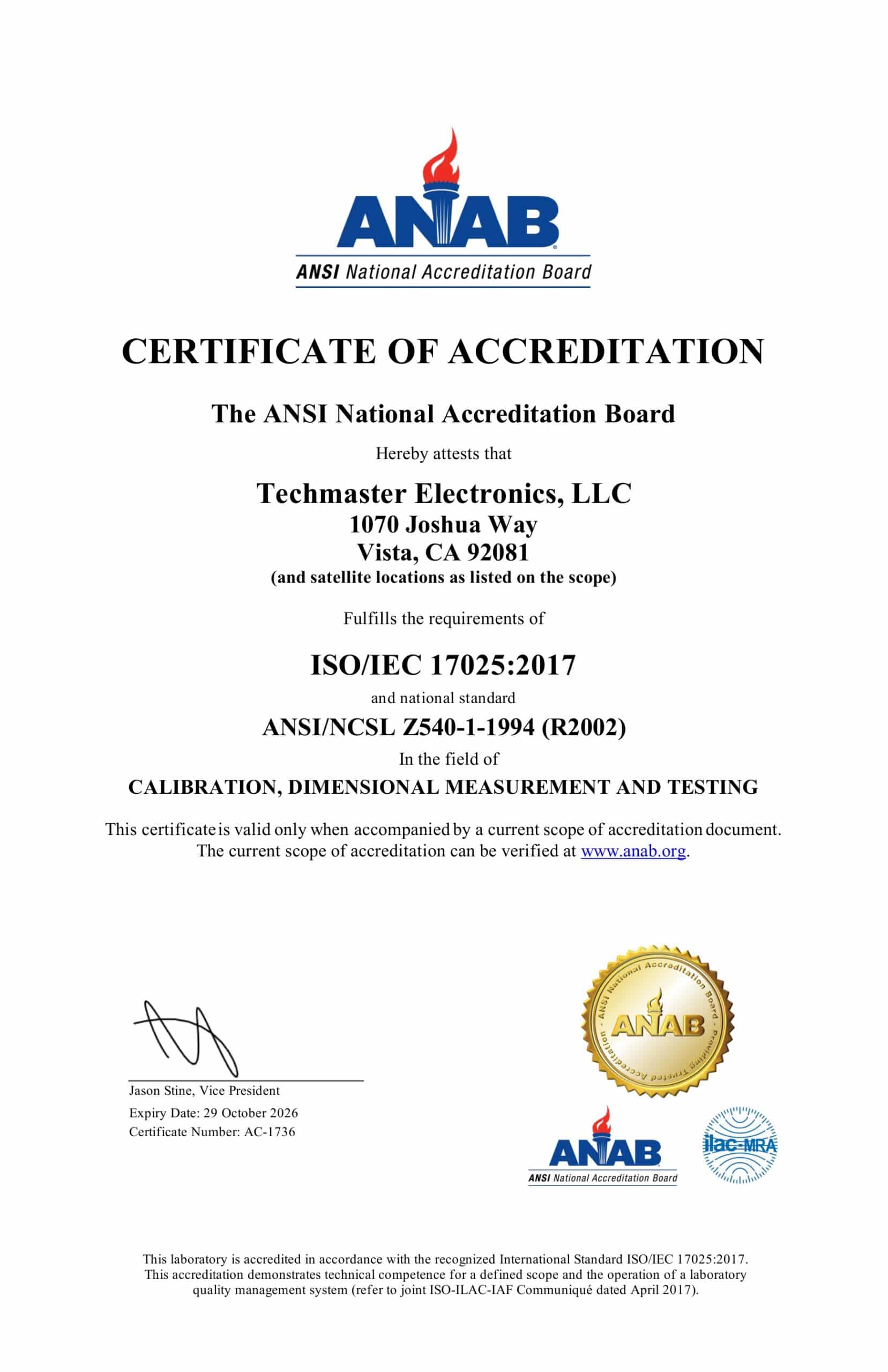
On our own scope, ANAB ISO/IEC 17025:2017 Cert. AC-1736, the directly relevant accredited capabilities are DC and AC high voltage (to 100 kV at the Vista laboratory and 150 kV at San Antonio) and RF and microwave measurement at the Vista, Santa Clara and Orlando laboratories — RF work is not on the San Antonio scope. Several instruments that appear in an EMC rack, including some immunity generator parameters, are outside that scope and are handled as NIST-traceable work. We would rather tell you which is which before you ship than after.
Which parts of an EMC rack actually get calibrated?
The rack is a system, and the parts that carry the measurement are not always the parts people think of. ESD simulator calibration covers the discharge network itself; EMC antenna factor calibration covers the antenna factors that turn a receiver reading into a field strength; electrostatic field meter calibration covers the meters used to check the static control environment around the test; and surface resistance test kit calibration covers the resistance kits used to qualify the mats and flooring. High-voltage sources used in dielectric and immunity work are covered by hipot tester calibration and AC withstanding voltage tester calibration.
Does pre-compliance data need calibrated equipment?
Yes, if anyone outside your own team will see it. Pre-compliance results are used to make design commitments and to argue readiness for the accredited test house, and both arguments collapse if the stimulus applied cannot be shown to be what the report says it was.
The suppliers who apply this most rigorously tend to be those working to aerospace and defence flow-downs, where the requirement arrives from the customer rather than from the standard — the pattern described in RF and microwave calibration for aerospace suppliers. If you are choosing a laboratory to support a campaign rather than just to hire a box, how to choose a calibration service is the checklist to run them through.
Frequently asked questions
Can you rent EMC test equipment with a calibration certificate?
Ask for it explicitly when you request the rental, because it is not automatic. A rented immunity generator or emissions receiver should arrive with a certificate that names the parameter you intend to apply – discharge voltage, surge waveform, field strength or antenna factor – and whose due date falls after the last day of your test campaign, not the first. A rental that arrives with two weeks of validity left on a six-week campaign is a problem you discover at the report stage.
Is an ESD or surge generator covered by ISO/IEC 17025 accreditation?
Not automatically, and not everywhere. Accreditation is granted parameter by parameter, so a laboratory can hold an accredited scope for high voltage and RF while the specific immunity-generator parameters you need sit outside it and are delivered as NIST-traceable instead. Ask the laboratory which of your line items are on its accredited scope before you ship, and expect an honest split rather than a blanket yes.
What has to ship with a rented EMC immunity generator?
The coupling network or clamp, the reference plane arrangement and the discharge tips are part of the measurement, not accessories. A generator that arrives on its own cannot be applied to a standard test setup. Confirm the kit list in writing, because the difference between a complete rental and a bare instrument is usually a lost week rather than a lost part.
Do pre-compliance results need calibrated equipment?
If the results will be shown to anyone outside your team, yes. Pre-compliance testing is used to make design decisions and to argue that a product is ready for the accredited test house, and both uses depend on knowing the stimulus was what you thought it was. Uncalibrated pre-compliance data is only safe as a private, internal indication.
The bottom line
Rent the instrument, but buy the certainty. Ask for the certificate before the equipment ships, check that it names your parameter and reaches your last test day, and confirm which line items are accredited and which are traceable. Ask us and we will check your list against our scope and tell you plainly which is which.
Need a quote, a rental, or a repair evaluation?
Techmaster Electronics — ISO/IEC 17025 accredited calibration laboratory, ANAB Cert. AC-1736, founded 1989. Five US labs, 5-day standard turnaround, 1–2 day expedite.
Request a quote →Techmaster Electronics, LLC is an independent ISO/IEC 17025:2017 accredited calibration laboratory. We are not affiliated with, authorized by, or endorsed by any manufacturer named on this page. All product names and model designations are trademarks of their respective owners and are used here only to identify the equipment we calibrate, repair, or rent. Confirm that our accredited scope covers your instrument’s parameters and ranges before shipping — ask us and we will check it against your model list.

Khanh Nguyen is the Marketing Manager at Techmaster Electronics, a B2B marketing leader covering the test, measurement, and ISO/IEC 17025 accredited calibration industry across the US and Vietnam markets.