
TL;DR: A torque wrench rental is a measuring instrument on somebody else’s asset register, and it is specified by the torque values the job actually calls for. Size the range so your targets sit high in it, because accuracy is a percentage of reading; match drive size and head type; pick the readout for the evidence you owe; and confirm the certificate covers the last day of the rental and the direction you will use. Torque is accredited at all four of Techmaster’s scope laboratories, to 1,000 lbf·ft at San Antonio.
What is a torque wrench rental for?
A torque wrench rental covers a bounded fastening job, a shutdown window, a commissioning or acceptance campaign, a range or capacity your own set does not reach, or the weeks your wrench is away being calibrated or repaired. The wrench is the measuring instrument of record for every fastener it touches, so its certificate carries the same weight as the torque values you record.
Torque tools were one of the larger clusters in the requests reaching our laboratories over the last quarter, from fleets calibrated annually by electrical contractors through to single wrenches sent in by individual professionals.
What decides which wrench you need?
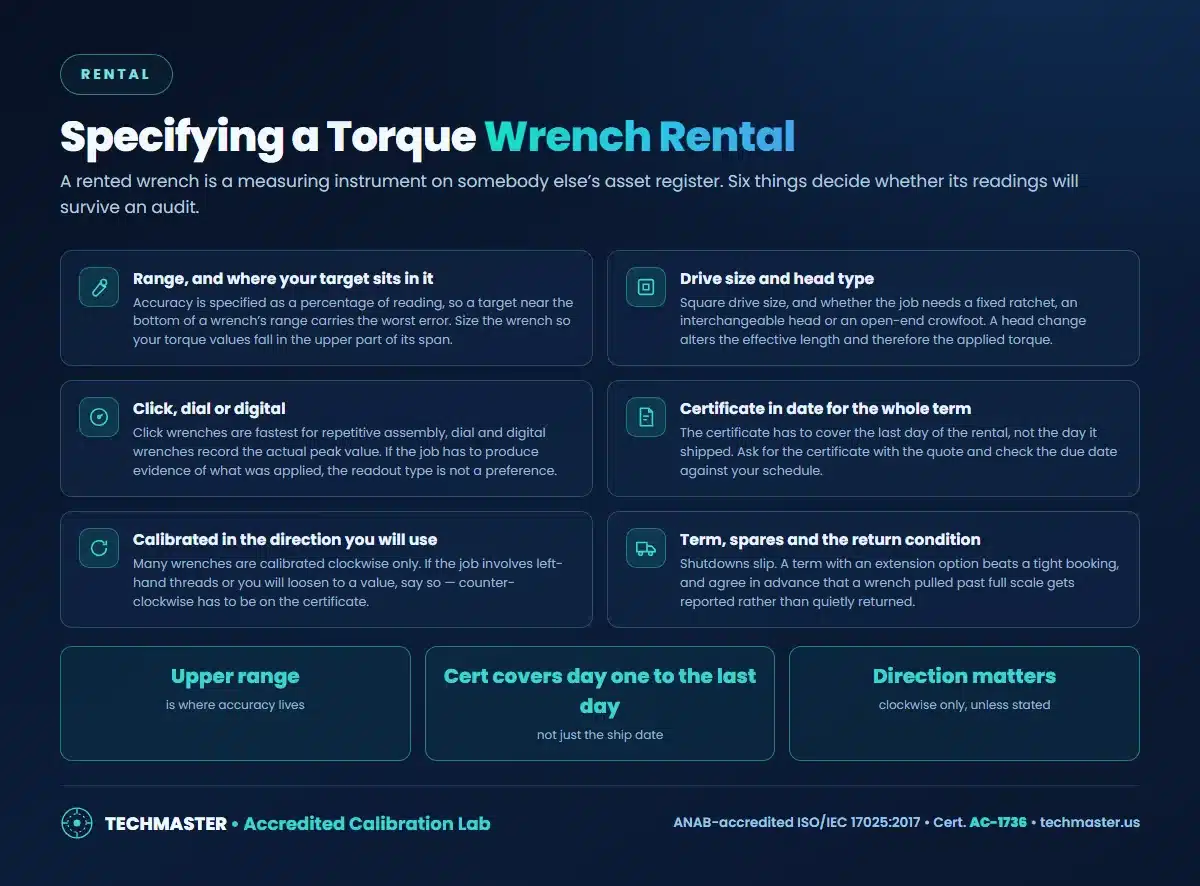
Range with your targets in its upper portion, drive size and head type, click versus dial or digital readout, a certificate in date for the whole term, calibration in the direction you will use, and a term with an extension option. The range question is the one most often got wrong, and it is the one that costs accuracy.
Why does the range matter more than the maximum?
Because torque wrench accuracy is specified as a percentage of reading rather than of full scale, a target near the bottom of a wrench’s span carries the largest error in absolute terms. A 300 lbf·ft wrench used at 40 lbf·ft is a worse instrument for that job than a 60 lbf·ft wrench used at 40.
This is the same reasoning that governs which wrench in a fleet gets used for which task, and it is why the equipment list is a poor substitute for the torque values themselves. The measurement principles behind it are in torque wrench calibration, with related instruments in torque screwdriver calibration and digital torque meter calibration.
Rent, or buy and calibrate?
| Situation | Usual answer | Why |
|---|---|---|
| A shutdown or commissioning window with an end date | Rent | The capacity is needed for weeks, not years |
| A torque range your set does not reach | Rent the capability | Buying for one campaign rarely pays back |
| Your own wrench is away for calibration | Rent to bridge | Avoids the outage without a second purchase |
| Daily production fastening | Buy, and stagger the due dates | Utilisation justifies ownership quickly |
| A wrench needed for recorded acceptance work | Either, but specify a dial or digital readout | A click wrench does not record the value applied |
| Left-hand threads or loosening to a value | Either, but certify counter-clockwise | Most wrenches are certified clockwise only |
Where ownership wins, the interval question is answered with history rather than habit, see how often to calibrate a torque wrench and the general method in how often test equipment should be calibrated.
How do you specify the rental?
- List your actual torque values first. Write down the fastener torques the job specifies, not the range you think you need. The values decide the wrench, and they decide it more reliably than the equipment list does.
- Size the range so targets sit high in it. Choose a wrench whose span puts your target torques in its upper portion, because accuracy is a percentage of reading and a target near the bottom of the range carries the worst absolute error.
- Match the drive and head to the fastener. Confirm square drive size and whether the job needs a fixed ratchet, an interchangeable head or a crowfoot – a head change alters effective length and therefore the applied torque.
- Choose the readout for the evidence you owe. A click wrench is fastest for repetitive assembly; a dial or digital wrench records the actual peak value, which is what you need if the job has to produce evidence of what was applied.
- Confirm the certificate and the direction. Ask for the calibration certificate with the quote, check it covers the last day of the rental, and state whether counter-clockwise operation has to be certified.
- Agree the term, the spares and the return condition. Book a term with an extension option rather than a tight window, and agree in advance that a wrench pulled past full scale is reported rather than quietly returned.
Read the certificate that comes back with the same care you would give your own: the parameters, the points, the direction and the uncertainty. How to read an ISO/IEC 17025 calibration certificate covers what each field commits the laboratory to, and what CMC and accreditation scope mean explains why a scope entry, not a logo, is the thing to check.
What capability stands behind the certificate?
Torque is on Techmaster’s ANAB ISO/IEC 17025 scope (Cert. AC-1736) at all four accredited laboratories, Vista and Santa Clara in California, Orlando in Florida, and San Antonio in Texas, with the highest ceiling, 1,000 lbf·ft, held at San Antonio. Where the wrenches cannot leave the site, in-lab versus on-site calibration sets out the trade-off, and audit expectations for a torque programme are covered in torque tester calibration.
Frequently asked questions
What should I check before renting a torque wrench?
Six things: that your target torque falls in the upper part of the wrench’s range rather than the bottom, that the drive size and head type suit the fastener, that the readout type suits whether you must record what was applied, that the calibration certificate is in date for the last day of the rental, that the wrench is calibrated in the direction you will actually use, and that the term has an extension option.
Why does my target torque need to be in the upper part of the range?
Because torque wrench accuracy is specified as a percentage of the reading, not of full scale. A value near the bottom of a wrench’s span therefore carries the largest error in absolute terms. Sizing the wrench so your target sits in the upper portion of its range is the single cheapest way to reduce measurement error on a rented tool.
Do rented torque wrenches come with a calibration certificate?
They should, and the certificate has to cover the last day of the rental rather than the day the wrench shipped. Ask for the certificate with the quote and check its due date against your schedule, because a wrench whose certificate expires mid-job produces fastening records you cannot defend.
Is a rented torque wrench calibrated in both directions?
Not necessarily. Many torque wrenches are calibrated clockwise only, which is fine for ordinary right-hand-thread assembly and useless if the job involves left-hand threads or loosening to a recorded value. If you need counter-clockwise, say so when you book, because it has to appear on the certificate.
The bottom line
Send your torque values, not your equipment list. Size the range so the targets sit high in it, specify the readout by the evidence you owe, and check the certificate covers the last day of the job and the direction you will turn. Ask us about availability, terms and delivery for your window.
Need a quote, a rental, or a repair evaluation?
Techmaster Electronics, ISO/IEC 17025 accredited calibration laboratory, ANAB Cert. AC-1736, founded 1989. Five US labs, 5-day standard turnaround, 1–2 day expedite.
Request a quote →Techmaster Electronics, LLC is an independent ISO/IEC 17025:2017 accredited calibration laboratory. We are not affiliated with, authorized by, or endorsed by any manufacturer named on this page. All product names and model designations are trademarks of their respective owners and are used here only to identify the equipment we calibrate, repair, or rent. Confirm that our accredited scope covers your instrument’s parameters and ranges before shipping, ask us and we will check it against your model list.

Khanh Nguyen is the Marketing Manager at Techmaster Electronics, a B2B marketing leader covering the test, measurement, and ISO/IEC 17025 accredited calibration industry in the United States.