
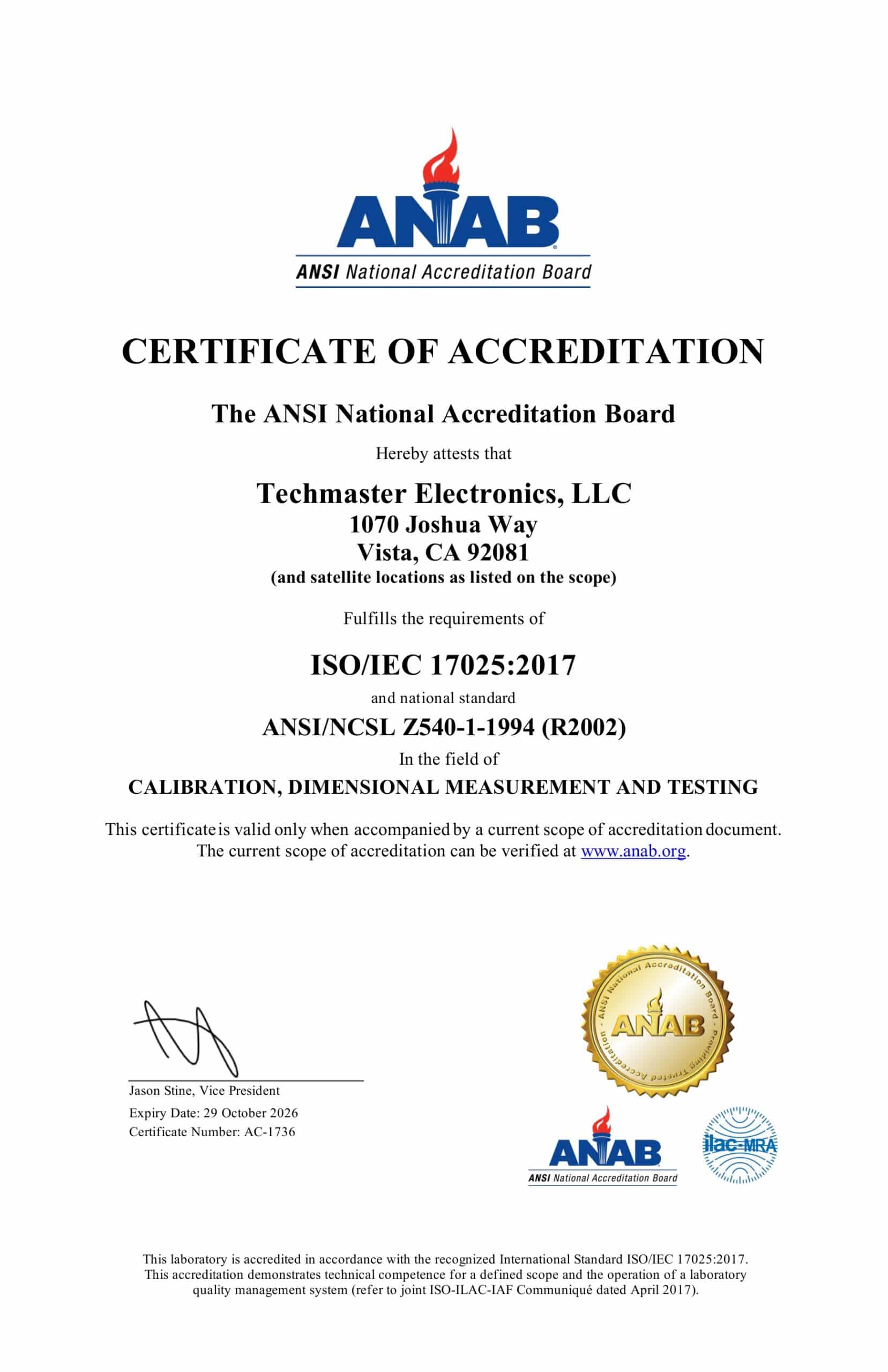
Metrology guide · ISO/IEC 17025 · ANAB-accredited
Electronic Calibration
Electronic Calibration verifies a Electronic against NIST-traceable standards under ISO/IEC 17025. Techmaster performs a documented multi-point check, reports measurement uncertainty, and issues an ANAB-accredited certificate, in-lab or on-site across the USA.
ANAB accredited ISO/IEC 17025 NIST traceable
ISO 17025Accredited method
NISTTraceability
12 moTypical interval
ANABAccreditation
In this guide
Accuracy across the range
Typical as-found results: the indicated error at each test point stays inside the acceptance tolerance band, with measurement uncertainty reported per point.
How Electronic calibration works
- Intake & visual inspection
- Environmental stabilization
- As-found measurement
- Comparison to NIST-traceable standards
- Adjustment if required
- As-left results & certificate
Your calibration, covered
In-lab calibrationAccredited bench service with pickup
On-site calibrationWe calibrate at your facility
Expedited turnaroundRush options to cut downtime
Accredited certificateANAB ISO 17025 with uncertainty
In-lab vs on-site calibration
In-lab calibration
- Accredited bench with full reference standards
- Best achievable measurement uncertainties
- Pickup & return logistics handled
- Ideal for precision and reference work
On-site calibration
- We calibrate the Electronic at your facility
- No shipping risk or transit downtime
- As-found data captured before any move
- Ideal for fixed, large or sensitive assets
In-depth guide
Electronic Calibration Module: A Complete guide to Modern VNA Calibration
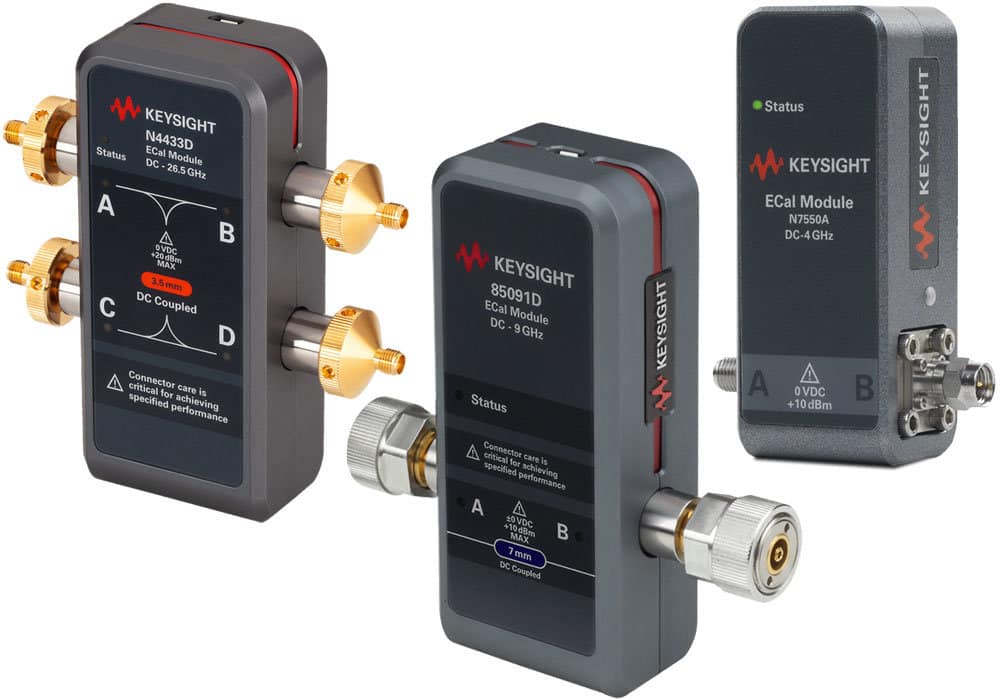
In radio frequency (RF) and microwave engineering, the accuracy of measurements is a decisive factor. The Vector Network Analyzer (VNA) is a foundational tool for measuring the characteristics of RF components and systems. However, the traditional VNA calibration process using mechanical kits is a significant challenge. It is not only time-consuming and labor-intensive but also prone to error. To thoroughly address these issues, a groundbreaking technology has emerged: the Electronic Calibration Module (E-Cal) This article provides a complete guide to the Electronic Calibration Module, explaining in detail its operational principles, superior benefits, practical applications, and how to select and maintain it for optimal work efficiency. We will explore why the E-Cal has become an indispensable tool in modern laboratories, production lines, and field work environments today.1. What is an Electronic Calibration Module (E-Cal)?
1.1. Structure and Operating Principle
An Electronic Calibration Module consists of an electronic board with high-frequency switches, standard impedances, and a control microprocessor. When connected to a VNA and launched with the calibration software, the E-Cal automatically switches between “Open,” “Short,” “Load,” and “Thru” states in a predefined sequence. Each state corresponds to a standard measurement. The data from these measurements is processed, stored, and then sent to the VNA for automatic calculation of the calibration parameters. This entire process happens in just a few seconds, making the Electronic Calibration Module a highly efficient tool.1.2. Key Differences from Mechanical Calibration
- Mechanical Calibration: Requires multiple manual connections and disconnections. Each manipulation can lead to errors (such as loose or overtightened connections) and cause connector wear.
- Electronic Calibration Module: Only requires a single connection. The entire calibration process is performed automatically and quickly via software. This completely eliminates manual operating errors and protects VNA ports from wear. This is the revolutionary difference that the E-Cal brings to the table.
2. A Breakthrough Solution for Modern Manufacturing

2.1. Speed and Work Efficiency
Speed is the most obvious advantage of the Electronic Calibration Module. A manual calibration process can take 5 to 10 minutes, but with E-Cal, it takes less than 30 seconds. In production lines with high testing frequency, this time saving significantly increases throughput. For R&D engineers, it allows for multiple calibrations in a single session, ensuring continuous accuracy without interrupting workflow.2.2. High Accuracy and Reliability
Each Electronic Calibration Module is factory-calibrated with very high precision. This calibration data is permanently stored in the module’s memory, which ensures measurement consistency. In addition, because it requires only a single connection, it eliminates errors caused by poor contact or connector wear, thereby enhancing the reliability and repeatability of measurement results. This makes the E-Cal a trusted solution for critical applications.2.3. Automation and Ease of Use
The Electronic Calibration Module is designed for full integration with VNA control software. This allows users to completely automate the calibration process, making it ideal for automated test systems. Even for new VNA users, calibration becomes incredibly simple. Just connect the E-Cal and run a command from the software, and the process will be completed automatically.2.4. VNA Port Protection and Cost Savings
The VNA’s ports are an extremely critical and expensive component. Every manual connection causes a certain level of wear. With the Electronic Calibration Module, the number of connections is minimized, which helps protect VNA ports and extends the equipment’s lifespan. In the long run, this allows a business to save significantly on maintenance and replacement costs. The value of an E-Cal goes beyond just the immediate savings.3. Diverse Applications of the E-Cal
Thanks to its outstanding advantages, the Electronic Calibration Module has found applications in various industrial sectors.3.1. Manufacturing and Testing
In factories that produce RF components like amplifiers, filters, or integrated circuits, the Electronic Calibration Module is an indispensable tool. The extremely fast calibration speed allows production lines to perform calibrations more frequently, ensuring the quality of 100% of the output products instead of just sampling.3.2. Research and Development (R&D)
In R&D laboratories, where the accuracy and repeatability of measurements are paramount, the Electronic Calibration Module helps engineers quickly calibrate VNAs to test new designs. This accelerates the product development process and shortens time-to-market.3.3. Telecommunications and Aerospace
Complex systems such as radar, satellite communications, and 5G/6G technologies require measurements at high-frequency ranges. The Electronic Calibration Module provides a reliable and accurate calibration solution for these applications, especially when working in millimeter-wave (mmWave) bands, where mechanical calibration becomes much more difficult.4. Choosing and Maintaining an Electronic Calibration Module
To optimize efficiency, selecting and maintaining an E-Cal is also very important.4.1. Factors to Consider When Purchasing
When choosing to purchase an E-Cal, you should consider the following factors:- Operating Frequency Range: Ensure the E-Cal’s frequency range matches your needs.
- Number and Type of Ports: Depending on your VNA (1-port, 2-port, 4-port, etc.), you need to choose an E-Cal with the appropriate number and type of connectors (N, SMA, 3.5mm, etc.).
- Compatibility: Ensure the E-Cal is compatible with the model and software of the VNA you are using.
4.2. Periodic Calibration and Support Services
Like all other measurement devices, an Electronic Calibration Module also needs to be calibrated periodically (typically once a year) to maintain its accuracy. However, E-Cal calibration is much simpler than a mechanical kit calibration, as only a single module needs to be sent. Reputable suppliers often have professional support and calibration services, giving you confidence about the quality and accuracy of your device throughout its lifespan. Techmaster Electronics is a specialized provider of professional E-Cal calibration services. With our team of experienced technicians and modern equipment, we ensure your module is tested and calibrated to national standards. This service not only reduces costs and production downtime but also provides a calibration certificate, a crucial requirement for quality control processes. Contact us today!Conclusion
The E-Cal is more than just a support tool; it has become an indispensable part of modern RF measurement engineering. With its ability to increase speed, enhance accuracy, and enable process automation, the Electronic Calibration Module helps businesses optimize work performance, minimize errors, and maintain a competitive edge. It is a smart, long-term investment for any organization operating in the RF and microwave technology sectors.Frequently asked questions
What is Electronic Calibration?
Electronic Calibration is the documented comparison of a Electronic against NIST-traceable reference standards under ISO/IEC 17025, measuring its error and measurement uncertainty and confirming it performs within tolerance.
How often should a Electronic be calibrated?
Most quality systems calibrate a Electronic every 12 months, and sooner after repair, overload or heavy use. Follow the manufacturer specification and your ISO 9001/13485/AS9100 program.
What standards apply to Electronic Calibration?
Calibration is performed under ISO/IEC 17025 with NIST-traceable references and the relevant manufacturer specification. Techmaster is ANAB-accredited.
What is included on the certificate?
An ANAB-accredited ISO/IEC 17025 certificate with as-found and as-left results and the measurement uncertainty for each point.
Can you calibrate the Electronic on-site?
Yes. Techmaster offers in-lab calibration with pickup and on-site service across the USA to minimize downtime.
Need Electronic calibration?
ANAB-accredited, NIST-traceable, fast turnaround, in-lab or on-site across the USA.
Contact us for a quoteReferences & industry standards
- ISO/IEC 17025 testing & calibration laboratory requirements
- NIST calibration services and measurement traceability
- A2LA / ANAB accreditation for calibration laboratories
External standards bodies. Techmaster Electronics is an ISO/IEC 17025-accredited, NIST-traceable calibration laboratory.

Khanh Nguyen is the Marketing Manager at Techmaster Electronics, a B2B marketing leader covering the test, measurement, and ISO/IEC 17025 accredited calibration industry across the US and Vietnam markets.