
TL;DR: Most spectrum analyzer repair requests are one of six faults: a power supply that will not start, a boot loop, a damaged RF front end, a reference or synthesizer fault, thermal shutdown from fans and filters, or display, keys and connectors. Diagnosed and repaired in our own laboratories, then recalibrated before return, because repair alone does not prove the instrument measures correctly.
Two of the analyzer requests reaching our RF laboratories over the last quarter were repairs rather than calibrations: an instrument that would not power on, and one caught in a reboot loop. Both are expensive instruments with years of life left, and both are typical of what actually fails on an analyzer.
How do spectrum analyzers actually fail?
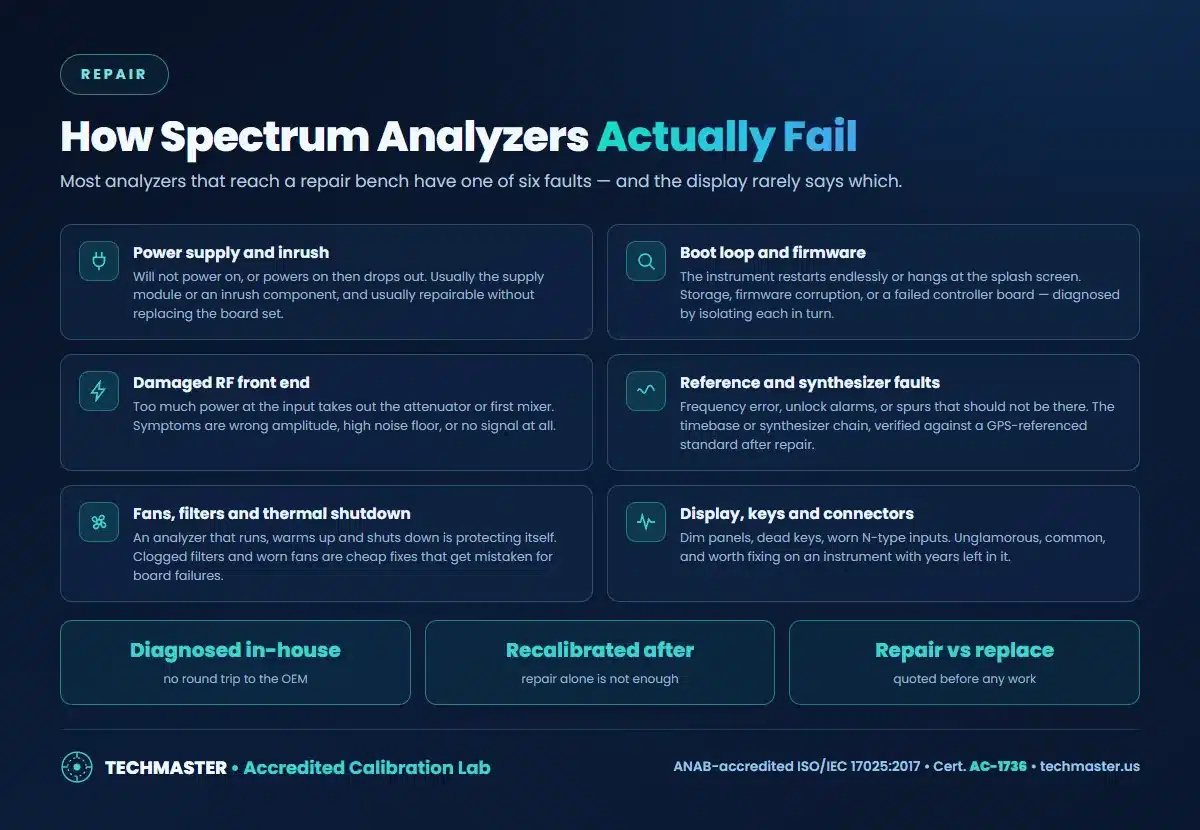
Power faults come first: will not power on, or powers on and drops out, usually the supply module or an inrush component. Boot loops point to storage, firmware or the controller board. A damaged front end, too much power at the input taking out the attenuator or first mixer, shows as wrong amplitude, a high noise floor, or no signal. Reference and synthesizer faults show as frequency error, unlock alarms or spurs. Thermal shutdown is usually fans and filters, cheap fixes mistaken for board failures. And dim panels, dead keys and worn N-type inputs are unglamorous, common, and worth fixing.
Repair or replace?
The evaluation answers that before any work starts, with a quote for the repair against the cost of replacement. Analyzers are among the most expensive instruments on a bench and most of their faults are in modules, not in the RF architecture, so repair usually wins on a five-year-old unit and often on a fifteen-year-old one. The considerations mirror what to do with an out-of-tolerance result: fix, document, and re-verify.
Why is recalibration part of the repair?
Because a repaired analyzer is a functioning instrument, not yet a measuring one. After the fault is fixed, amplitude accuracy, frequency response, displayed average noise level and phase noise are verified against traceable standards, the same checks described in spectrum analyzer calibration, with noise figure covered in noise source ENR calibration. Absolute power measurement is accredited to 50 GHz on Techmaster’s ANAB scope (Cert. AC-1736) at its Vista, Santa Clara and Orlando laboratories.
What should I send with the analyzer?
The symptom in one sentence, what happened just before it (a power event, a firmware update, an input overload), and any error codes. Send the analyzer with its power cord and nothing else unless a fault involves an accessory. Related instruments in the same chain, a signal generator feeding it, for instance, can be evaluated on the same order.
Frequently asked questions
My spectrum analyzer will not power on. Is it worth repairing?
Usually, yes. A no-power fault is most often the supply module or an inrush component, both repairable without replacing the board set. A repair evaluation quotes the fix against replacement before any work is done.
Do you repair in-house or send analyzers back to the manufacturer?
In our own laboratories. That is why the quote and the turnaround stay under our control, and why every repaired analyzer is recalibrated before it returns.
What happens after the repair?
Recalibration. A repair restores function; only calibration proves the analyzer measures correctly again. Amplitude, frequency response, noise floor and phase noise are verified against traceable standards after the fault is fixed.
Can you repair an analyzer stuck in a reboot loop?
Yes. A boot loop points to storage, firmware or the controller board, and is diagnosed by isolating each in turn rather than replacing everything.
The bottom line
Six faults account for most analyzer repairs, most are modular, and every repair ends with recalibration. Describe the symptom and request an evaluation.
Need a quote, a rental, or a repair evaluation?
Techmaster Electronics, ISO/IEC 17025 accredited calibration laboratory, ANAB Cert. AC-1736, founded 1989. Five US labs, 5-day standard turnaround, 1–2 day expedite.
Request a quote →Techmaster Electronics, LLC is an independent ISO/IEC 17025:2017 accredited calibration laboratory. We are not affiliated with, authorized by, or endorsed by any manufacturer named on this page. All product names and model designations are trademarks of their respective owners and are used here only to identify the equipment we calibrate, repair, or rent. Confirm that our accredited scope covers your instrument’s parameters and ranges before shipping, ask us and we will check it against your model list.

Khanh Nguyen is the Marketing Manager at Techmaster Electronics, a B2B marketing leader covering the test, measurement, and ISO/IEC 17025 accredited calibration industry across the US and Vietnam markets.