
TL;DR: Most insulation tester repair starts with a tester that was connected to a live circuit, blowing the fuse or input protection. The other common faults are damaged high-voltage and guard leads, a high-voltage supply that cannot reach test voltage, contamination and moisture that cap the top of the range, a failed discharge circuit, a safety fault, and battery or drop damage. High resistance to 10 PΩ is accredited at San Antonio.
What is insulation tester repair?
Insulation tester repair is the diagnosis and restoration of a megohmmeter’s input protection, high-voltage supply, very-high-resistance measurement circuit, discharge circuit, leads and power system, followed by calibration of its test voltages and resistance ranges. It differs from hipot tester repair: an insulation tester measures resistance at DC, while a hipot applies a withstand voltage and trips on leakage current.
Hipot, insulation and megohmmeter requests formed a steady cluster reaching our laboratories over the last two quarters, with repair among them. Calibration of a working unit is covered in insulation tester calibration and megohmmeter calibration; withstand testers in hipot tester calibration.
Why does an insulation tester end up on the bench?
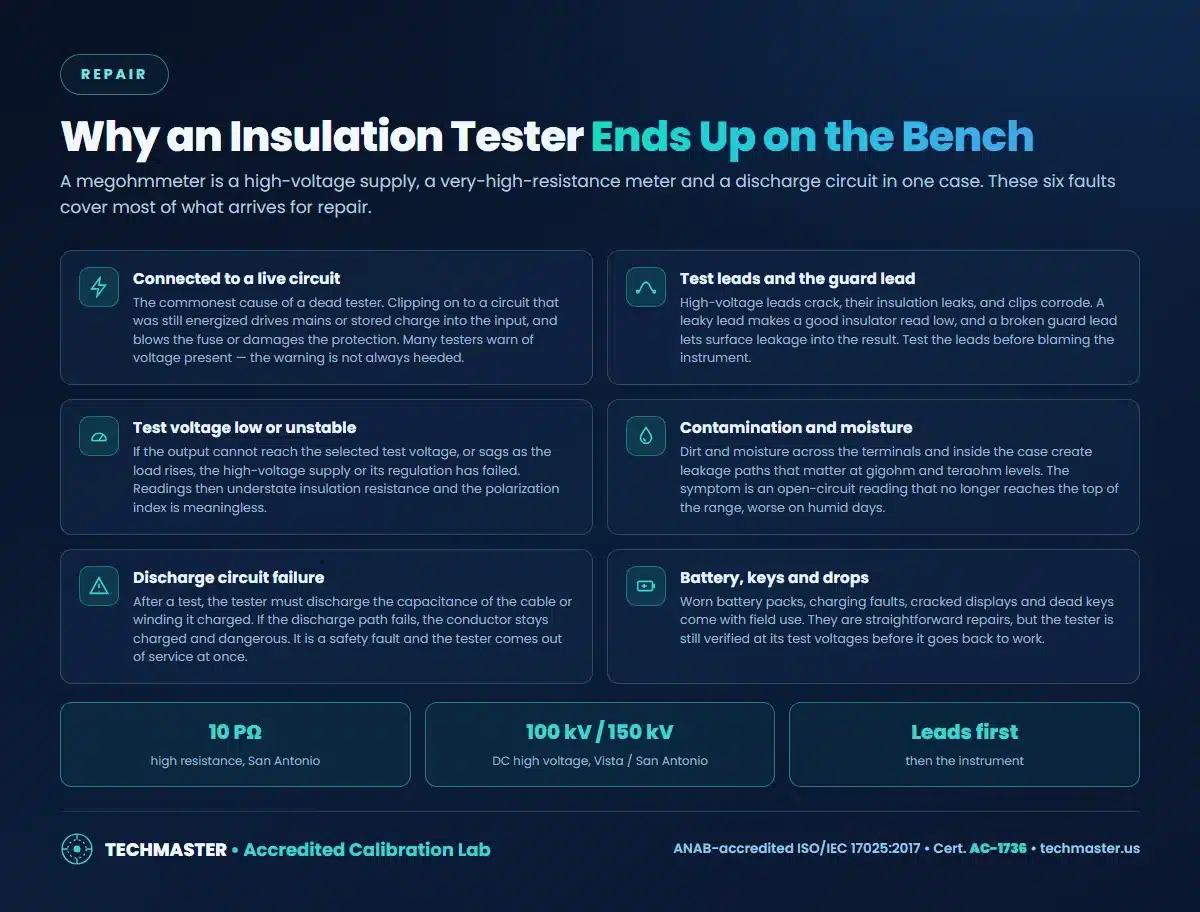
Six faults cover most of it: damage from connecting to a live circuit; cracked or contaminated test and guard leads; a high-voltage supply that cannot reach or hold test voltage; contamination and moisture that create leakage paths; a failed discharge circuit; and worn batteries, charging faults and drop damage.
The leads are accessories and are replaced. The protection, the high-voltage supply, the discharge circuit and the power system are repairs. Contamination is cleaned and dried, then proven by an open-circuit test at every voltage.
Repair, replace the leads, or clean?
| Symptom | Most likely cause | Repair, replace, or clean |
|---|---|---|
| Dead or no reading after testing an installation | Fuse or input protection hit by a live circuit | Replace the fuse; repair the protection if it recurs |
| Good insulation reads low | Leaky high-voltage lead or broken guard | Replace the leads |
| Open circuit does not reach the top of the range | Contamination or moisture across terminals | Clean and dry; repair if it persists |
| Test voltage low or sags under load | High-voltage supply or regulation | Repair |
| No discharge indication, voltage remains on the object | Discharge circuit failed | Repair – remove from service now |
| Shuts down mid-test or will not charge | Battery pack or charger | Replace the battery; repair the charger |
What happens when a megohmmeter is connected to a live circuit?
Mains voltage, or charge stored in a long cable or a large winding, drives into the tester’s terminals. A well-protected tester blows its fuse or warns of voltage present; a harder hit damages the protection components or the measurement circuit. Prove the circuit dead and discharged before connecting, and replace a blown fuse only with the exact rated type.
A fuse of the wrong rating removes the protection and turns the next mistake into a larger repair. Low-resistance instruments on the same jobs have their own checks, see winding resistance test set calibration and insulation multimeter calibration.
What should you check before sending it for repair?
Six checks, in order: replace the fuse with the exact rated type and fit a charged battery; inspect the high-voltage and guard leads and check continuity; run an open-circuit test at each voltage and confirm the reading reaches the top of the range; short the leads and confirm a near-zero reading; measure a known high-value resistor at more than one voltage; and, after a test into a capacitive load, confirm with a separate meter that nothing is left charged. Send the results with the tester, they shorten the evaluation.
What capability stands behind the recalibration?
High resistance measured with a 10 PΩ tera-ohmmeter is accredited at the San Antonio laboratory only, and DC high voltage is accredited to 100 kV at Vista and 150 kV at San Antonio, on Techmaster’s ANAB ISO/IEC 17025 scope (Cert. AC-1736). The reference instrument is described in tera-ohmmeter calibration, and what a scope line covers in calibration and measurement capability. A repair always ends in recalibration with as-found and as-left data; if the as-found data is out of tolerance, the steps in out-of-tolerance calibration results apply to the tests it made.
Frequently asked questions
Why did my insulation tester stop working after a test?
The most common cause is connecting it to a circuit that was still energized. Mains voltage or stored charge driven into the terminals blows the input fuse or damages the protection circuit. Check and replace the fuse with the exact rated type first. If the tester still fails, or the fuse blows again, the protection or measurement circuit needs a bench repair.
Why does my megohmmeter read low on good insulation?
Check the leads first. A high-voltage lead with cracked or contaminated insulation leaks current and makes good insulation look poor, and a missing or broken guard connection lets surface leakage into the result. Clean and dry the terminals, test with open leads, then with known-good leads. If readings stay low, the high-voltage supply or measurement circuit is the suspect.
Is an insulation tester with a faulty discharge circuit safe to use?
No. After each test the tester must discharge the capacitance of the cable, motor winding or transformer it charged. If the discharge path has failed, the conductor can stay charged at a dangerous voltage. Take the tester out of service, discharge test objects by a separate safe method, and send the instrument for repair.
Does a repaired insulation tester need calibration?
Yes, always. Repair to the high-voltage supply, protection or measurement circuit changes what the previous certificate described. The calibration checks test voltage at each setting, resistance readings across the ranges, and timers used for polarization index and dielectric absorption, with as-found and as-left data. High resistance to 10 PΩ is on Techmaster’s accredited scope at the San Antonio laboratory.
The bottom line
Check the fuse, the leads and an open-circuit reading before deciding an insulation tester is broken, and take it out of service at once if it stops discharging. Then send the model, the symptom and what your checks showed, and we will evaluate and quote before any work is done.
Need a quote, a rental, or a repair evaluation?
Techmaster Electronics, ISO/IEC 17025 accredited calibration laboratory, ANAB Cert. AC-1736, founded 1989. Five US labs, 5-day standard turnaround, 1–2 day expedite.
Request a quote →Techmaster Electronics, LLC is an independent ISO/IEC 17025:2017 accredited calibration laboratory. We are not affiliated with, authorized by, or endorsed by any manufacturer named on this page. All product names and model designations are trademarks of their respective owners and are used here only to identify the equipment we calibrate, repair, or rent. Confirm that our accredited scope covers your instrument’s parameters and ranges before shipping, ask us and we will check it against your model list.

Khanh Nguyen is the Marketing Manager at Techmaster Electronics, a B2B marketing leader covering the test, measurement, and ISO/IEC 17025 accredited calibration industry in the United States.