
TL;DR: A vector network analyzer rarely fails outright — it drifts, goes unlevelled or loses a port while the traces still look believable. Rule out the cal kit and cables first, then expect source, receiver or connector work. Repair is not accredited; the calibration that follows it is.
How does a network analyzer actually fail?
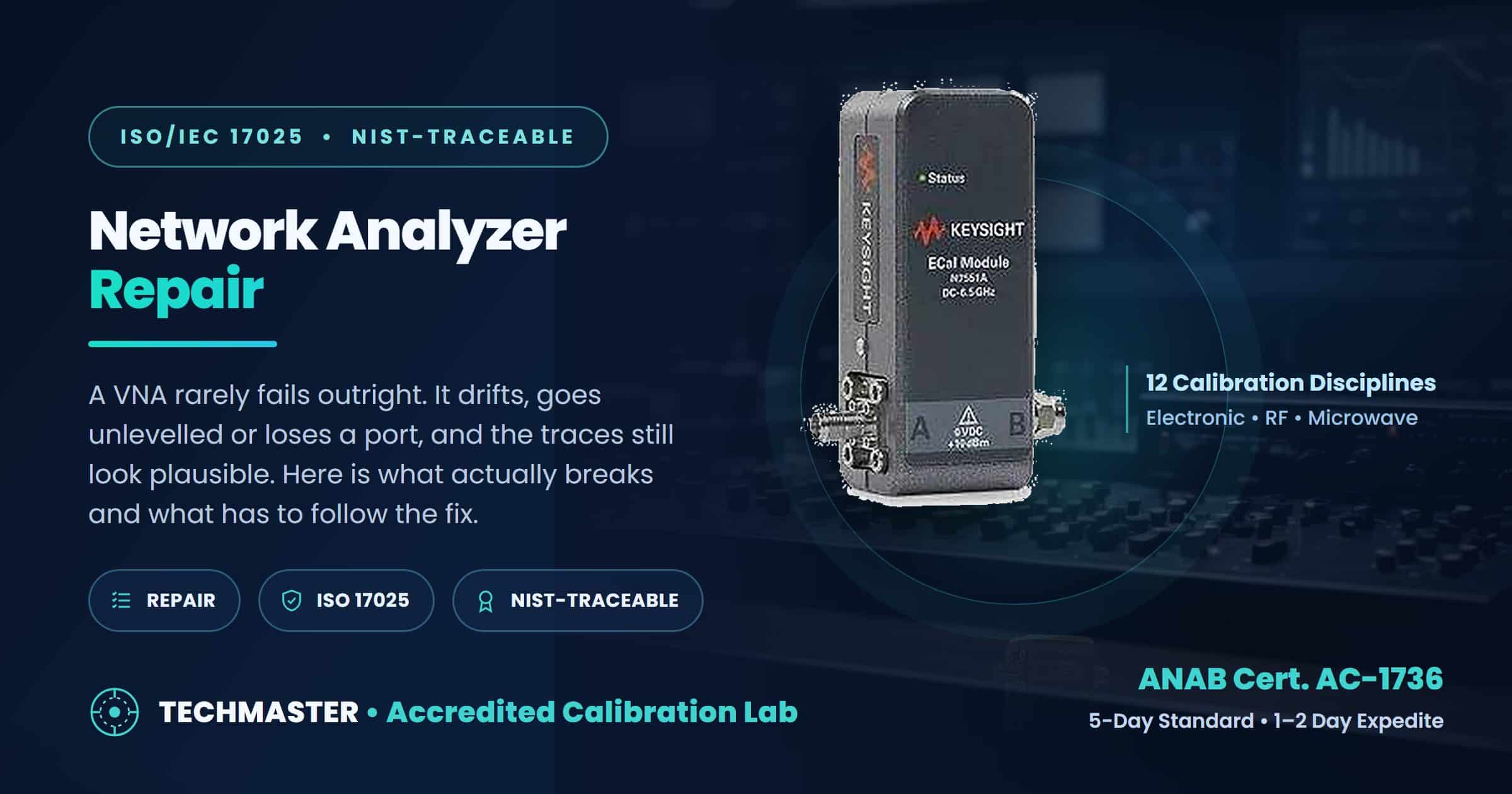
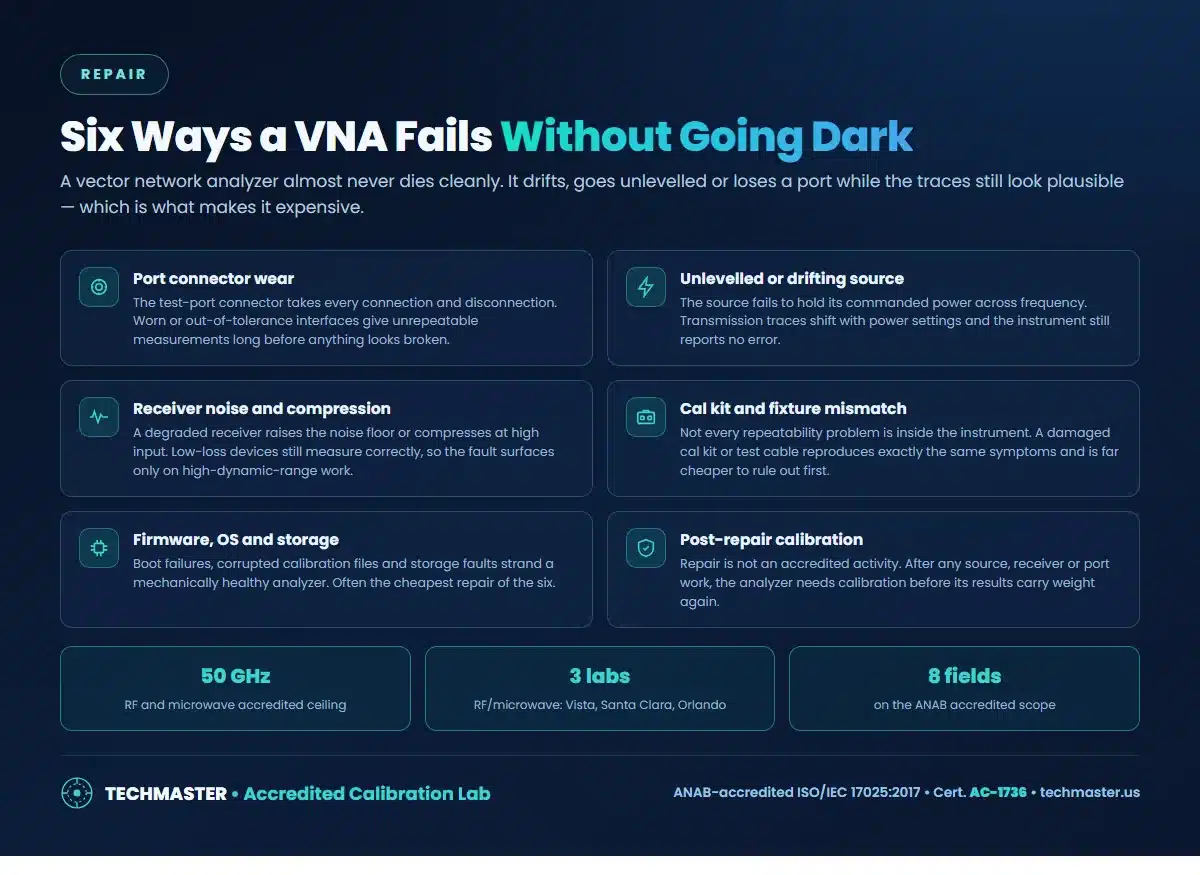
A VNA usually degrades rather than dies: the source stops holding its commanded power, the receiver noise floor rises, or a test port goes out of tolerance, and the instrument reports no error while doing it. That is the expensive failure mode, because measurements keep being taken and believed.
Outright failures — no boot, no sweep, a dead display — are the minority and, awkwardly, the good news. They stop work immediately instead of quietly contaminating it.
What should you rule out before sending it in?
Check the calibration kit, adapters and test cables first. A worn cal kit standard or a damaged phase-stable cable produces unrepeatable measurements, drift between calibrations and poor return loss — the same symptoms as a failing analyzer, at a fraction of the cost to fix.
Verifying the kit is its own discipline; see VNA calibration kit verification for how SOLT standards are checked. If the kit is sound and the symptoms persist across cables and ports, the instrument is the next suspect.
Matching symptoms to likely causes
| Symptom | Likely cause | First step |
|---|---|---|
| Unrepeatable traces between connections | Port connector or cal kit wear | Substitute kit and cables; inspect port with a gauge |
| Transmission shifts with source power | Unlevelled or drifting source | Calibration check across power settings |
| Noise floor raised on low-loss devices | Receiver degradation | Dynamic-range check against specification |
| Correct at low power, wrong at high | Receiver compression | Linearity check |
| Boot failure or lost cal files | Firmware, OS or storage | Often the cheapest repair |
| Drift within a single session | Thermal or reference instability | Extended warm-up check |
What has to happen after the repair?
Calibration, before the analyzer goes back into service. Repair is not an accredited activity — ISO/IEC 17025 accreditation covers the calibration that follows it. Any work touching the source, receiver, reference or test ports invalidates the previous certificate, whatever the calibration due date says.
For what that calibration covers on this instrument class, see network analyzer calibration and NIST-traceable calibration. RF and microwave work sits on the accredited scope at Vista, Santa Clara and Orlando — not San Antonio. Related reading for RF fleets: RF and microwave calibration for AS9100 suppliers and how to read a CMC on an accreditation scope. Adjacent RF instruments: spectrum analyzer calibration and RF power sensor calibration.
Frequently asked questions
What are the most common vector network analyzer faults?
Test-port connector wear, an unlevelled or drifting source, and receiver noise or compression. All three degrade measurements while the instrument continues to boot, sweep and display plausible traces, which is why they are often found during calibration rather than reported by the user.
Is a repaired network analyzer still ISO/IEC 17025 accredited?
Repair itself is not an accredited activity. Accreditation attaches to the calibration performed afterwards. A VNA that has had source, receiver or port work needs calibration before its results carry weight again, and the certificate from that calibration is what an auditor reads.
How do I tell an instrument fault from a cal kit or cable fault?
Substitute before you ship. A damaged calibration kit, adapter or test cable reproduces the symptoms of a failing analyzer almost exactly — unrepeatable traces, drift between calibrations, poor return loss. Swapping the kit and cables is quicker and cheaper than diagnosing the instrument.
Where does Techmaster calibrate RF and microwave instruments?
RF and microwave calibration is on the accredited scope at Vista CA, Santa Clara CA and Orlando FL. It is not on the San Antonio scope, so RF work is routed to one of those three laboratories.
Techmaster Electronics is accredited by ANAB to ISO/IEC 17025:2017 under certificate AC-1736, across eight accredited calibration fields at four US laboratories — Vista CA, Santa Clara CA, Orlando FL and San Antonio TX. Ask us to confirm your specific instrument and parameter ranges against the current scope before shipping.
Send us the model list. We will come back with an itemized quote, the service level per instrument, and which items sit inside our ANAB accredited scope. Request a quote.
Techmaster Electronics, LLC is an independent ISO/IEC 17025:2017 accredited calibration laboratory. We are not affiliated with, authorized by, or endorsed by any manufacturer named on this page. All product names and model designations are trademarks of their respective owners and are used here only to identify the equipment we calibrate, repair, or rent. Confirm that our accredited scope covers your instrument’s parameters and ranges before shipping — ask us and we will check it against your model list.

Khanh Nguyen is the Marketing Manager at Techmaster Electronics, a B2B marketing leader covering the test, measurement, and ISO/IEC 17025 accredited calibration industry across the US and Vietnam markets.