
TL;DR: DAQ and logger calibration verifies every channel (not a sample), thermocouple and RTD conversion, cold-junction compensation, scan rate and inter-channel timing, isolation and common-mode rejection, and for loggers, timestamp accuracy. A 40-channel logger is 40 measurement instruments sharing an enclosure. Typical interval: 12 months.
Data acquisition systems fail calibration in a distinctive way: not dramatically, but on one channel out of forty, in a quantity nobody was watching. And because the output is a spreadsheet rather than a front-panel reading, the error arrives pre-formatted as evidence.
What does DAQ calibration verify?
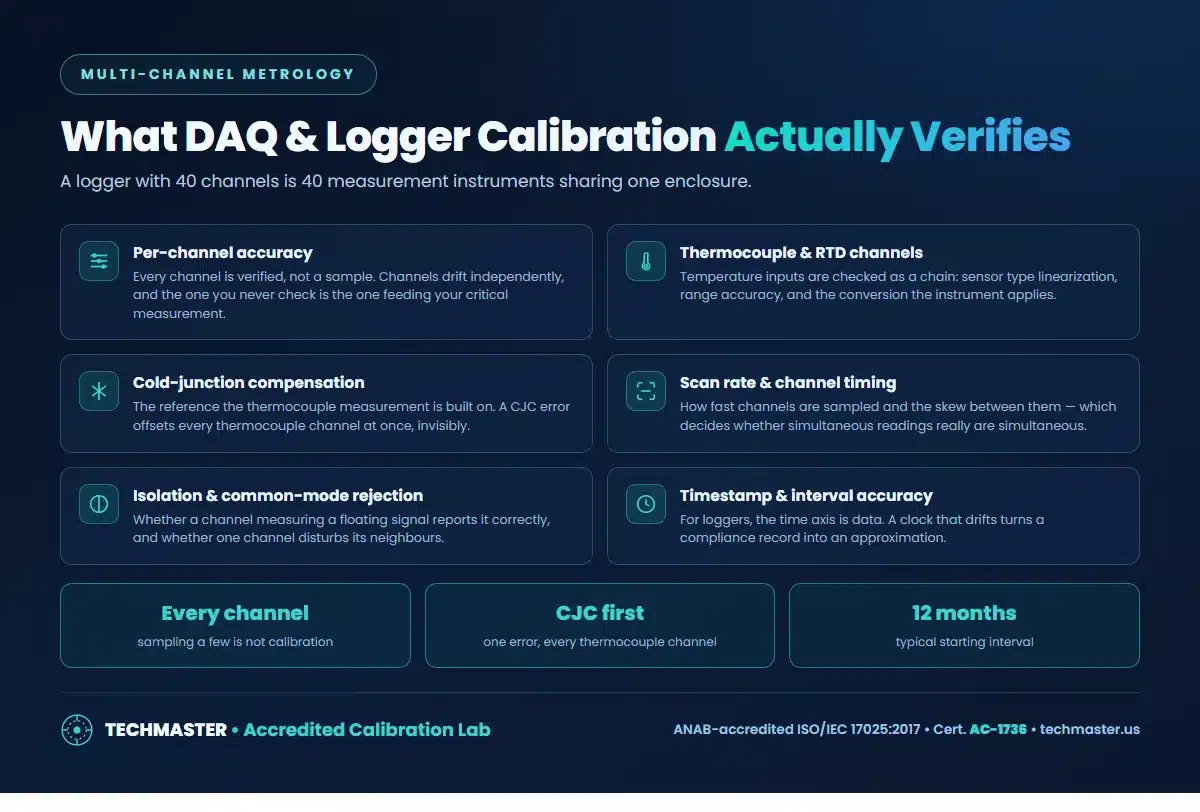
Per-channel accuracy is the headline: each channel is verified across its ranges, because each has its own conditioning path. Temperature channels are checked as a chain, sensor-type linearization, range accuracy, and the conversion applied, with cold-junction compensation the single highest-use item, since one CJC error offsets every thermocouple channel at once. Scan rate and channel timing determine whether readings you treat as simultaneous actually are. Isolation and common-mode rejection decide whether a floating measurement is reported correctly and whether channels disturb each other. And timestamp accuracy matters whenever the time axis is part of the record.
When the data is the deliverable
Loggers are frequently the instrument of record in regulated environments, chamber qualification, cold-chain monitoring, environmental control evidence. That raises the stakes on two things. First, certificate level: accredited calibration with as-found data per channel is appropriate when the logger’s output is evidence rather than convenience. Second, out-of-tolerance handling, if a channel comes back out, you need per-channel as-found data to work out which records are affected and which are fine. A pass stamp cannot answer that question.
What to ask for
Ask for all channels explicitly, with as-found data per channel, and say which sensor types and ranges you actually use so the lab verifies those conversions. Confirm the lab’s accredited scope covers the electrical and temperature parameters involved, the discipline split is explained in types of calibration, and how to read the scope in this guide. Related instruments: multimeters and modular DAQ cards, which follow the same module-level logic.
Frequently asked questions
Does every channel of a DAQ need calibrating?
Yes. Channels drift independently, they have their own signal conditioning, and in many designs their own amplifiers and multiplexer paths. Calibrating a sample of channels and assuming the rest are fine is a common shortcut, and the unchecked channel is invariably the one carrying a critical measurement.
What is cold-junction compensation and why does it matter?
Thermocouples measure a temperature difference, so the instrument must know the temperature at the terminal block where the thermocouple connects, the cold junction. That reference is measured by a sensor inside the instrument. If cold-junction compensation is off by a degree, every thermocouple channel is off by a degree simultaneously, with nothing on screen to suggest it.
Do data loggers need their clock calibrated?
For any record where timing is part of the evidence, yes. A logger’s timestamps are data: they establish when a temperature excursion happened, how long it lasted, and whether it fell inside a controlled window. A drifting clock quietly turns a compliance record into an approximation.
How often should a DAQ or data logger be calibrated?
Twelve months is the standard starting interval, adjusted on documented as-found history. Loggers used for regulated environmental monitoring or product qualification generally stay annual, because their records are the evidence rather than a convenience.
The bottom line
Calibrate every channel, insist on cold-junction verification for thermocouple work, and treat the logger clock as data. Techmaster calibrates DAQ systems and loggers under ANAB accreditation to ISO/IEC 17025:2017 (Cert. AC-1736).
Get an accredited calibration quote
ANAB-accredited ISO/IEC 17025:2017 (Cert. AC-1736) • 5 US labs • 5-day standard, 1–2 day expedite • in-lab or on-site.
Request a quoteReferences & industry standards
- ISO/IEC 17025 testing & calibration laboratory requirements
- NIST calibration services and measurement traceability
- A2LA / ANAB accreditation for calibration laboratories
External standards bodies. Techmaster Electronics is an ISO/IEC 17025-accredited, NIST-traceable calibration laboratory.

Khanh Nguyen is the Marketing Manager at Techmaster Electronics, a B2B marketing leader covering the test, measurement, and ISO/IEC 17025 accredited calibration industry in the United States.