
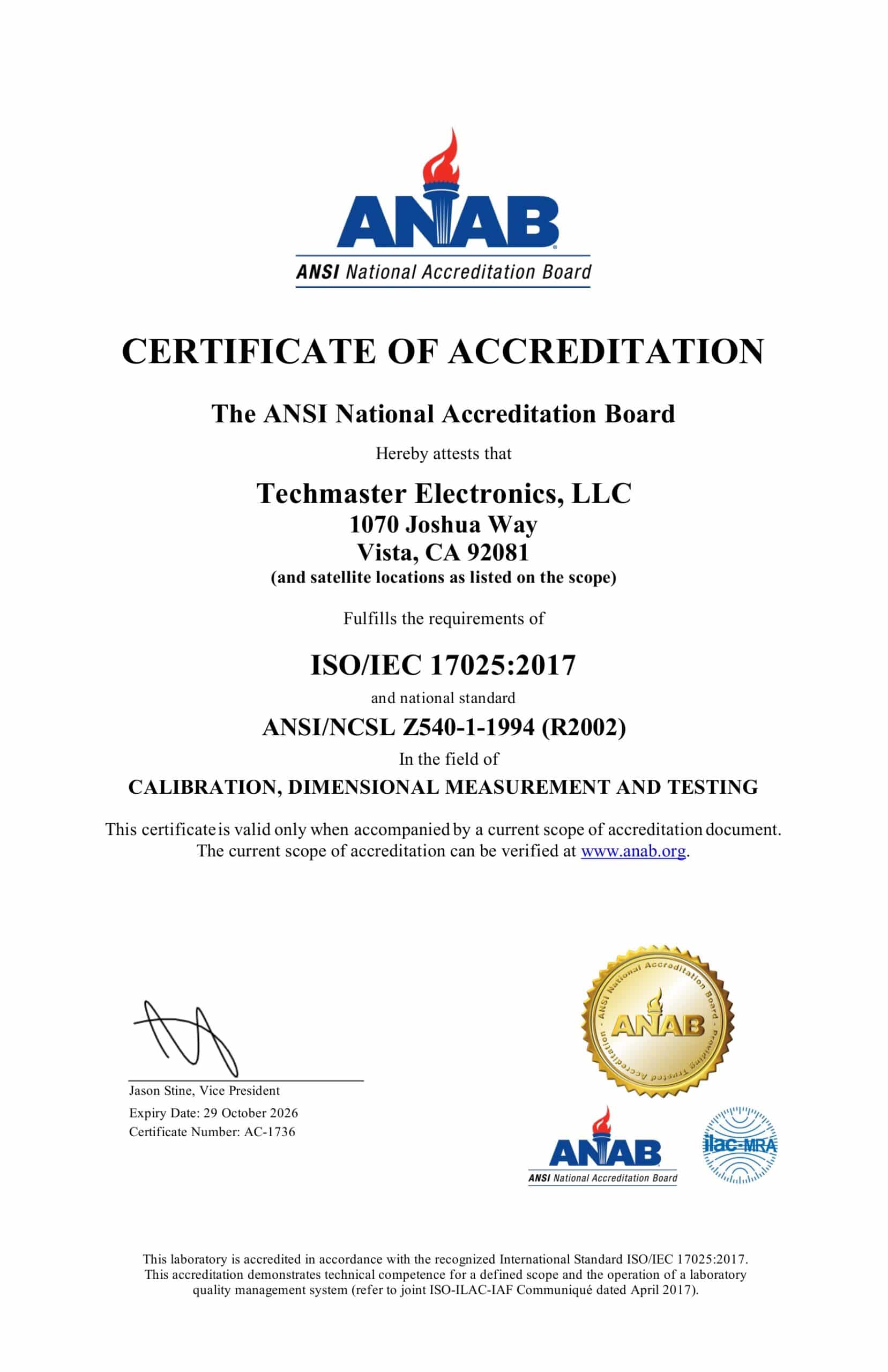
TL;DR: A gas flow analyzer is five instruments in one box, flow, airway pressure, oxygen, derived volume, and the gas and temperature corrections applied to all of them. A certificate that covers only flow leaves four of them unverified. The oxygen cell is a consumable and is the usual reason an analyzer starts disagreeing with the ventilator it is testing. Instruments of this class sit outside Techmaster’s ANAB scope (AC-1736); we calibrate them NIST-traceable and say so.
What is gas flow analyzer calibration?
Gas flow analyzer calibration is the verification of every measurement channel in a ventilator or anaesthesia test analyzer, bidirectional flow, airway pressure, oxygen and other gas concentrations, and derived volume, against traceable standards, at the ranges and under the correction convention actually used in service.
The instrument is used to decide whether a ventilator is delivering what it claims. That makes it a reference, and a reference that is wrong is worse than no reference at all, because it produces confident numbers rather than obvious failures. The complication is that a gas flow analyzer is not one measurement. It is a flow sensor, a pressure transducer, an electrochemical or paramagnetic oxygen sensor, and an integrator that turns flow into volume, four independent drift mechanisms sharing one enclosure and one certificate.
The neighbouring biomedical instruments have the same structure and the same failure modes: electrical safety analyzer calibration and defibrillator analyzer calibration both put several unrelated measurements behind one front panel, and external pacemaker analyzer calibration makes the same point about timing channels.
What has to be on a gas flow analyzer certificate?
Each channel separately, at the ranges you use, with the correction convention stated. A single “calibrated” line for the instrument as a whole tells you nothing about which of its four measurement systems was checked.
| Channel | What it measures | How it drifts | What the certificate must state |
|---|---|---|---|
| Bidirectional flow | Instantaneous gas flow in both directions | Sensor contamination, moisture, mechanical damage | The flow ranges checked – neonatal and adult are different measurements |
| Airway pressure | Peak, mean, plateau and PEEP | Transducer zero and span drift, independent of flow | Static and dynamic pressure points, with the range |
| Oxygen concentration | Delivered oxygen fraction | The cell is consumable and ages continuously | Concentrations checked, and the cell’s condition or age |
| Volume | Tidal and minute volume, integrated from flow | Inherits every flow error, plus integration and correction errors | That volume was verified, not merely inferred from flow |
| Gas and temperature corrections | BTPS, ATP or STPD conversion of the readings | Not drift – a configuration difference | Which convention was used during the calibration |
| Accreditation status | Whether this work sits on an accredited scope | Not applicable | Plainly, so nobody assumes accreditation that is not held |
Why does the analyzer disagree with the ventilator?
Usually because the two are applying different gas and temperature corrections. BTPS, ATP and STPD describe the same breath under different reference conditions, and two perfectly good instruments will report different volumes if they are set differently.
Check the correction convention on both before assuming either is faulty. If the conventions match and the disagreement persists, the oxygen cell and the flow sensor are the next two suspects, in that order. Where the disagreement is discovered after devices have already been released on the analyzer’s readings, the reach of the problem is a reverse traceability and recall impact analysis question, and the recovery procedure is the one in what to do about an out-of-tolerance result.
Between calibrations, a documented check against a second analyzer or a known flow source is worth having, the pattern in intermediate checks between calibrations. Related flow work outside the biomedical setting follows the same principles: flow meter calibration, mass flow meter calibration and flow controller calibration.
How is the pressure channel verified?
Against a traceable pressure standard, at static and dynamic points across the range used clinically – not by comparison with the ventilator under test, which is the instrument the analyzer exists to check.
Techmaster’s accredited pressure capability under ANAB certificate AC-1736 runs from −12 psi to 10,000 psi, with 15,000 psi at the San Antonio laboratory and barometric measurement to 39 psia. Airway pressures sit at the very bottom of that span, which is exactly why the low-range points matter more than the ceiling here, a standard chosen for its maximum is often the wrong standard for a measurement made in centimetres of water. pressure meter calibration for medical gas systems covers the adjacent medical gas case, and test uncertainty ratio and decision rules explains how much better than your tolerance the standard needs to be.
Is this work accredited?
Not at Techmaster. Patient simulators and analyzers of this class are not on our ANAB scope under certificate AC-1736, so we perform this work as NIST-traceable calibration and say so rather than implying otherwise.
This is a distinction worth checking with any supplier, because “ISO 17025 accredited laboratory” describes the organisation, not your instrument. how to read CMC on an accreditation scope is the practical guide to finding your parameter and range on a scope document, accredited versus NIST-traceable calibration sets out what each certificate type gives you, and what an accredited calibration laboratory is covers what accreditation actually certifies. Where the device programme itself sets the requirement, FDA-compliant medical device calibration is the relevant starting point.
Frequently asked questions
What does gas flow analyzer calibration cover?
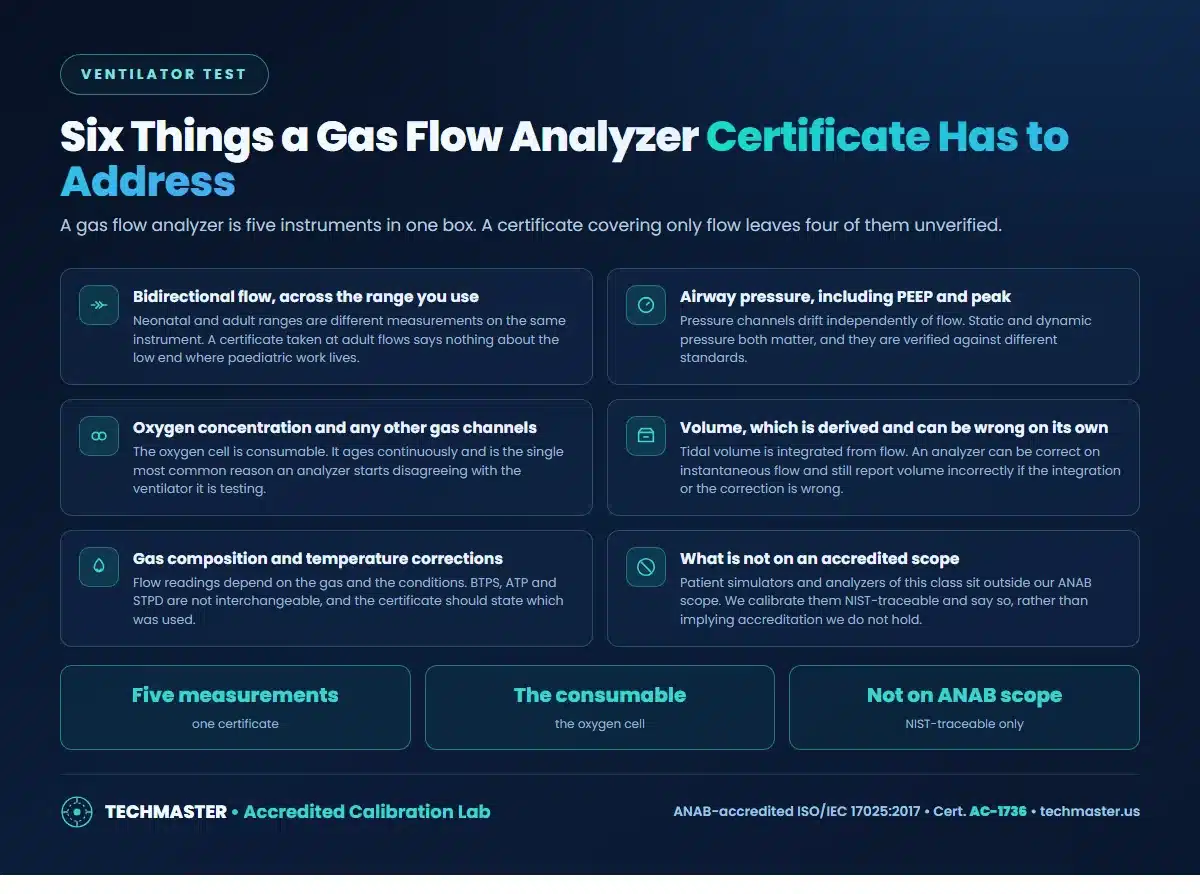
Every channel the instrument reports, not just flow. That normally means bidirectional flow across the ranges you use, airway pressure including peak and PEEP, oxygen concentration and any other gas channels, derived volume, and the gas composition and temperature corrections applied to the readings. A certificate that lists only flow leaves the rest of the instrument unverified.
How often should a gas flow analyzer be calibrated?
Annually is the usual interval, and the oxygen cell often needs attention sooner because it is a consumable that ages continuously whether the instrument is used or not. Set the interval from observed drift and from the consequence of an error rather than from habit, and recalibrate after any repair or a suspected overpressure event.
Is gas flow analyzer calibration ISO/IEC 17025 accredited at Techmaster?
No. Patient simulators and analyzers of this class sit outside our ANAB scope under certificate AC-1736, so we calibrate them as NIST-traceable work and say so plainly rather than implying accreditation we do not hold. If your quality system requires an accredited certificate for this specific instrument, ask any supplier to show you that parameter on their scope document.
Why does a gas flow analyzer disagree with the ventilator it is testing?
Most often because one of them applies a different gas or temperature correction than the other. BTPS, ATP and STPD are different conventions and are not interchangeable, so two correct instruments can report different volumes from the same breath. The second most common cause is an ageing oxygen cell in the analyzer.
The bottom line
Ask for every channel on the certificate, ask which correction convention was used, and treat the oxygen cell as the consumable it is. Techmaster calibrates biomedical analyzers as NIST-traceable work from five US laboratories, with 5-day standard turnaround and 1–2 day expedite.
Need a quote, a rental, or a repair evaluation?
Techmaster Electronics, ISO/IEC 17025 accredited calibration laboratory, ANAB Cert. AC-1736, founded 1989. Five US labs, 5-day standard turnaround, 1–2 day expedite.
Request a quote →Techmaster Electronics, LLC is an independent ISO/IEC 17025:2017 accredited calibration laboratory. We are not affiliated with, authorized by, or endorsed by any manufacturer named on this page. All product names and model designations are trademarks of their respective owners and are used here only to identify the equipment we calibrate, repair, or rent. Confirm that our accredited scope covers your instrument’s parameters and ranges before shipping, ask us and we will check it against your model list.

Khanh Nguyen is the Marketing Manager at Techmaster Electronics, a B2B marketing leader covering the test, measurement, and ISO/IEC 17025 accredited calibration industry in the United States.