
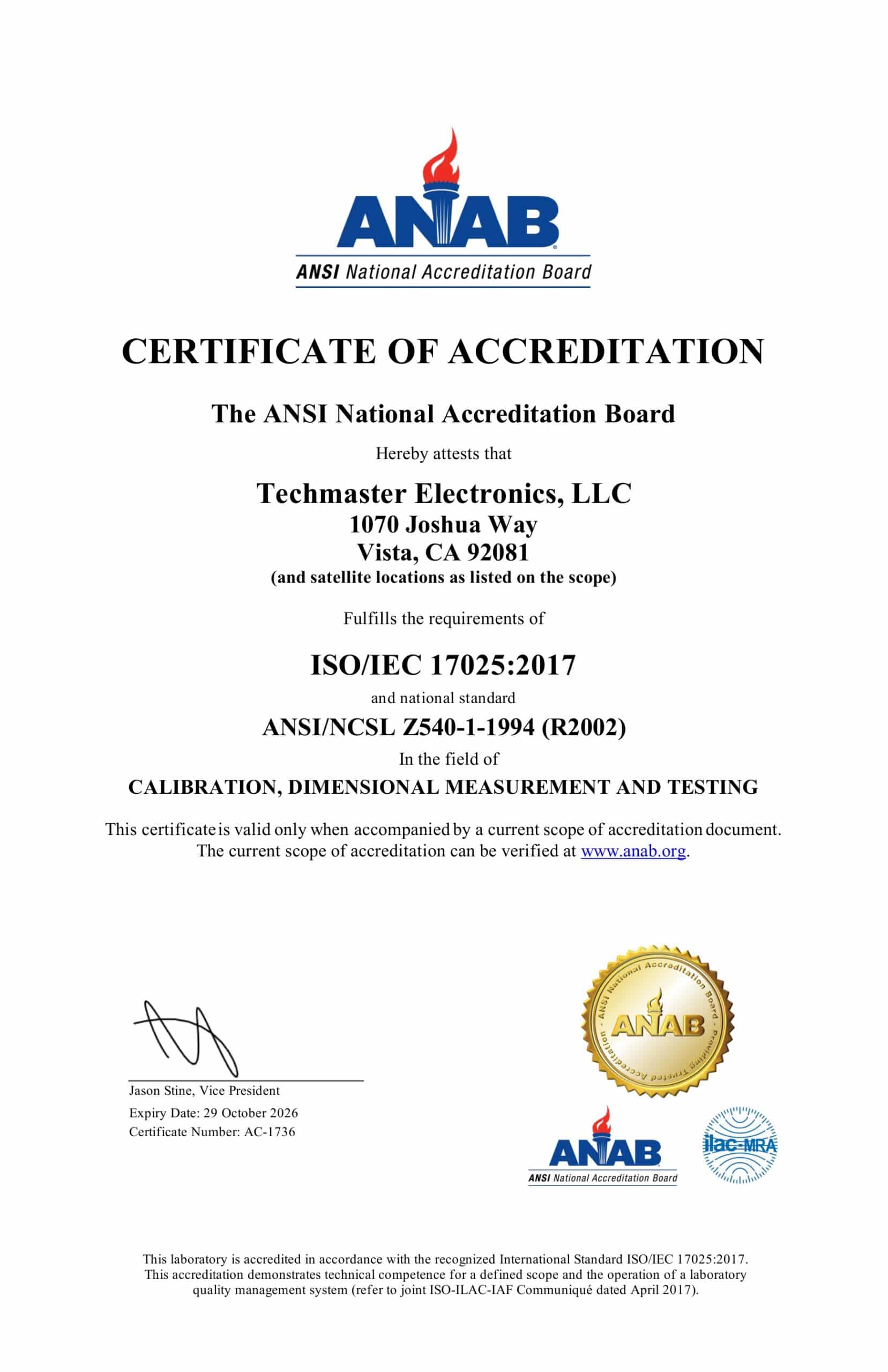
Quick answer: Portable gas detectors should be bump-tested before each day of use and fully calibrated at least every 6 months, or more often where the manufacturer, a confined-space program, or OSHA guidance requires it. Any detector that fails a bump test, is exposed to high concentrations, or is used in a life-safety role should be recalibrated immediately. Techmaster calibrates gas detectors to ISO/IEC 17025 using NIST-traceable reference gases with documented as-found/as-left results.
Key points
- Calibration confirms measurements you can defend in an ISO 9001 / 13485 / AS9100 audit.
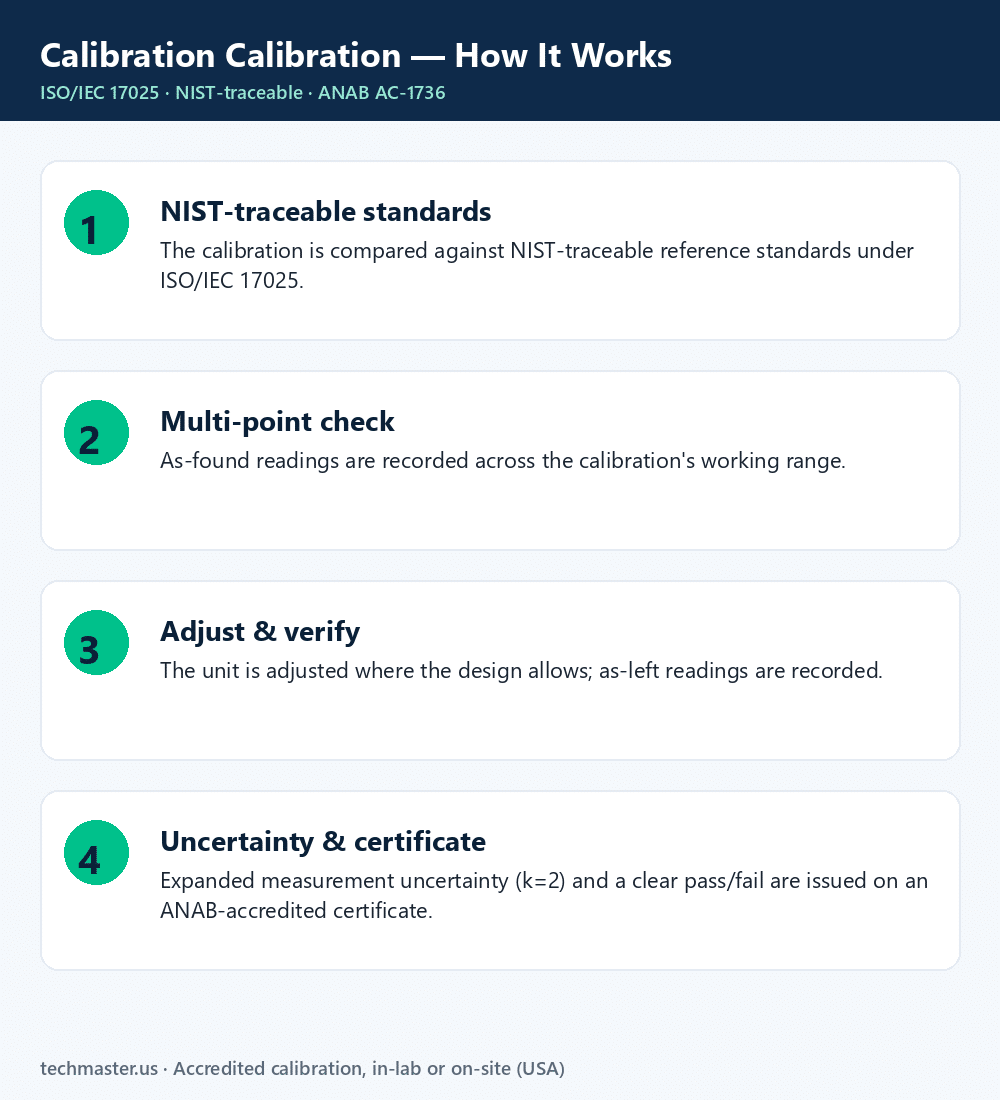
- Every certificate is NIST-traceable with a full measurement-uncertainty budget (as-found / as-left).
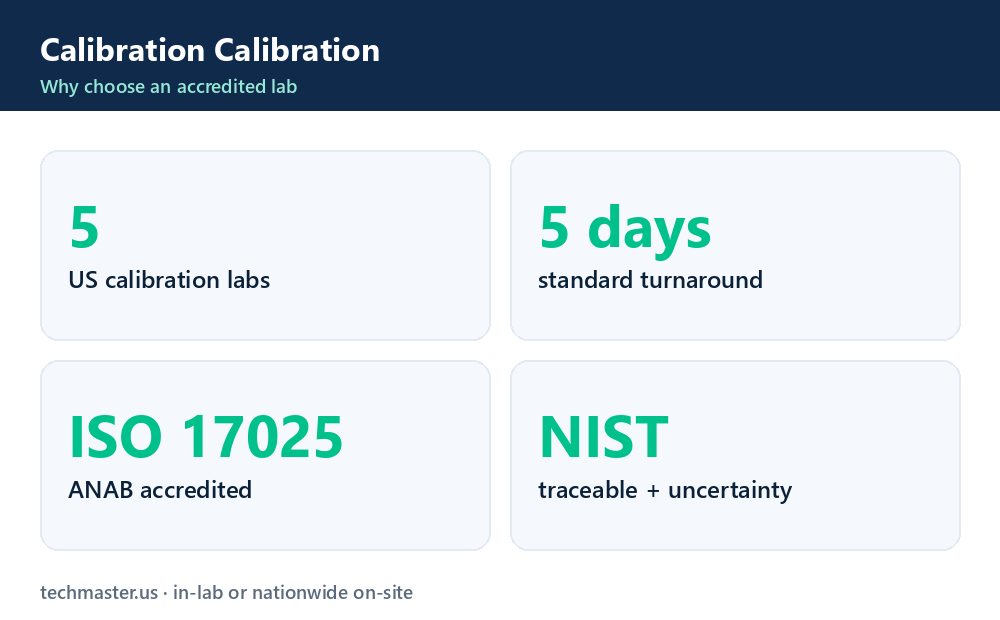
- Techmaster is ANAB-accredited (AC-1736) with five US labs, in-lab or nationwide on-site.
- Standard turnaround is 5 business days, with 1–2 business-day expedite available.
Why it matters
Measurement confidence
A drifting calibration produces readings that fail under audit scrutiny.
Compliance
ISO 9001, 13485, AS9100 and FDA systems require traceable calibration.
Cost control
Catching drift early prevents scrapped product and failed lots.
Traceability
An unbroken chain to NIST with stated uncertainty makes your data valid.

Accredited calibration at Techmaster
Techmaster Electronics is an ANAB-accredited (Certificate AC-1736) ISO/IEC 17025:2017 calibration laboratory with five US labs, NIST-traceable standards and a full measurement-uncertainty budget on every certificate, in-lab or on-site nationwide. See our calibration services or request a quote.
Frequently asked questions
What is how often should you calibrate?
How Often Should You Calibrate is the documented comparison of a calibration against NIST-traceable reference standards under ISO/IEC 17025. It quantifies the calibration’s error and measurement uncertainty and confirms it performs within tolerance, with as-found and as-left data on the certificate.
How often should a calibration be calibrated?
Most quality systems calibrate a calibration every 12 months, or sooner after repair, overload, or before critical measurements. Set your interval from the manufacturer spec and your ISO 9001 / 13485 / AS9100 program and drift history.
Is Techmaster’s calibration ISO 17025 accredited?
Yes. Techmaster Electronics is ISO/IEC 17025:2017 accredited by ANAB (Certificate AC-1736). Every calibration is NIST-traceable and issued with a full measurement-uncertainty budget.
What is the turnaround for calibration?
Standard turnaround is 5 business days, with 1–2 business-day expedite available. On-site calibration removes shipping time entirely for calibrations that can’t leave the floor.
Do you calibrate calibrations on-site or in-lab?
Both. Techmaster runs five US labs (Vista CA, Santa Clara CA, Orlando FL, San Antonio TX, Holly Springs NC) and offers nationwide on-site calibration to minimize downtime.
Related calibration guides
Get accredited calibration
ANAB-accredited, NIST-traceable, 5 US labs, in-lab or on-site.
Contact us for a quoteKhanh Nguyen, Marketing Manager, Techmaster Electronics
Writes on ISO/IEC 17025 calibration, metrology and measurement compliance for US labs. Connect on LinkedIn →

Khanh Nguyen is the Marketing Manager at Techmaster Electronics, a B2B marketing leader covering the test, measurement, and ISO/IEC 17025 accredited calibration industry across the US and Vietnam markets.