
Keysight vs Tektronix Oscilloscope: A Complete Guide for Laboratories and Engineers
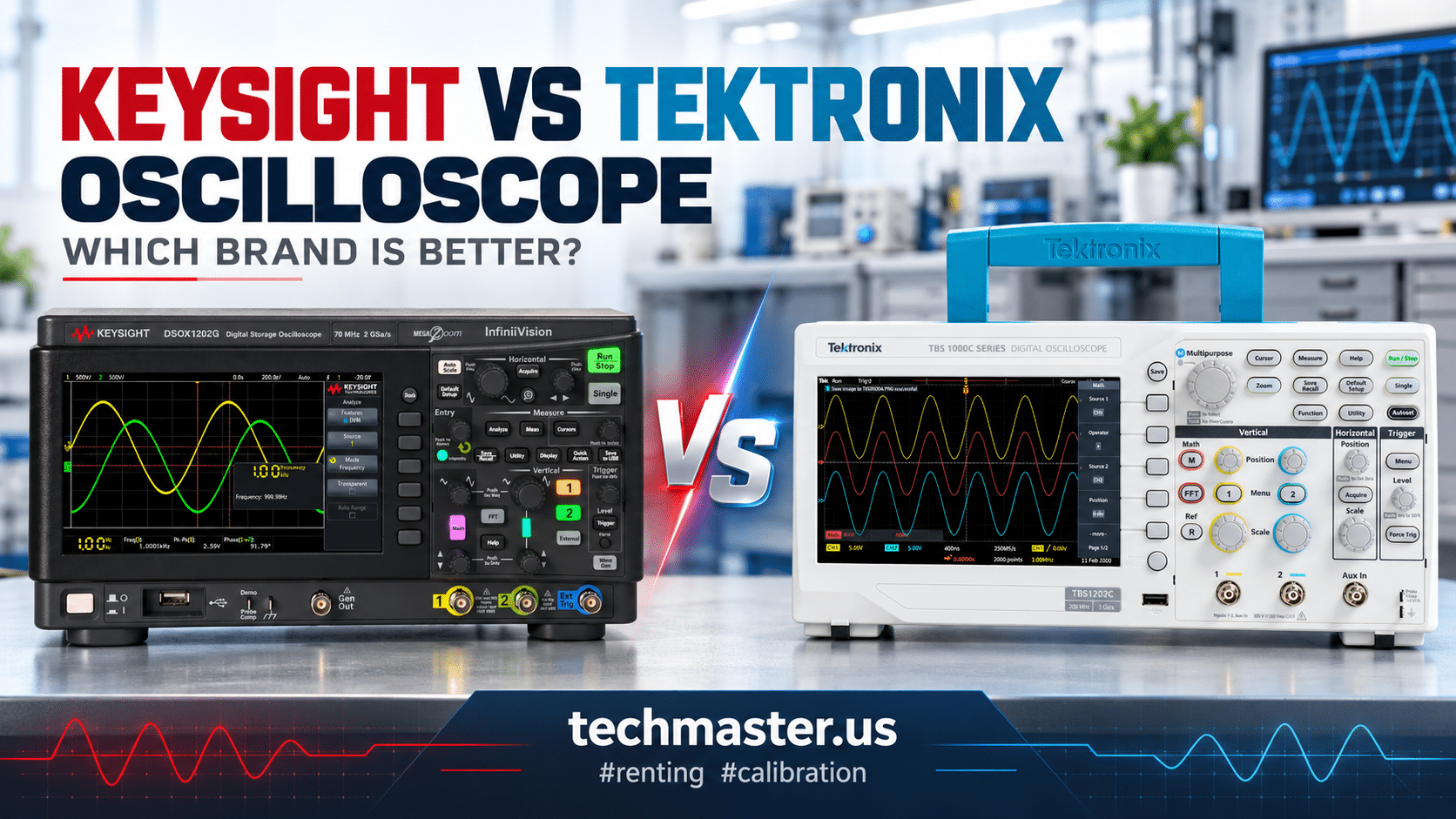
Selecting the right electronic test equipment is a critical decision that directly impacts testing accuracy, operational efficiency, and product quality. Consequently, quality managers, manufacturing engineers, and metrology professionals face this choice regularly. They need reliable tools to capture and analyze waveforms accurately. Usually, the industry conversation narrows down to two major brands. For example, evaluating a [keysight vs tektronix oscilloscope]([INSERT LANDING PAGE URL]) is a common challenge. Laboratories must balance hardware performance, software integration, and measurement reliability. Specifically, Keysight Technologies and Tektronix produce industry-leading instruments. Both manufacturers boast deep roots in test and measurement history. In the end, this guide breaks down the core differences between the two brands, explores common applications, and highlights why an accredited Calibration service plays a vital role in maintaining these tools.
1. What Is a Benchtop Oscilloscope and Why Does Brand Matter?
A benchtop oscilloscope is a vital piece of electronic test equipment that graphically displays varying electrical voltages. Specifically, the screen shows a two-dimensional plot of signals over time. Engineers rely on these instruments daily. In addition, they use them to test, verify, and debug complex electronic designs.
When organizations evaluate the best oscilloscope brand for their bench, they buy more than hardware. Indeed, they invest in a software ecosystem, a user interface philosophy, and an automation architecture.
Engineers highly regard Keysight oscilloscopes for their proprietary ASIC technology. This advanced hardware allows for fast waveform update rates without sacrificing memory depth. As a result, Keysight scopes excel at hunting rare glitches in high-speed digital designs.
Conversely, users celebrate Tektronix oscilloscopes for their intuitive user interfaces and physical durability. Modern Tektronix series feature highly responsive touchscreens and drag-and-drop measurement badges. Therefore, engineers who manually drive the instrument daily often prefer Tektronix scopes.
2. Why the Keysight vs Tektronix Oscilloscope Comparison Matters
Choosing the right brand directly impacts measurement accuracy, traceability, and workflow. Here is why comparing a Keysight vs Tektronix oscilloscope matters for your facility:
-
Automation and Scripting (SCPI): Automated test environments rarely drive oscilloscopes by hand. Both brands use SCPI (Standard Commands for Programmable Instruments). However, their software implementations vary significantly. Keysight provides consistent SCPI command sets across different instrument families, making it easier to scale automation. Meanwhile, Tektronix now offers robust Python libraries to simplify automated testing.
-
Software Lock-In: Modern oscilloscopes rely on specialized software for advanced analysis. For instance, Keysight uses its PathWave ecosystem, while Tektronix employs TekScope. Consequently, choosing a brand dictates your software infrastructure for years to come.
-
Hardware Strengths: Keysight’s InfiniiVision and Infiniium series excel in sample rate consistency and offer great RF measurement integration. On the other hand, Tektronix’s MSO and DPO series offer a superior user experience alongside reliable performance in automotive and mixed-signal environments.
-
Risk Reduction: A high-quality oscilloscope lowers the risk of passing defective products. In addition, it prevents failing good products. Therefore, this directly protects your company’s bottom line and safety record.
3. Common Applications
Industry Applications & Niche Strengths
High-stakes industries heavily use both Keysight and Tektronix oscilloscopes. Nevertheless, their specific features make them lean toward certain niches.
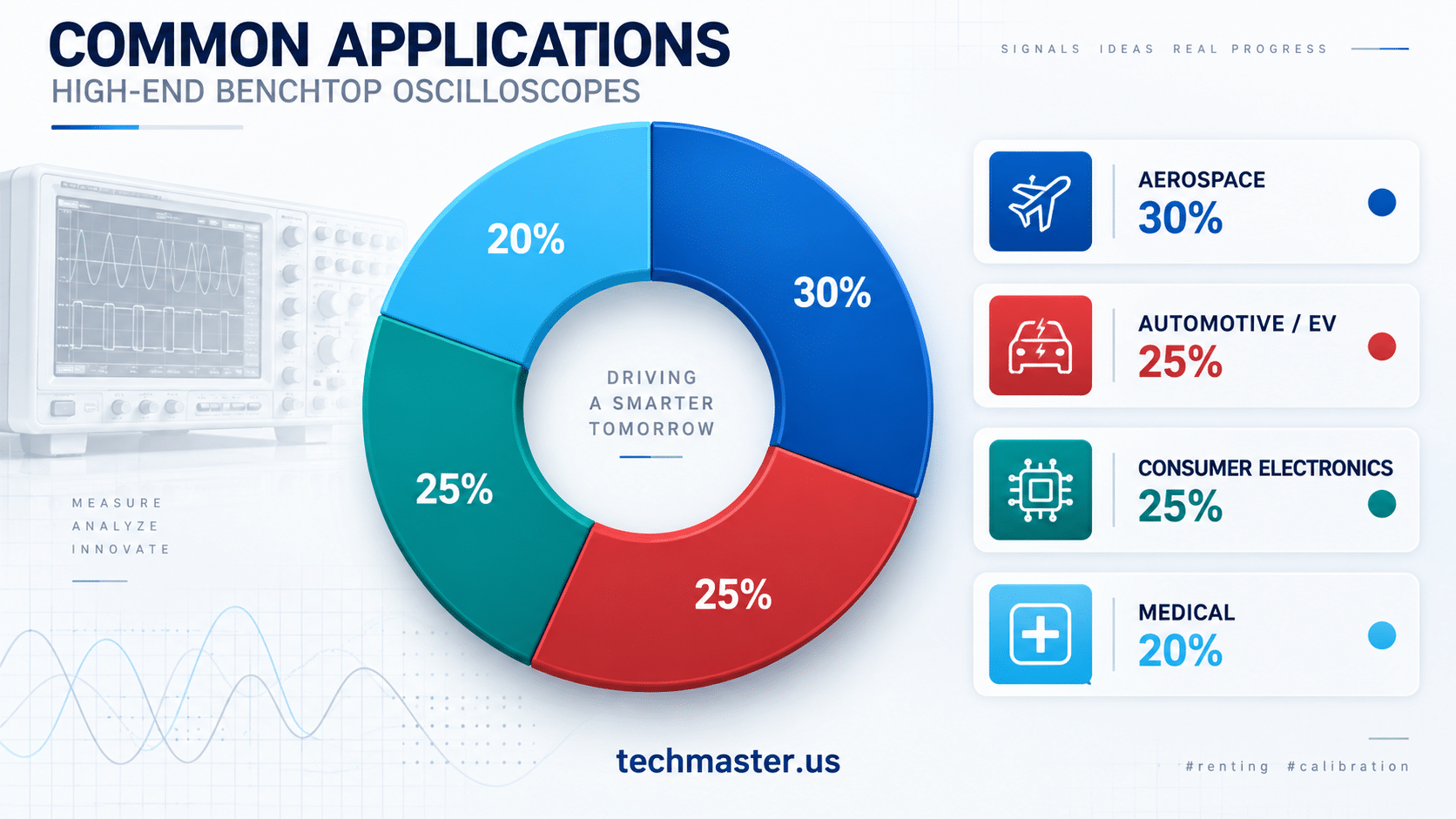
Aerospace and Defense
Engineers use scopes for radar pulse analysis and avionics communications testing. Additionally, they validate mission-critical electronic components. Fortunately, both brands offer the deep memory and high bandwidth necessary for these tough applications.
Automotive Manufacturing
Electric vehicles (EVs) and advanced driver-assistance systems (ADAS) require extensive testing. Consequently, technicians use these scopes to decode CAN/LIN buses and analyze power electronics. Tektronix is very popular here because users love its robust protocol decoding capabilities.
Consumer Electronics
Firms use oscilloscopes for signal integrity testing and eye diagram analysis. Also, they debug high-speed digital interfaces like USB, PCIe, and HDMI. Keysight’s extremely fast waveform update rates catch elusive hardware bugs quickly, making it a favorite in these fast-paced sectors.
Medical Device Manufacturing
Technicians validate the electrical safety and precise timing of life-saving equipment. Naturally, this work requires strict adherence to FDA and ISO compliance standards. Both brands provide the necessary accuracy for these critical tasks.
4. Calibration Standards and Traceability
You might decide Keysight is the best fit. Alternatively, you might find Tektronix to be the best oscilloscope brand for your needs. Either way, a premium instrument is only as good as its last calibration.
ISO/IEC 17025 Accreditation
Quality-critical environments require strict calibration standards. Therefore, an ISO/IEC 17025 accredited laboratory must calibrate your oscilloscopes. This accreditation ensures the provider demonstrates technical competence. In addition, it proves they follow a rigorous quality management system.
NIST Traceability
All calibration measurements must trace back to the National Institute of Standards and Technology (NIST). Otherwise, they must trace to a recognized equivalent National Metrology Institute (NMI). Traceability guarantees an unbroken chain of comparisons. Consequently, this ensures your 1 GHz measurement in California matches a 1 GHz measurement anywhere in the world.
Measurement Uncertainty
A premium calibration certificate includes data on measurement uncertainty. Specifically, you must understand the uncertainty ratio between the unit under test and the calibration standard. This ratio is critical for compliance and risk management.
5. Common Issues Found During Calibration
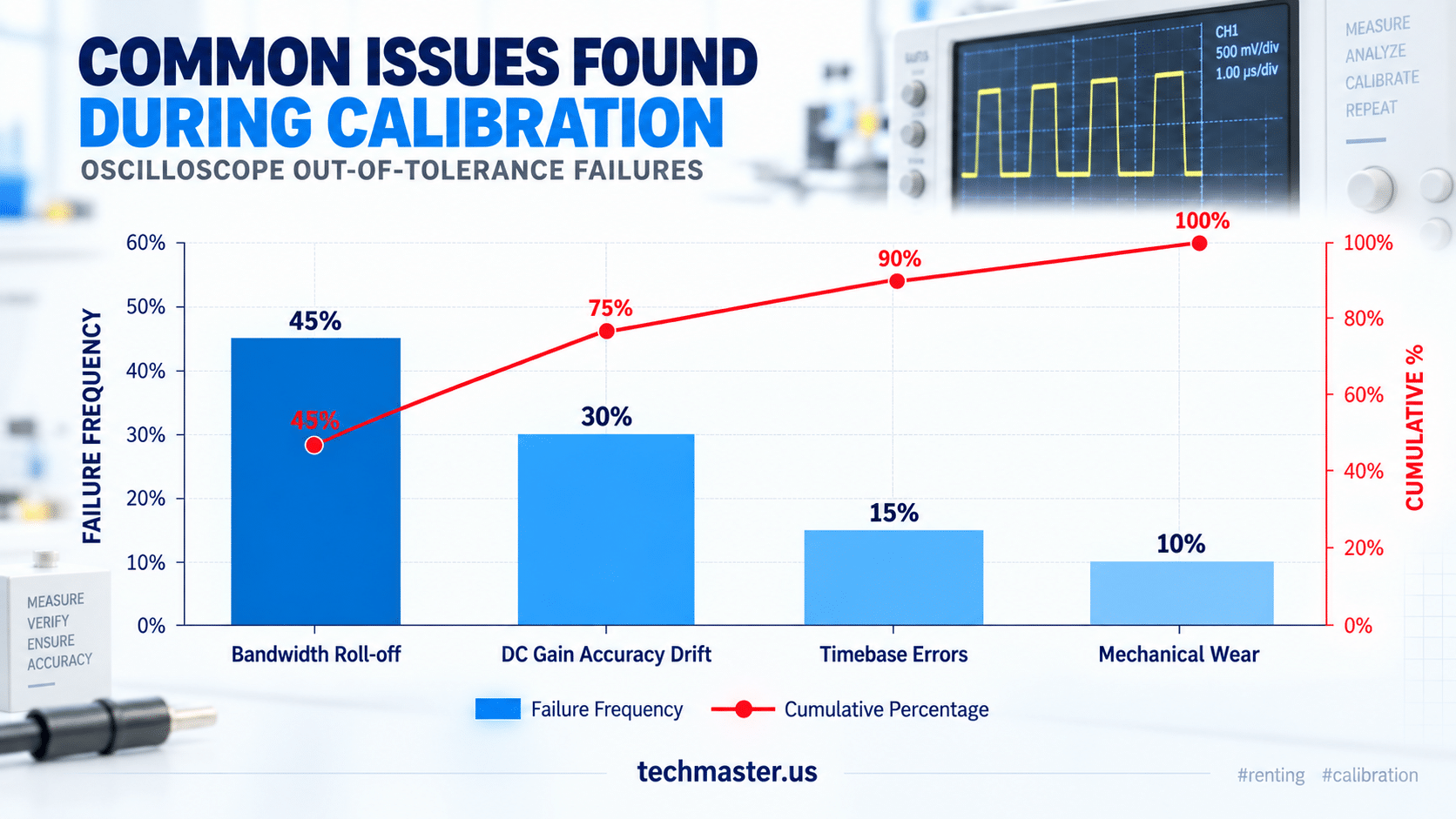
During routine oscilloscope calibration, metrologists frequently uncover hidden issues. Often, standard daily use might not reveal these problems. Common out-of-tolerance (OOT) conditions include:
-
Bandwidth Roll-Off: Input amplifiers degrade over time. Consequently, this causes the scope to attenuate high-frequency signals early. As a result, engineers might miscalculate the rise time of a digital signal.
-
DC Gain Accuracy Drift: Thermal stress and aging components cause voltage readings to drift. For example, an engineer might measure 5.0V on a logic line when the actual voltage is 4.8V.
-
Timebase Errors: Aging or environmental changes cause the internal reference oscillator to drift. Therefore, this creates errors in frequency and timing measurements, which cause severe problems in synchronized digital systems.
-
Relay and Switch Wear: Mechanical relays inside the attenuator networks endure heavy wear. Eventually, failing connections cause the scope to display noisy or intermittent signals.
-
Environmental Degradation: Factory floors and field service environments expose equipment to dust and humidity. In addition, temperature extremes accelerate sensor and component degradation.
6. How Often Should This Equipment Be Calibrated?
Establishing the Correct Calibration Interval
Establishing the correct calibration interval maintains measurement integrity. Typically, a 12-month calibration interval serves as the industry standard for benchtop oscilloscopes. However, quality managers should adjust frequencies based on these four factors:
Manufacturer Recommendations
Brands like Keysight and Tektronix generally recommend annual calibration for their mid-tier and high-end oscilloscopes to guarantee their published data sheets.
Usage Environment
A scope in a climate-controlled R&D lab easily holds its specifications for 12 months. Conversely, the same scope on a hot, vibrating factory floor might need a stricter 6-month interval.
Criticality of Measurements
Pharmaceutical and aerospace applications often mandate shorter intervals. Indeed, they do this to aggressively minimize the risk of an Out-Of-Tolerance (OOT) condition during an audit or critical test.
Historical Data
An instrument might consistently require adjustment during its annual calibration. If so, you should definitely shorten the calibration interval.
7. What to Look for in a Calibration Provider
Selecting the right partner for your electronic test equipment calibration is crucial. In fact, it is just as important as selecting the instrument itself. When you evaluate a calibration laboratory, consider the following points:
-
Scope of Accreditation: Ensure the lab holds ISO/IEC 17025 accreditation for your specific needs. Specifically, check their approved bandwidth, frequency, and parameters. Not all labs have the multi-product calibrators needed for high-end scopes.
-
Technical Capability: The lab should use modern metrology standards. For instance, Fluke 9500B or 5820A oscilloscope calibrators are excellent examples. In addition, automated procedures help eliminate human error.
-
Documentation Quality: Your provider should offer detailed calibration certificates. These documents must include “As Found” and “As Left” data, and they must clearly state measurement uncertainty.
-
Turnaround Time: Test equipment serves as the lifeblood of production. Therefore, find a lab that offers rapid standard turnarounds or expedited options.
-
On-Site Services: Large inventories or delicate rack-mounted equipment require special care. Consequently, a provider capable of accredited on-site calibration saves days of downtime and eliminates shipping risks.
8. Techmaster Electronics Equipment Rental Services
Downtime is not an option for fast-paced manufacturing and R&D facilities. Sometimes, your primary oscilloscope might leave the floor for calibration or repair. Alternatively, you might face a sudden surge in testing requirements. In these cases, waiting is a poor strategy.
Therefore, Techmaster Electronics offers complete equipment rental services alongside our world-class calibration lab. We provide fully calibrated, ready-to-deploy oscilloscopes. In addition, our inventory includes top models from Keysight and Tektronix. Renting allows you to maintain continuous production flow. Additionally, you can evaluate a specific model before making a capital purchase, or access high-bandwidth models for short-term validation projects without a massive upfront cost.
9. Why Choose Techmaster Electronics?
Techmaster Electronics stands as a premier partner for organizations demanding exact accuracy. Specifically, we bring decades of experience in metrology and industrial quality assurance. Our ISO/IEC 17025 accredited laboratories employ top-tier technical experts who easily service complex electronic test equipment.
Also, we do more than perform basic verifications. We deliver complete, automated, and highly documented calibration services. We tailor our work to the strict compliance rules of the aerospace, medical, automotive, and semiconductor industries. Whether you use Keysight, Tektronix, or a mixed fleet of instruments, Techmaster provides smooth asset management and rapid turnaround times. In the end, we give you the technical confidence you need to trust every measurement.
Choosing between a Keysight and Tektronix oscilloscope depends on your specific application. You might prioritize raw waveform update rates and RF integration, or you might prefer a great user interface and rugged reliability. Regardless of the brand on the front panel, measurement accuracy relies entirely on rigorous calibration. Consequently, partnering with a proven metrology provider ensures your critical instruments perform exactly as engineered, safeguarding your product quality and compliance status.
Contact Techmaster Electronics today to discuss your calibration requirements and keep your measurement equipment accurate, reliable, and compliant.
10. Frequently Asked Questions (FAQs)
Frequently Asked Questions
Frequently asked questions
What is oscilloscope calibration?
Oscilloscope Calibration is the documented comparison of a oscilloscope against NIST-traceable reference standards under ISO/IEC 17025. It quantifies the oscilloscope’s error and measurement uncertainty and confirms it performs within tolerance, with as-found and as-left data on the certificate.
How often should a oscilloscope be calibrated?
Most quality systems calibrate a oscilloscope every 12 months, or sooner after repair, overload, or before critical measurements. Set your interval from the manufacturer spec and your ISO 9001 / 13485 / AS9100 program and drift history.
Is Techmaster’s oscilloscope calibration ISO 17025 accredited?
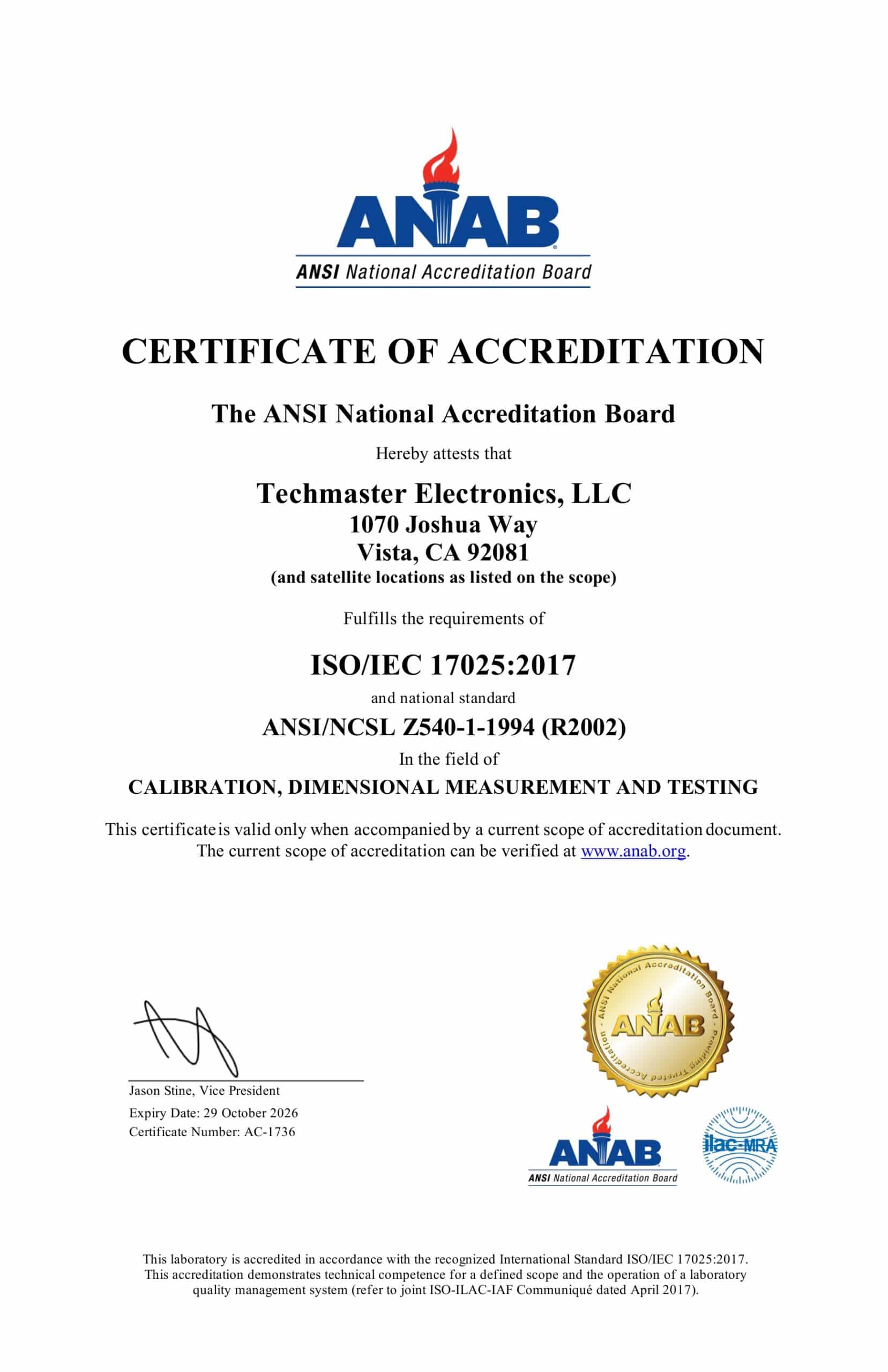
Yes. Techmaster Electronics is ISO/IEC 17025:2017 accredited by ANAB (Certificate AC-1736). Every oscilloscope calibration is NIST-traceable and issued with a full measurement-uncertainty budget.
What is the turnaround for oscilloscope calibration?
Standard turnaround is 5 business days, with 1–2 business-day expedite available. On-site calibration removes shipping time entirely for oscilloscopes that can’t leave the floor.
Do you calibrate oscilloscopes on-site or in-lab?
Both. Techmaster runs five US labs (Vista CA, Santa Clara CA, Orlando FL, San Antonio TX, Holly Springs NC) and offers nationwide on-site oscilloscope calibration to minimize downtime.
References & industry standards
- ISO/IEC 17025 testing & calibration laboratory requirements
- NIST calibration services and measurement traceability
- NIST Fundamental Electrical Measurements
- A2LA / ANAB accreditation for calibration laboratories
External standards bodies. Techmaster Electronics is an ISO/IEC 17025-accredited, NIST-traceable calibration laboratory.

Khanh Nguyen is the Marketing Manager at Techmaster Electronics, a B2B marketing leader covering the test, measurement, and ISO/IEC 17025 accredited calibration industry in the United States.