
TL;DR: RF passives drift mechanically, not electronically. Calibration produces attenuation versus frequency (not one number), plus match/SWR, power handling behaviour, step attenuator repeatability and connector condition. Connectors are the dominant failure mode, gauging is part of the calibration. Calibrate any passive whose value enters a measurement; a protective pad needs far less.
Passive devices are the easiest thing in an RF rack to overlook. No firmware, no self-test, no error message. They still decide what your measurement says, and they degrade in ways that are invisible until someone measures them.
What does calibrating an RF passive verify?
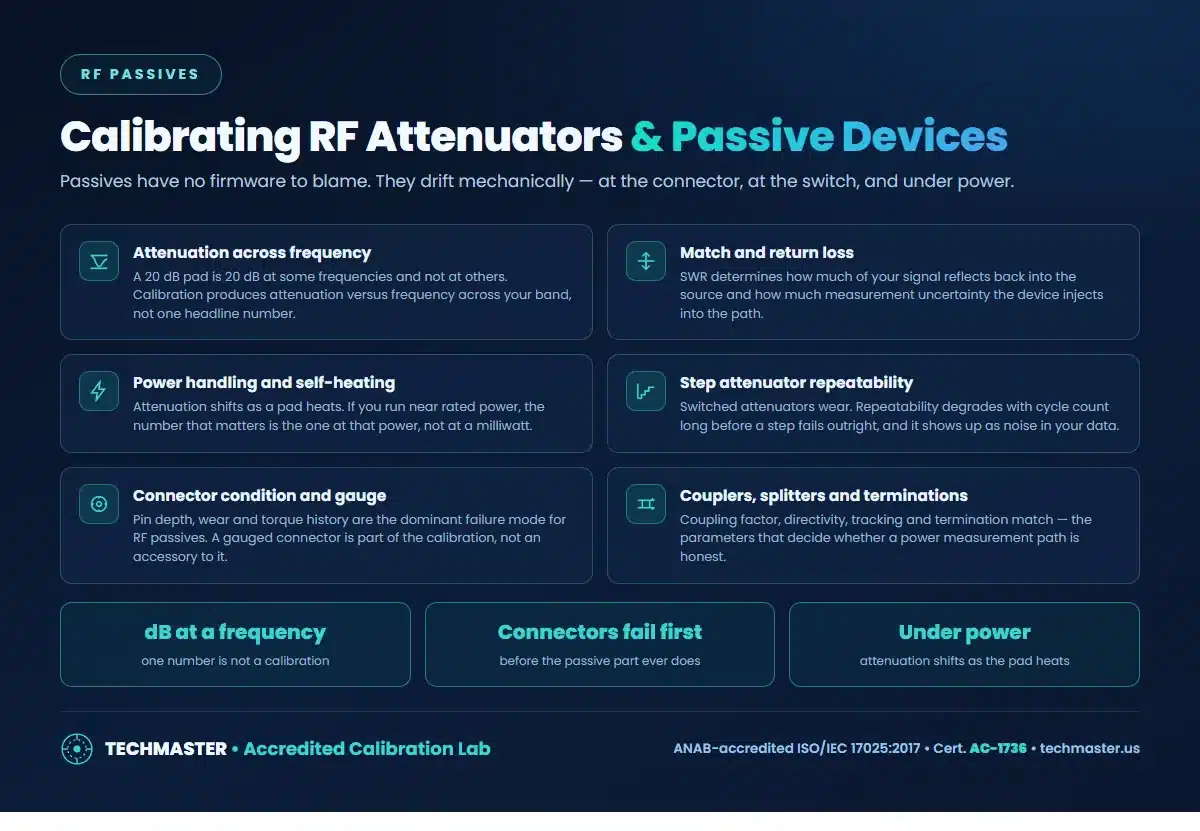
Attenuation across frequency is the core output. A pad is its nominal value at some frequencies and something else at others, and it is that curve, not the label, that corrects your measurement. Match and return loss determine how much signal reflects back into the source and how much uncertainty the device injects into the path. Power handling matters if you run near the rating, because attenuation shifts as a pad heats. Step attenuator repeatability degrades with switching cycles long before a step fails outright, and it appears in your data as unexplained scatter. Connector condition and gauge is the one most programs skip and the one that causes the most damage. And for couplers, splitters and terminations, coupling factor, directivity, tracking and termination match decide whether a power measurement path is honest at all.
Which passives actually need calibration?
Split them by role. A device whose value enters a measurement, a pad correcting a level, a coupler feeding a power sensor, a termination setting a reference, needs traceable calibration, because its error becomes your error directly. A device merely protecting an input or padding a source for isolation needs functional checks and connector care, not a certificate. That distinction, applied honestly, keeps the cost of RF passives sensible while covering the parts that matter. The same reasoning appears throughout RF and microwave calibration.
Connectors are the real maintenance item
Pin depth, wear and torque history change insertion loss and match, and a damaged connector propagates damage into every port it touches next. Gauge connectors, torque them properly, keep protective caps on, and inspect before mating, a habit that also protects the ports on your network analyzer and spectrum analyzer. When passives travel, the packing advice in shipping test equipment for calibration applies with extra force, because a loose connector in transit is a common cause of an unexplained out-of-tolerance result.
What to ask for
State the frequency range you need, whether you want data at operating power, and whether match is required alongside attenuation. Confirm the laboratory’s accredited scope covers RF attenuation and match over your frequencies and connector types using how to read an accreditation scope, RF scope limits are narrower than people expect. The uncertainty contribution of the passive belongs in your budget as described in measurement uncertainty explained, and passives supporting power meter measurements or source levelling deserve the same certificate level as the instruments they serve, see certificate levels compared.
Frequently asked questions
Do passive RF devices really need calibration?
Yes, for any device whose value enters a measurement. Attenuators, couplers and terminations have no electronics to drift, but they degrade mechanically: connectors wear, switch contacts in step attenuators age, and attenuation shifts with temperature and applied power. A pad used to protect an input needs far less attention than a pad used to correct a measured level.
What does RF attenuator calibration produce?
Attenuation as a function of frequency across the band of interest, rather than a single number. A device nominally rated at a given attenuation will differ across its band, and that variation is the useful output of the calibration. Match or SWR is usually reported alongside it, since reflection contributes directly to measurement uncertainty.
Why do connectors matter so much on RF passives?
Because they are the dominant failure mode. Pin depth, wear and torque history change insertion loss and match, and a damaged connector can damage every instrument port it subsequently touches. Connector gauging is part of the calibration rather than an optional extra, and connector care is a large part of keeping the calibration meaningful between visits.
Does attenuation change with applied power?
It can, once a pad is dissipating meaningful power, because attenuation shifts as the device heats. If you operate near the rated power, the relevant figure is attenuation under those conditions rather than at low level. Say so when requesting the calibration so the test conditions match your use.
The bottom line
Calibrate the passives whose values enter your measurements, ask for attenuation across frequency rather than a single number, and treat connectors as the maintenance item they are. Techmaster calibrates RF attenuators, couplers, splitters and terminations under ANAB accreditation to ISO/IEC 17025:2017 (Cert. AC-1736).
Get an accredited calibration quote
ANAB-accredited ISO/IEC 17025:2017 (Cert. AC-1736) • 5 US labs • 5-day standard, 1–2 day expedite • in-lab or on-site.
Request a quote
Khanh Nguyen is the Marketing Manager at Techmaster Electronics, a B2B marketing leader covering the test, measurement, and ISO/IEC 17025 accredited calibration industry in the United States.