
Yes. A GPS-disciplined oscillator still needs periodic calibration. GPS lock makes a GPSDO inherently accurate, but traceability is a property of a measurement result, not of a system or an instrument. Without a documented calibration and a stated uncertainty, an assessor has no basis to accept your time or frequency data.
Every accredited calibration laboratory eventually has the same argument with an assessor. The lab points at a GPS-disciplined oscillator humming away in the corner, locked to satellites, holding 1 × 10-12 on the front panel display, and says: that is our house standard, and it is traceable because it follows GPS. The assessor asks for the calibration certificate and the uncertainty budget, and the conversation stops.
This article explains exactly why that argument fails, what GPS disciplined oscillator calibration actually has to prove, what the traceability chain looks like from the SI second down to your device under test, and what you need on file to defend a GPSDO-based measurement during an ISO/IEC 17025 assessment.
Does a GPS-disciplined oscillator still need calibration?
The confusion is understandable. A GPSDO disciplines a local oscillator, usually an OCXO or a rubidium standard, to the one pulse-per-second signal recovered from GPS satellites. Over long averaging times the local oscillator inherits the accuracy of the atomic clocks aboard the satellites, which are themselves steered to UTC(USNO). That is genuinely excellent performance, and it is why GPSDOs became the default house standard in calibration labs, telecom central offices, substations, and trading data centers.
But performance is not evidence. The International Vocabulary of Metrology defines metrological traceability as the property of a measurement result whereby the result can be related to a reference through a documented unbroken chain of calibrations, each contributing to the measurement uncertainty. NIST metrologists writing on this exact question are blunt about what that excludes:
Traceability is not a property of a system. As Matsakis, Levine and Lombardi put it in their NIST paper on time-signal traceability, traceability is not a property of the Global Positioning System, but a traceable measurement that involves GPS can be made. They add that traceability is not a property of an instrument either, and not a property of an organization: simply being NIST or the US Naval Observatory does not make every measurement traceable. Read the NIST paper.
Apply that to your bench. The GPS constellation is traceable in the loose, colloquial sense. Your particular receiver, with your particular antenna, on your particular roof, with your particular length of coaxial cable and your particular firmware, is a measuring system whose error nobody has ever measured. Until somebody does, and writes it down with an uncertainty, there is no chain.
Why is GPS lock not the same as metrological traceability?
ILAC, the international body that accreditation bodies such as ANAB operate under, takes a stricter view than the bare VIM wording. Its guidance requires traceability to a national or international measurement standard, a documented measurement uncertainty, a documented measurement procedure, accredited technical competence, and calibrations at regular intervals. A green LOCK LED satisfies none of those five.
Consider what physically sits in that gap. The GPS signal in space is very good indeed: measured against UTC(USNO), the broadcast prediction agrees to roughly 1 ns, even though the GPS interface control document conservatively specifies 90 ns. By the time that signal reaches your output BNC, the picture is very different. NIST puts the synchronization uncertainty of a GPS-disciplined clock at approximately 10 ns in the best case and approximately 1 microsecond in the worst case at k = 2.
That is a hundred-to-one spread across nominally identical products. The difference is not the box. The difference is the installation and whether anyone characterized it.
What does the traceability chain from the SI second to your GPSDO look like?
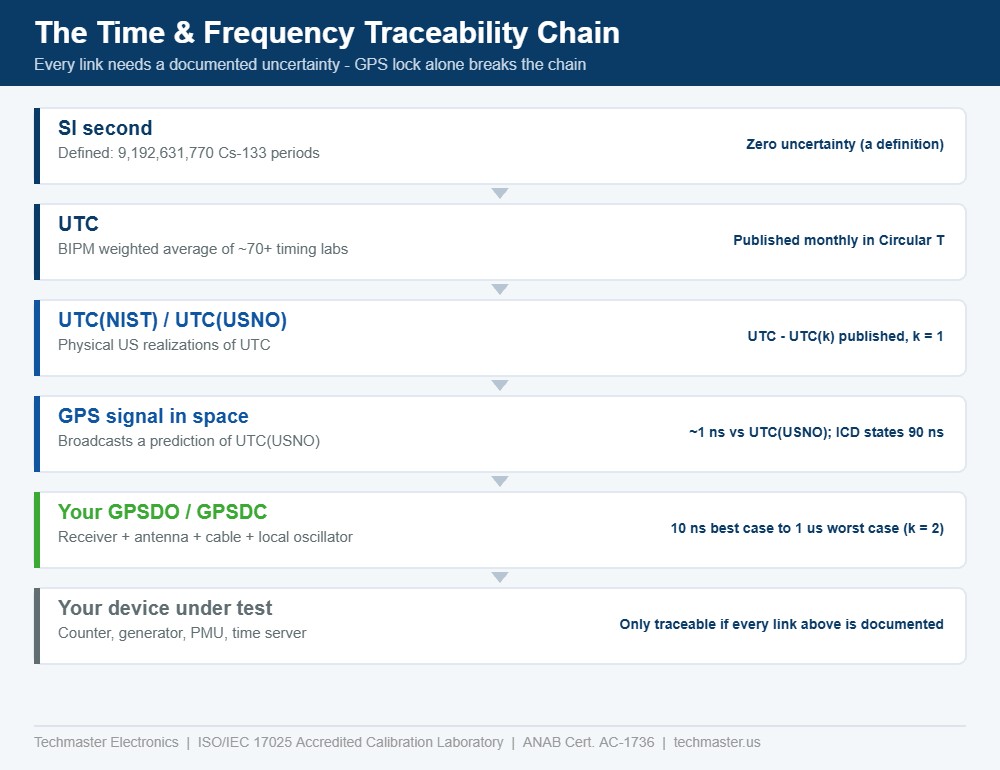
Two details in that chain surprise people. The first is that UTC itself is a paper time scale. It is computed after the fact by the International Bureau of Weights and Measures as a weighted average of more than 70 national timing laboratories, and published monthly in a document called Circular T, typically with 10 to 45 days of latency. You cannot connect a cable to UTC. You connect to a realization, written UTC(k).
The second is that GPS does not carry UTC(NIST). GPS has its own time scale, and the satellites broadcast correction parameters that let a receiver convert GPS time into a prediction of UTC(USNO). Under the America COMPETES Act of 2007, US official time is UTC as interpreted by the Secretary of Commerce in coordination with the Secretary of the Navy, which in practice means NIST is the reference for the financial and electric power sectors while USNO is the source for the Department of Defense and for GPS itself.
That distinction matters when a regulator names a specific reference. If your obligation says UTC(NIST) and your evidence chain runs through GPS, you are relying on UTC(USNO) plus the published relationship between the two. That is a legitimate route, but it is an extra link, and extra links carry extra uncertainty that you are responsible for documenting.
How accurate is a GPSDO in practice, and why does the number vary so much?
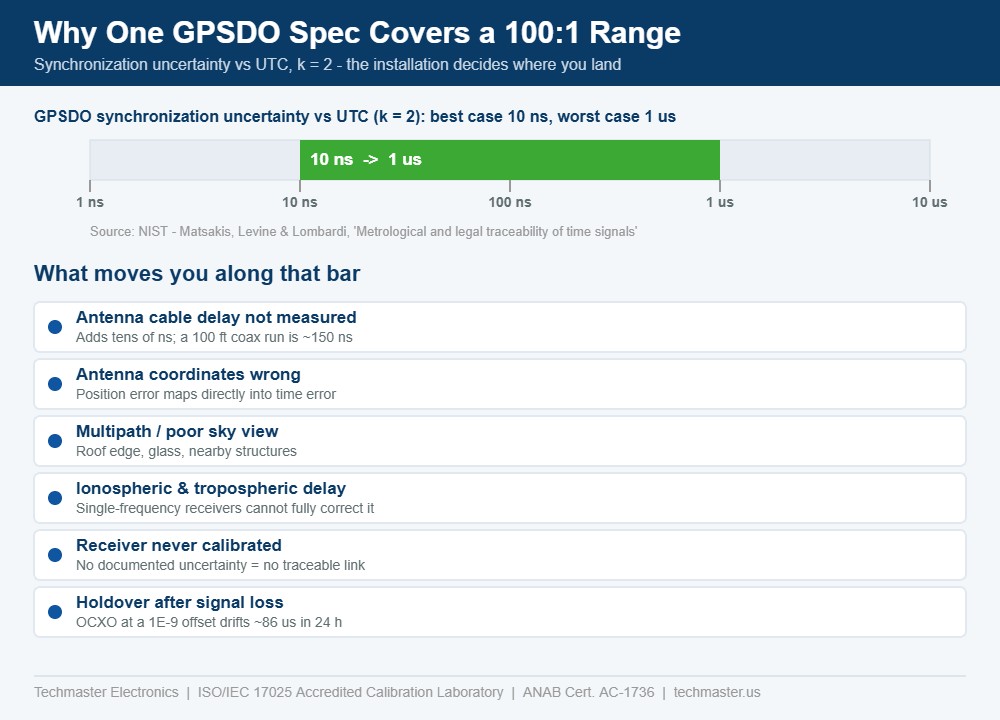
The dominant contributors are unglamorous and physical:
| Contributor | Typical magnitude | How it is resolved |
|---|---|---|
| Antenna cable delay | Roughly 1.2 to 1.5 ns per foot depending on cable type; a 100 ft RG-213 run is near 150 ns | Measure the cable, apply the delay offset in the receiver, record it |
| Antenna coordinate error | Tens of ns for a surveyed-in error of a few meters | Survey the antenna position or let the receiver self-survey and log the result |
| Multipath and sky obstruction | Nanoseconds to tens of ns, environment dependent | Clear sky view, ground plane, elevation mask |
| Ionospheric and tropospheric delay | Nanoseconds; larger for single-frequency receivers | Dual-frequency receiver, or accept it as a Type B term |
| Receiver and internal signal path | Unknown until measured | Accredited calibration against a UTC(k)-referenced standard |
| Local oscillator during holdover | See Table 2 | Specify holdover, alarm on loss of lock |
Notice how many of these are one-time site measurements rather than recurring work. That is the good news: characterizing a GPSDO installation properly is mostly a project, not a treadmill. The recurring part is the periodic calibration that confirms the box itself has not drifted, degraded, or been quietly reconfigured.
For a deeper treatment of how to evaluate these terms formally, Lombardi wrote the standard reference for metrologists and assessors on this exact problem: Evaluating the Frequency and Time Uncertainty of GPS Disciplined Oscillators and Clocks. If you are building the budget itself, our guide to building a measurement uncertainty budget under ISO/IEC 17025 walks through combining Type A and Type B terms.
What happens to traceability when GPS is lost?
This is the part most quality systems have never quantified, and it is the easiest audit finding to avoid. The arithmetic is simple. For a constant fractional frequency offset y, accumulated time error over an interval T is y multiplied by T.
| Local oscillator | Assumed offset | Error after 1 hour | Error after 24 hours | Time to exceed 1 microsecond |
|---|---|---|---|---|
| TCXO | 1 × 10⁻⁸ | 36 microseconds | 864 microseconds | About 100 seconds |
| Standard OCXO | 1 × 10⁻⁹ | 3.6 microseconds | 86 microseconds | About 17 minutes |
| High-stability OCXO | 1 × 10⁻¹⁰ | 360 nanoseconds | 8.6 microseconds | About 2.8 hours |
| Rubidium | 1 × 10-11 | 36 nanoseconds | 864 nanoseconds | About 28 hours |
Read the last column against your actual requirement. If you operate phasor measurement units and need 1 microsecond, a standard OCXO gives you roughly seventeen minutes of grace after an antenna failure before you are out of specification, and nobody gets an alarm because the oscillator is still running perfectly happily. A rubidium reference buys you more than a day. That single column is usually enough to justify the upgrade, or at minimum to justify a loss-of-lock alarm wired into the monitoring system.
Holdover behavior is also where short-term stability metrics earn their keep. If you want to understand what the manufacturer stability curve is really telling you, see our explainer on Allan deviation and oscillator frequency stability.
What synchronization does your industry actually require?
Pinning your requirement to a number first is the single most useful thing you can do, because it decides how much evidence you actually need. Over-engineering a traceability chain to nanoseconds when the regulation says 50 milliseconds wastes money; assuming a GPSDO is automatically good enough when the requirement is 1 microsecond is how findings happen.
| Sector and rule | Reference time source | Requirement |
|---|---|---|
| US markets, FINRA OATS Rule 7430 | NIST | 1 second, manual orders |
| US markets, FINRA Regulatory Notice 16-23 | NIST | 50 ms computer clocks, 1 s mechanical clocks |
| US markets, CAT NMS Plan | NIST | 50 ms automated, 1 s manual, 1 ms timestamp resolution |
| EU markets, MiFID II, non-HFT automated | Any UTC(k) | 1 ms |
| EU markets, MiFID II, high-frequency trading | Any UTC(k) | 100 microseconds, 1 microsecond timestamp resolution |
| Electric power, IEEE C37.118.1 synchrophasors | UTC, typically via GPS | 26 microseconds equals 1 percent TVE; about 1 microsecond in practice |
The synchrophasor row deserves a note because the standard states it indirectly. At 60 Hz, a 26 microsecond timing error corresponds to a phase angle error of 0.57 degrees, which is a 1 percent total vector error. The standard recommends a source at least ten times better than that, which lands near 2.6 microseconds, and in practice utilities design to 1 microsecond, equivalent to a 0.022 degree phase error.
What should an ISO/IEC 17025 time and frequency certificate contain?
When you send a GPSDO, frequency counter, or timing analyzer out for calibration, check the returned certificate against this list:
- Reference standard and its traceability. Which UTC(k) does the laboratory chain back to, and by what method: common-view GPS, a disciplined clock service, or a cesium standard?
- Stated uncertainty with coverage factor. Under the GUM, combined uncertainty is reported with k stated. A k = 2 figure corresponds to roughly 95 percent coverage; k = 1 to roughly 68 percent. A number without k is ambiguous.
- As-found and as-left data. As-found is what supports reverse traceability if the unit turns up out of tolerance and you have to assess what it measured since the last calibration.
- Accreditation mark and scope reference. The certificate should identify the accreditation body and certificate number so an assessor can check the parameter is genuinely on scope, not merely performed by an accredited laboratory.
- Decision rule. If the certificate states conformity, ISO/IEC 17025:2017 requires the decision rule used to be documented.
Those last two points catch people out more than any other. Being accredited is not the same as being accredited for the specific parameter and range you need. Our walkthrough on how to read an ISO/IEC 17025 calibration certificate covers the fine print in detail.
Techmaster published time and frequency capability
For reference, these are the accredited parameters and best measurement uncertainties on the Techmaster Electronics published time and frequency scope, under ANAB Certificate AC-1736 to ISO/IEC 17025:2017:
| Parameter | Range | Best measurement uncertainty |
|---|---|---|
| Frequency | 0.01 Hz to 50 GHz | 1 × 10⁻¹⁰ |
| Time interval | 10 ns to 100 s | 0.5 ns to 10 ns |
| Pulse width and rise time | 1 ns to 1 s | 0.5 ns to 5 ns |
| Rotational speed | 1 to 100,000 RPM | 0.01 percent to 0.1 percent |
| Stopwatch and timer | 1 s to 24 h | 0.01 s to 0.1 s |
| Stroboscope | 100 to 300,000 FPM | 0.02 percent to 0.1 percent |
Techmaster has run accredited calibration laboratories since 1989 and holds ISO/IEC 17025:2017 accreditation under ANAB Certificate AC-1736 at four US laboratories: Vista and Santa Clara in California, Orlando in Florida, and San Antonio in Texas. Full details of the discipline are on our time and frequency calibration page, part of the wider calibration services portfolio.
Key takeaways
- GPS lock is a control-loop state, not a calibration. GPSDO traceability is established by a certificate with a stated uncertainty, not by a lock LED. Traceability is a property of a measurement result, never of a system, an instrument, or an organization.
- The 100:1 spread is real. NIST places GPSDO synchronization uncertainty between about 10 ns and about 1 microsecond at k = 2, and the installation decides which end you get.
- Measure the cable and the antenna position. A 100 ft coax run is roughly 150 ns of uncorrected delay if nobody enters the offset.
- Know your holdover number. A standard OCXO exceeds 1 microsecond about seventeen minutes after losing lock; a rubidium reference takes about 28 hours.
- Fix the requirement first. 50 ms under FINRA and 100 microseconds under MiFID II for HFT demand very different evidence.
- Check scope, not just accreditation. Confirm the parameter and range appear on the laboratory certificate of accreditation.
Frequently asked questions
Is a GPS-disciplined oscillator traceable to NIST?
Not automatically. GPS satellites broadcast a prediction of UTC(USNO), not UTC(NIST), so a GPSDO chains back to the US Naval Observatory realization of UTC. Traceability to UTC(NIST) can still be established through the published relationship between the two realizations, or directly through a NIST common-view or disciplined-clock service, but either route has to be documented with its own uncertainty.
How often should a GPS-disciplined oscillator be calibrated?
Most laboratories calibrate annually, then adjust the interval using reliability data from as-found results. ILAC guidance expects calibration at regular intervals as part of establishing traceability, and ISO/IEC 17025:2017 requires intervals to be justified rather than arbitrary. Continuous monitoring of the lock status and the local oscillator control voltage can support a longer interval, provided the monitoring records are retained.
What uncertainty should I claim for my GPSDO?
Claim a number you can defend with measurements, not the manufacturer datasheet figure. NIST puts real-world GPS-disciplined clock synchronization uncertainty between roughly 10 ns and 1 microsecond at k = 2. Your value depends on the cable delay correction, antenna coordinates, receiver calibration, and sky view. Anything you cannot evidence should be carried as a Type B contribution.
Does a loss of GPS signal break my traceability?
It does not break the chain retroactively, but it starts an error that grows with time. During holdover your output is a free-running oscillator, so accumulated time error equals the fractional frequency offset multiplied by elapsed time. A standard OCXO at 1 part in 10 to the ninth exceeds 1 microsecond in about seventeen minutes. Log every loss-of-lock event with its duration so the exposure can be assessed later.
Is a rubidium standard better than a GPS-disciplined oscillator?
They solve different problems, and the best timing references combine both. A rubidium standard has excellent short and medium-term stability and long holdover, but it ages and will drift away from UTC without steering. A GPSDO supplies the long-term steering that removes that drift. A rubidium oscillator disciplined by GPS gives you accuracy from the satellites and robustness during outages.
Can I use a network time server instead of GPS for traceability?
Yes, for requirements measured in milliseconds. NTP over the public internet is typically limited by network asymmetry, and the worst-case time error is half the round-trip delay, so a 100 ms round trip supports uncertainties of a few milliseconds at best. That satisfies the 50 ms FINRA computer-clock requirement but not the 100 microsecond MiFID II high-frequency trading requirement or synchrophasor timing.
Need an accredited time and frequency calibration?
Techmaster Electronics calibrates GPS-disciplined oscillators, frequency counters, and timing instruments to ISO/IEC 17025:2017 under ANAB Cert. AC-1736, with certificates that state the reference, the uncertainty, and the coverage factor.
Request a quoteRelated reading: how the frequency counter time base decides your measurement accuracy

Khanh Nguyen is the Marketing Manager at Techmaster Electronics, a B2B marketing leader covering the test, measurement, and ISO/IEC 17025 accredited calibration industry across the US and Vietnam markets.