
TL;DR: Extending an interval is a decision you have to earn. Auditors accept six things: three or more cycles of in-tolerance as-found data, a stated reliability target (commonly 90–95%), a criticality and risk assessment, adequate measurement margin (TUR and guard-banding), a written, approved rationale, and ongoing monitoring with a reversal rule. Without the documentation, an extended interval reads exactly like an overdue instrument.
Interval extension is the biggest legitimate saving in most calibration budgets, and the fastest way to a finding when it’s done on instinct. The difference is entirely in the evidence.
What evidence supports an extension?
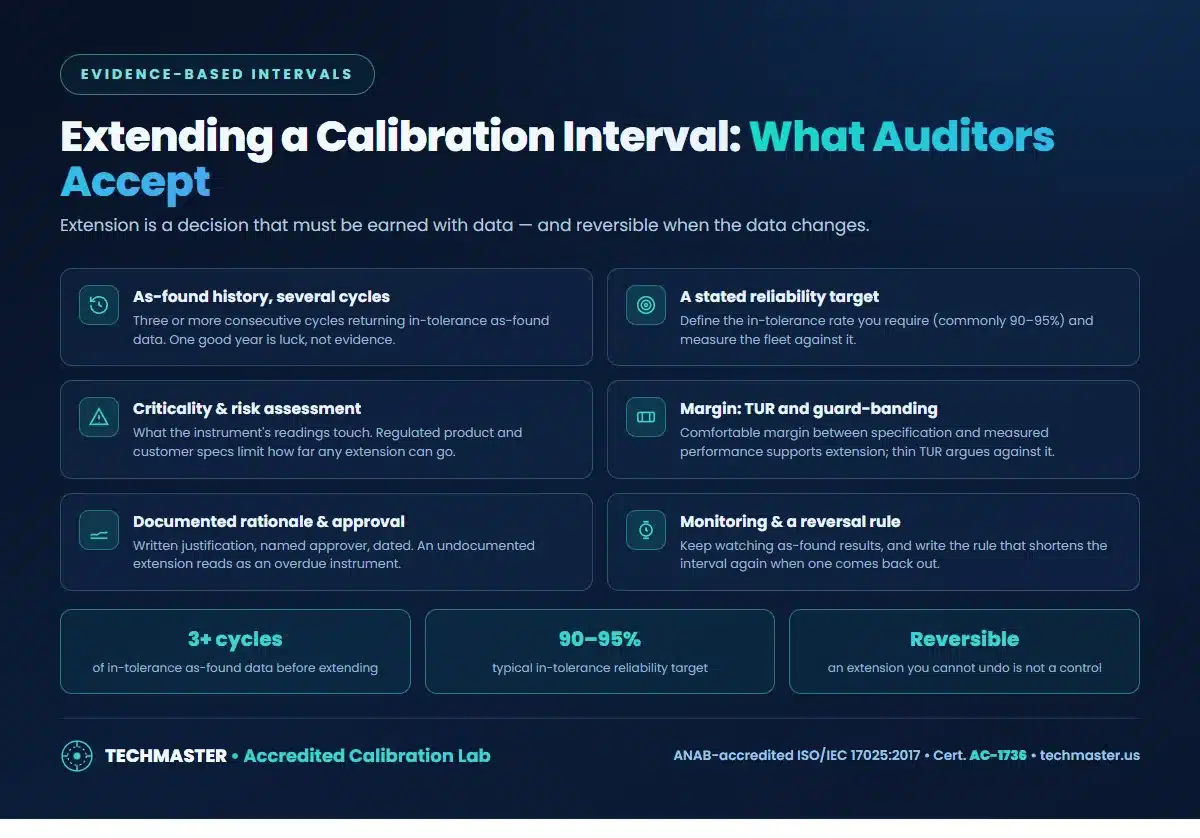
As-found history is the foundation, and it must be genuinely as-found, measured before any adjustment. This is why the distinction in calibration vs verification vs adjustment matters commercially: a lab that silently adjusts before measuring leaves you unable to justify anything. A reliability target turns anecdote into a rule. Criticality caps how far you can go regardless of data. Margin, how much room sits between specification and measured performance, and what your TUR looks like (measurement uncertainty explained), determines how much risk an extension actually adds.
The two parts people skip
The written rationale with a named approver. An extension living in someone’s head is indistinguishable from neglect when an auditor finds a 24-month gap. The reversal rule. Extension is not permanent: write down what happens when an instrument in the extended group comes back out of tolerance, typically that unit returns to the shorter interval and the group’s data gets re-examined. That rule is what makes the extension a control rather than a hope. Both belong in the same procedure that governs your recall system.
When not to extend
Leave the interval alone for instruments whose data reaches regulated product or customer specifications, for references and calibrators whose error propagates to everything they touch, for units with a history of out-of-tolerance findings, and for anything that travels or lives in a harsh environment. Also weigh the asymmetry: a longer interval means any OOT discovery covers a longer stretch of measurements, and that investigation usually costs more than the calibration you skipped. Cheaper levers exist, see the calibration budget guide.
Frequently asked questions
Can I extend a calibration interval beyond 12 months?
Yes, if you can show why. Auditors accept extensions supported by evidence: several consecutive cycles of in-tolerance as-found data, a stated reliability target, a criticality assessment, adequate measurement margin, a written and approved rationale, and continued monitoring with a rule for shortening the interval again.
How much as-found history do I need before extending an interval?
Three or more consecutive cycles returning in-tolerance as-found results is the common threshold. One good cycle is not evidence, it may simply mean the instrument had an easy year. The data must be as-found, taken before any adjustment, which is why certificates without as-found readings cannot support an extension.
What reliability target should I use?
Most programs target 90–95% of instruments in a group returning in-tolerance at calibration. If the group falls below the target, intervals shorten; if it sits comfortably above over several cycles, extension can be justified. State the target in your procedure so the decision rule is not invented after the fact.
Can extending intervals cost more than it saves?
It can. A longer interval means more time at risk, so an out-of-tolerance finding covers a longer period of measurements and a larger product-impact assessment. For critical instruments the investigation cost and product risk usually outweigh the saved calibration fee, which is why criticality has to be part of the decision.
The bottom line
Extend on data, document the reasoning, keep watching, and be willing to reverse. Ask your lab for as-found data on every certificate, without it, no extension is defensible. Techmaster supplies as-found/as-left data on accredited certificates as standard (ANAB Cert. AC-1736).
Get an accredited calibration quote
ANAB-accredited ISO/IEC 17025:2017 (Cert. AC-1736) • 5 US labs • 5-day standard, 1–2 day expedite • in-lab or on-site.
Request a quote
Khanh Nguyen is the Marketing Manager at Techmaster Electronics, a B2B marketing leader covering the test, measurement, and ISO/IEC 17025 accredited calibration industry across the US and Vietnam markets.