
Standard Weight Calibration
Accuracy across the range
How Standard Weight calibration works
- Intake & visual inspection
- Environmental stabilization
- As-found measurement
- Comparison to NIST-traceable standards
- Adjustment if required
- As-left results & certificate
Your calibration, covered
In-lab vs on-site calibration
In-lab calibration
- Lab bench with full reference standards
- Best achievable measurement uncertainties
- Pickup & return logistics handled
- Ideal for precision and reference work
On-site calibration
- We calibrate the Standard Weight at your facility
- No shipping risk or transit downtime
- As-found data captured before any move
- Ideal for fixed, large or sensitive assets
In-depth guide
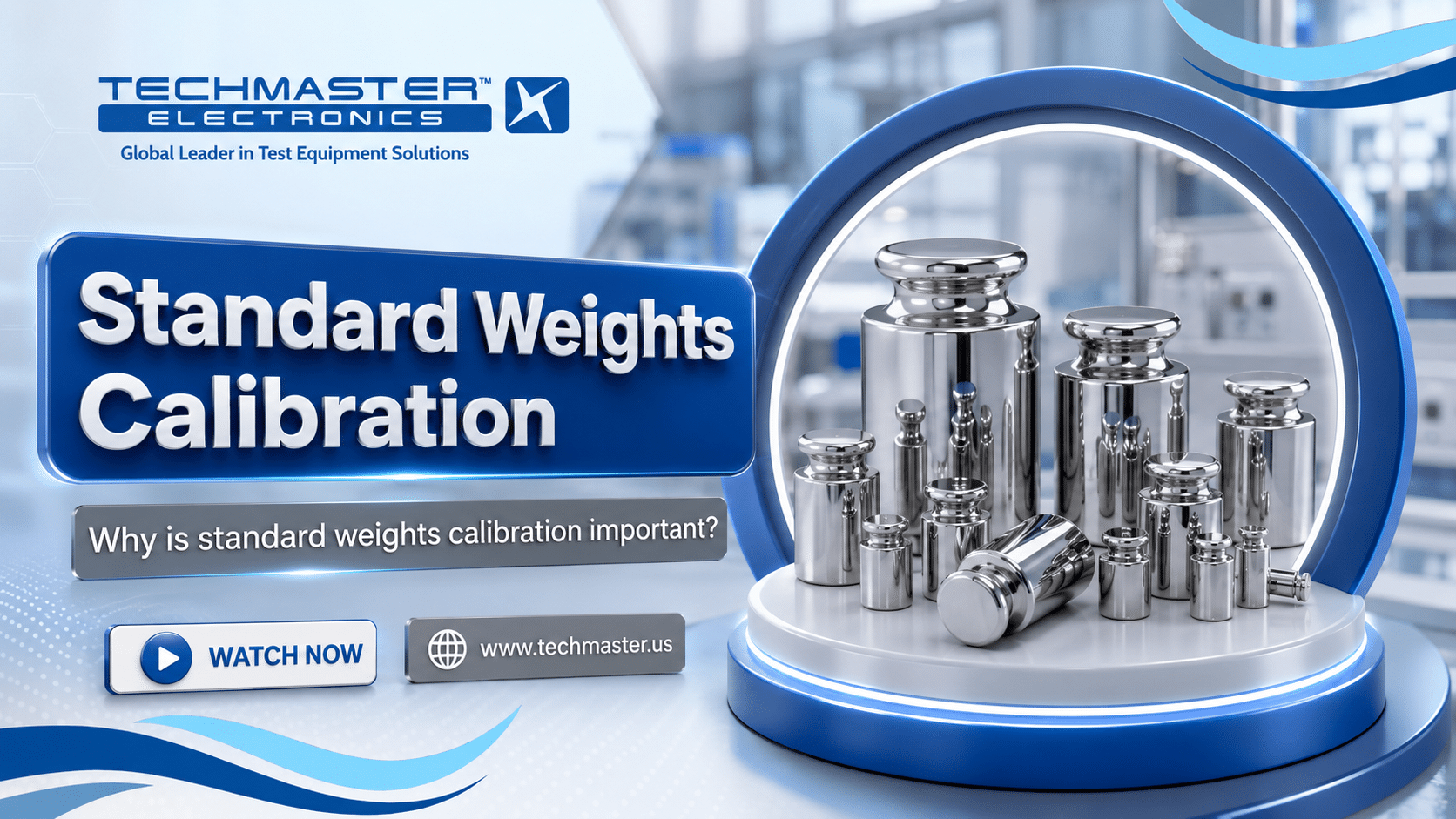
Standard weights calibration is the process of verifying and adjusting standard weights to ensure accurate and reliable measurements. This calibration is essential for industries that require high precision, such as pharmaceuticals, laboratories, aerospace, and manufacturing.
This calibration falls under our mass and mechanical calibration service.
Proper calibration ensures compliance with international standards like OIML (International Organization of Legal Metrology) and ASTM (American Society for Testing and Materials), as well as ISO 17025 certification for traceability and accuracy.
Class 1 weighing standards sit near the top of the ASTM E617 accuracy classes; see how small Class 1 weights from 1 mg to 20 g are calibrated and what their certificate should show.

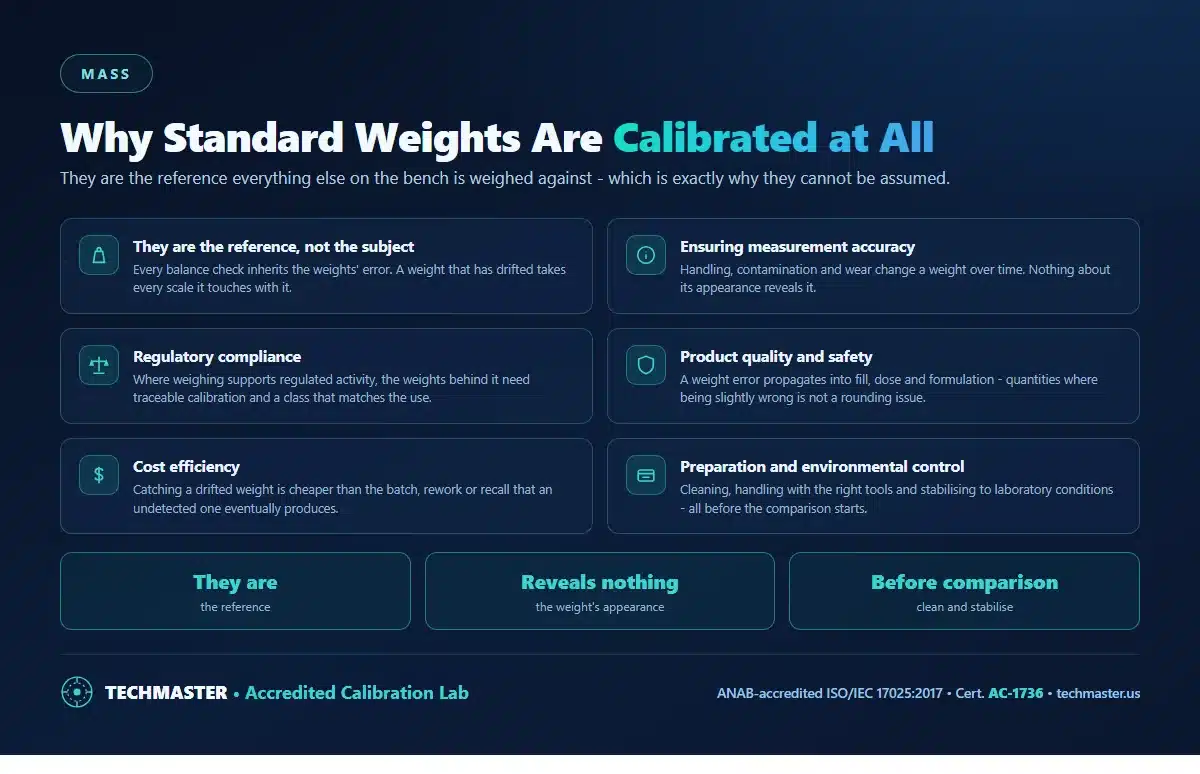
Why is standard weights calibration important?
Accurate weight calibration is essential in various industries to maintain measurement integrity and ensure compliance with international standards. Here’s why it’s important:
Ensures Measurement Accuracy
Calibration helps prevent errors in weighing equipment used in laboratories, manufacturing, and quality control. Even minor inaccuracies in standard weights can lead to significant deviations in measurements, affecting processes like:
- Laboratory testing: Ensuring reliable scientific and pharmaceutical research.
- Manufacturing & Production: In particular, maintaining consistency in material usage and product specifications.
- Quality Control: Verifying product compliance before distribution.
Regulatory Compliance
Different industries must meet strict calibration standards to ensure traceability and precision. Standard Weights Calibration aligns with:
- OIML R111 – International classification for calibration weights.
- ASTM E617 – U.S. standard for laboratory weight calibration.
- ISO 17025 – Ensures accredited laboratories provide traceable and reliable calibration results.
Compliance with these standards prevents regulatory violations, which can lead to operational disruptions and legal consequences.
Product Quality & Safety
Weight inaccuracies can lead to inconsistent product quality, which is especially critical in:
- Pharmaceuticals: For example, precise ingredient measurement to maintain drug efficacy and safety.
- Food Production: Ensuring correct portioning and compliance with food safety regulations.
- Aerospace & Automotive: Furthermore, Maintaining weight balance in critical components.
A well-calibrated weight system helps significantly avoid defects, recalls, and safety hazards caused by measurement errors.
Cost Efficiency
Regular calibration plays a critical role in reducing financial losses by addressing several key cost factors: Product recalls: Incorrect weight-based measurements can lead to product defects, which may go unnoticed until the product reaches the market. This can result in costly product recalls that damage a company’s reputation and customer trust. Furthermore, the logistics costs of recalling products and compensating consumers can be substantial. Non-compliance penalties: Regulatory bodies like the FDA, ISO, and EPA impose strict requirements on industries such as pharmaceuticals, food production, and aerospace. Failure to comply with calibration standards can result in severe penalties, fines, and even legal action. In industries where non-compliance may lead to suspension of operations, the financial consequences can be devastating. Wasted raw materials: Inaccurate weight measurements lead to overuse of raw materials. For instance, if a manufacturing process consistently overestimates the weight of ingredients or materials, companies may end up using more resources than necessary, driving up production costs. Additionally, the excess material may go to waste if it doesn’t meet product specifications.Calibration process for standard weights
The standard weights calibration process typically includes the following steps:1. Preparation & Environmental Control
- Ensure a controlled environment with stable temperature and humidity.
- Use an accredited calibration laboratory with traceable reference standards.
2. Visual Inspection & Cleaning
- Check weights for visible damage, corrosion, or contamination.
- Clean weights using appropriate methods to remove dust or residues.
3. Weighing & Comparison
- Weigh the standard against a traceable reference weight.
- Perform multiple measurements to ensure consistency.
4. Adjustment & Certification
- If discrepancies are found, adjustments are made.
- A calibration certificate is issued with details like measurement uncertainty and compliance to standards.
Applications of standard weights calibration
Industries that rely on standard weights calibration include:- Laboratories: For calibrating analytical and precision balances.
- Pharmaceuticals & Healthcare: Ensuring accurate dosage measurements.
- Manufacturing & Production: Maintaining consistency in product weight measurements.
- Aerospace & Automotive: Ensuring compliance with strict quality control measures.
- Jewelry & Precious Metals: Verifying weight accuracy for high-value materials.
Choosing a standard weights calibration service provider
Selecting a reliable calibration service provider is essential for compliance and accuracy. Consider:- Accreditation to ISO 17025 standards.
- Use of traceable reference weights.
- Detailed calibration certificates with measurement uncertainties.
- Compliance with industry-specific requirements.
Conclusion
Standard weights calibration is vital for ensuring precise and reliable measurements across various industries. Adhering to standards like OIML, ASTM, and ISO 17025 ensures compliance, accuracy, and efficiency. Regular calibration not only maintains measurement integrity but also prevents costly errors in production and quality assurance. For professional Standard Weights Calibration Services, ensure you choose an accredited provider to meet your compliance needs. Contact us today to learn more about our calibration solutions!
Air Buoyancy Correction in Mass Calibration: Altitude, Density and Real Error Budgets
Air buoyancy correction explained with the NIST SOP 2 formula: how altitude and artifact density...
Aug

ASTM E4 vs ISO 7500-1: Which Force Verification Does Your Tensile Tester Need?
ASTM E4-24 or ISO 7500-1:2018? The test method you run decides which force verification your...
Aug
USP <41> Minimum Weight: How to Calculate It on an Analytical Balance
USP minimum weight is calculated, not specified: 2s divided by 0.001 from a 10-weighing repeatability...
Aug
Deadweight Tester vs. Digital Pressure Calibrator: Which Does Your Lab Need?
Deadweight tester or digital pressure calibrator? How each works, the gravity/buoyancy/temperature corrections, typical accuracy, pressure...
Jul
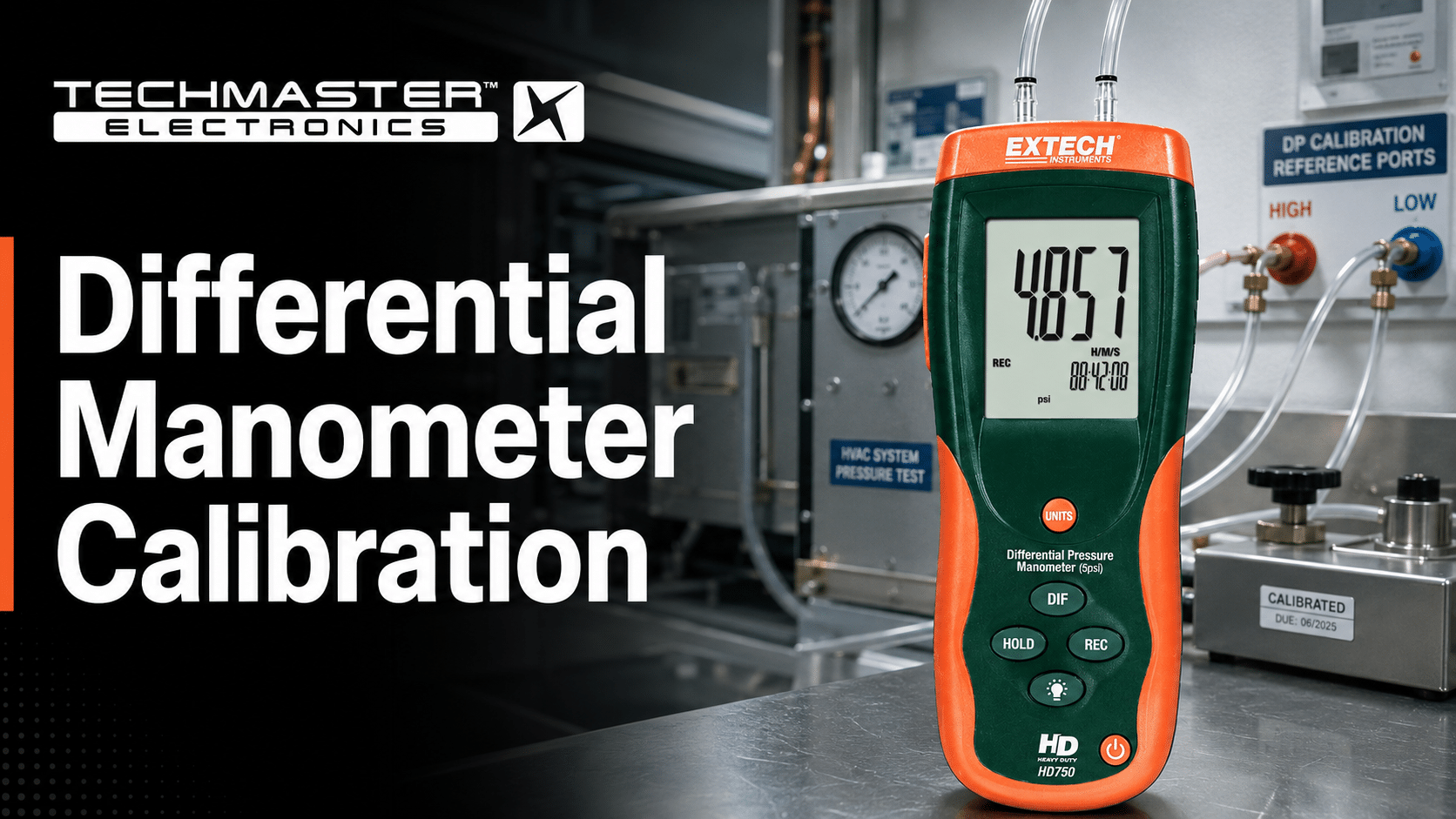
Differential Manometer Calibration: Solve Drift Pain
Home » Standard Weights CalibrationIndustrial environments rely on absolute precision to maintain safety, ensure product...
Jun
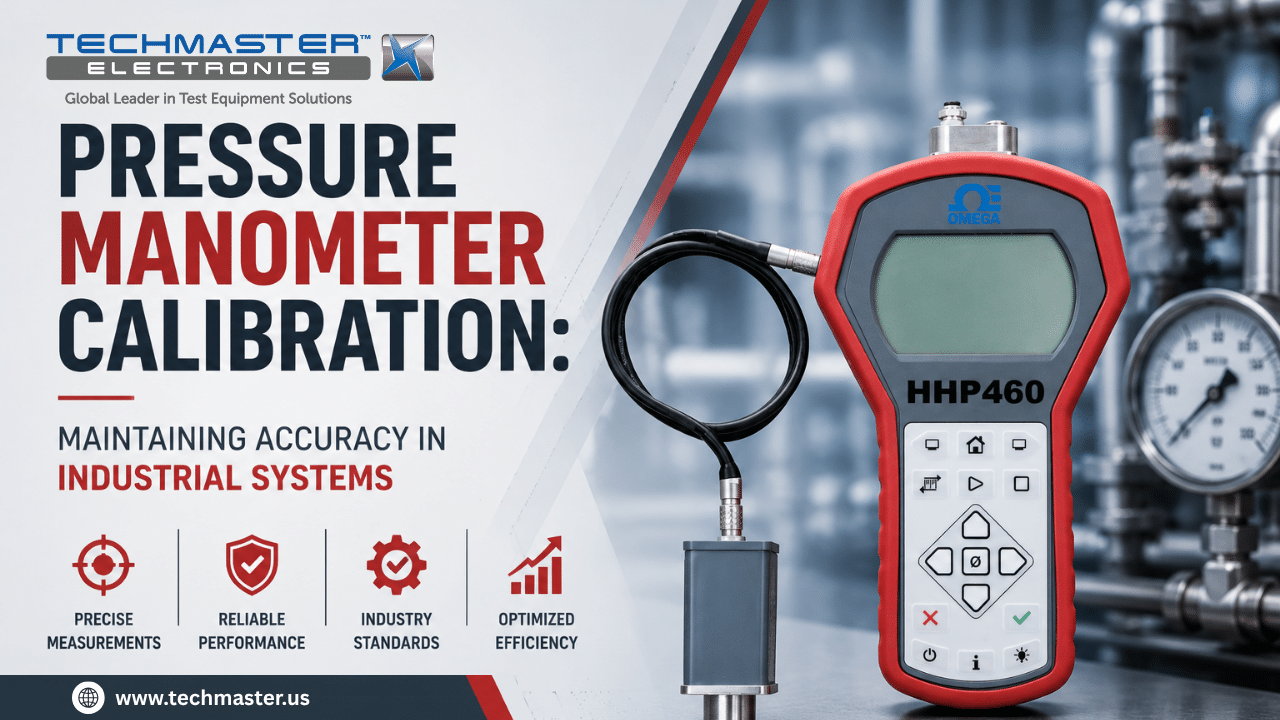
Pressure Manometer Calibration in Industrial Systems
Home » Standard Weights Calibration Metrology guide · ISO/IEC 17025 · ANAB-accredited Pressure Manometer Calibration...
Jun
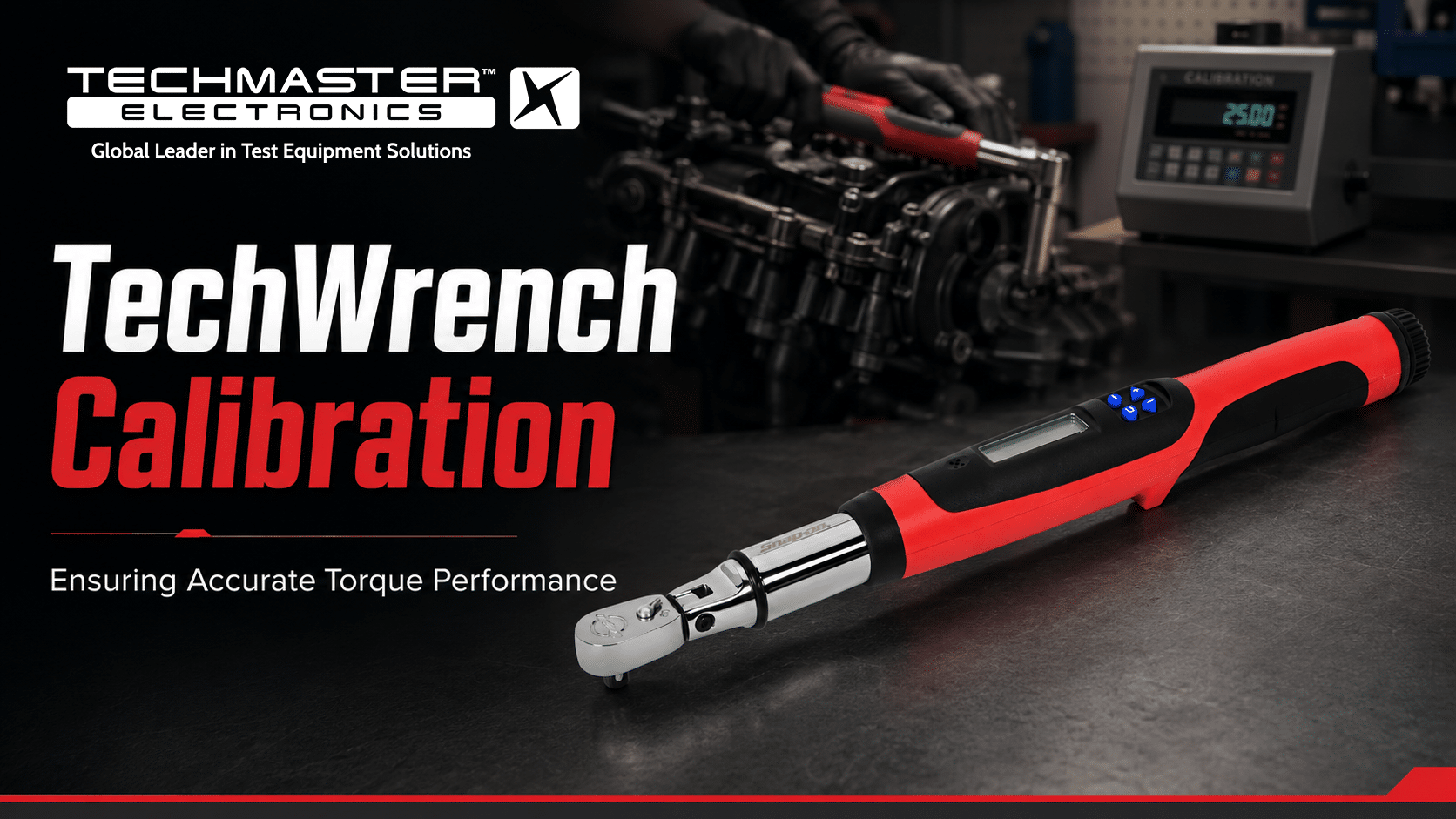
Techwrench Calibration: The Technical & Compliance Guide
Home » Standard Weights Calibration Metrology guide · ISO/IEC 17025 · ANAB-accredited Techwrench Calibration Techwrench...
Jun
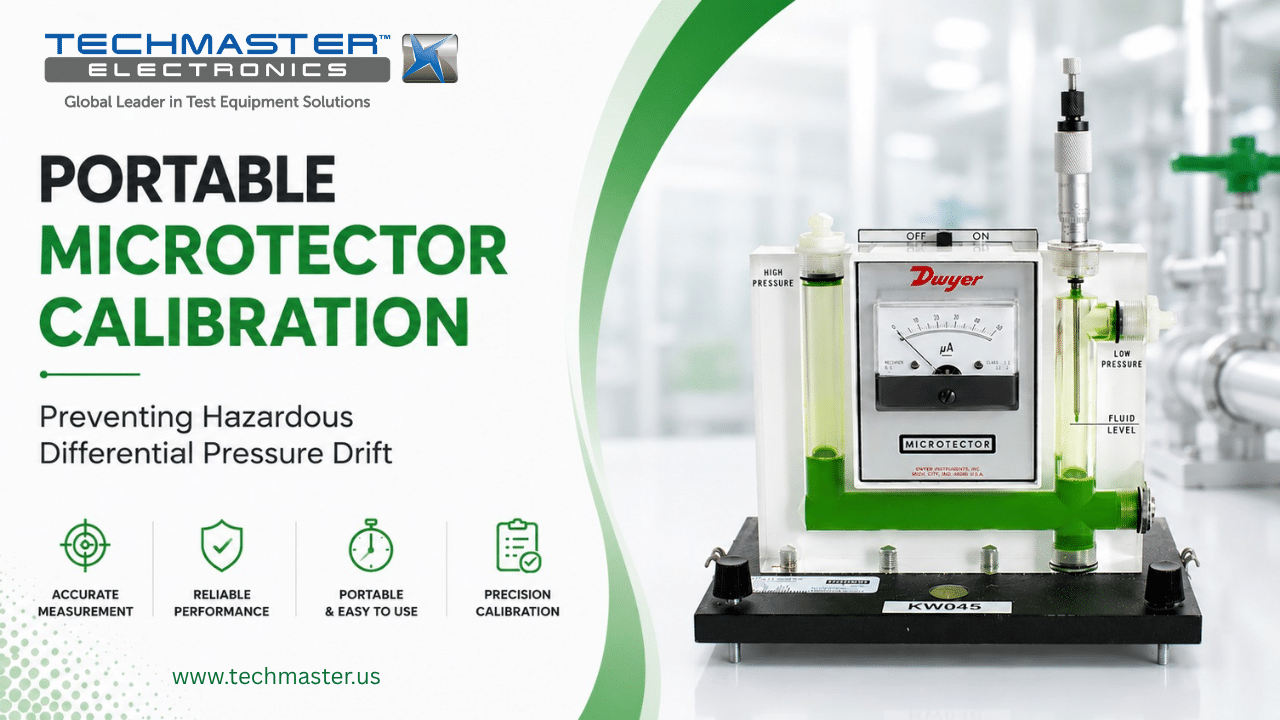
Portable Microtector Calibration: Preventing Pressure Drift
Home » Standard Weights Calibration Metrology guide · ISO/IEC 17025 · ANAB-accredited Portable Microtector Calibration...
Jun
Weight Classes, NIST Tolerances and How Test Weights Are Calibrated
A test weight is only as good as the class it is certified to. In the US, three systems cover almost every weight you will meet:
- ASTM E617: Classes 000 through 7, from the tightest laboratory standards down to rough industrial weights. Analytical-balance work usually calls for Class 1 or better.
- OIML R111: Classes E1, E2, F1, F2, M1 and below. You will see these on weights from European makers and in international supply chains.
- NIST Handbook 105-1: Class F field standards, used by weights-and-measures inspectors and scale service companies to test commercial scales.
Each class sets a maximum permissible error for each nominal value. This is what people mean by “NIST weight tolerances”. A 100 g weight can be in tolerance for Class 4 and out of tolerance for Class 1 with exactly the same measured error.
How the calibration is done
Weights are calibrated by comparison, not by weighing them on a scale and reading the display. Each weight is compared with a reference standard of the same nominal value on a mass comparator, in a repeated sequence (for example A-B-B-A) that cancels drift. The report gives the conventional mass or the correction from nominal, the measurement uncertainty, and whether the weight is within the tolerance of its class. A weight that is out of tolerance can sometimes be adjusted. Otherwise it is reclassified to a lower class rather than discarded.
Handling between calibrations
Most drift on a good weight comes from handling: fingerprints, dust, corrosion and dropped pieces. Use gloves or tweezers, keep the weights in their case, and recalibrate any weight that has been dropped or shows marks. Set the interval by how often a weight is used and what it is used for. Reference weights that only check other weights can usually run longer than working weights handled every day.
Weights and the balances they check
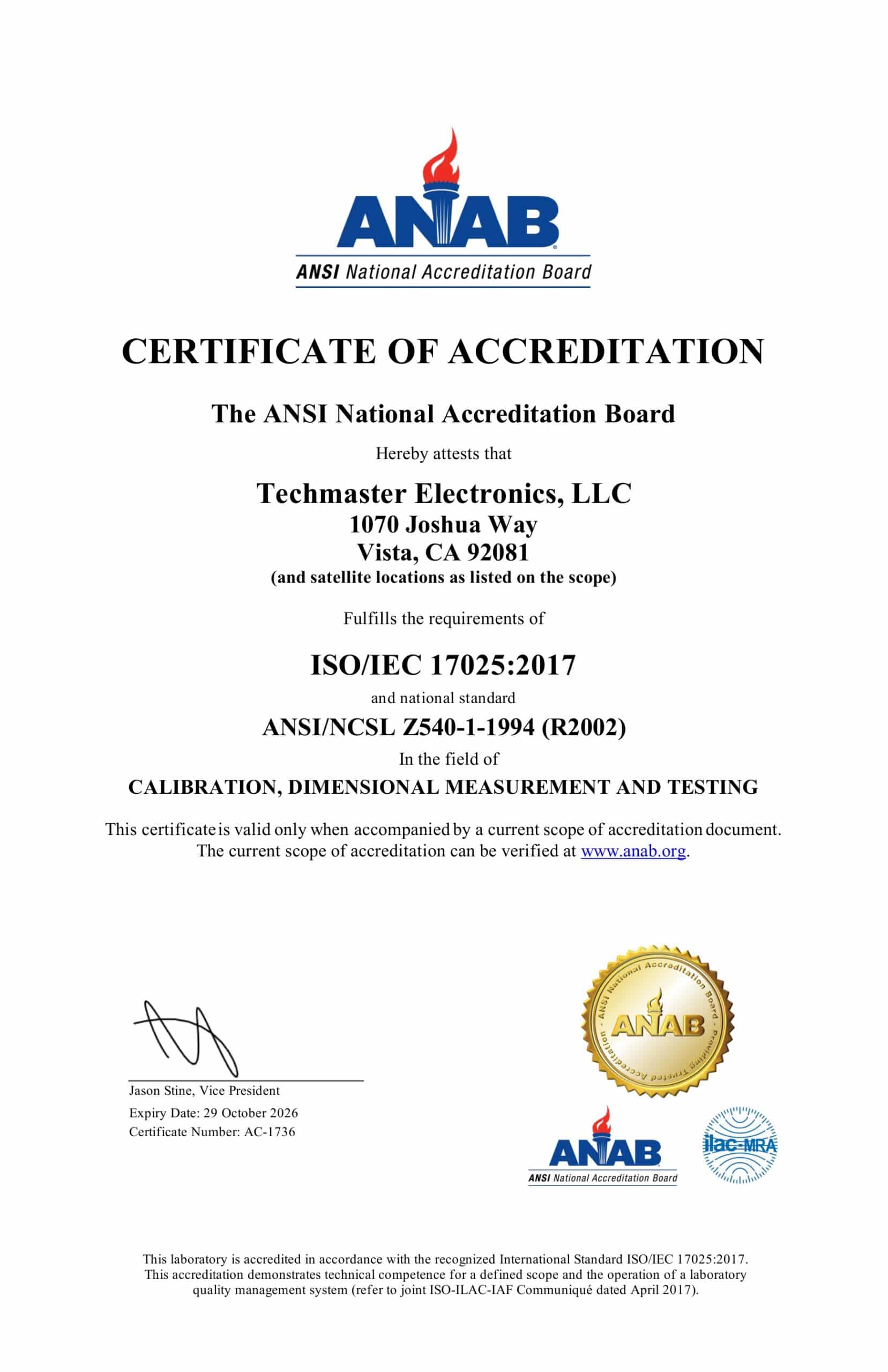
Test weights exist to verify scales and analytical balances, so it makes sense to calibrate both on the same cycle. Techmaster’s accredited mass work covers scales and balances: it is on our ANAB scope (certificate AC-1736) using ASTM E617 Class 0 reference weights. Weight sets sent in on their own are calibrated with NIST traceability. If your quality system requires an ISO/IEC 17025 accredited certificate for the weights themselves, tell us before you ship. Weights travel well, so customers anywhere in the US can send them to the nearest Techmaster lab.
Frequently asked questions
What is Standard Weight Calibration?
How often should a Standard Weight be calibrated?
What standards apply to Standard Weight Calibration?
What is included on the certificate?
Can you calibrate the Standard Weight on-site?
Need Standard Weight calibration?
NIST-traceable calibration, fast turnaround — in-lab or on-site across the USA.
Contact us for a quoteReferences & industry standards
- ISO/IEC 17025 testing & calibration laboratory requirements
- NIST calibration services and measurement traceability
- NIST Mass and Force Group
- A2LA / ANAB accreditation for calibration laboratories
External standards bodies. Techmaster Electronics is an ISO/IEC 17025-accredited, NIST-traceable calibration laboratory.
Related reading: How to calculate USP <41> minimum weight on an analytical balance

Khanh Nguyen is the Marketing Manager at Techmaster Electronics, a B2B marketing leader covering the test, measurement, and ISO/IEC 17025 accredited calibration industry in the United States.