
TL;DR: Current is measured indirectly, so calibration has to cover the transducer ratio (mV per amp), frequency response, zero drift, shunt value and temperature coefficient, and, for power work, phase shift. Calibrate the probe, conditioner and meter as a chain where they are used as a set. Typical interval: 12 months.
Almost nothing measures current directly. A probe, clamp or shunt converts current into a voltage, and something else measures that voltage. Every link in that chain has its own error, and the certificate for one link says nothing about the others.
What does current probe and shunt calibration verify?
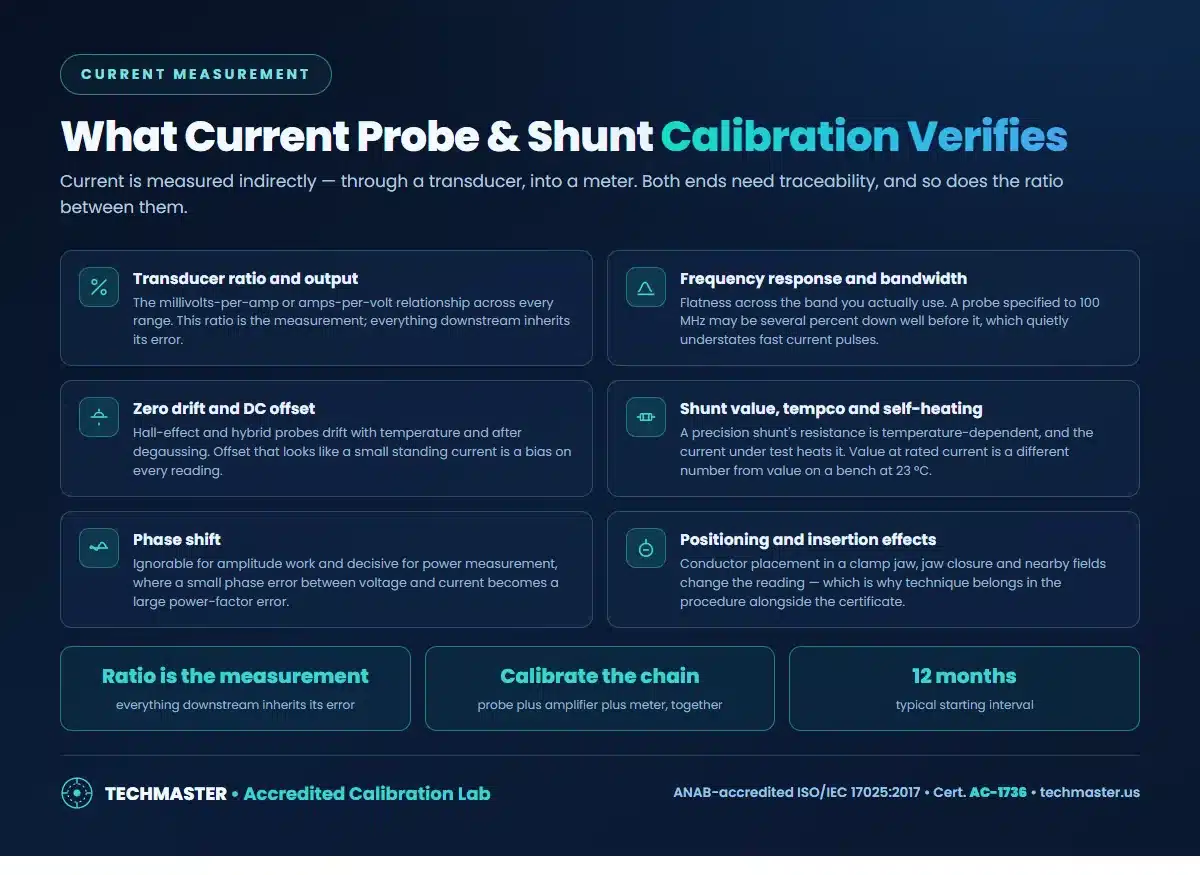
The transducer ratio is the measurement. Millivolts per amp, verified across every range you use, because everything downstream simply inherits its error. Frequency response matters more than most users assume: a probe specified to a given bandwidth can be several percent down well below that figure, which quietly understates fast switching currents. Zero drift and DC offset affect Hall-effect and hybrid probes in particular, offset looks exactly like a small standing current and never announces itself. Shunts bring their own problem: resistance is temperature-dependent and the current under test heats the shunt, so the value at rated current is not the value measured cold. And conductor position within a clamp jaw changes the reading enough that technique belongs in the written procedure alongside the certificate.
Calibrate the chain, not just the probe
Where a probe, its amplifier and a specific oscilloscope or multimeter are used together as a fixed set, calibrate them that way. Chain calibration captures loading and interface effects that individual certificates cannot. If instead the parts rotate freely, calibrate them individually and account for the combined uncertainty honestly, the arithmetic is in measurement uncertainty explained, and the practical consequence is that your real measurement uncertainty is larger than the best certificate in the stack.
Where current measurement bites
Three situations reward attention. Power and efficiency testing, where phase error becomes power error. Compliance work, where current probes feed EMC measurements that produce a pass or fail against a limit line. And logged current data, where a probe feeds a data acquisition system and an offset error becomes a permanent bias across an entire dataset. In all three the reading is used as evidence, which is the test for whether you need as-found data, see calibration vs verification.
What to ask for
Specify the ranges and frequencies you actually use, say whether you need phase response, and state whether the probe should be calibrated with its amplifier. Confirm the laboratory’s accredited scope covers current at your ranges using how to read an accreditation scope, and note that ambient conditions affect shunt work, see how lab environment changes your measurements. Probes used alongside supplies are worth sending together on one recall date.
Frequently asked questions
What does current probe calibration verify?
The transducer ratio, millivolts of output per amp of input, across every range, plus frequency response and bandwidth flatness, zero drift and DC offset, phase shift, and the effect of conductor position within the jaw. For shunts, it verifies the resistance value, its temperature coefficient, and behaviour under load current rather than on a cold bench.
Should the probe be calibrated together with its amplifier and meter?
Yes where the parts are used as a fixed set. Current measurement is a chain: transducer, amplifier or conditioner, then the measuring instrument. Calibrating the chain as used captures interactions the individual certificates miss. If parts are interchanged freely across a fleet, calibrate them individually and understand that the combination uncertainty is larger than any single certificate suggests.
Why does phase shift matter for current probes?
For amplitude measurements it usually does not. For power measurement it decides the result: power depends on the phase relationship between voltage and current, so a small phase error in the current path becomes a disproportionately large power-factor error. If the probe is used for power or efficiency work, phase response belongs on the certificate.
How often should current probes and shunts be calibrated?
Twelve months is the standard starting interval, adjusted on documented as-found history. Hall-effect probes used in variable-temperature environments and shunts routinely run near their power rating are the two cases where shortening the interval usually pays for itself.
The bottom line
Verify the ratio across ranges and frequency, watch zero drift and shunt self-heating, and calibrate the chain the way you use it. Techmaster calibrates current probes, shunts and clamp meters under ANAB accreditation to ISO/IEC 17025:2017 (Cert. AC-1736).
Get an accredited calibration quote
ANAB-accredited ISO/IEC 17025:2017 (Cert. AC-1736) • 5 US labs • 5-day standard, 1–2 day expedite • in-lab or on-site.
Request a quote
Khanh Nguyen is the Marketing Manager at Techmaster Electronics, a B2B marketing leader covering the test, measurement, and ISO/IEC 17025 accredited calibration industry in the United States.