
TL;DR: Modern scopes rarely wear out; they fail in a handful of repairable ways. Oscilloscope repair requests are mostly will not power up, a dead or noisy channel, self-test or self-cal failures, timebase and trigger faults, and display, encoders and keys, plus legacy models the manufacturer no longer supports. Repaired in our own laboratories and recalibrated before return.
Oscilloscopes were one of the larger clusters in the requests reaching our labs over the last quarter, and the repair requests had a pattern: a university laboratory with a digital storage scope that would not power up and an experiment built around it; contract manufacturers with scopes that had lost a channel. Neither situation is served by a quote for a new instrument.
Which oscilloscope faults are worth repairing?
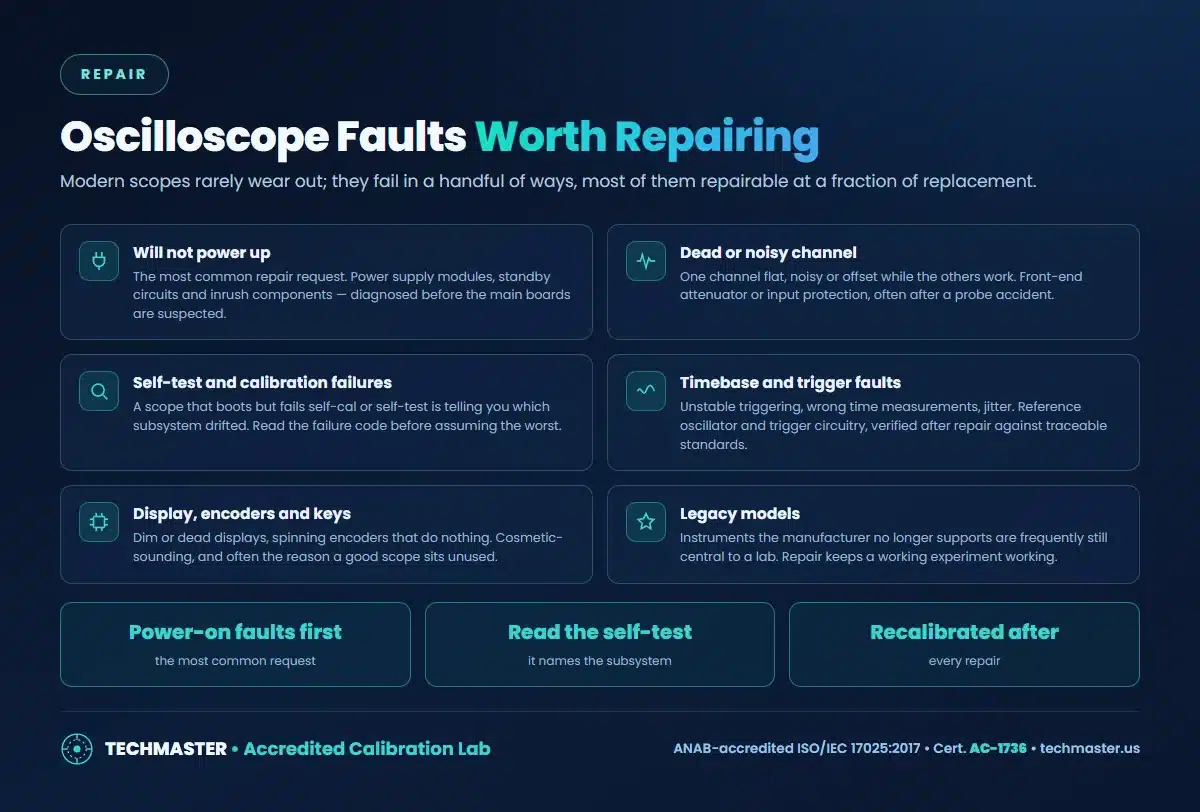
Power-up faults first, because they are the most common request and most often a supply module or standby circuit. A dead or noisy channel is usually the front-end attenuator or input protection after a probe accident. A scope that boots but fails self-test is naming the subsystem that drifted, read the code before assuming the worst. Unstable triggering and wrong time measurements point to the reference oscillator or trigger circuitry. And dim displays and spinning encoders are the cosmetic-sounding faults that leave a good scope unused.
What about scopes the manufacturer has retired?
They are frequently the instruments that matter most. A research laboratory’s experiment is built around a specific scope’s behaviour; a production line’s fixture was designed for a specific model. Repair keeps the setup working, and parts availability is confirmed at evaluation rather than assumed. The point is made from the other direction in oscilloscope functionality and applications: the capability you rely on is the scope’s, not the badge’s.
Why does repair end in calibration?
Because self-cal is not calibration, and a repaired scope has not yet proven anything. Vertical gain and offset on every channel, timebase, trigger sensitivity and bandwidth are verified against traceable standards after the fault is fixed, the procedure in oscilloscope calibration, step by step, with the interval afterwards set per how often to calibrate an oscilloscope. Mixed-signal instruments add their own checks, covered in mixed-signal oscilloscope calibration.
What bandwidth can be verified after repair?
Techmaster’s accredited oscilloscope verification uses leveled sine to 2.1 GHz with square wave, time markers and programmable edge and rise-time standards at its Vista, Santa Clara and Orlando laboratories, and to 600 MHz with a wave generator at San Antonio, on the ANAB ISO/IEC 17025 scope (Cert. AC-1736).
Frequently asked questions
My oscilloscope will not power up. Can it be repaired?
Usually. It is the most common scope repair request, and it is most often the power supply module, a standby circuit or an inrush component, all diagnosed before the main boards are suspected. A repair evaluation quotes the fix against replacement.
Do you repair older scopes the manufacturer no longer supports?
Yes. Instruments a manufacturer has retired are frequently still central to a laboratory’s work, particularly in research, and repair keeps a working setup working. Parts availability is confirmed at evaluation.
One channel is dead or noisy. Is the scope worth fixing?
Typically, yes. A single bad channel is usually the front-end attenuator or input protection, often after a probe accident, and is repaired without touching the rest of the instrument.
Is a repaired oscilloscope recalibrated?
Always. Vertical gain and offset on every channel, timebase, trigger and bandwidth are verified against traceable standards after repair, so the certificate proves the scope measures correctly again.
The bottom line
Power-up faults, dead channels and failed self-tests are usually modular and repairable, legacy scopes included. Describe the symptom and request an evaluation; the repair ends with a certificate.
Need a quote, a rental, or a repair evaluation?
Techmaster Electronics, ISO/IEC 17025 accredited calibration laboratory, ANAB Cert. AC-1736, founded 1989. Five US labs, 5-day standard turnaround, 1–2 day expedite.
Request a quote →Techmaster Electronics, LLC is an independent ISO/IEC 17025:2017 accredited calibration laboratory. We are not affiliated with, authorized by, or endorsed by any manufacturer named on this page. All product names and model designations are trademarks of their respective owners and are used here only to identify the equipment we calibrate, repair, or rent. Confirm that our accredited scope covers your instrument’s parameters and ranges before shipping, ask us and we will check it against your model list.

Khanh Nguyen is the Marketing Manager at Techmaster Electronics, a B2B marketing leader covering the test, measurement, and ISO/IEC 17025 accredited calibration industry across the US and Vietnam markets.