
TL;DR: With calibrated equipment rental, the instrument arrives with someone else’s calibration history. Ask for the actual certificate before delivery, compare its due date with your last day of testing rather than the delivery date, confirm whether it is accredited or only traceable, record the instrument’s condition on arrival, and settle who recalibrates on a long rental before the crate ships.
Renting is often the right call: a short project, a frequency band you need once, a second unit to keep a line running through a shutdown. What renting does not do is transfer the metrology problem to somebody else. The readings go into your report, so the calibration behind them has to hold up as if the instrument were yours.
What calibration actually follows a rented instrument?
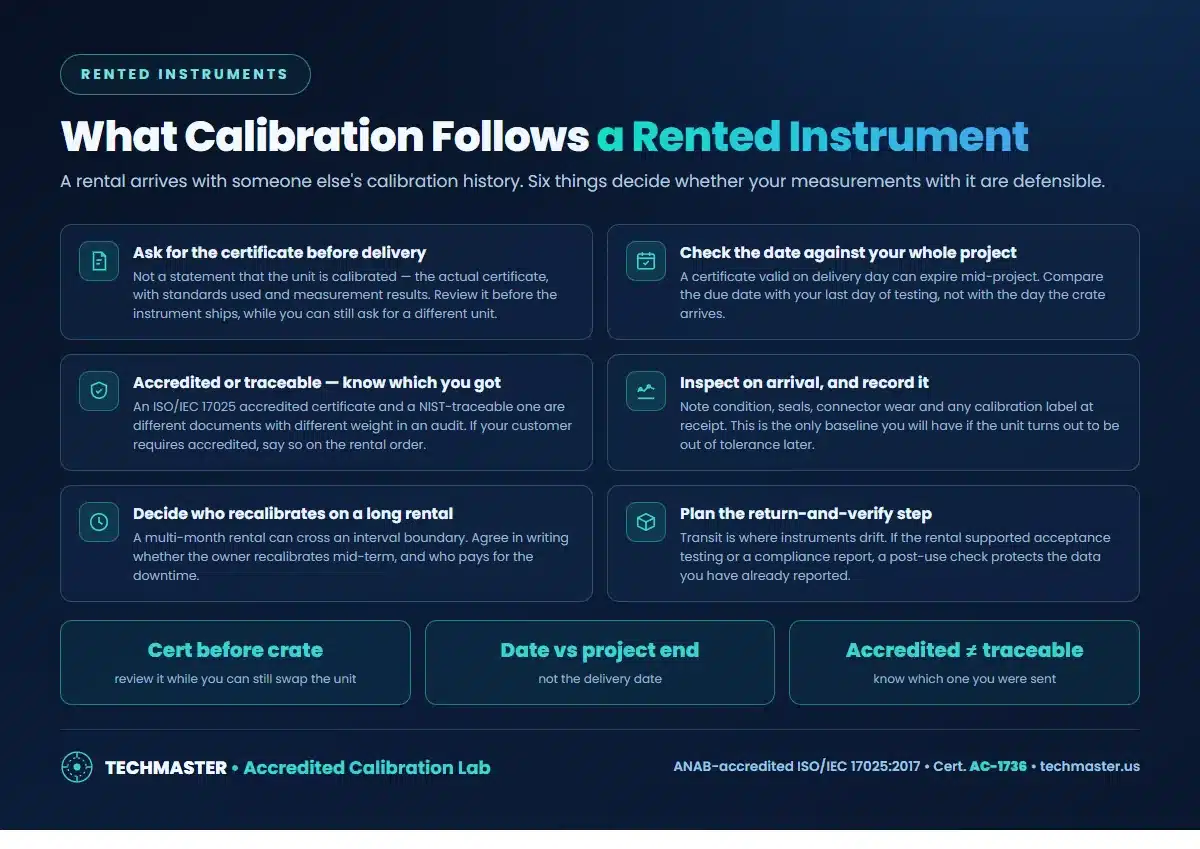
Six things, and only the first is usually offered without being asked for. The certificate itself, the date on it measured against your project rather than the calendar, its certificate level, a receipt inspection you actually record, a written answer on mid-term recalibration, and a plan for verifying anything critical after the rental ends. The related question of whether borrowed or second-hand equipment needs calibration at all is covered in does used or rented test equipment need calibration; this article assumes you have answered yes and asks what the paperwork has to look like.
Why ask for the certificate before the instrument ships?
Because that is the last moment you can change your mind cheaply. Once the crate is on your dock, a certificate with the wrong scope, an inconvenient due date or no measurement data has already cost you a week. Read it the same way you would read your own: the eight fields that matter apply identically to a borrowed instrument, and how to read an accreditation scope tells you whether the accreditation covers the measurement you plan to make or merely something adjacent to it.
Accredited or NIST-traceable, which did you get?
These are different documents. ISO/IEC 17025 accreditation means a third party has assessed the laboratory’s competence for a defined scope of measurements. NIST-traceable asserts an unbroken comparison chain without that assessment. Both are legitimate; they simply carry different weight when a customer or auditor asks. Specify which you need on the rental order, because a certificate level cannot be upgraded after the calibration happened.
Who recalibrates during a long rental?
A two-month rental rarely crosses an interval boundary. A six-month one often does, and nobody wants to discover that in week twenty. Ask before signing: does the owner recalibrate mid-term, does the unit get swapped for a freshly calibrated one, and what does either option do to your schedule? The trade-offs are the same ones covered in how often equipment should be calibrated, with the added complication that the asset is not yours to send out.
What if the rental turns out to be out of tolerance?
Work it exactly like your own asset. The out-of-tolerance response playbook starts with the same question, what did this instrument measure since it was last known good, and a rental makes that harder, because the “last known good” point is the owner’s certificate rather than your own record. Your receipt inspection is what stands between you and having no baseline at all. Transit is also a genuine risk factor in both directions, which is why how to ship test equipment is worth reading before the return leg as well as before a calibration.
Frequently asked questions
Does rented test equipment come with a calibration certificate?
Usually, but you should ask for the actual document rather than an assurance. A statement that a unit is calibrated is not a certificate: the certificate names the standards used, the measurement results and the date, and it is the only thing an auditor will accept. Ask to see it before the instrument ships, while you still have the option of requesting a different unit.
What happens if a rental’s calibration expires in the middle of my project?
The measurements taken after the due date are difficult to defend, so the date has to be compared with your last day of testing rather than with the delivery date. On a multi-month rental, agree in writing before the unit arrives whether the owner recalibrates mid-term, how long that takes, and who absorbs the downtime. Discovering the problem at the end of a test campaign is the expensive version.
Is a rental certificate accredited or just traceable?
It depends entirely on the supplier and the unit, which is exactly why it should be specified on the rental order. An ISO/IEC 17025 accredited certificate carries the accreditation body’s mark and a defined scope; a NIST-traceable certificate asserts an unbroken chain to national standards without third-party assessment of the laboratory. If your customer or regulator requires accredited, requesting it after delivery is too late.
Who is responsible if a rented instrument turns out to be out of tolerance?
Contractually that depends on the rental agreement, but practically the burden of the impact assessment falls on you, because you are the one who used the readings. This is why receipt inspection matters: condition, seals, connector wear and the calibration label recorded on arrival are the only baseline you will have. Treat it as an out-of-tolerance event and work through the same response you would for your own asset.
The bottom line
Rent the instrument, not the assumption. Certificate before crate, due date against project end, accredited or traceable decided in advance, and condition recorded on arrival. Techmaster has calibrated test equipment since 1989 and operates five US labs under ANAB-accredited ISO/IEC 17025:2017 (Cert. AC-1736), ask about certificate level and turnaround for any instrument you are sending in.
Get an accredited calibration quote
ANAB-accredited ISO/IEC 17025:2017 (Cert. AC-1736) • 5 US labs • 5-day standard, 1–2 day expedite • in-lab or on-site.
Request a quote
Khanh Nguyen is the Marketing Manager at Techmaster Electronics, a B2B marketing leader covering the test, measurement, and ISO/IEC 17025 accredited calibration industry in the United States.