
TL;DR: A multimeter repair is worth doing when the fault is blown input protection, worn input jacks, a dirty rotary switch, a failed display or a corroded battery compartment, all common, all inexpensive relative to replacement. Every repair ends in a full calibration with as-found and as-left data, because a working meter is not yet a proven one.
What is a multimeter repair?
Multimeter repair is the diagnosis and physical restoration of a digital multimeter that has failed or become unreliable, distinct from calibration, which measures and corrects accuracy on a meter that still works. A repair replaces damaged parts; a calibration proves the result. Almost every repair therefore ends with a calibration, and the certificate is what makes the meter usable again in a quality system.
Multimeters are the most numerous instruments in most fleets, and they were the largest single cluster in the requests reaching our laboratories over the last quarter. They are also the instrument most often written off when a twenty-dollar part would have saved it.
How do digital multimeters actually fail?
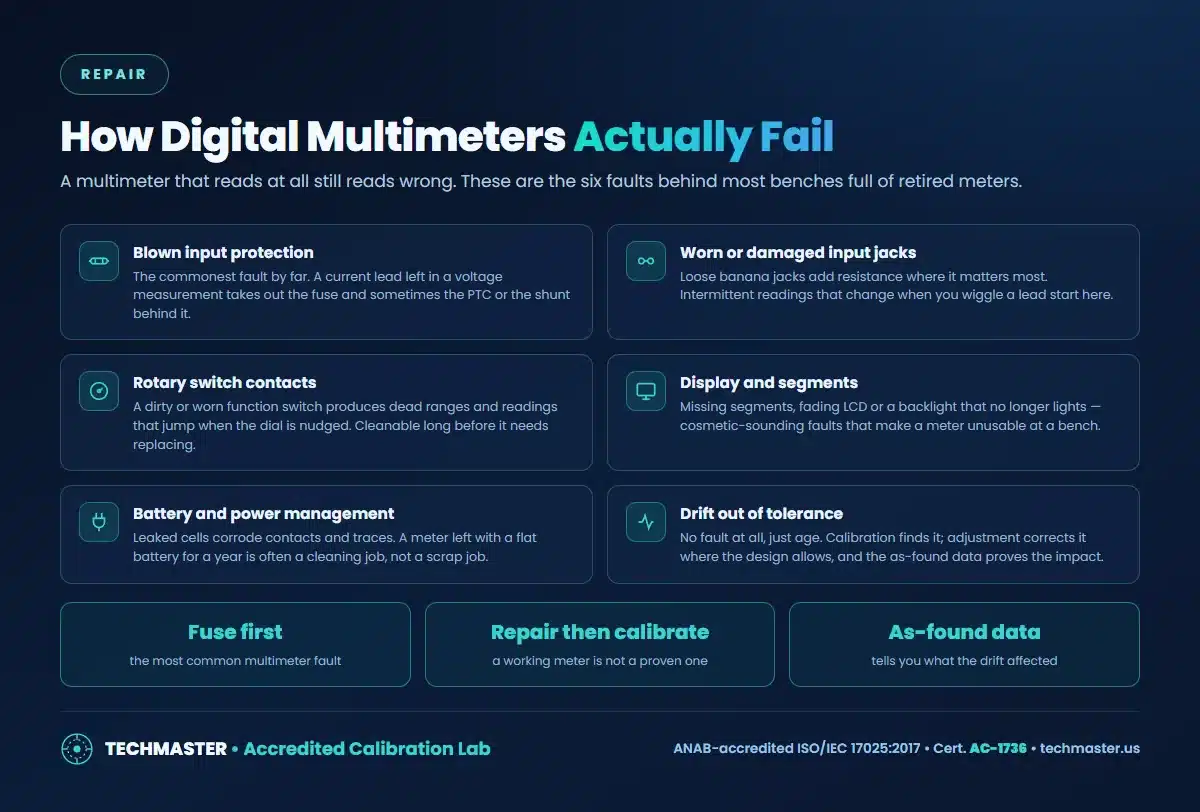
Six faults account for the overwhelming majority: blown input protection after leads were left in the current jacks, worn or loose input jacks, dirty rotary switch contacts producing dead ranges, a failed or fading display, corrosion from a leaked battery, and simple drift out of tolerance with age.
Only the last of those is a calibration problem rather than a repair. The other five are physical, and four of the five are inexpensive on an instrument that will then run for years.
Repair or replace?
The honest answer depends on the meter and the fault, which is what the evaluation establishes before any work is authorised.
| Situation | Usual answer | Why |
|---|---|---|
| Blown fuse or input protection, bench or industrial meter | Repair | Low-cost parts, meter otherwise sound |
| Worn jacks, dirty switch, dead display | Repair | Mechanical wear on an instrument with years left |
| Battery corrosion caught early | Repair | Cleaning and contact replacement, not a board |
| Damaged main board, low-cost handheld | Replace | Board cost approaches a new meter |
| Reads wrong but functions normally | Calibrate, not repair | Drift is corrected by adjustment, with as-found data |
| Dropped, then reads intermittently | Evaluate first | Could be a jack, a cracked board, or both |
How is a multimeter repair handled?
The meter is evaluated and quoted against replacement cost, the fault is repaired, function is verified across all ranges, and the meter is then fully calibrated with as-found and as-left data before a certificate is issued.
The as-found data is the part that matters beyond the bench. If the meter was reading outside tolerance before repair, that data is what lets you assess which earlier measurements were affected, the process set out in what to do with out-of-tolerance results.
Why does repair end in calibration?
Because the input path is where both the fault and the accuracy live. Replacing a shunt, a protection device or a jack changes the electrical path the meter measures through, so the previous certificate no longer describes the instrument. The parameters verified afterwards are those in handheld multimeter calibration, with the interval reset per how often to calibrate a multimeter. Insulation multimeters add high-resistance checks, covered in insulation multimeter calibration.
What capability stands behind the recalibration?
Accredited DC and AC voltage and current, resistance, capacitance and frequency on Techmaster’s ANAB ISO/IEC 17025 scope (Cert. AC-1736), with DC voltage to 1.1 kV and current measurement to 1,000 A through calibrated shunts, at the Vista, Santa Clara, Orlando and San Antonio laboratories. If a meter is beyond economic repair, rent versus buy sets out the replacement decision.
Frequently asked questions
Is it worth repairing a digital multimeter?
Usually yes for a bench or industrial meter, and the economics turn on the fault. A blown fuse, a worn input jack, a dirty rotary switch or a corroded battery compartment are inexpensive repairs on an instrument with years of life left. A meter with a damaged main board on a low-cost handheld is the case where replacement wins, and an evaluation tells you which one you have before any work starts.
What is the most common multimeter fault?
Blown input protection, by a wide margin. It happens when the leads are left in the current jacks and the meter is then used to measure voltage across a live circuit. The fuse is designed to fail first, but the PTC device and the current shunt behind it can go with it, which is why a meter that seems dead after a fuse change often still needs a bench repair.
Does a repaired multimeter need recalibration?
Yes, always. A repair restores function; only calibration demonstrates the meter measures correctly again. Any repair touching the input path, the shunt or the reference should be followed by a full calibration with as-found and as-left data so you can see what the fault did to earlier measurements.
My multimeter reads slightly wrong but works. Repair or calibration?
Start with calibration. A meter that functions but reads outside tolerance is usually drift rather than damage, and drift is corrected by adjustment during calibration where the design allows it. The as-found data is the valuable part, because it tells you the size of the error your previous measurements carried.
The bottom line
Five of the six common multimeter faults are inexpensive repairs, and the sixth is a calibration. Describe the symptom, request an evaluation, and the meter comes back with a certificate rather than just a fix.
Need a quote, a rental, or a repair evaluation?
Techmaster Electronics, ISO/IEC 17025 accredited calibration laboratory, ANAB Cert. AC-1736, founded 1989. Five US labs, 5-day standard turnaround, 1–2 day expedite.
Request a quote →Techmaster Electronics, LLC is an independent ISO/IEC 17025:2017 accredited calibration laboratory. We are not affiliated with, authorized by, or endorsed by any manufacturer named on this page. All product names and model designations are trademarks of their respective owners and are used here only to identify the equipment we calibrate, repair, or rent. Confirm that our accredited scope covers your instrument’s parameters and ranges before shipping, ask us and we will check it against your model list.

Khanh Nguyen is the Marketing Manager at Techmaster Electronics, a B2B marketing leader covering the test, measurement, and ISO/IEC 17025 accredited calibration industry across the US and Vietnam markets.