
Pressure Gauge Calibration
Why calibration intervals matter
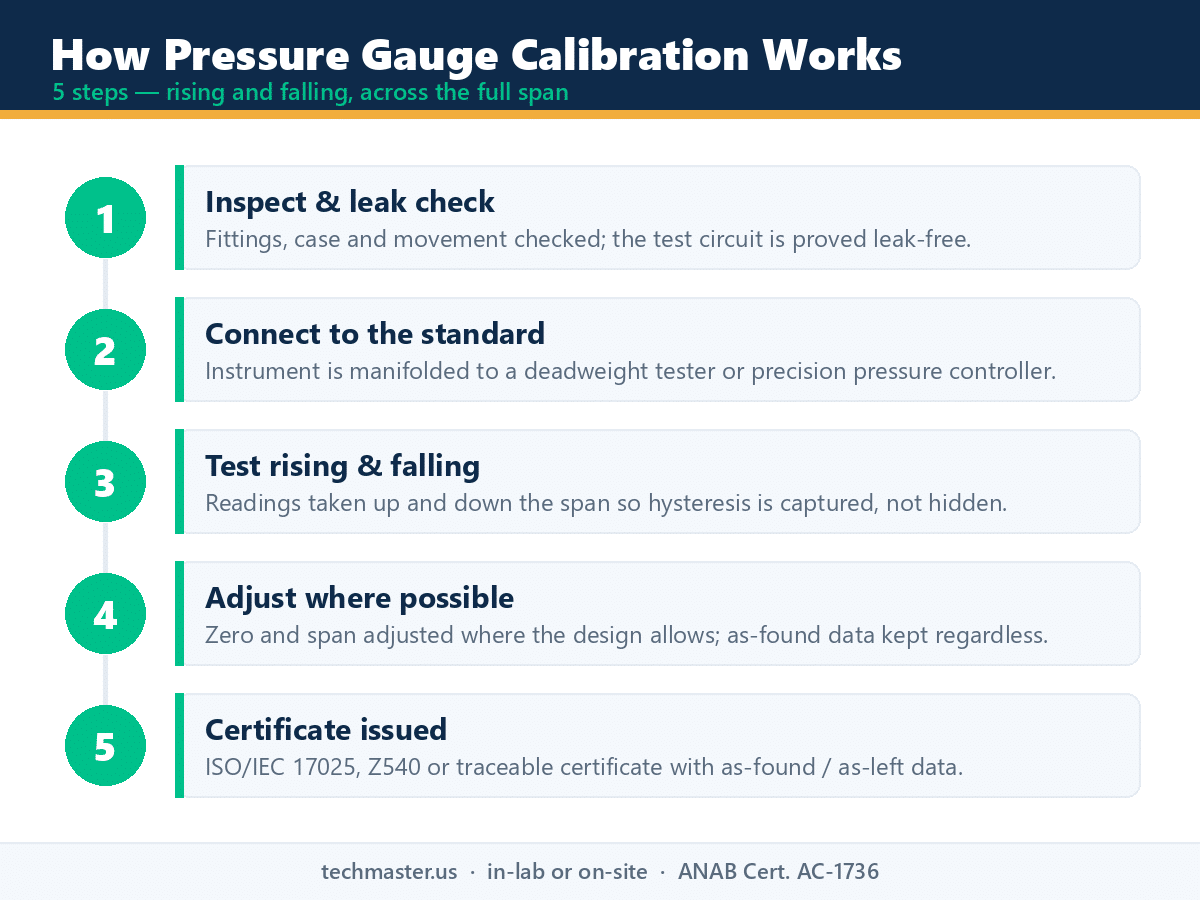
How Pressure Gauge calibration works
- Intake & visual inspection
- Environmental stabilization
- As-found measurement
- Comparison to NIST-traceable standards
- Adjustment if required
- As-left results & certificate
Your calibration, covered
In-lab vs on-site calibration
In-lab calibration
- Accredited bench with full reference standards
- Best achievable measurement uncertainties
- Pickup & return logistics handled
- Ideal for precision and reference work
On-site calibration
- We calibrate the Pressure Gauge at your facility
- No shipping risk or transit downtime
- As-found data captured before any move
- Ideal for fixed, large or sensitive assets
In-depth guide
0Pressure gauge calibration is essential to ensure accurate pressure measurements in industrial applications. Over time, gauges can drift due to environmental conditions, mechanical wear, or exposure to extreme pressure. Regular calibration helps maintain measurement accuracy, compliance with industry standards, and safe operation. This guide will walk you through how to calibrate a pressure gauge step by step, ensuring you achieve precise and reliable results.
1. Quick Overview & Types of Pressure Gauges
1.1. What is a Pressure Gauge?
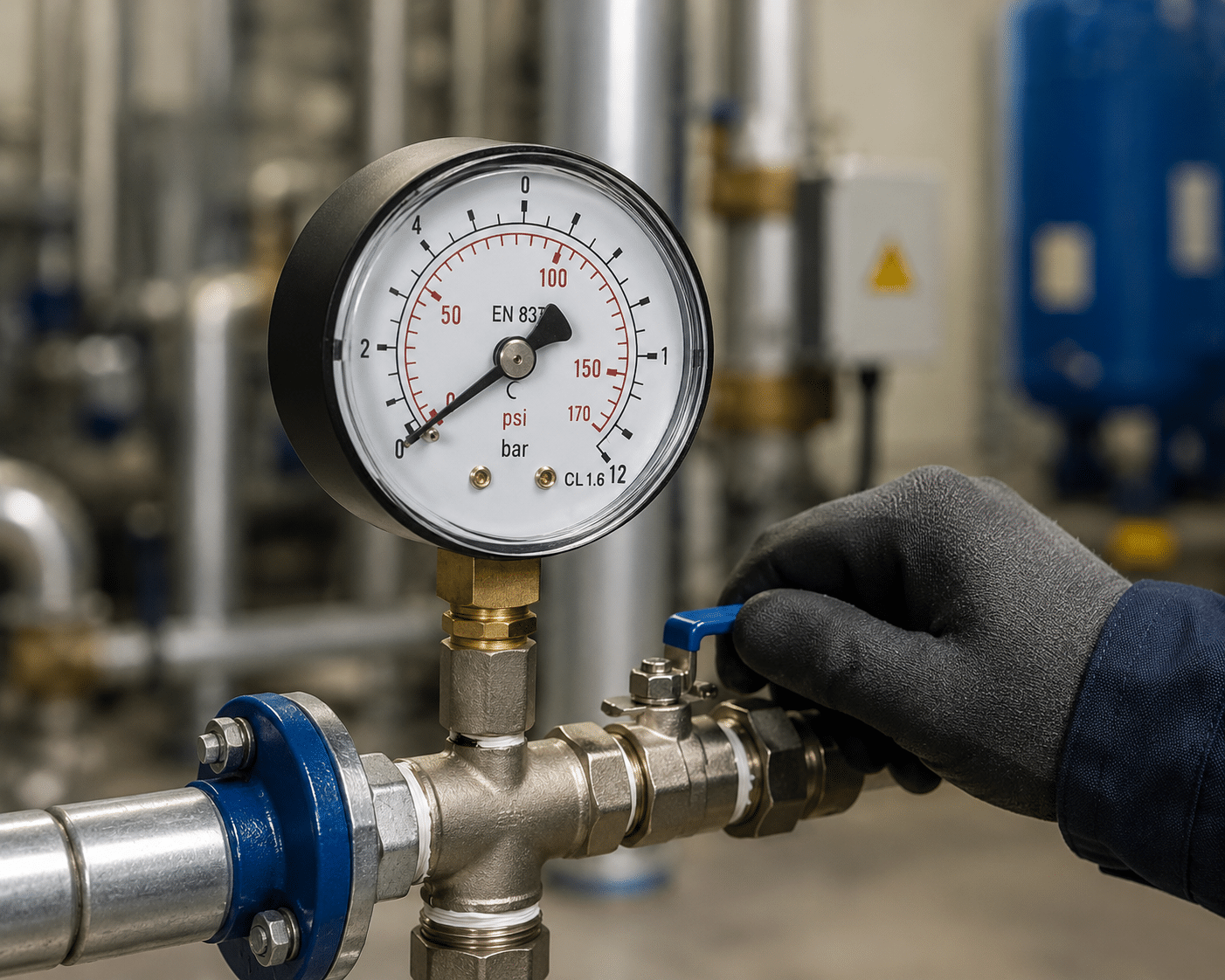
A pressure gauge is an instrument used to measure and display the pressure of a gas or liquid in a system. It plays a key role in monitoring and maintaining process control in various industries, including manufacturing, oil & gas, pharmaceuticals, and HVAC systems. Pressure gauges help ensure safety, efficiency, and compliance with industry regulations by providing real-time pressure readings.
1.2. Common Types of Pressure Gauges
Different types of pressure gauges are used depending on the application, medium, and required accuracy. Selecting the right gauge is crucial for ensuring accurate pressure gauge calibration and maintaining reliable measurements. Below are the most common types:
1.2.1 Bourdon Tube Pressure Gauge
- Most widely used mechanical gauge.
- Consists of a coiled metal tube that expands or contracts based on applied pressure.
- Suitable for measuring high-pressure applications in industrial processes, hydraulics, and pneumatic systems. Regular calibration of Bourdon tube gauges helps maintain accuracy over time.
1.2.2 Diaphragm Pressure Gauge
- Uses a flexible diaphragm that deforms under pressure.
- Ideal for corrosive, viscous, or sensitive media where traditional gauges may fail.
- Commonly found in chemical and pharmaceutical industries, where pressure gauge accuracy verification is essential for process control.
1.2.3 Capsule Pressure Gauge
- Designed for measuring very low pressures, primarily in gas applications.
- Contains two thin diaphragms welded together to form a capsule.
- Often used in HVAC, medical equipment, and environmental monitoring systems. Routine pressure gauge calibration procedures ensure these gauges provide precise readings.
1.2.4 Digital Pressure Gauge
- Uses electronic sensors to provide accurate, real-time readings on a digital display.
- Offers higher precision than analog gauges and often includes data logging capabilities.
- Commonly used in laboratories, calibration facilities, and modern industrial processes. Calibrating digital pressure gauges is necessary to maintain their superior accuracy.
1.2.5 Differential Pressure Gauge
- Measures the pressure difference between two points in a system.
- Essential for monitoring filtration systems, flow measurement, and level monitoring in tanks.
- Helps detect blockages or pressure imbalances in critical systems. Proper pressure gauge calibration is crucial to ensure these measurements remain reliable.
Understanding the type of gauge being calibrated ensures the correct procedure and equipment are used, leading to accurate and traceable pressure gauge calibration results.
2. What is Pressure Gauge Calibration?
Pressure gauge calibration is the process of comparing a gauge’s readings with a known reference standard to determine accuracy. If discrepancies are found, adjustments can be made to bring the gauge back within acceptable tolerance levels. Calibration follows industry standards such as ISO 17025, ASME B40.100, and ANSI.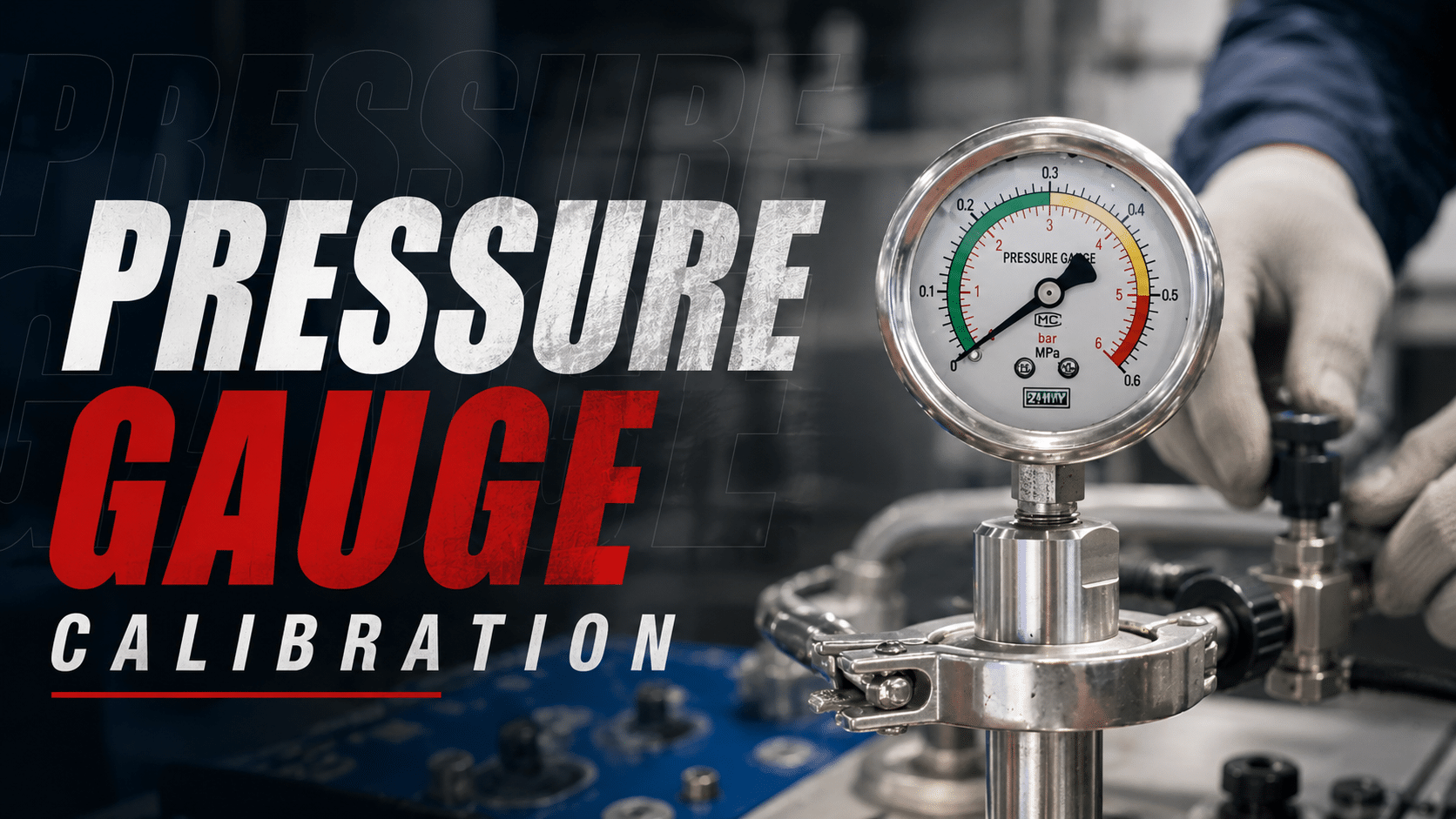
3. Equipment Required for Calibration
To perform pressure gauge calibration, specific equipment is required to ensure precision and traceability.
- Reference Standard: A highly accurate pressure gauge (e.g., digital pressure gauge) or dead-weight tester, calibrated and traceable to national standards, with accuracy typically ±0.1% or better.
- Pressure Source: A hand pump or pressure comparator to generate known pressure levels, such as the P-700-3 hydraulic hand test pump.
- Adaptors and Connectors: Necessary fittings to connect the gauge under test to the reference standard and pressure source, ensuring no leaks.
- Calibration Certificate: Documentation proving the calibration, including date, technician, and results, often required for audits.
4. Step-by-Step Pressure gauge Calibration Procedure
The calibration process, often referred to as the pressure gauge calibration procedure, involves a series of systematic steps to verify and adjust the gauge’s accuracy. Below is a detailed breakdown:
01: Preparation
-
- Ensure the pressure gauge is clean and free from visible damage or debris.
- Verify that the reference standard is calibrated and traceable to a recognized standard, such as those defined by ASME B40.1 for dial-type gauges or ASME B40.7 for digital gauges.
- Check compatibility of the pressure medium, especially for gauges used in oxygen service, where oil-based calibrators should be avoided.
02: Set Up the Pressure Gauge Calibration Range
-
- Determine the gauge’s measurement range, including the minimum and maximum pressures (e.g., 0 to 10 bar).
- Set up the calibration equipment to cover this range, ensuring the pressure source can generate the required levels.
03: Connect the Gauge
-
- Mount the gauge in the same orientation as its normal use to account for any gravitational effects.
- Connect the gauge under test (UUC, or Unit Under Calibration) to the pressure source and the reference standard, using adaptors to ensure secure connections.
- Include a block valve to isolate the pressure source and a bleeding valve for releasing pressure, ensuring safety.
04: Apply Pressure and Record Readings
-
- Apply pressure in increments across the gauge’s range, typically at 0%, 25%, 50%, 75%, and 100% of full scale. For example, for a 0-10 bar gauge, apply pressures at 0, 2.5, 5, 7.5, and 10 bar.
- Record the readings from both the gauge under test and the reference standard at each point.
- Repeat the process for decreasing pressures to check for hysteresis, which indicates mechanical or electronic lag in the gauge’s response.
05: Compare and Adjust the Pressure Gauge Calibration
-
- Compare the readings from the gauge under test with those from the reference standard. Calculate the error using the formula: Error = Reading of Gauge Under Test – Reading of Reference Standard.
- If the gauge is adjustable, use a pointer puller or remover to adjust the pointer to match the reference standard at key points, such as full scale.
- For digital gauges, adjustments may involve recalibrating the electronic output, such as scaling a 4-20 mA signal (e.g., 4 mA = 0 bar, 20 mA = 100 bar).
06: Document the Results
-
- Record all data, including the calibration range, reference standard used, any adjustments made, and the date and time of calibration.
- Include the technician responsible and provide a calibration certificate as evidence of accuracy, which may be required for ISO 9000 qualified laboratories or audits.
5. Best Practices for Accurate Pressure Gauge Calibration
To ensure the calibration process is effective and reliable, consider the following best practices:
- Follow Manufacturer Instructions: Some gauges may require special procedures, such as temperature compensation or multiple adjustments for different pressure ranges. Always refer to the manufacturer’s guidelines for specific instructions.
- Use Traceable Standards: The reference standard should have an accuracy of at least 4 times that of the gauge under test, or a lower combined standard measurement uncertainty, to meet industry norms.
- Handle with Care: Avoid damaging the gauge during calibration, as physical shock can affect accuracy. Use a spirit level to ensure the setup is level, especially for dead-weight testers.
- Account for Environmental Factors: Perform calibration in stable temperature conditions, as temperature can affect both the gauge and the reference standard. For example, extreme temperatures may require additional temperature compensation.
For gauges in critical applications, such as medical sterilizers or high-pressure systems, the calibration process may involve additional safety precautions, such as venting both high and low-pressure ports to the atmosphere before starting.
6. When Should You Calibrate a Pressure Gauge?
The frequency of pressure gauge calibration depends on several factors, including the gauge’s application, operating conditions, and manufacturer recommendations. Industry standards, such as those outlined by the International Maritime Organization (IMO) and ISO audits, often mandate at least annual calibration for compliance. For example, IMO article 13.1.4 states that instruments should be tested for reliability and recalibrated at regular intervals, with intervals typically interpreted as at least once a year.
Immediate pressure gauge calibration may be necessary in certain scenarios, such as:- After the gauge has been dropped or subjected to physical shock.
- Following exposure to extreme temperatures or pressures.
- When unusual readings are observed, indicating potential inaccuracy.
- Post-repair or adjustment to ensure the gauge returns to accurate operation.
7. Conclusion
Regular pressure gauge calibration is crucial for accurate and reliable measurements. By following a structured calibration procedure, industries can maintain compliance, enhance safety, and optimize operational efficiency. If you need professional calibration services, consider partnering with an accredited lab to ensure the highest standards of accuracy.
Air Buoyancy Correction in Mass Calibration: Altitude, Density and Real Error Budgets
Air buoyancy correction explained with the NIST SOP 2 formula: how altitude and artifact density...
Aug

ASTM E4 vs ISO 7500-1: Which Force Verification Does Your Tensile Tester Need?
ASTM E4-24 or ISO 7500-1:2018? The test method you run decides which force verification your...
Aug

USP <41> Minimum Weight: How to Calculate It on an Analytical Balance
USP minimum weight is calculated, not specified: 2s divided by 0.001 from a 10-weighing repeatability...
Aug

Deadweight Tester vs. Digital Pressure Calibrator: Which Does Your Lab Need?
Deadweight tester or digital pressure calibrator? How each works, the gravity/buoyancy/temperature corrections, typical accuracy, pressure...
Jul
Differential Manometer Calibration: Solve Drift Pain
Home » Pressure Gauge Calibration: A Complete GuideIndustrial environments rely on absolute precision to maintain...
Jun
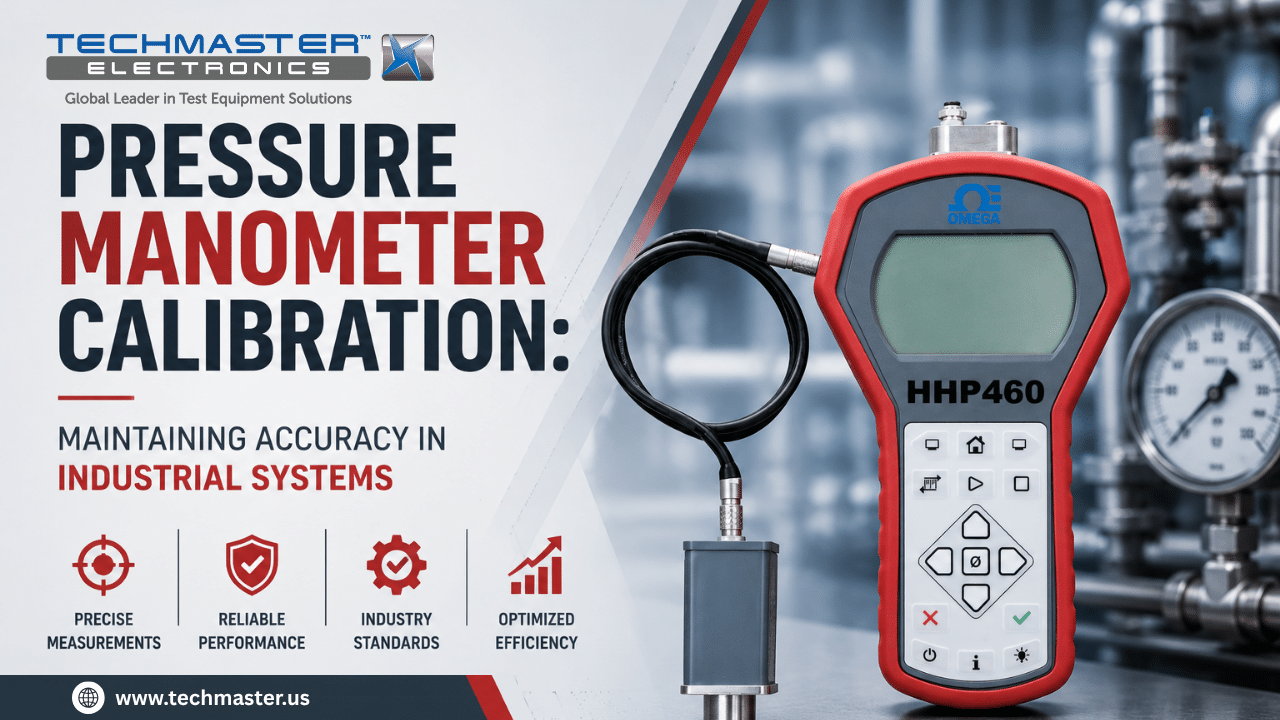
Pressure Manometer Calibration in Industrial Systems
Home » Pressure Gauge Calibration: A Complete Guide Metrology guide · ISO/IEC 17025 · ANAB-accredited...
Jun
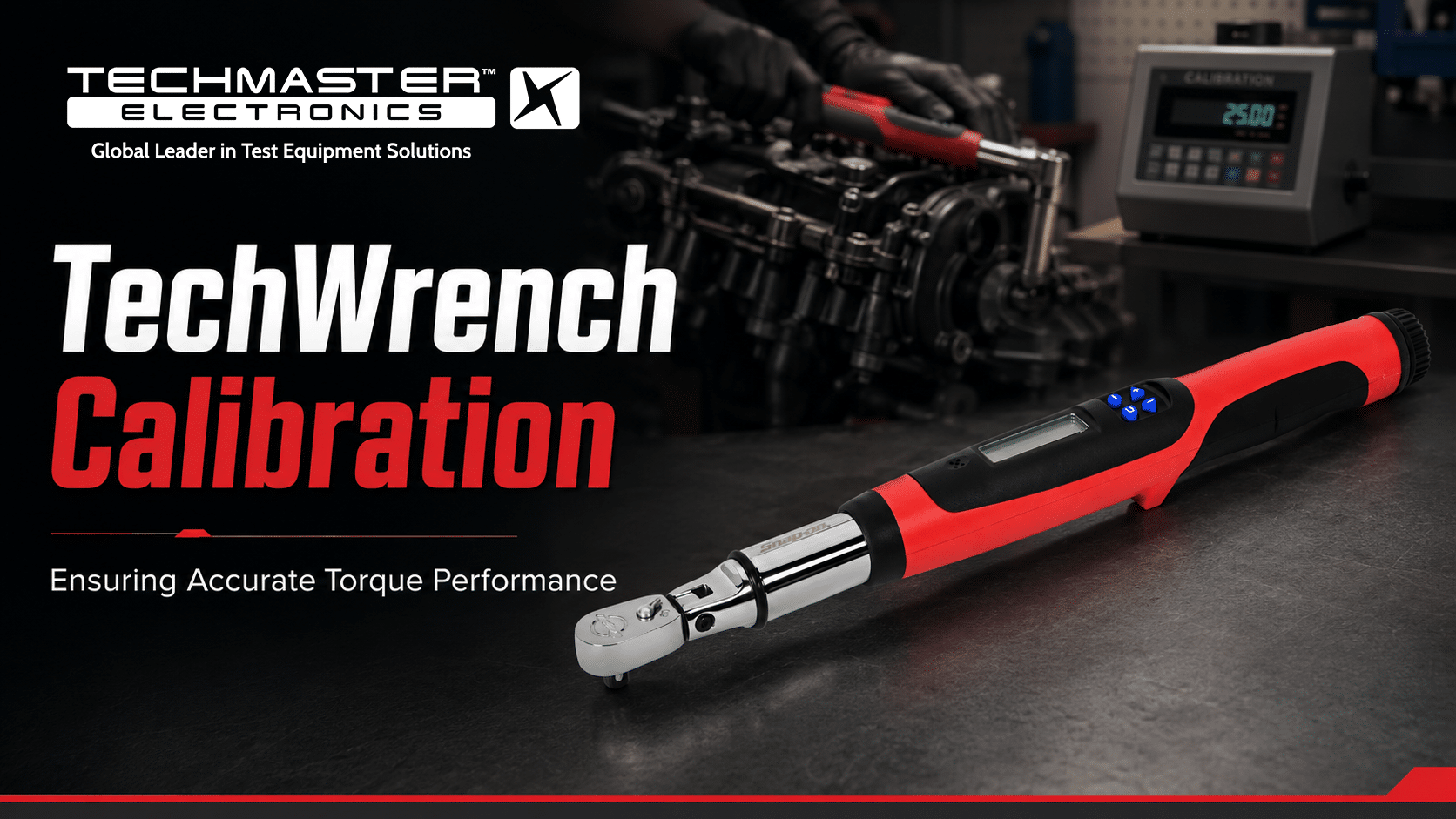
Techwrench Calibration: The Technical & Compliance Guide
Home » Pressure Gauge Calibration: A Complete Guide Metrology guide · ISO/IEC 17025 · ANAB-accredited...
Jun
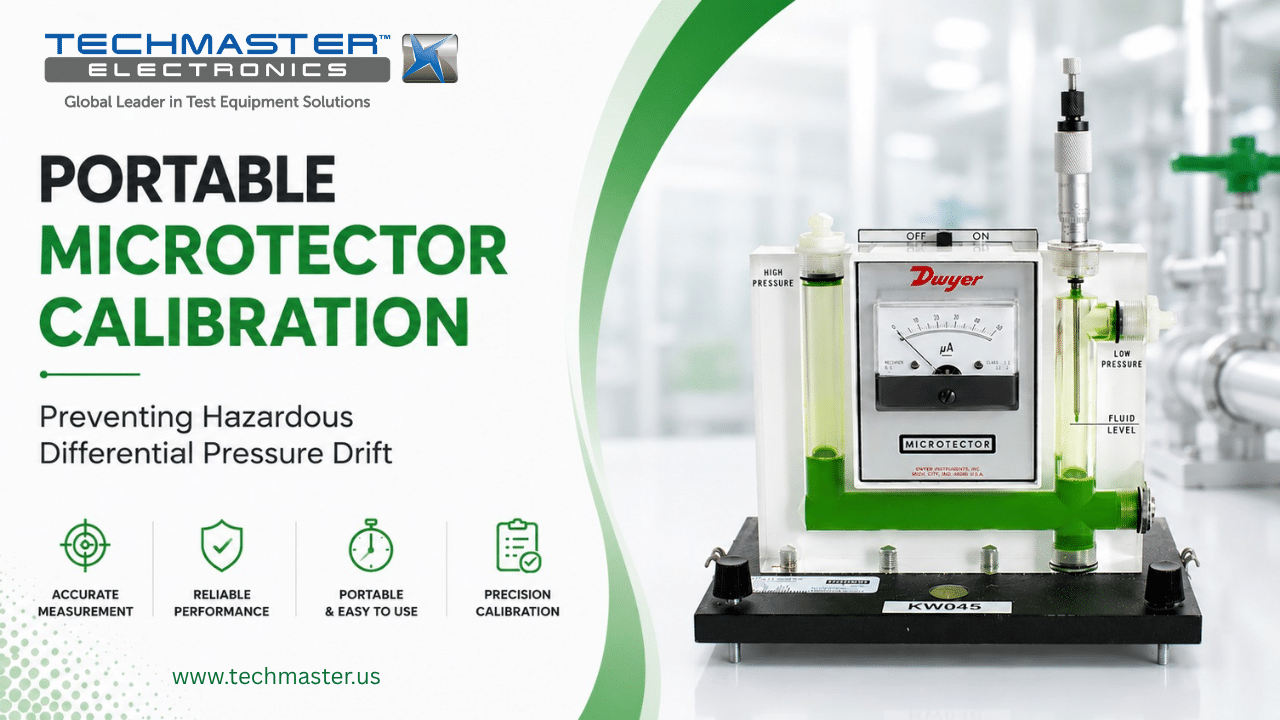
Portable Microtector Calibration: Preventing Pressure Drift
Home » Pressure Gauge Calibration: A Complete Guide Metrology guide · ISO/IEC 17025 · ANAB-accredited...
Jun
Using a Hand Pump for Pressure Gauge Calibration
In the field, pressure gauges are usually calibrated by comparison: the gauge under test and a reference gauge or calibrator are connected to a hand pump, which generates the test pressure. Pneumatic hand pumps typically cover vacuum to a few hundred psi. Hydraulic hand pumps reach several thousand psi and above.
The pump is not the reference, but it affects the result
A hand pump has no measurement of its own, so it does not get a calibration certificate. The reference gauge or calibrator connected to it does. The pump still decides how good the comparison can be:
- Leaks make readings creep, so the system should hold pressure before readings are taken.
- Fine adjustment (a vernier or volume adjuster) lets you set each test point precisely instead of overshooting.
- Heat of compression: in pneumatic systems, pressure falls for a short time after pumping as the air cools. Wait for it to settle before reading, or the gauge will look wrong when it is not.
- Clean, compatible media: oil or water in a hydraulic pump must suit the gauge, and gauges for oxygen service must never be connected to an oil-filled system.
Check pumps, hoses and fittings for leaks before each use, and replace worn seals before they affect results. The reference itself should be calibrated on its own cycle, ideally with an accuracy several times better than the gauges it checks.
Frequently asked questions
What is Pressure Gauge Calibration?
How often should a Pressure Gauge be calibrated?
What standards apply to Pressure Gauge Calibration?
What is included on the certificate?
Can you calibrate the Pressure Gauge on-site?
What pressure range is accredited?
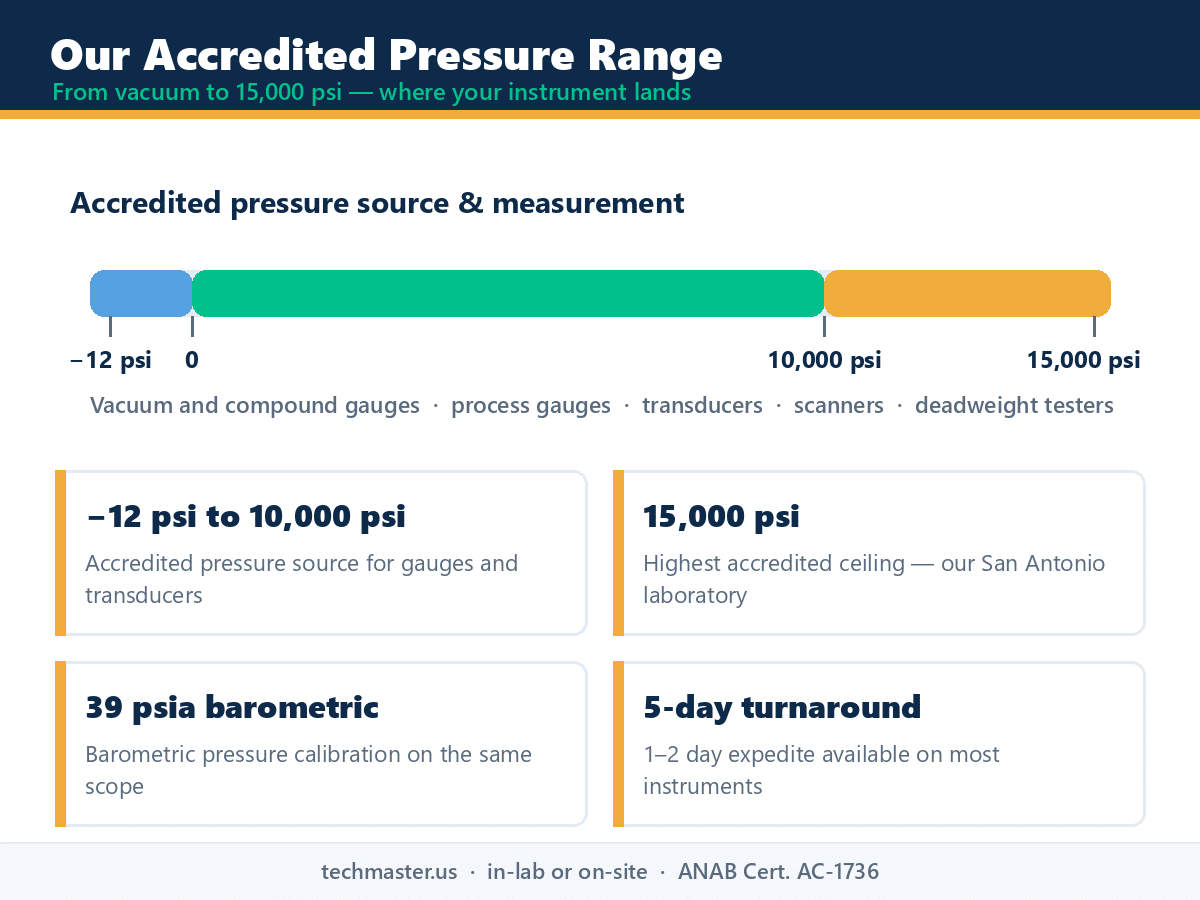
Accredited pressure source and measurement runs from −12 psi (vacuum) through 10,000 psi, with our San Antonio laboratory reaching 15,000 psi, plus barometric pressure to 39 psia. Pressure is on the ANAB ISO/IEC 17025 accredited scope (Cert. AC-1736) at Vista, Santa Clara, Orlando, and San Antonio. The negative end matters more than people expect, vacuum gauges, compound gauges, and suction-side instruments all live below zero and need the same traceability as everything above it.
Related calibration guides
Need Pressure Gauge calibration?
ANAB-accredited, NIST-traceable, fast turnaround, in-lab or on-site across the USA.
Contact us for a quoteReferences & industry standards
- ISO/IEC 17025 testing & calibration laboratory requirements
- NIST calibration services and measurement traceability
- NIST Pressure and Vacuum Group
- A2LA / ANAB accreditation for calibration laboratories
External standards bodies. Techmaster Electronics is an ISO/IEC 17025-accredited, NIST-traceable calibration laboratory.
Pressure gauge calibration at Techmaster, at a glance
- ISO/IEC 17025:2017 accredited by ANAB (Certificate AC-1736)
- NIST-traceable reference standards with a full measurement-uncertainty budget reported on every certificate (as-found / as-left data included)
- 5 US calibration labs: Vista CA, Santa Clara CA, Orlando FL, San Antonio TX, and Holly Springs NC
- Turnaround: 5 business days standard; 1–2 business-day expedite available
- In-lab or nationwide on-site calibration to minimize your downtime

Khanh Nguyen is the Marketing Manager at Techmaster Electronics, a B2B marketing leader covering the test, measurement, and ISO/IEC 17025 accredited calibration industry in the United States.