
TL;DR: A cable and antenna analyzer rental is judged by what arrives alongside the analyzer: calibration standards that are themselves in calibration, phase-stable jumpers, the right adapters, and a certificate that reaches the top of the band you sweep. The analyzer is the cheapest part of a kit that decides whether a season of sweeps is defensible.
What is a cable and antenna analyzer rental?
A cable and antenna analyzer rental is the short-term hire of a portable vector analyzer used to sweep feeders, jumpers and antennas, return loss, VSWR, cable loss and distance-to-fault, together with the calibration standards, jumpers and adapters that define where the measurement is actually made. The rental is a kit, not a box, and every item in it affects the number written on the sweep report.
Requests for this instrument class arrive in bursts, mostly around installation and maintenance seasons, and they split between rentals and repairs rather than routine calibrations. That is the signature of equipment that is used hard, in the field, for short periods, which is exactly the case where renting a properly documented kit beats owning a neglected one.
What has to arrive with the analyzer?
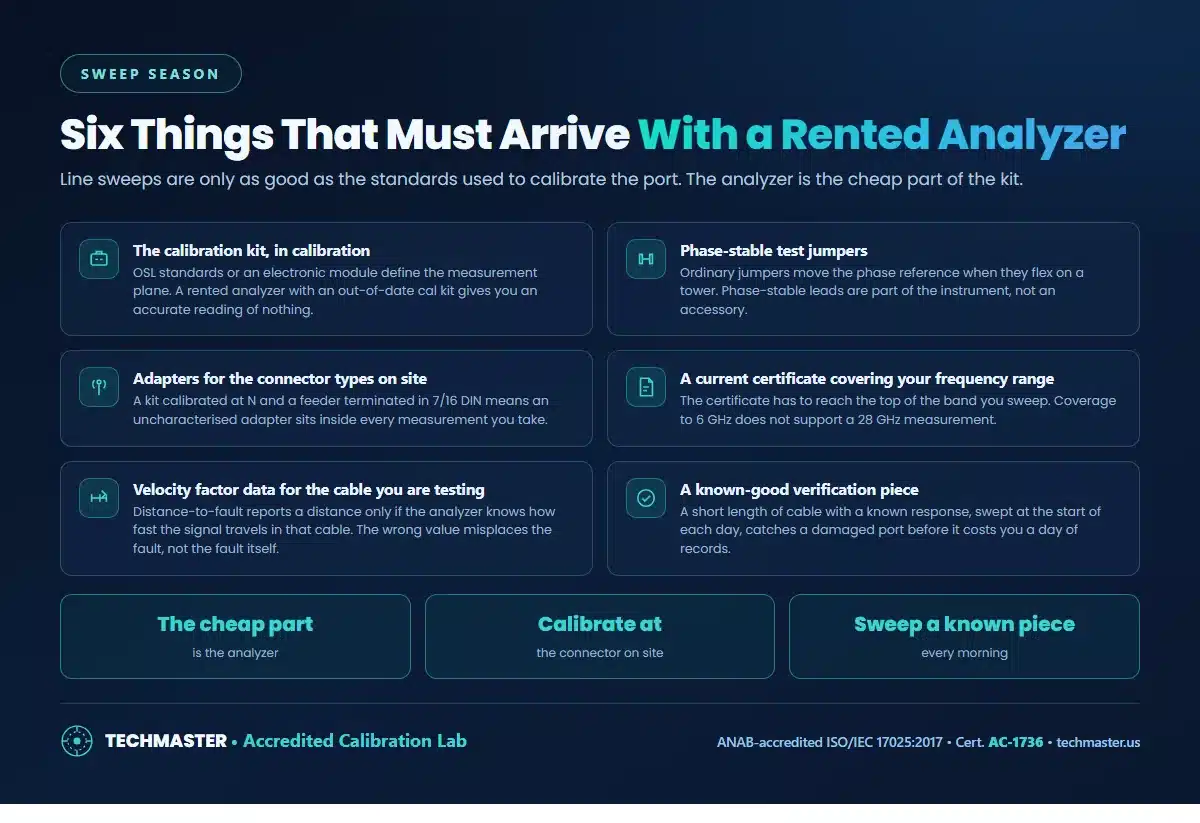
Six items: the calibration kit or electronic module with its own in-date certificate, phase-stable test jumpers, adapters for the connector types actually present on site, an analyzer certificate covering your full sweep range, velocity factor data for the cable under test, and a known-good verification piece to sweep each morning.
Five of those cost a fraction of the analyzer and every one of them can invalidate a sweep on its own. The most expensive mistake in the list is the cheapest item: an uncharacterised adapter sitting between the calibration plane and the feeder.
Rent or own?
| Situation | Usual answer | Why |
|---|---|---|
| One installation or sweep season a year | Rent | Certificates stay current because they are the rental company’s problem, not yours |
| Continuous field maintenance across sites | Own, on a short interval | Utilisation is high and the interval question has a clear answer |
| Your analyzer is in for repair mid-season | Rent a bridge unit | Sweeps do not wait; confirm the bridge unit’s kit is in calibration |
| A new band above your instrument’s certified range | Rent the higher-frequency unit | A certificate that stops below your band cannot be stretched |
| Acceptance sweeps a customer will audit | Rent with an accredited certificate | The sweep will be read by someone who checks the paperwork |
| Occasional fault-finding only | Rent, or subcontract the sweep | Distance-to-fault work is short, specialised and easy to outsource |
Why are there two calibrations?
Because they answer different questions. The laboratory calibration proves the instrument measures correctly across the band and produces a certificate; the on-site calibration with the OSL standards or electronic module sets the measurement plane at the connector for that specific sweep. Neither replaces the other.
The distinction confuses more field engineers than any other part of this instrument, and it is worth being precise about, because it is where disputed sweeps usually begin. The mechanics of the on-site step are covered in how to use a cable and antenna analyzer, and what the laboratory actually verifies is set out in cable and antenna analyzer calibration.
How do I check a rented analyzer on arrival?
- Read the certificate before unpacking. Top frequency and due date, checked against your sweep plan and your last day on site.
- Check the calibration standards separately. They carry their own certificate and their own due date.
- Inventory the adapters against the site. Note every adapter that will sit inside a measurement.
- Calibrate at the connector that touches the site. Put the jumper inside the calibration, not inside the result.
- Sweep a known-good piece. A cable with a response you already know catches a damaged port on day one.
- Record the serial numbers. Against every sweep, so a disputed result can be traced to a specific instrument.
What capability stands behind the certificate?
Our accredited RF and microwave work, ANAB ISO/IEC 17025:2017, Cert. AC-1736, is held at the Vista, Santa Clara and Orlando laboratories, and it is not on the San Antonio scope. That scope includes calibration factors to 50 GHz and single-sideband phase noise to 50 GHz, with verification on 7 mm, Type N, 3.5 mm and 2.4 mm ports. When an analyzer’s certified range is the limiting factor in a sweep plan, that is the capability the range is drawn from. Where an interval needs justifying rather than assuming, setting calibration intervals with ILAC-G24 is the method auditors accept, and the same reasoning applied to whole fleets appears in how often test equipment should be calibrated.
For suppliers whose sweeps are read by a customer’s quality team rather than only by their own, RF and microwave calibration for aerospace suppliers sets out how the flow-down usually arrives, and how to choose a calibration service is the vetting checklist.
Frequently asked questions
What should be included in a cable and antenna analyzer rental?
The analyzer, a calibration kit or electronic calibration module with its own current certificate, phase-stable test jumpers, adapters matching the connector types you will meet on site, and a current certificate for the analyzer covering the full frequency range you intend to sweep. The kit and jumpers are not accessories – they define the measurement plane, and a rental missing either produces sweeps you cannot defend.
Does a rented analyzer need a calibration certificate?
Yes, and so does the calibration kit that comes with it. The analyzer certificate demonstrates the instrument measures correctly across the band; the kit certificate demonstrates the standards used to set the measurement plane are what they claim to be. Sweeps taken with an in-date analyzer and an out-of-date kit are exactly as questionable as sweeps taken with neither.
What is the difference between the analyzer’s calibration and the field calibration I do on site?
They answer different questions. The laboratory calibration, performed against traceable standards, establishes that the instrument measures correctly and is documented on a certificate. The on-site calibration you perform with the OSL standards or electronic module sets the measurement plane at the connector for that particular sweep. You need both, and neither substitutes for the other.
Can I sweep to 28 GHz with an analyzer certified to 6 GHz?
You can take the reading, but you cannot support it. A certificate states the range over which the instrument’s performance was verified, and measurements above that range are unverified regardless of what the display shows. If your work reaches millimetre-wave frequencies, confirm the certified range covers it before the analyzer ships.
The bottom line
Rent the kit, not the analyzer. Check two certificates rather than one, calibrate at the connector that meets the site, and sweep something known every morning. Tell us the band and the connector types and we will tell you what the case has to contain.
Need a quote, a rental, or a repair evaluation?
Techmaster Electronics, ISO/IEC 17025 accredited calibration laboratory, ANAB Cert. AC-1736, founded 1989. Five US labs, 5-day standard turnaround, 1–2 day expedite.
Request a quote →Techmaster Electronics, LLC is an independent ISO/IEC 17025:2017 accredited calibration laboratory. We are not affiliated with, authorized by, or endorsed by any manufacturer named on this page. All product names and model designations are trademarks of their respective owners and are used here only to identify the equipment we calibrate, repair, or rent. Confirm that our accredited scope covers your instrument’s parameters and ranges before shipping, ask us and we will check it against your model list.

Khanh Nguyen is the Marketing Manager at Techmaster Electronics, a B2B marketing leader covering the test, measurement, and ISO/IEC 17025 accredited calibration industry in the United States.