
TL;DR: A surge generator is defined entirely by the shape of what it produces. Its certificate has to show six things: the 1.2/50 µs open-circuit voltage waveform, the 8/20 µs short-circuit current waveform, the resulting 2 Ω effective output impedance, amplitude accuracy at the levels actually used, phase-angle and coupling network behaviour, and the measurement chain behind all of it. Ask any laboratory to show you these parameters on its accreditation scope rather than assuming they are covered.
What is surge generator calibration?
Surge generator calibration is the verification that a combination wave generator produces the open-circuit voltage and short-circuit current waveforms defined by IEC 61000-4-5, within the standard’s tolerances, at the amplitudes and phase angles used in testing.
Almost every other instrument is calibrated by comparing what it reads against a known value. A surge generator reads nothing. It is a source, and the only meaningful question is whether what comes out of it matches a waveform definition. That makes the calibration an exercise in waveform capture: a calibrated high-voltage divider, a current shunt or transducer, and an oscilloscope with enough bandwidth to resolve a front time measured in microseconds without distorting it.
The same logic governs the other EMC sources in the laboratory. ESD simulator calibration for immunity testing covers the electrostatic discharge simulator, where the current waveform is measured in nanoseconds rather than microseconds, and EMC antenna factor calibration under ANSI C63.5 covers antenna factor determination on the emissions side.
What has to be on a surge generator calibration certificate?
Six parameter groups, each with the measured value and the tolerance it was judged against – not a bare pass. A certificate that says only “within specification” tells you nothing about which levels were checked.
| Parameter | What IEC 61000-4-5 defines | How it is verified |
|---|---|---|
| Open-circuit voltage waveform | 1.2 µs front time, 50 µs time to half value | Calibrated HV divider into an open circuit, captured on a wide-bandwidth oscilloscope |
| Short-circuit current waveform | 8 µs front time, 20 µs duration | Current shunt or transducer into a short, same capture chain |
| Effective output impedance | 2 Ω, the defining property of a combination wave generator | Derived from peak voltage and peak current on the same generator setting |
| Amplitude accuracy | At each level used in testing, not only at full scale | Peak measurement at each selected level across the working range |
| Phase angle and synchronisation | Firing position relative to the mains waveform | Timing capture referenced to the AC supply waveform |
| Coupling / decoupling network | Waveform preserved through the CDN as delivered to the EUT | Verified with the generator and CDN together, not separately |
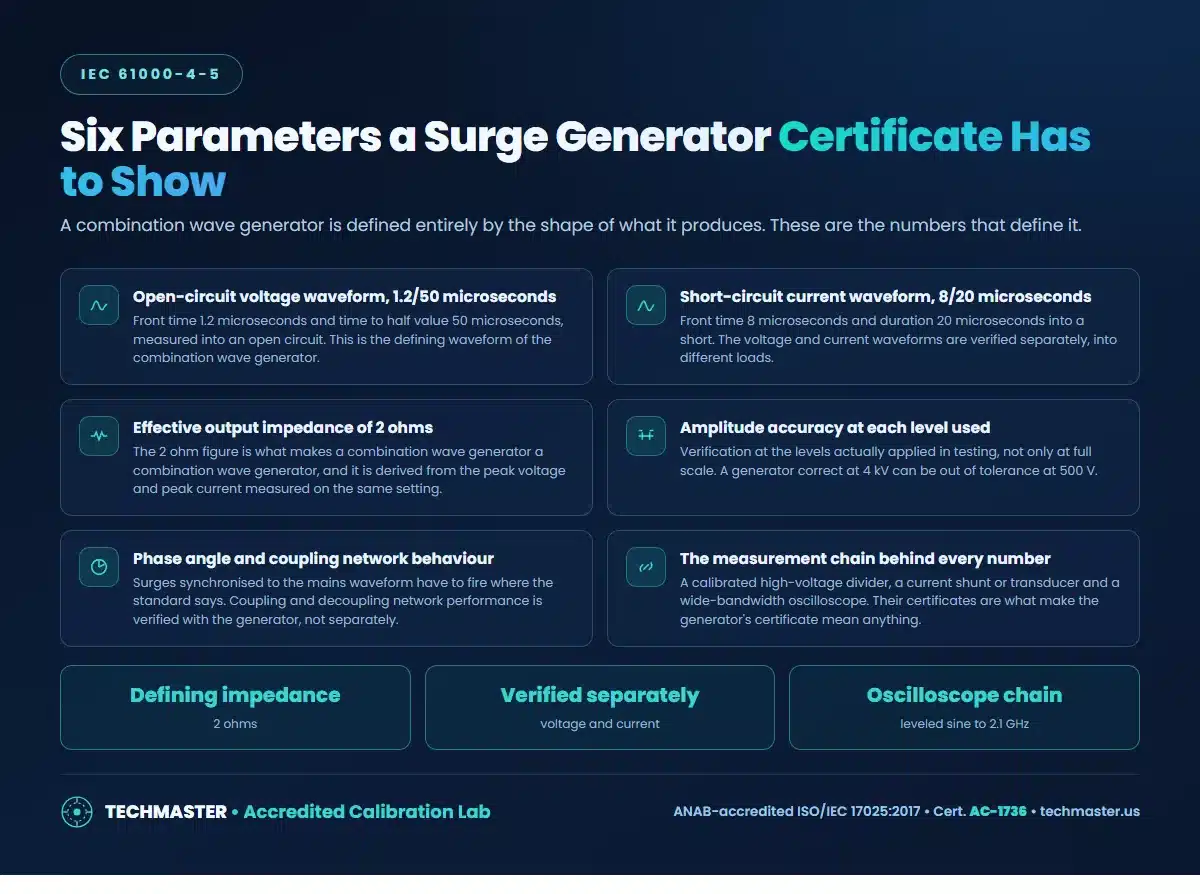
The point of the table is the third column. Every number on that certificate is only as good as the divider, the shunt and the oscilloscope behind it, which is why how an oscilloscope is calibrated matters more here than on a typical instrument, and why the certificate should let you trace each figure back to a standard with its own certificate. Techmaster’s oscilloscope capability is accredited for leveled sine to 2.1 GHz at Vista, Santa Clara and Orlando; DC and AC high voltage is accredited to 100 kV at Vista and 150 kV at San Antonio.
Why check amplitude at every level, not just full scale?
Because a generator that is correct at 4 kV can be out of tolerance at 500 V. Test levels are selected from a series, and the certificate is only evidence for the levels it actually reports.
This is the single most common gap in EMC source certificates, and it is also the easiest to close: give the laboratory the list of levels you use before the calibration, not after. The tolerance question behind it, how much accuracy you need in the standard relative to the tolerance you are enforcing, is the test uncertainty ratio and decision rules argument, and the uncertainty that goes with each reported figure is covered in measurement uncertainty and traceability.
Is surge generator calibration accredited?
Ask, per parameter, and read the answer off the scope document. EMC immunity sources are frequently handled as NIST-traceable characterisation rather than accredited calibration, and a laboratory being accredited does not mean this measurement is on its scope.
That is not a criticism of any supplier, it is how accreditation works. A scope lists parameters and ranges, and anything not on it is not accredited work no matter who performs it. how to read CMC on an accreditation scope explains how to find your parameter on a scope, accredited versus NIST-traceable calibration sets out what the two certificate types give you, and what an accredited calibration laboratory is covers what accreditation certifies in the first place. Where the immunity test result feeds a product qualification, Z540.3 and ISO/IEC 17025 for semiconductor test equipment shows how the same reasoning is applied under Z540.3.
How often should a surge generator be calibrated?
Annually is the common practice. Add a verification after any repair, after a suspected overload, and before a major qualification campaign – those events, not the calendar, are what usually catch a drifting generator.
The reasoned version of that answer is in how to set calibration intervals under ILAC-G24, which sets intervals from observed drift and consequence rather than convention, and how often test equipment should be calibrated covers the general case. Between calibrations, capturing the open-circuit waveform on a known setting and comparing it to the last certificate is a cheap and effective control, the pattern described in intermediate checks between calibrations. The related field instrument, the electrostatic field meter used to police the ESD-protected area, is covered in electrostatic field meter calibration.
Frequently asked questions
What is verified during surge generator calibration?
The shape and size of what the generator produces: the 1.2/50 microsecond open-circuit voltage waveform, the 8/20 microsecond short-circuit current waveform, the resulting effective output impedance of 2 ohms, the amplitude accuracy at the levels actually used, and the behaviour of the coupling and decoupling network including phase-angle synchronisation.
How often should a surge generator be calibrated?
Annually is the common interval, and it is the one most EMC laboratory quality systems adopt. The defensible approach is to set the interval from observed drift and the consequence of an error rather than from habit, and to add a check after any repair, after a suspected overload, and before a major qualification campaign.
Is surge generator calibration ISO/IEC 17025 accredited?
That depends on the laboratory and the parameter, and it is a question worth asking directly rather than assuming. EMC immunity generators are frequently handled as NIST-traceable characterisation work rather than under an accredited scope. Ask any supplier to show you the specific parameter on their scope document before you rely on the certificate.
Why does the 2 ohm output impedance matter?
Because it is what makes a combination wave generator a combination wave generator. The 2 ohm effective output impedance is what allows one generator to deliver a 1.2/50 microsecond voltage waveform into an open circuit and an 8/20 microsecond current waveform into a short, and it is derived from the peak voltage and peak current measured on the same setting.
The bottom line
A surge generator certificate should show measured waveform parameters at the levels you actually use, with the measurement chain identified, not a bare statement of conformity. Ask which parameters sit on the laboratory’s accredited scope before you rely on the document.
Need a quote, a rental, or a repair evaluation?
Techmaster Electronics, ISO/IEC 17025 accredited calibration laboratory, ANAB Cert. AC-1736, founded 1989. Five US labs, 5-day standard turnaround, 1–2 day expedite.
Request a quote →Techmaster Electronics, LLC is an independent ISO/IEC 17025:2017 accredited calibration laboratory. We are not affiliated with, authorized by, or endorsed by any manufacturer named on this page. All product names and model designations are trademarks of their respective owners and are used here only to identify the equipment we calibrate, repair, or rent. Confirm that our accredited scope covers your instrument’s parameters and ranges before shipping, ask us and we will check it against your model list.

Khanh Nguyen is the Marketing Manager at Techmaster Electronics, a B2B marketing leader covering the test, measurement, and ISO/IEC 17025 accredited calibration industry in the United States.