
Anemometers measure air velocity for HVAC balancing, fume hood and cleanroom airflow checks, weather stations and industrial ventilation. Every type drifts: vane bearings wear, hot-wire sensors get contaminated, and cup rotors lose balance.
Anemometer calibration compares the instrument with a reference air velocity in a controlled wind tunnel, at the speeds you actually measure.
Anemometer types and what drifts
| Type | Typical use | Common drift |
|---|---|---|
| Rotating vane | HVAC grilles, duct traverses | Bearing friction raises the starting speed and reads low at low velocity |
| Hot-wire / thermal | Low velocities, fume hoods, cleanrooms | Sensor contamination and temperature compensation errors |
| Cup and propeller | Weather stations, wind monitoring | Bearing wear, damaged cups, imbalance |
| Pitot tube with manometer | Ducts and higher velocities | Blocked ports, manometer error |
How the calibration is done
The anemometer is placed in the test section of a wind tunnel. Its reading is compared with a reference, such as a calibrated pitot-static tube, a laser Doppler system or a reference anemometer, at several air velocities across its range. Air temperature and pressure are recorded, because density affects some measurement principles. Thermal anemometers are especially sensitive at low velocities, so the low end of the range deserves extra test points if that is where you work.
Position and probe orientation matter
Vane and thermal probes are directional. A probe turned a few degrees from the flow, or held too close to a grille, reads differently from the tunnel result. Calibration proves the instrument. Correct technique in the field is what turns that into a correct airflow measurement. For airflow testing of cleanrooms and containment devices, see fume hood testing.
Intervals
Annual calibration is common, and more often for instruments used to certify cleanrooms, hoods or HVAC systems. Recalibrate after a drop, a sensor replacement or any visible damage to vanes or cups. Related instruments are covered in airflow meter calibration.
Accreditation and certificates
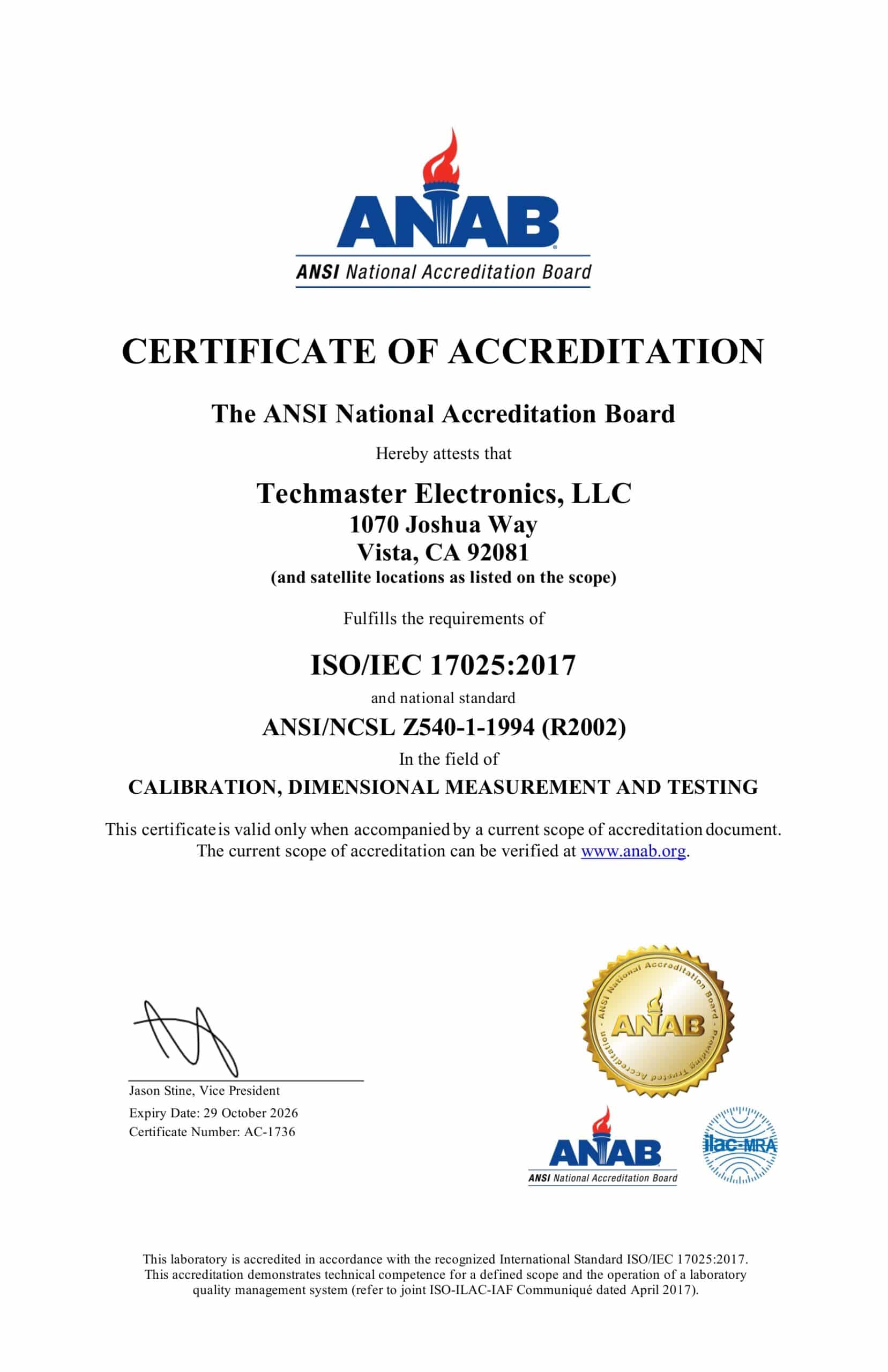
Anemometer calibration is not listed on Techmaster’s ANAB scope, so it is calibrated with NIST-traceable reference standards and issued a traceable certificate with as-found and as-left data. If your auditor requires an ISO/IEC 17025 accredited certificate, tell us before you send the instrument.
Frequently asked questions
How is an anemometer calibrated?
Why do vane anemometers read low at low speeds?
How often should anemometers be calibrated?
Is anemometer calibration accredited at Techmaster?
Related calibration guides
References & industry standards
- ISO/IEC 17025 testing & calibration laboratory requirements
- NIST calibration services and measurement traceability
- ANAB ISO/IEC 17025 calibration laboratory accreditation
External standards bodies. Techmaster Electronics is an ISO/IEC 17025-accredited, NIST-traceable calibration laboratory.
Accredited calibration at Techmaster
Techmaster Electronics is an ANAB-accredited (Certificate AC-1736) ISO/IEC 17025:2017 calibration laboratory with five US labs, NIST-traceable standards and a full measurement-uncertainty budget on every certificate — in-lab or nationwide on-site, with 5-business-day standard turnaround and expedite options. See our calibration services or request a quote.
Calibration labs near you: Techmaster Electronics is an ISO/IEC 17025 accredited calibration laboratory (ANAB Certificate AC-1736) with accredited labs in Vista, CA, Santa Clara, CA, Orlando, FL and San Antonio, TX, plus a lab in Holly Springs, NC. Accredited parameters vary by lab; compare locations or request a quote.

Khanh Nguyen is the Marketing Manager at Techmaster Electronics, a B2B marketing leader covering the test, measurement, and ISO/IEC 17025 accredited calibration industry in the United States.