
TL;DR: Pressure transducer repair covers the parts outside the sensing element, cables and connectors, moisture in the connector or electronics, and a failed 4–20 mA or voltage output stage. An over-pressured diaphragm or one attacked by the process media is a replacement, and zero and span drift is a calibration finding. Accredited pressure runs −12 psi to 10,000 psi, with 15,000 psi at San Antonio.
What is pressure transducer repair?
Pressure transducer repair is the diagnosis and restoration of a pressure transducer’s cable, connector, seals and signal-conditioning electronics, followed by calibration, as distinct from replacing a sensing element that has been over-pressured or corroded, which cannot be repaired. Telling those two apart is the first and most valuable step.
Pressure and vacuum requests were the joint-largest cluster still open to new content among those reaching our laboratories over the last two quarters, and repair was one of its two leading axes. Mechanical gauges and vacuum gauges fail differently; an electronic transducer is a sensing element and an electronics stage in one housing, and the fault is usually in one or the other. Routine calibration of a working unit is covered in pressure sensor calibration and pressure transmitter calibration.
What goes wrong with a pressure transducer?
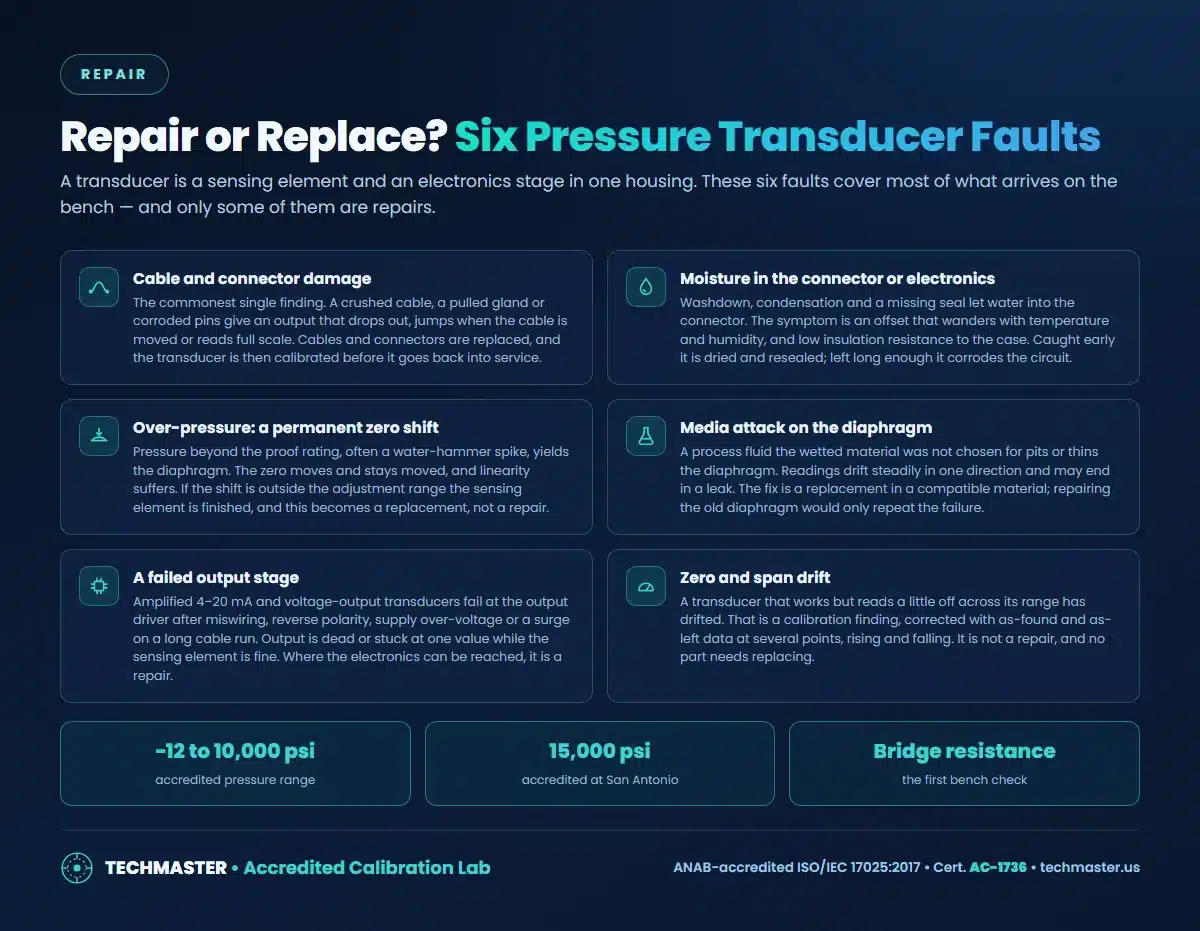
Six faults cover most of what arrives on the bench: a damaged cable or connector; moisture in the connector or electronics; a permanent zero shift after over-pressure; a diaphragm pitted or thinned by incompatible media; a failed output stage on an amplified unit after miswiring or a surge; and ordinary zero and span drift.
The cable, the moisture and the output stage are repairs where the parts can be reached. The over-pressure and the media attack end the sensing element. The drift is corrected by calibration, with nothing replaced.
Repair, replace, or calibrate?
| Symptom | Most likely cause | Repair, replace, or calibrate |
|---|---|---|
| Output drops out or jumps when the cable is moved | Cable or connector | Repair – replace the cable or connector |
| Offset wanders with temperature and humidity | Moisture in the connector or electronics | Repair if caught early – dry and reseal |
| Zero offset at atmosphere that will not adjust out | Diaphragm yielded by over-pressure | Replace the transducer |
| Steady drift in one direction, possibly a leak | Media attack on the diaphragm | Replace in a compatible wetted material |
| 4-20 mA or voltage output dead or stuck | Output stage after miswiring, reverse polarity or a surge | Repair where the electronics are accessible |
| Open or unbalanced bridge resistance | Damaged strain-gauge bridge | Replace the transducer |
| Works, but slightly off across the range | Ordinary zero and span drift | Calibrate with as-found data |
How do you tell if a transducer was over-pressured?
Vent it and read the zero. A transducer taken beyond its proof pressure usually keeps a zero offset afterwards and loses linearity across its range. If the offset exceeds the zero adjustment, the sensing element has yielded and the unit is replaced. Pressure spikes from water hammer or fast-closing valves are the common cause, and they rarely show on a slow gauge.
The prevention is cheaper than the replacement: a snubber or damper in liquid lines, a range chosen with headroom above the working pressure, and wetted materials chosen for the process fluid. The trade-offs between reference instruments used to check them are covered in deadweight tester vs digital pressure calibrator, and readout-side drift in digital pressure indicator calibration.
How is a transducer repair evaluated?
Six steps, in order: record the media, the peak pressure the line can see and the output type; check the electrical side, bridge resistance on millivolt units, loop current on amplified ones, and insulation resistance from circuit to case; vent the transducer and read its zero; run pressure points rising and falling to expose non-linearity, hysteresis and leaks; quote the repair or the replacement; then calibrate with as-found and as-left data. Sending the media and the peak pressure with the unit shortens the evaluation more than anything else.
Does a repaired transducer need calibration?
Yes, always. A new cable, a resealed connector or a repaired output stage changes what the previous certificate described. The calibration applies pressure at several points rising and falling, records zero, span, linearity and hysteresis, and keeps both as-found and as-left data.
The as-found data answers the harder question, whether readings taken before the failure can be trusted, which is the process in out-of-tolerance calibration results and the distinction in as-found versus as-left calibration data.
What capability stands behind the calibration?
Pressure calibration on Techmaster’s ANAB ISO/IEC 17025 scope (Cert. AC-1736) runs from −12 psi to 10,000 psi, with 15,000 psi at the San Antonio laboratory and barometric measurement to 39 psia. Transducers used above those ranges should be discussed before they ship. What a scope line covers is explained in calibration and measurement capability, certificate types in accredited versus NIST-traceable calibration, and mechanical instruments in pressure gauge calibration.
Frequently asked questions
Can a pressure transducer be repaired?
Partly. Cables, connectors, seals and, on amplified units, the output electronics can often be repaired, and the transducer is then calibrated. The sensing element is a different matter: many transducers are sealed, welded assemblies, and a diaphragm that has been over-pressured or attacked by the process media is replaced rather than rebuilt. An evaluation tells you which case you have before any work is authorised.
How do I know if my pressure transducer was over-pressured?
Vent it to atmosphere and read the zero. A transducer that was taken beyond its proof pressure usually shows a zero offset that does not go away, and its readings are no longer linear across the range. If the offset is larger than the zero adjustment can remove, the sensing element has yielded. Water hammer and pressure spikes in liquid lines are the usual cause, even when the gauge never showed the peak.
Why does my transducer output drift with temperature and humidity?
Moisture is the usual reason. Water that gets into the connector or the electronics through a damaged seal, washdown or condensation creates leakage paths, and the output offset wanders with the weather. Measuring insulation resistance between the circuit and the case confirms it. Caught early the unit can be dried and resealed; left in service it corrodes the circuit.
Does a repaired pressure transducer need calibration?
Yes, always. Any repair to the cable, connector or electronics changes what the previous certificate described. The calibration applies pressure at several points rising and falling, records as-found and as-left data, and shows linearity and hysteresis as well as zero and span. Accredited pressure calibration covers minus 12 psi to 10,000 psi, with 15,000 psi at the San Antonio laboratory.
The bottom line
Vent it, read the zero, swap the cable and check the insulation resistance before deciding a transducer is broken. Then send the model, the output type, the process media and the highest pressure the line can see, and we will tell you whether it is a repair, a replacement or a calibration before any work is done.
Need a quote, a rental, or a repair evaluation?
Techmaster Electronics, ISO/IEC 17025 accredited calibration laboratory, ANAB Cert. AC-1736, founded 1989. Five US labs, 5-day standard turnaround, 1–2 day expedite.
Request a quote →Techmaster Electronics, LLC is an independent ISO/IEC 17025:2017 accredited calibration laboratory. We are not affiliated with, authorized by, or endorsed by any manufacturer named on this page. All product names and model designations are trademarks of their respective owners and are used here only to identify the equipment we calibrate, repair, or rent. Confirm that our accredited scope covers your instrument’s parameters and ranges before shipping, ask us and we will check it against your model list.

Khanh Nguyen is the Marketing Manager at Techmaster Electronics, a B2B marketing leader covering the test, measurement, and ISO/IEC 17025 accredited calibration industry in the United States.