
TL;DR: Cable and antenna analyzer repair most often means a worn or damaged test port, a receiver damaged by power or DC on the line, battery and charging faults, or drop and water damage. Two frequent complaints are found in the carry case: a worn test cable and a worn calibration kit. Check cable, kit and port in that order. RF calibration is accredited at Vista, Santa Clara and Orlando, not San Antonio.
What is cable and antenna analyzer repair?
Cable and antenna analyzer repair is the diagnosis and restoration of a handheld line-sweep instrument, its test port, RF front end, power system, display and housing, followed by calibration of return loss, distance-to-fault and frequency performance. Because the measurement also depends on the test cable and calibration kit, finding which part actually failed comes first.
Antenna and cable analyzer requests formed a smaller but specific cluster reaching our laboratories over the last two quarters, with rental leading and repair close behind. Routine calibration of a working unit is covered in cable and antenna analyzer calibration, and intervals in how often to calibrate a cable and antenna analyzer.
What breaks on a cable and antenna analyzer?
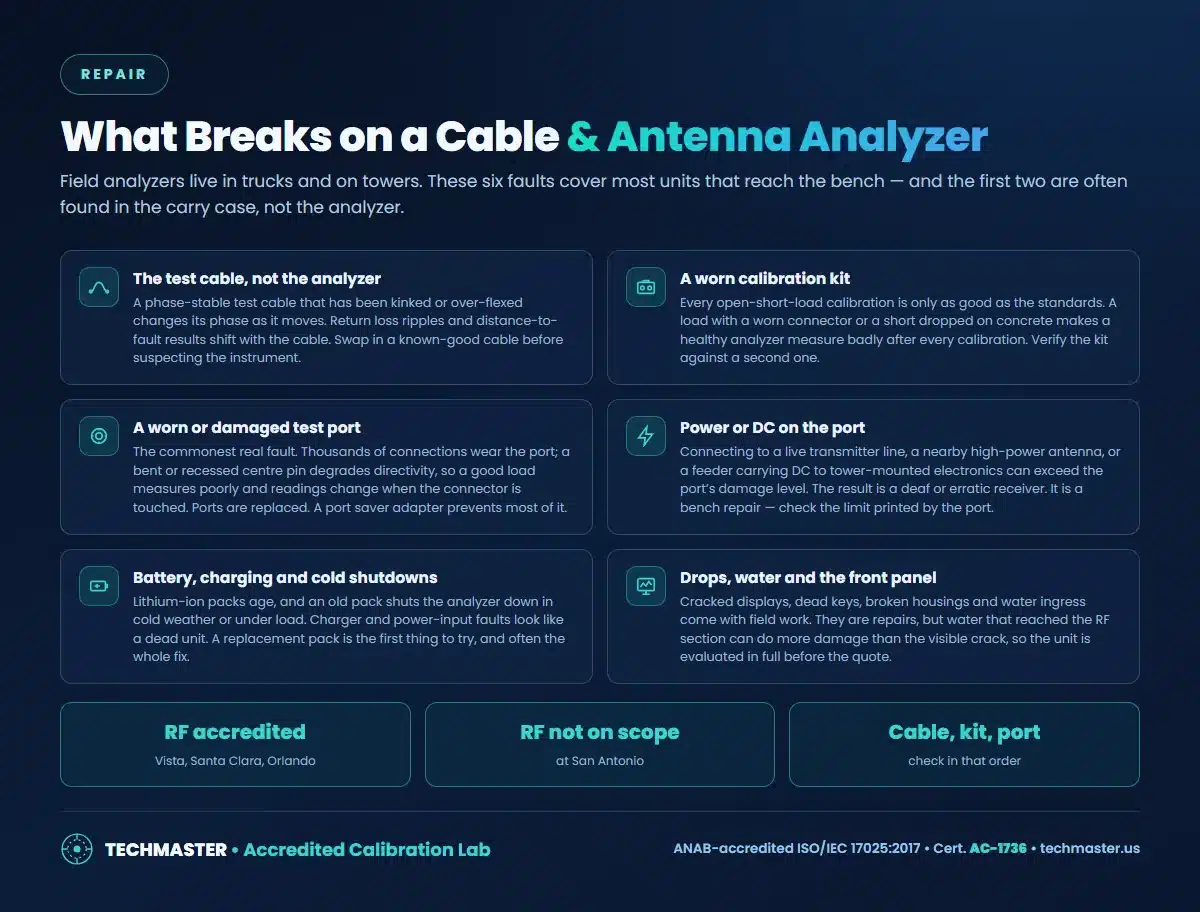
Six faults cover most of it: a worn or kinked test cable; a worn open-short-load calibration kit; a worn or damaged test port; a receiver damaged by RF power or DC on the line; ageing batteries and charging faults; and drop or water damage to the display, keys and housing.
The cable and the kit are accessories and are replaced. The port, the receiver, the power system and the front panel are repairs. A port saver adapter left on the test port prevents most port wear, because the adapter takes the connections instead.
Analyzer, cable, or kit?
| Symptom | Most likely cause | Repair, replace, or neither |
|---|---|---|
| Return loss ripples and fault distances move as the cable is flexed | Worn or kinked test cable | Replace the test cable |
| A healthy line measures badly after every calibration | Worn calibration kit standards | Replace or recalibrate the kit |
| Good load measures poorly; reading changes when the port is touched | Worn or damaged test port | Repair – replace the port |
| Deaf or erratic after connecting to a live or DC-fed line | Receiver front end damaged | Repair |
| Shuts down in cold weather or under load | Aged battery pack | Replace the battery |
| Fault location wrong, return loss correct | Velocity factor or cable loss setting | Neither – correct the settings |
| Cracked screen, dead keys, water ingress | Drop or weather damage | Repair after a full evaluation |
How does a test port get damaged?
Two ways. Wear: thousands of connections, a cross-threaded mate or a dirty connector gradually bend or recess the centre pin, which degrades directivity so a good load looks bad. Overload: connecting to a line carrying transmitter power or DC for tower-mounted electronics can exceed the port’s damage level and harm the receiver. A port saver prevents the first; a dead, DC-free line prevents the second.
How the port, the cable and the calibration fit together in normal use is covered in how to use a cable and antenna analyzer, and verifying calibration standards in calibration kit verification.
How do you triage an analyzer in the field?
Six steps, in order: inspect and gauge the test port; swap the test cable for a known-good one; recalibrate with a second calibration kit; measure a good load, a short and an open and compare with what they should show; confirm the velocity factor and cable loss settings before trusting a fault location; and, if the fault stays with the analyzer, send it with the model, the symptom and the result of each check. Most field complaints end at step two or three.
What capability stands behind the recalibration?
RF and microwave calibration is accredited on Techmaster’s ANAB ISO/IEC 17025 scope (Cert. AC-1736) at the Vista, Santa Clara and Orlando laboratories. RF work is not on the scope at San Antonio. Confirm your analyzer’s frequency range against the scope before shipping; what a scope line covers is in calibration and measurement capability, and certificate types in accredited versus NIST-traceable calibration. A repair always ends in recalibration with as-found and as-left data. For radiated-emissions work, antennas themselves are covered in EMC antenna factor calibration.
Frequently asked questions
Is it worth repairing a cable and antenna analyzer?
Usually, yes. Handheld cable and antenna analyzers are costly field instruments, and their common faults – a worn test port, a damaged receiver front end, battery and charging problems, a cracked display or keypad – are defined repairs. An evaluation identifies the failed section and quotes the repair against replacement cost before any work is authorised.
Why do my return loss readings change when I move the test cable?
Because the cable, not the analyzer, is changing. A phase-stable test cable that has been kinked or over-flexed changes its phase as it moves, so return loss ripples and distance-to-fault results shift. Swap in a known-good cable and repeat the calibration. If the readings still move when you touch the analyzer’s own connector, the test port is worn.
Can connecting to a live antenna line damage the analyzer?
Yes. Connecting to a feeder that carries transmitter power, sitting close to a high-power antenna, or connecting to a line that carries DC for tower-mounted electronics can exceed the test port’s damage level. The result is usually a deaf or erratic receiver that needs a bench repair. Check the input limit marked by the port and make sure the line is dead and DC-free before connecting.
Does a repaired analyzer need calibration?
Yes, always. A new test port or a repaired receiver changes what the previous certificate described. The calibration verifies frequency accuracy, return loss and distance-to-fault performance and any power or spectrum functions, with as-found and as-left data. Techmaster’s RF calibration is accredited at the Vista, Santa Clara and Orlando laboratories; RF work is not on the scope at San Antonio.
The bottom line
Swap the cable, recalibrate with a second kit and look at the port before deciding the analyzer is broken. If the fault stays with the instrument, send the model, the symptom and what each check showed, and we will evaluate and quote before any work is done.
Need a quote, a rental, or a repair evaluation?
Techmaster Electronics, ISO/IEC 17025 accredited calibration laboratory, ANAB Cert. AC-1736, founded 1989. Five US labs, 5-day standard turnaround, 1–2 day expedite.
Request a quote →Techmaster Electronics, LLC is an independent ISO/IEC 17025:2017 accredited calibration laboratory. We are not affiliated with, authorized by, or endorsed by any manufacturer named on this page. All product names and model designations are trademarks of their respective owners and are used here only to identify the equipment we calibrate, repair, or rent. Confirm that our accredited scope covers your instrument’s parameters and ranges before shipping, ask us and we will check it against your model list.

Khanh Nguyen is the Marketing Manager at Techmaster Electronics, a B2B marketing leader covering the test, measurement, and ISO/IEC 17025 accredited calibration industry in the United States.