
A refractometer turns the way light bends in a sample into a concentration reading: °Brix for sugar, refractive index (nD) for oils and chemicals, specific gravity for urine or coolant, salinity for brine. The optics barely change, but the zero point, the scale and the temperature compensation all drift. That shows up as product that passes on the line and fails at the customer.
Refractometer calibration checks the instrument against liquids of known refractive index at the points you actually measure, and documents how far it was off before any adjustment.
Handheld, digital and benchtop refractometers
The method depends on the instrument:
- Handheld analog refractometers are read through an eyepiece and adjusted with a calibration screw. They are zeroed with distilled water and checked at one or more points with a standard solution.
- Digital handheld refractometers read the shadow line with a sensor. They usually zero automatically with water, and the check is whether the reading at a known standard falls inside the stated accuracy.
- Benchtop (Abbe-type and automatic) refractometers read refractive index to four or five decimal places, often with a temperature-controlled prism. They need certified reference liquids at several points across the range.
What a refractometer calibration checks
| Check | How it is done | Why it matters |
|---|---|---|
| Zero | Distilled or deionized water at 20 °C should read 0.0 °Brix (nD 1.3330) | Offsets every reading by the same amount |
| Span / linearity | Certified sucrose solutions or refractive index reference liquids at low, mid and high points | Catches scale errors a water zero cannot show |
| Temperature compensation (ATC) | Readings repeated with sample and prism at different temperatures | A 1 °C error can shift a sugar reading by several hundredths of a °Brix, enough to matter on tight specs |
| Prism and optics | Inspection for scratches, coating damage and residue | Damaged prisms give soft or wandering shadow lines |
Standards and traceability
The simplest reference is pure water, but water only proves the zero. For anything beyond a quick check, the standards should be certified sucrose solutions or refractive index liquids with a stated value, uncertainty and expiry. Sucrose solutions absorb water and grow mold once opened, so an expired or contaminated standard is a common cause of a refractometer that “won’t calibrate”. Industries with their own reference tables, such as ICUMSA tables for sugar, expect the instrument to be checked against them at the working temperature.
Daily checks versus formal calibration
A zero check with water at the start of each shift catches most problems, and it should be logged. Formal calibration adds the span points, the temperature check and a certificate. Typical intervals are 6 to 12 months for production instruments, and sooner after a drop, a prism replacement or a failed daily check. In food, beverage and pharmaceutical plants, the interval is usually set by the HACCP plan or the quality system, not by the instrument maker.
Getting refractometers calibrated
Handheld and benchtop refractometers ship easily, so most customers send them to the nearest Techmaster lab. Include the range and the scale you use (Brix, RI, salinity or specific gravity) so the test points match your process.
Accreditation and certificates
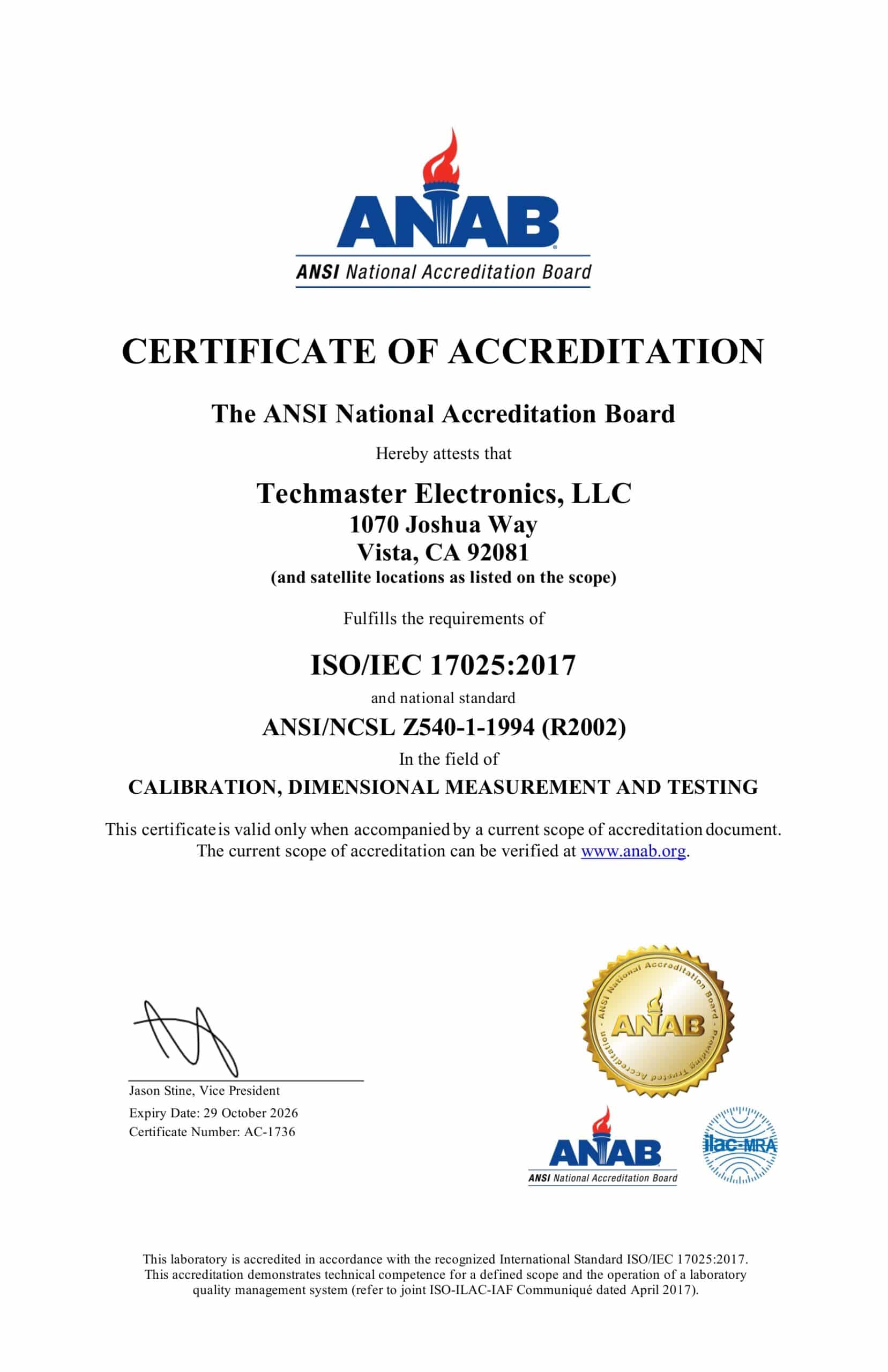
Refractometer calibration is not listed on Techmaster’s ANAB scope, so it is calibrated with NIST-traceable reference standards and issued a traceable certificate with as-found and as-left data. If your auditor requires an ISO/IEC 17025 accredited certificate, tell us before you send the instrument.
Frequently asked questions
How do you calibrate a refractometer?
What liquid is used to calibrate a refractometer?
How often should a refractometer be calibrated?
Is refractometer calibration accredited?
Related calibration guides
References & industry standards
- ISO/IEC 17025 testing & calibration laboratory requirements
- NIST calibration services and measurement traceability
- A2LA / ANAB accreditation for calibration laboratories
External standards bodies. Techmaster Electronics is an ISO/IEC 17025-accredited, NIST-traceable calibration laboratory.

Khanh Nguyen is the Marketing Manager at Techmaster Electronics, a B2B marketing leader covering the test, measurement, and ISO/IEC 17025 accredited calibration industry in the United States.