
Gage Block Calibration
Accuracy across the range
How Gage Block calibration works
- Intake & visual inspection
- Environmental stabilization
- As-found measurement
- Comparison to NIST-traceable standards
- Adjustment if required
- As-left results & certificate
Your calibration, covered
In-lab vs on-site calibration
In-lab calibration
- Accredited bench with full reference standards
- Best achievable measurement uncertainties
- Pickup & return logistics handled
- Ideal for precision and reference work
On-site calibration
- We calibrate the Gage Block at your facility
- No shipping risk or transit downtime
- As-found data captured before any move
- Ideal for fixed, large or sensitive assets
In-depth guide
In precision manufacturing, even a fraction of a millimeter can make the difference between a flawless component and a costly failure. Gage blocks calibration ensures that your reference standards remain accurate, traceable, and compliant with industry requirements. Whether you’re an engineer fine-tuning high-precision tools, a quality manager preparing for an audit, or a procurement specialist sourcing compliant equipment, accurate gage blocks are the foundation of reliable measurements.
For the main overview, see our guide to gage block calibration.
Over time, wear, environmental changes, and frequent handling can cause even the most durable gage blocks to drift from their nominal dimensions. Without proper calibration, every measurement you take could introduce errors that ripple through your entire production process, leading to rework, scrap, failed audits, and damaged customer trust.
This guide will walk you through what gage blocks calibration is, why it matters for your business, the latest calibration technologies, and how to choose the right service provider so every measurement you make is precise, traceable, and audit-ready
1. Introduction: Understanding Gage Blocks and Their Uses

In precision manufacturing, even a fraction of a millimeter can make the difference between a flawless component and a costly failure. Gage blocks calibration ensures that your reference standards remain accurate, traceable, and compliant with industry requirements. Whether you’re an engineer fine-tuning high-precision tools, a quality manager preparing for an audit, or a procurement specialist sourcing compliant equipment, accurate gage blocks are the foundation of reliable measurements.
Gage blocks, also called gauge blocks or Johansson blocks, are precision-ground measuring standards. These hardened steel, ceramic, or carbide blocks come in sets of varying sizes and are used as the building blocks of dimensional accuracy. Engineers and technicians stack them to achieve exact lengths, often to within a few millionths of an inch.
Industries that use gage blocks include:
-
Aerospace, jet engine parts, turbine blades, and airframe components
-
Automotive, engine assembly, gearbox components, safety systems
-
Medical devices, surgical tools, implants, and diagnostic equipment
-
Defense & manufacturing, firearms, weapon systems, high-precision optics
Think of gage blocks as the “master key” of measurement, if they’re off, everything else you measure will be off too.
2. What is Gage Block Calibration?
Simply put, gage block calibration is the process of comparing your gage blocks against a known, traceable measurement standard to verify their accuracy. Over time, gage blocks can drift from their nominal size due to:
-
Wear and tear from frequent wringing or handling
-
Contamination from oil, dust, or corrosion
-
Thermal expansion/contraction in uncontrolled environments
Calibration doesn’t just “check the numbers”, it gives you confidence. It’s like a health check-up for your measurement system. Without it, you’re running on assumptions. And assumptions in manufacturing can cost far more than a calibration ever will.
3. Why It’s Critical for Businesses
Here’s the blunt truth: Skipping calibration is a false economy.
Let’s imagine a scenario:
A supplier delivers parts based on measurements taken with out-of-calibration gage blocks. The parts don’t fit during assembly, forcing a production halt. Not only is there the cost of rework, but also the loss of delivery time, possible penalties, and, worst of all, damage to your reputation.
Business risks without calibration:
-
Regulatory non-compliance, failing ISO 9001, AS9100, or FDA inspections
-
Increased scrap and rework, wasted materials and labor
-
Supply chain disruption, missed delivery deadlines ripple through production
-
Customer trust loss, once it’s gone, it’s expensive to win back
ROI insight: Calibration is far cheaper than the combined cost of scrap, downtime, and lost contracts. In other words, a small investment in precision prevents a large cost in mistakes.
Case Study 1: Aerospace Supplier Avoids Costly Rework
A Tier-2 aerospace parts manufacturer relied on gage blocks for setting up precision milling machines. During a routine external audit, their in-house gage block set failed verification, showing wear beyond acceptable limits.
Without recent professional calibration records, their production line risked a quality hold that could delay deliveries to an OEM customer.
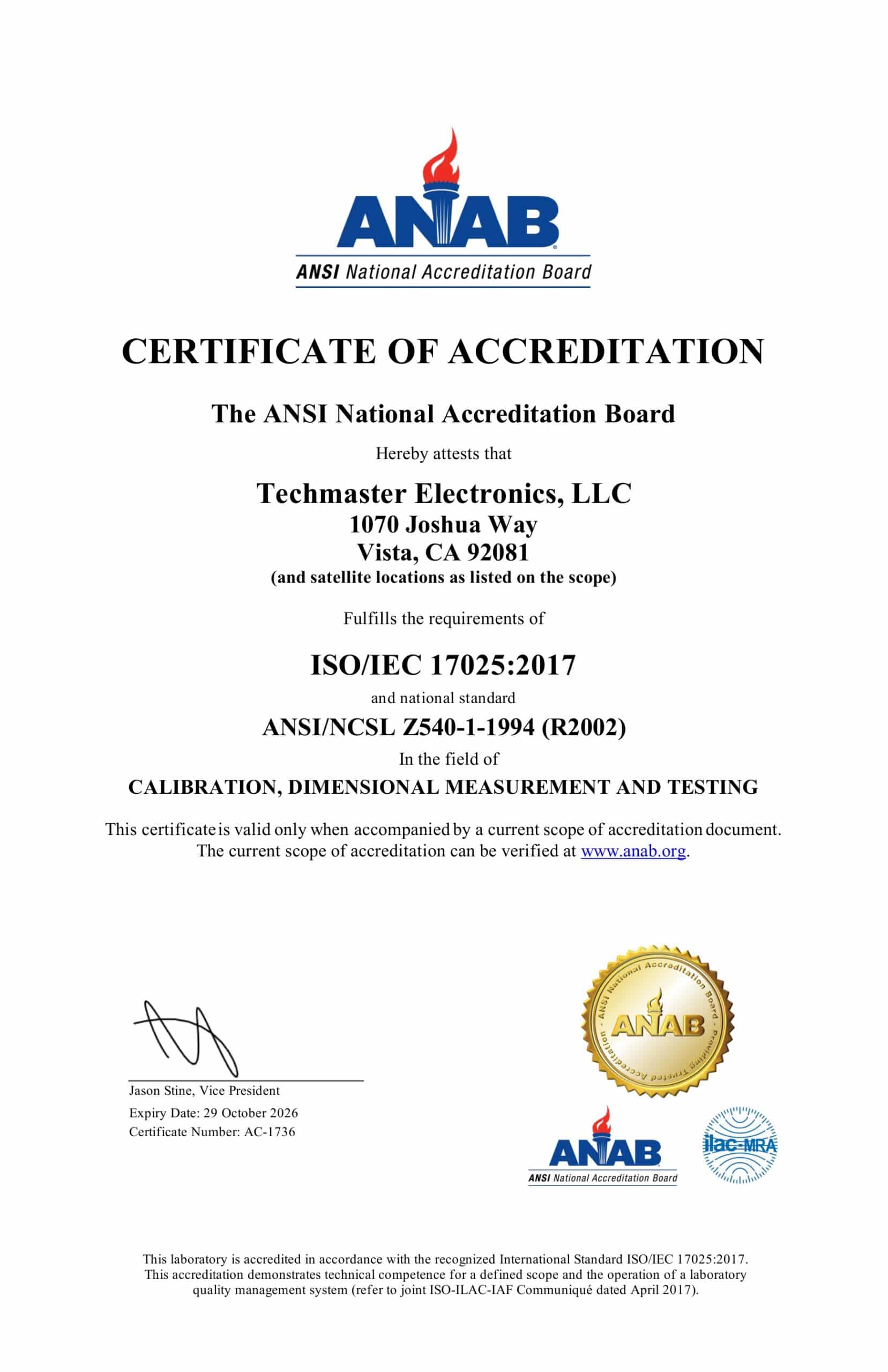
They contacted Techmaster for an expedited ISO/IEC 17025 calibration. Within days, the blocks were:
-
Cleaned, measured, and certified traceable to NIST
-
Delivered with a digital calibration certificate for audit proof
-
Labeled with next calibration due date for easier tracking
Impact:
Production resumed immediately after the updated certificates were presented to auditors. The supplier kept their delivery schedule intact and avoided contract penalties. More importantly, the OEM’s trust in their quality systems remained unshaken.
Case Study 2: Medical Device Manufacturer Strengthens Compliance
A medical device company manufacturing surgical implants had their QA team flagged by an internal quality review, several gage blocks had exceeded their recommended calibration interval.
While the blocks were still in good physical condition, the company’s ISO 13485 compliance required documented calibration history to prove measurement accuracy.
By engaging Techmaster’s on-site calibration service:
-
Calibrations were performed without removing equipment from the cleanroom
-
Certificates were uploaded instantly to their Techmaster Online Portal
-
The QA team implemented automatic recall alerts for all dimensional standards
Impact:
The company passed its subsequent regulatory inspection with zero findings related to measurement traceability. Internal processes for calibration scheduling became automated, reducing administrative workload and ensuring ongoing compliance.
4. New Technology in Calibration

Modern calibration labs now use laser interferometers, CMMs (coordinate measuring machines), and automated temperature-controlled environments to achieve sub-micron measurement uncertainty.
Benefits of these advancements:
-
Higher accuracy, better than older comparator methods
-
Faster turnaround, automated systems reduce downtime
-
Digital record-keeping, integrated systems link results directly to your quality management software
For businesses, this means fewer errors, faster production restart, and clear audit trails.
5. Overview of the Gage Blocks Calibration Process
While every accredited lab has its specific procedures, most gage block calibrations include:
-
Cleaning & inspection, removing contaminants and checking for visible damage
-
Environmental conditioning, stabilizing the block at standard temperature (20°C)
-
Measurement against reference standards, often using high-precision comparators or interferometry
-
Data recording & certificate issuance, documenting results for compliance and future traceability
Thinking about scheduling your next calibration? We can guide you through the process and help you choose the right service level for your needs.
6. International Standards and Their Benefits
Calibrations gain credibility when they meet internationally recognized standards, such as:
-
ISO/IEC 17025, proof of technical competence and recognized worldwide
-
ANSI/NCSL Z540.1, common in US aerospace and defense sectors
-
NIST Traceability, direct link to US national measurement standards
Benefits for your business:
-
Pass domestic and international audits
-
Avoid disputes over measurement validity
-
Simplify supplier quality management
7. In-House vs. Professional Calibration
Some companies try in-house calibration, but there are trade-offs.
| In-House Calibration | Professional Calibration |
|---|---|
| Lower upfront cost | Higher technical accuracy |
| Quick turnaround internally | Certified, traceable to standards |
| Limited by available equipment | Uses advanced reference standards |
| Risk of bias or human error | Documented by accredited labs |
| May not meet ISO/ASTM | Compliant with ISO 17025, Z540.1 |
For most businesses, especially those under strict quality standards, professional calibration provides the documentation and confidence needed to satisfy auditors and customers.
8. How Often Should I Calibrate?
The optimal calibration interval depends on:
-
Usage frequency, daily use wears blocks faster
-
Environmental factors, humidity, temperature fluctuations, and contamination
-
Required tolerance, tighter specs require more frequent checks
Typical guidance:
-
Heavy use: every 6–12 months
-
Moderate/light use: every 1–2 years
-
After any suspected damage or contamination
9. Key Factors When Choosing a Calibration Provider
When selecting a calibration lab, consider:
-
Accreditation level, ISO/IEC 17025 preferred for high assurance
-
Traceability, NIST or equivalent international standards
-
Measurement uncertainty, relevant to your application
-
Turnaround time, keep downtime minimal
-
Service flexibility, on-site vs. lab-based
-
Digital accessibility, online portal for certificates and scheduling
10. Techmaster’s Calibration Service Levels for Gage Blocks
Techmaster offers three service tiers:
-
Commercial Calibration, NIST traceable, basic compliance needs
-
ANSI/NCSL Z540.1 Calibration, includes test data for aerospace/defense
-
ISO/IEC 17025 Accredited Calibration, full uncertainties, global recognition
With a network of US and international labs plus on-site services, Techmaster delivers both speed and compliance, supported by an online portal for certificate access and recall notifications.

11. FAQ: Gage Blocks Calibration
Q1: What materials are gage blocks made from?
Steel, ceramic, or carbide, each with unique wear resistance and thermal stability.
Q2: Do I need ISO/IEC 17025 calibration for my gage blocks?
If you operate under strict regulatory or international trade requirements, yes.
Q3: Can I calibrate gage blocks myself?
Possible, but without accredited equipment, you risk non-compliance and measurement errors.
Q4: How long does calibration take?
Typically 3–7 business days; expedited services may be available.
12. Strong CTA: Contact Us Today
Contact us for expert advice on gage blocks calibration and service scheduling tailored to your industry.
We’ll help you choose the right calibration level, minimize downtime, and ensure every measurement you make is accurate, traceable, and audit-ready.

Outside Micrometer Calibration: Flatness, Parallelism and Linearity Checks
How an ISO/IEC 17025 lab calibrates an outside micrometer: gage block linearity points, optical flat...
Oct

Glass Scale Calibration for DROs, Comparators and Measuring Machines
Home » Gage Blocks Calibration That Eliminates Measurement ErrorsGlass scales (linear encoders) sit inside digital...
Oct

Microscope Calibration: Stage Micrometers, Reticles and Imaging Software
Home » Gage Blocks Calibration That Eliminates Measurement Errors If a microscope is only used...
Oct
How Often Calibrate Universal Testing Machine?
Home » Gage Blocks Calibration That Eliminates Measurement Errors Universal Testing Machine FAQ: Calibration Intervals,...
Sep
How to Use a Universal Testing Machine?
Home » Gage Blocks Calibration That Eliminates Measurement Errors How to Use a Universal Testing...
Sep
Universal Testing Machine Calibration: ISO/IEC 17025 Guide
Home » Gage Blocks Calibration That Eliminates Measurement Errors Universal Testing Machine Calibration: ISO/IEC 17025...
Sep
How often calibrate Ultrasonic Thickness Gauge?
Home » Gage Blocks Calibration That Eliminates Measurement Errors Ultrasonic Thickness Gauge FAQ: Calibration Intervals,...
Sep
How to Use an Ultrasonic Thickness Gauge?
Home » Gage Blocks Calibration That Eliminates Measurement Errors How to Use an Ultrasonic Thickness...
Sep
Frequently asked questions
What is Gage Block Calibration?
How often should a Gage Block be calibrated?
What standards apply to Gage Block Calibration?
What is included on the certificate?
Can you calibrate the Gage Block on-site?
Need Gage Block calibration?
ANAB-accredited, NIST-traceable, fast turnaround, in-lab or on-site across the USA.
Contact us for a quoteReferences & industry standards
- ISO/IEC 17025 testing & calibration laboratory requirements
- NIST calibration services and measurement traceability
- A2LA / ANAB accreditation for calibration laboratories
External standards bodies. Techmaster Electronics is an ISO/IEC 17025-accredited, NIST-traceable calibration laboratory.

Khanh Nguyen is the Marketing Manager at Techmaster Electronics, a B2B marketing leader covering the test, measurement, and ISO/IEC 17025 accredited calibration industry in the United States.