
TL;DR: Multimeter calibration checks every function across its ranges, DC/AC voltage (with frequency response), DC/AC current, 2- and 4-wire resistance, frequency, capacitance, and temperature functions, at multiple points per range against a traceable calibrator. Typical starting interval: 12 months. Market cost: $50–150 handheld, $100–250 bench. The catch at 6.5+ digits: maintaining a 4:1 uncertainty ratio requires standards most in-house benches don’t have.
The humble DMM is the most-calibrated instrument in industry, and the one where corner-cutting hides best, because a meter that reads something plausible looks fine. Here’s what a proper multimeter calibration covers, what it costs, and where the traps are.
What does multimeter calibration include?
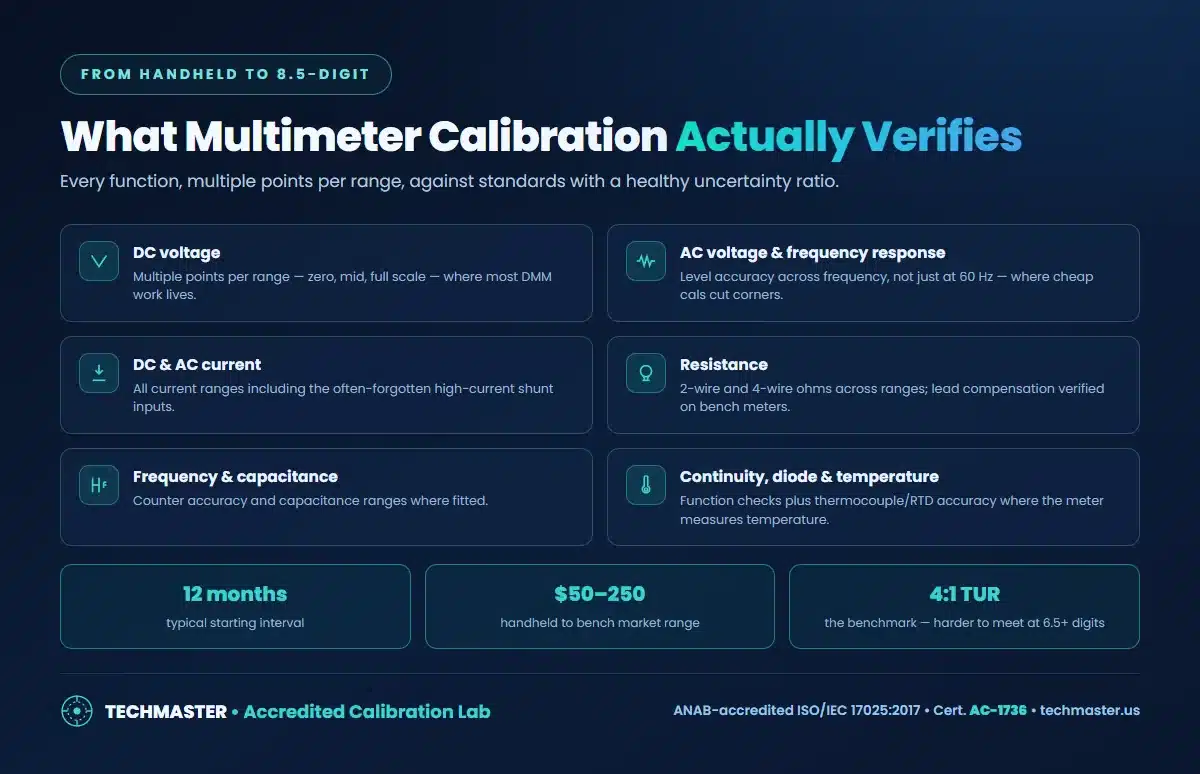
A complete calibration exercises every function the meter has, at zero, mid, and full scale per range. The corner most often cut: AC voltage across frequency, checking only at 60 Hz says nothing about the meter’s response at 10 kHz. Bench meters add 4-wire resistance with lead compensation; meters with temperature functions get thermocouple or RTD accuracy verified. As always, the certificate should carry as-found/as-left data and uncertainty, the fields explained in how to read a calibration certificate.
Why are high-digit meters different?
A 6.5-digit meter reading 10.00000 V needs a standard several times more accurate than itself to keep a healthy test uncertainty ratio. That pushes the job onto multifunction calibrators and reference standards that only calibration labs economically maintain, and it’s why “we check it against another meter” isn’t calibration. At 7.5 and 8.5 digits, even labs manage the TUR carefully via guard-banding and stated decision rules.
How often and how much?
Twelve months is the default; field handhelds that ride in tool bags drift faster, while bench references with clean history can extend, the evidence rules are in the interval guide. Pricing runs $50–150 handheld and $100–250 bench at market rates; accredited certificates add 20–50% and include the data. For fleets, batch due dates and use pickup: Techmaster offers free local pickup in Silicon Valley, Southern California, and Orlando with 5-day standard turnaround and 1–2 day expedite options.
Frequently asked questions
How much does it cost to calibrate a multimeter?
Market-typical US pricing is roughly $50–150 for handheld DMMs and $100–250 for bench meters, for a standard NIST-traceable calibration. High-accuracy 6.5–8.5 digit meters and accredited certificates with full data cost more.
How often should a multimeter be calibrated?
Every 12 months as the default. Handhelds in rough field service drift faster and may warrant shorter intervals; stable bench references with clean as-found history can often extend to 24 months with documentation.
Can I calibrate a multimeter myself?
You can verify a meter against a known reference, but calibration that stands up to audits requires NIST-traceable standards with a documented uncertainty budget, typically a 4:1 test uncertainty ratio, which for 6.5+ digit meters means a high-end calibrator only labs maintain.
What is checked during multimeter calibration?
All functions across ranges: DC and AC voltage (including frequency response), DC and AC current, 2-wire and 4-wire resistance, plus frequency, capacitance, continuity, diode, and temperature functions where fitted, with multiple test points per range.
The bottom line
Calibrate DMMs annually, insist on full-function coverage including AC frequency response, and match the certificate level to your audit exposure. Techmaster Electronics calibrates multimeters from handheld to 8.5-digit bench standards under ANAB certificate AC-1736, across 12 calibration disciplines.
Get an accredited calibration quote
ANAB-accredited ISO/IEC 17025:2017 (Cert. AC-1736) • 5 US labs • 5-day standard, 1–2 day expedite • in-lab or on-site.
Request a quoteReferences & industry standards
- ISO/IEC 17025 testing & calibration laboratory requirements
- NIST calibration services and measurement traceability
- NIST Time and Frequency Division
- A2LA / ANAB accreditation for calibration laboratories
External standards bodies. Techmaster Electronics is an ISO/IEC 17025-accredited, NIST-traceable calibration laboratory.

Khanh Nguyen is the Marketing Manager at Techmaster Electronics, a B2B marketing leader covering the test, measurement, and ISO/IEC 17025 accredited calibration industry across the US and Vietnam markets.