
TL;DR: Specify an environmental chamber rental by temperature range and required ramp rate, whether humidity control is genuinely needed, and usable volume with the fixture in place, then confirm your site power and drainage before booking. Ramp rate rules chambers out more often than the temperature extremes do, and qualification work needs the chamber mapped after installation.
When does renting a chamber make sense?
An environmental chamber rental covers a bounded need: a qualification or design-verification programme with a defined end date, a capacity overflow during a busy period, or the weeks an owned chamber is out for repair. Chambers are expensive to buy, expensive to move, and idle between programmes, which is why short-term access is often the better economics.
Chamber requests reaching our laboratories over the last quarter were split between calibration, mapping and repair, and notably, several were units that had stopped cooling, which is exactly the situation a rental bridges while the owned chamber is fixed.
What do I need to specify?
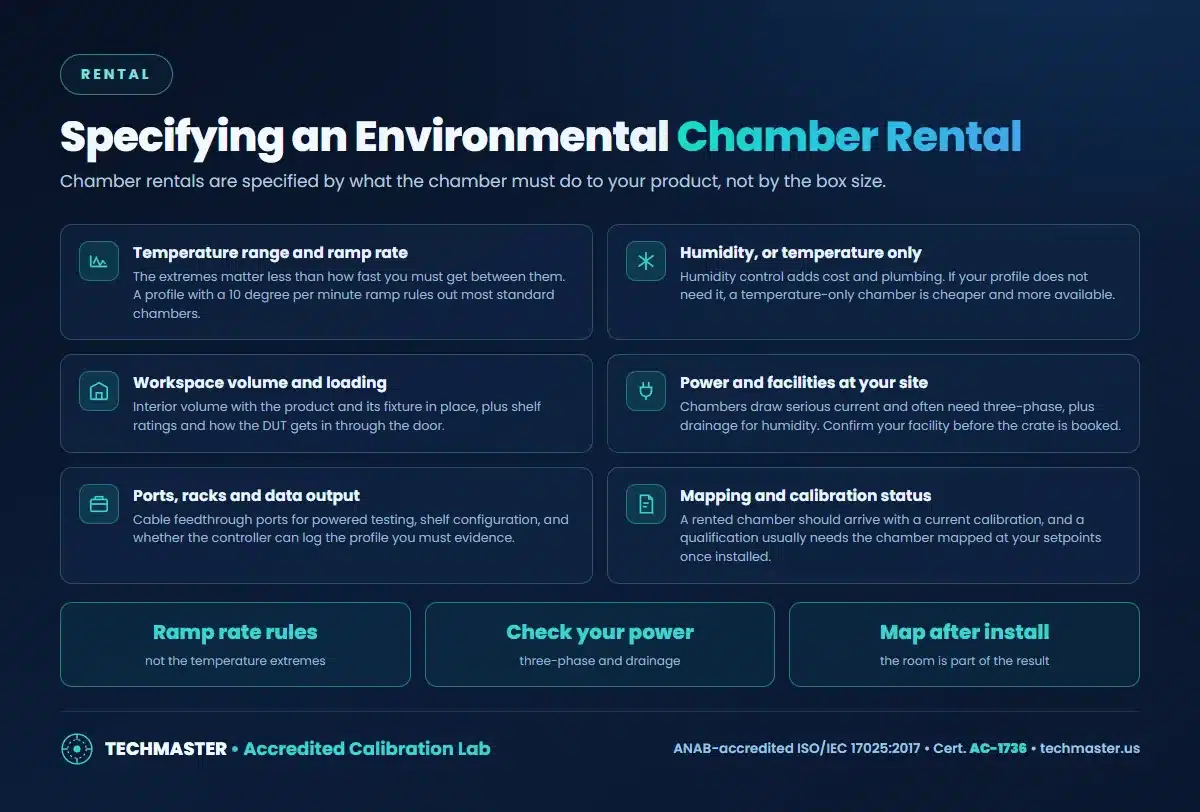
Temperature range and ramp rate, humidity control or temperature only, usable workspace volume with the fixture installed, site power and drainage, cable feedthrough ports and shelf configuration, and the calibration and mapping status of the chamber.
Why ramp rate matters more than the extremes
Reaching minus forty is a matter of refrigeration capacity. Reaching it quickly, repeatedly, with a loaded chamber, is a different machine. A profile specifying ten degrees per minute rules out most standard chambers regardless of their stated range, and it is the specification most often omitted from a rental enquiry. State the full profile, not just the endpoints.
Rent, or repair the one you have?
| Situation | Usual answer | Why |
|---|---|---|
| Owned chamber will not cool | Repair, rent to bridge | Refrigeration faults are usually repairable |
| One-off qualification programme | Rent | No ongoing utilisation to justify purchase |
| Capacity overflow in a busy quarter | Rent | Cheaper than a second chamber standing idle |
| Profile outside your chamber’s range | Rent the capability | Buying for one programme rarely pays |
| Continuous production testing | Buy | Daily use justifies ownership and mapping |
If the underlying problem is a chamber that has stopped cooling, that is usually a repairable refrigeration fault, see temperature chamber and oven calibration for what a serviced chamber should demonstrate afterwards.
Mapping after installation
A chamber arrives with a calibration certificate for the instrument, but the temperature distribution inside the working volume depends on the load, the fixture and the installation. For qualification evidence the chamber is mapped at your setpoints, with your product in place, after it is installed.
The method mirrors temperature mapping studies, and the sensors used to do it need their own traceability. Accredited chamber calibration is held at Techmaster’s Santa Clara, California and Orlando, Florida laboratories on the ANAB ISO/IEC 17025 scope (Cert. AC-1736); related salt-spray work is covered in ASTM B117 chamber calibration.
Frequently asked questions
What should I specify when renting an environmental chamber?
Temperature range and required ramp rate first, then whether you need humidity control, then usable workspace volume with the fixture in place. Ramp rate is the specification most often missed and the one most likely to rule a chamber out, because a fast profile needs far more refrigeration capacity than the same temperature extremes reached slowly.
Do I need humidity control?
Only if your profile calls for it. Humidity control adds cost, requires a water supply and drainage, and reduces the pool of available chambers. If the test is temperature cycling alone, a temperature-only chamber is cheaper, more available and simpler to install.
What facilities does a rented chamber need at my site?
More than most people expect. Chambers draw significant current and frequently need three-phase power, humidity models need a water supply and a drain, and all of them need clearance for airflow and a route through your doors. Confirm all of it before the chamber is booked, not when it arrives.
Does a rented chamber need mapping after installation?
For qualification work, yes. The chamber should arrive with a current calibration, but the temperature distribution in the working volume depends on the load and the installation, so a mapping study at your setpoints with your product in place is what produces defensible evidence.
The bottom line
Ramp rate, humidity, volume, and your building’s power. Send the full profile rather than the temperature extremes, and confirm the facilities before the chamber ships.
Need a quote, a rental, or a repair evaluation?
Techmaster Electronics, ISO/IEC 17025 accredited calibration laboratory, ANAB Cert. AC-1736, founded 1989. Five US labs, 5-day standard turnaround, 1–2 day expedite.
Request a quote →Techmaster Electronics, LLC is an independent ISO/IEC 17025:2017 accredited calibration laboratory. We are not affiliated with, authorized by, or endorsed by any manufacturer named on this page. All product names and model designations are trademarks of their respective owners and are used here only to identify the equipment we calibrate, repair, or rent. Confirm that our accredited scope covers your instrument’s parameters and ranges before shipping, ask us and we will check it against your model list.

Khanh Nguyen is the Marketing Manager at Techmaster Electronics, a B2B marketing leader covering the test, measurement, and ISO/IEC 17025 accredited calibration industry across the US and Vietnam markets.