
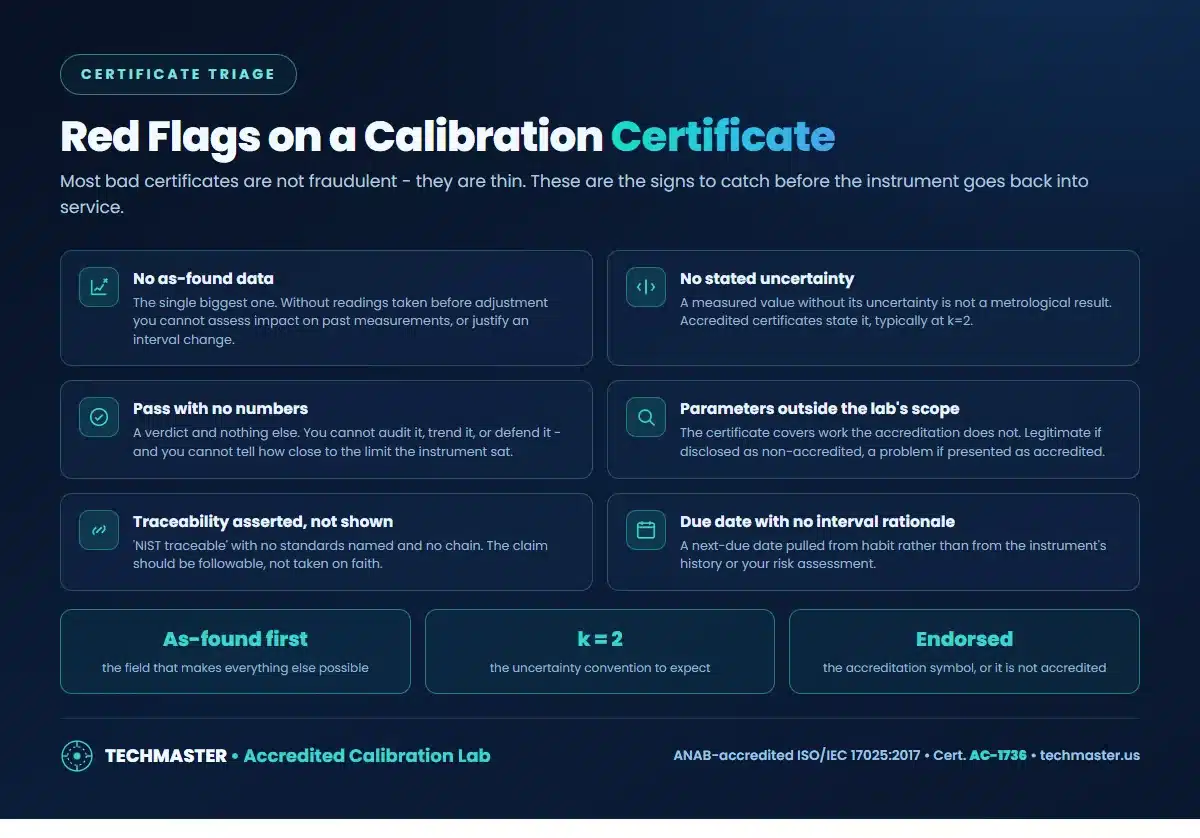
TL;DR: Twelve things should stop you before an instrument goes back into service: no as-found data, no stated uncertainty, a pass with no numbers, missing endorsement on supposedly accredited work, parameters outside the lab’s scope presented as accredited, traceability asserted but not shown, no decision rule, missing environmental conditions, no standards identified, wrong or missing instrument identification, a due date with no rationale, and adjustment performed without as-found data recorded first. Most bad certificates are not fraudulent, they are thin.
Certificates get filed, not read. These are the twelve checks worth running on arrival, while you can still do something about it.
What are the red flags on a calibration certificate?
Short answer: They fall into three groups: missing measurement evidence, missing metrological context, and missing accreditation proof. The first group is the most damaging because it cannot be reconstructed later.
| # | Red flag | Why it matters | What to do |
|---|---|---|---|
| 1 | No as-found data | You cannot assess past measurements or justify interval changes | Reject; require as-found on re-issue |
| 2 | Adjustment made, no as-found recorded | The evidence was destroyed before it was captured | Reject; this is a process failure at the lab |
| 3 | Pass statement with no numbers | Unauditable and untrendable | Request the data report |
| 4 | No stated measurement uncertainty | A value without uncertainty is not a result | Require it, typically at k=2 |
| 5 | No decision rule stated | You cannot tell how pass/fail was decided | Ask whether guard-banding applied |
| 6 | Standards used not identified | Traceability cannot be followed | Require standards and their cert numbers |
| 7 | Traceability asserted, not shown | ‘NIST traceable’ with no chain is a claim | Ask for the chain |
| 8 | Missing endorsement on accredited work | Unendorsed means not an accredited calibration | Check for the body’s symbol and number |
| 9 | Parameters outside the accredited scope | Presented as accredited when it is not | Acceptable only if clearly disclosed |
| 10 | No environmental conditions recorded | Conditions affect results and repeatability | Require temperature and humidity |
| 11 | Instrument identification wrong or vague | The certificate may not belong to your asset | Verify model and serial against the unit |
| 12 | Due date with no interval rationale | A habit, not a decision | Set your own interval and justify it |
Which red flag matters most?
Short answer: Missing as-found data. Every other gap can usually be filled by asking the laboratory; as-found readings cannot, because once the instrument has been adjusted the evidence of its prior condition no longer exists.
That single field is what makes an out-of-tolerance impact assessment possible, what supports a documented interval extension, and what regulated customers look for in medical, aerospace and automotive programs. The distinction between measuring and adjusting is in calibration vs verification vs adjustment; the field-by-field reading guide is in how to read a calibration certificate.
How do you prevent thin certificates?
Short answer: Specify what you want on the purchase order rather than hoping: accredited (endorsed) certificate with as-found and as-left data, stated uncertainty, and the decision rule identified.
Laboratories deliver the level you order, and standard calibration is the default on most order forms, the three levels are compared in calibration certificate levels compared. Verify the lab’s scope covers your parameters first (how to read an accreditation scope), and re-check it at renewal, because scope changes are easy to miss (calibration audit preparation).
Frequently asked questions
What should I check on a calibration certificate before accepting it?
That it identifies the instrument and the standards used, reports as-found and as-left readings per parameter with the tolerance applied, states measurement uncertainty, names the decision rule behind any pass/fail statement, shows traceability to national standards, and – if you ordered accredited work – carries the accreditation body’s endorsement and certificate number.
Is a certificate without as-found data still valid?
It can be technically valid and still be useless to you. Without as-found readings you cannot assess whether measurements taken before the calibration were valid, which is exactly what every quality standard requires after an out-of-tolerance finding, and you cannot build the history needed to justify an interval change.
What does it mean if a certificate covers parameters outside the lab’s accredited scope?
It means that portion of the work was performed as standard calibration rather than accredited calibration. This is legitimate and common, provided it is clearly disclosed on the certificate. It becomes a problem when a certificate is presented as fully accredited and an auditor discovers otherwise.
Should a calibration certificate state a due date?
A due date is useful but it is the laboratory’s suggestion, not a requirement of the standard – the interval is yours to set and justify based on the instrument’s use, criticality and as-found history. Treat a printed due date as a default to review, not as an instruction.
The bottom line
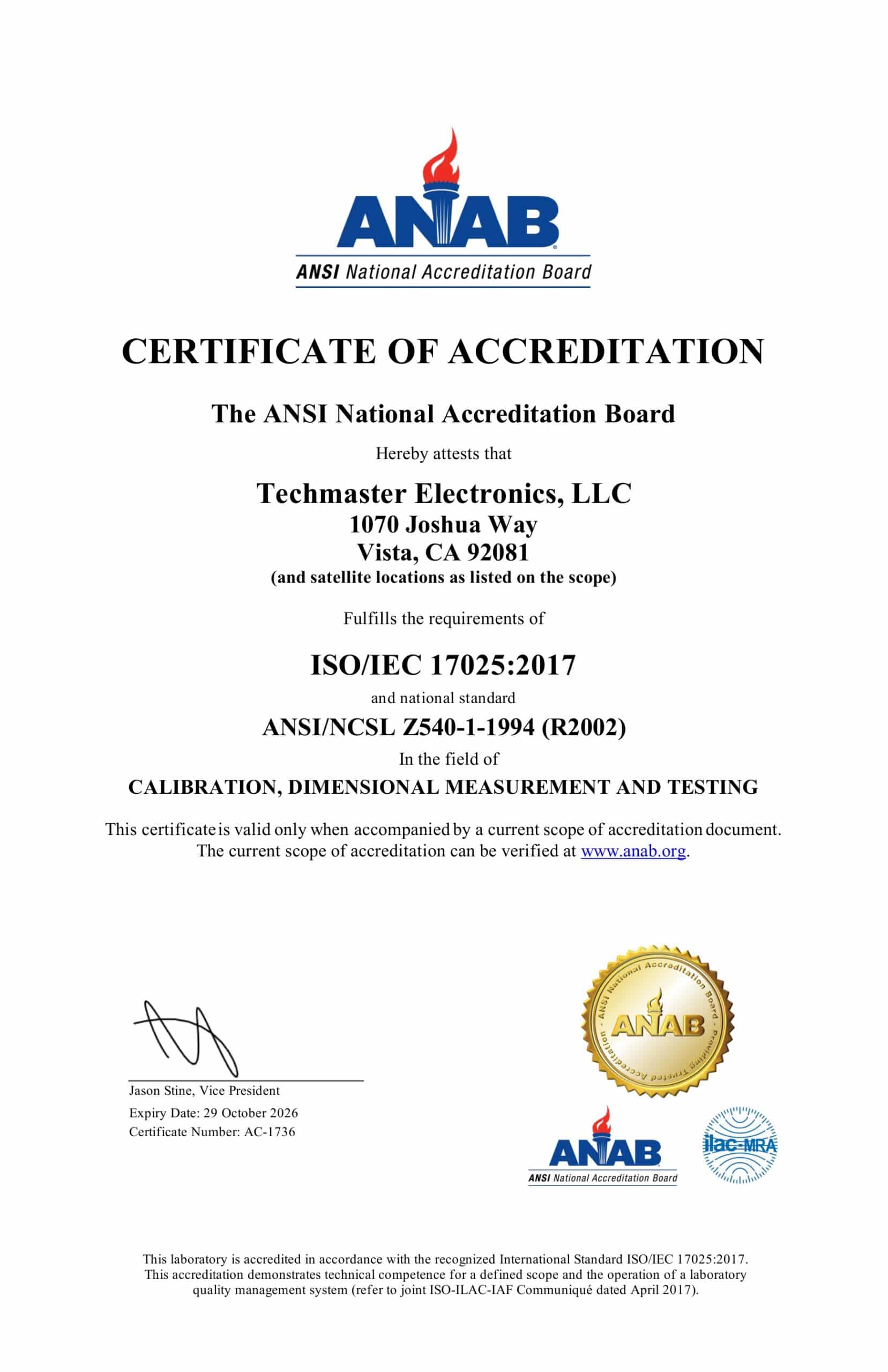
Read certificates on arrival, not at audit. The twelve checks above take a couple of minutes and are the difference between a filed document and usable evidence. Techmaster issues accredited certificates with as-found and as-left data as standard under ANAB certificate AC-1736.
Get an accredited calibration quote
ANAB-accredited ISO/IEC 17025:2017 (Cert. AC-1736) • 4 accredited US labs • 5-day standard, 1–2 day expedite • in-lab or on-site.
Request a quote
Khanh Nguyen is the Marketing Manager at Techmaster Electronics, a B2B marketing leader covering the test, measurement, and ISO/IEC 17025 accredited calibration industry across the US and Vietnam markets.