
Expert DC Power Supply Calibration Services in the US
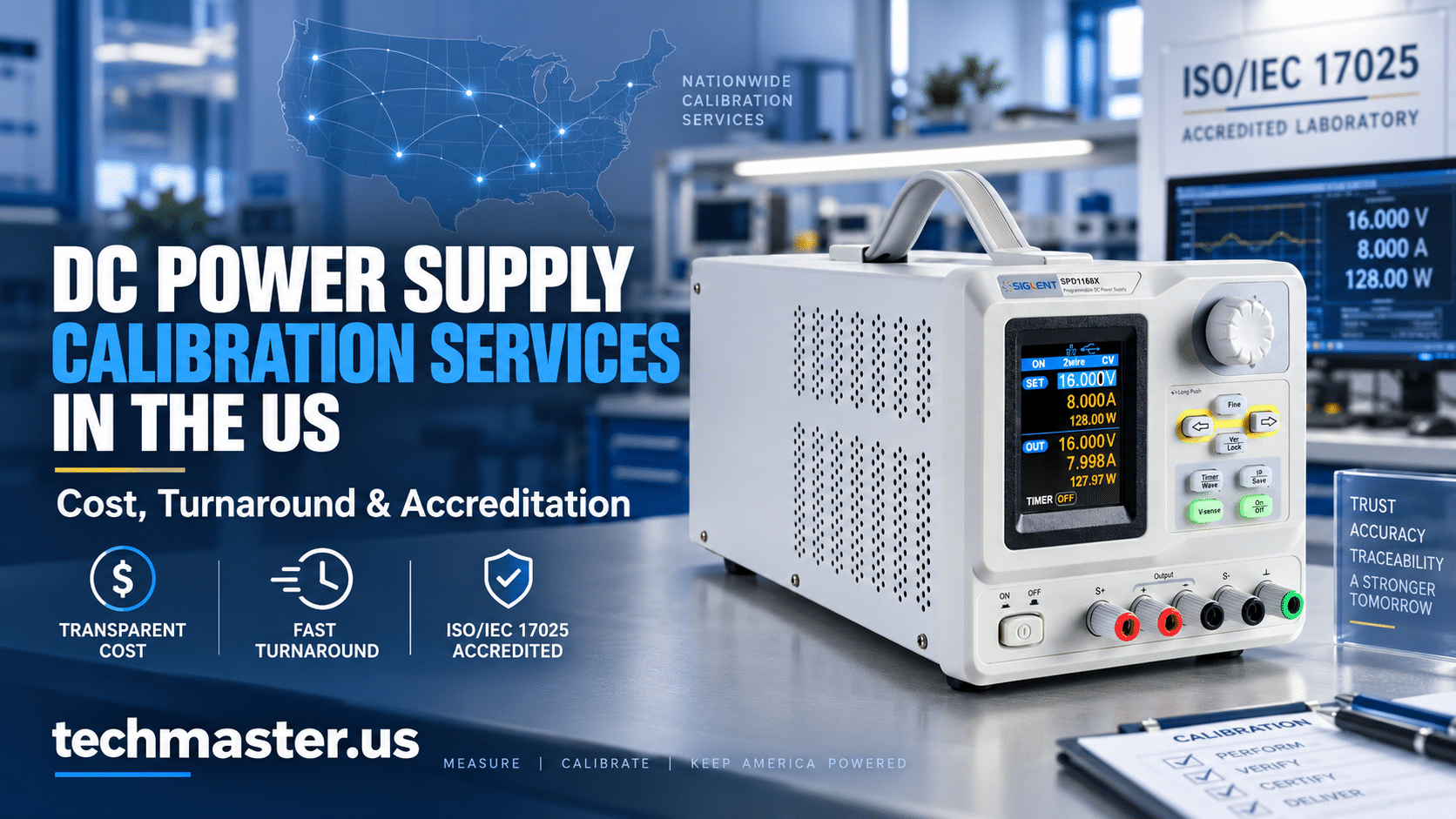
Undoubtedly, precision drives modern electronics manufacturing, aerospace testing, and pharmaceutical development. Specifically, it acts as an absolute requirement rather than just a goal. Therefore, a DC power supply sits at the heart of virtually every testing laboratory. This equipment provides the stable voltage and current necessary to power complex circuits.
However, even top-tier instruments experience component aging and thermal drift over time. Consequently, these issues create hidden measurement errors. Furthermore, relying on an inaccurate power supply creates massive risks. For instance, it can ruin expensive prototypes, produce false test passes, or cause dangerous safety failures.
Ultimately, partnering with a professional Calibration service protects your laboratory from these dangers. Quality managers must specifically invest in expert dc power supply calibration services. This proactive step subsequently ensures your equipment delivers exact performance specifications. As a result, it mitigates risk and protects product quality from the ground up.
1. What Is a Bench DC Power Supply and Its Calibration?
A bench DC power supply serves as essential test equipment. It converts alternating current (AC) into stable direct current (DC). Engineers use linear power supplies for ultra-low noise applications. They use switching power supplies for high-efficiency needs. Both types deliver precise voltage and current to a device under test (DUT).
A proper bench dc power supply calibration verifies this output against accurate reference standards. Metrologists use precision digital multimeters and specialized electronic loads. They measure the exact voltage and current at the output terminals.
Metrologists then compare these true readings to the front panel display. Software interface values also require verification. Metrologists adjust the instrument if they find it out of tolerance. They restore the equipment back to original equipment manufacturer (OEM) specifications.
2. Why DC Power Supply Calibration Services Matter
Ignoring routine equipment maintenance carries disastrous financial consequences. Regular calibration serves as a proactive defense mechanism. It protects your entire quality control infrastructure.
Guaranteeing Measurement Accuracy
Engineers trust the digital display when setting a power supply to 12.00 volts. Calibration ensures the terminal output matches this display perfectly.
Even a few millivolts of error can destroy sensitive microprocessors. Inaccurate voltage also ruins data collection during critical product testing.
Ensuring Traceability and Compliance
Global industries operate under strict regulatory frameworks. Medical device manufacturers follow FDA requirements. Aerospace companies adhere to AS9100 standards.
Traceability proves your measurements hold up to auditor scrutiny. Regular calibration links your data mathematically to international standards. This creates the unbroken chain of trust that auditors demand.
Enhancing Product Safety and Quality
Uncalibrated power supplies may fail to trigger over-voltage protection. Current limits might also fail to engage in time. These failures cause catastrophic component damage and thermal runaway.
They can even spark electrical fires on the test bench. Consistent calibration validates these crucial safety features. It protects your personnel, secures your products, and reduces warranty claims.
3. Common Applications for DC Power Supplies
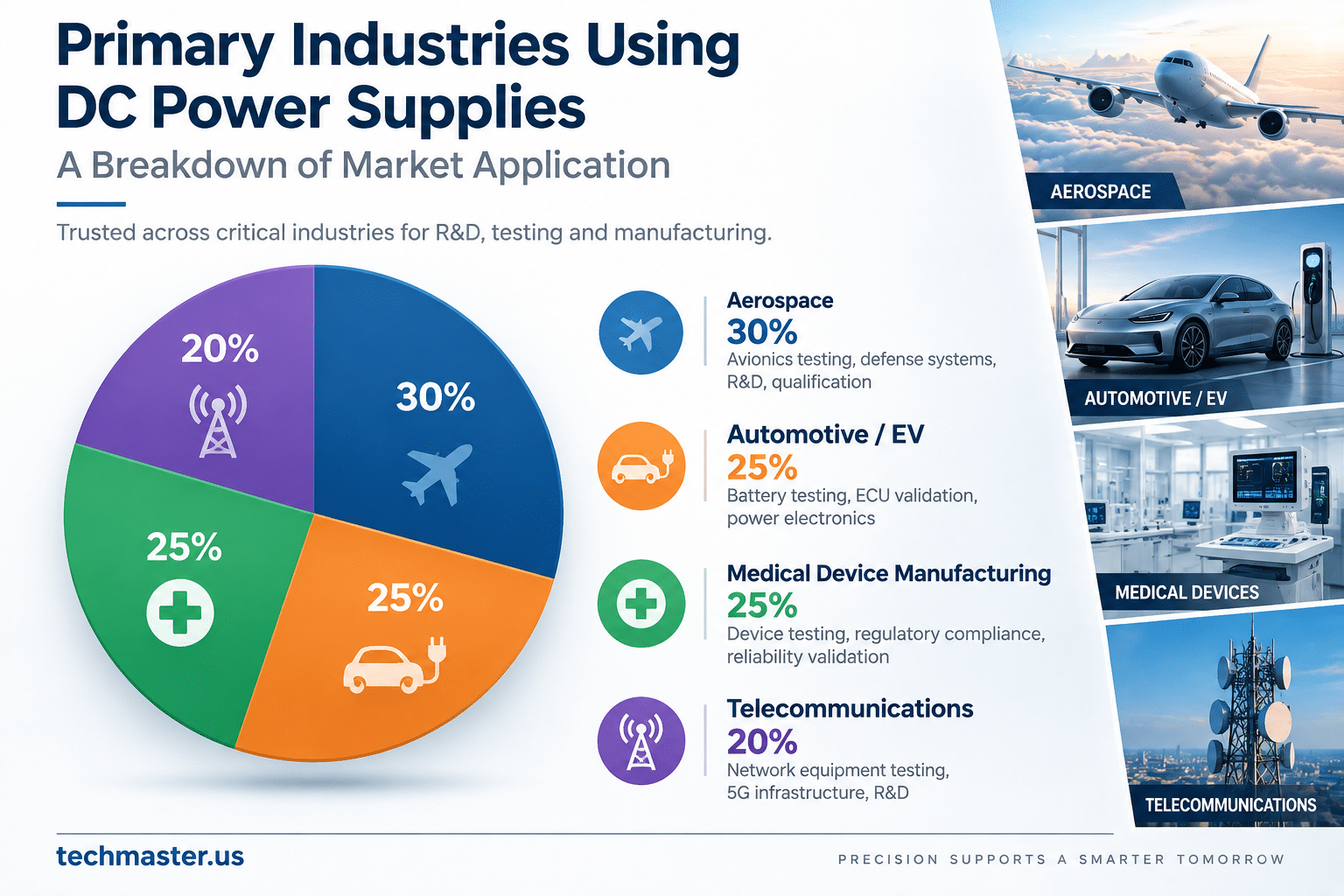
Electrical power remains fundamental to all modern technology. Industries worldwide utilize DC power supplies for critical applications:
-
Electronics Manufacturing: Engineers prototype circuit boards and test consumer electronics. They simulate battery performance under various load conditions.
-
Aerospace and Defense: Avionics systems demand highly stable power sources. Technicians replicate the stringent electrical conditions found in modern aircraft.
-
Medical Device Manufacturing: Life-saving medical equipment requires perfectly clean power. Manufacturers test pacemakers and imaging devices to ensure absolute patient safety.
-
Automotive Industry: Electric vehicle (EV) expansion drives massive testing requirements. Engineers test battery management systems, sensors, and in-cabin electronics.
-
Telecommunications: Network infrastructure requires continuous, ripple-free DC power. This clean power prevents dropped data packets and system crashes.
4. Calibration Standards and Traceability
Understanding governing metrology standards remains crucial when selecting a service provider. An ISO/IEC 17025 accredited calibration represents the highest technical competence. This international standard ensures the laboratory utilizes validated testing methods. Accredited labs carefully control environmental conditions like temperature and humidity. They also mathematically calculate measurement uncertainty for every test point.
A credible laboratory also delivers a NIST traceable power supply calibration. The National Institute of Standards and Technology (NIST) sets US measurement standards. Traceability guarantees the lab calibrated your equipment against master government standards.
Upon completion, you receive a comprehensive digital certificate. This document details the “As-Found” and “As-Left” measurement data. It also lists specific measurement uncertainties to satisfy your quality audits.
5. Common Issues Found During Calibration
Power supplies feature robust designs, but heavy usage takes a toll. Metrologists frequently uncover several common performance issues during routine calibration:
-
Voltage and Current Drift: Thermal cycling causes internal resistors to drift over time. The front panel eventually displays a higher or lower value than the actual output.
-
Ripple and Noise Degradation: Aging filter capacitors lose their effectiveness after heavy use. This allows AC ripple and high-frequency noise to leak into the DC output.
-
Load Regulation Failures: Power supplies must maintain constant voltage as current draw fluctuates. Wear and tear degrades internal feedback loops, causing unacceptable voltage drops.
-
Inaccurate Current Limiting: Engineers use power supplies to restrict current and protect components. Out-of-tolerance current limit circuits allow destructive power levels to reach the DUT.
6. How Often Should This Equipment Be Calibrated?
Calibration intervals depend heavily on instrument utilization and environmental factors. Metrology industry standards recommend a 12-month calibration cycle for benchtop power supplies.
However, quality managers must shorten this interval to 6 months under certain conditions. Harsh environments with extreme temperatures or dust demand frequent checks. Equipment running continuously 24/7 also requires a 6-month cycle. Hyper-critical medical or aerospace applications necessitate tighter intervals as well.
You must schedule immediate recalibration if technicians drop the unit. Severe electrical overloads also mandate immediate testing. Always consult your internal quality manual and OEM guidelines. These documents help establish the best schedule for your specific facility.
7. What to Look for in a Calibration Provider
You must evaluate calibration labs carefully before partnering with them. Consider the following criteria when selecting a metrology provider:
-
Scope of Accreditation: Verify the lab holds a valid ISO/IEC 17025 accreditation. Check their official scope to ensure it covers your equipment’s power ranges.
-
Transparent DC Power Supply Calibration Cost: Choose a provider offering clear, upfront pricing. The price should reflect instrument complexity and output channel count. Avoid labs with hidden evaluation fees.
-
Swift Calibration Turnaround Time: Manufacturing downtime costs companies thousands of dollars hourly. A top-tier provider offers a standard calibration turnaround time of 3 to 5 days. Look for expedited or on-site service options.
-
Documentation Quality: The lab must provide easily accessible digital certificates. These certificates must list measurement uncertainties and exact traceability details.
8. Keep Your Operations Running: Techmaster’s Renting Service
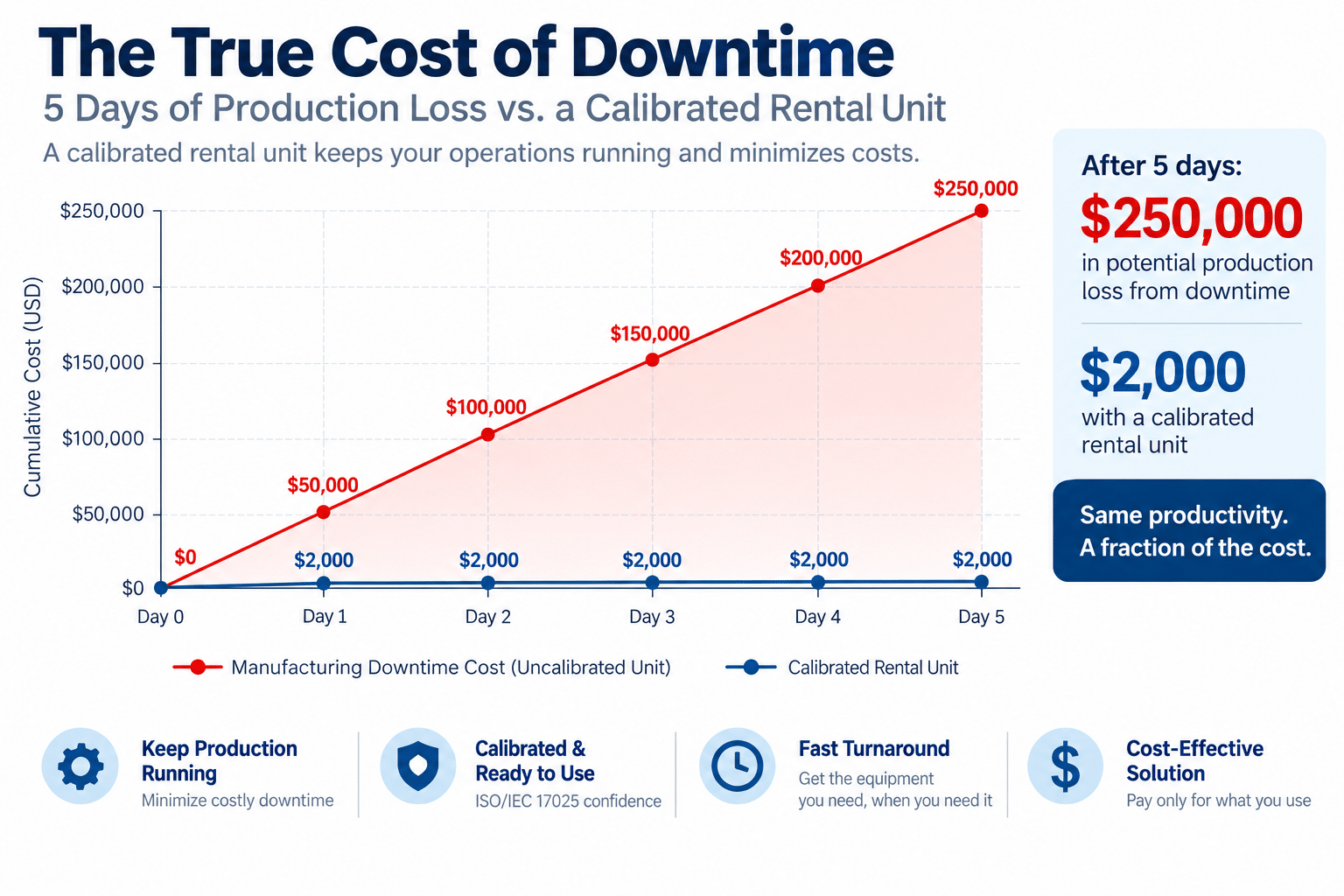
Sending a vital power supply out for calibration can halt manufacturing lines. Delayed product launches cost your business money and reputation. You simply cannot afford prolonged equipment downtime in today’s fast-paced environment.
Techmaster Electronics offers a comprehensive equipment renting service to solve this problem. You can instantly rent a fully calibrated replacement unit from our inventory. We ship this temporary unit while your primary instrument visits our metrology lab.
Our flexible rental terms help you maintain seamless production schedules. You meet strict customer deadlines and eliminate equipment absence stress. We supply high-power systems for a week or bench supplies for a month. Our rental program keeps your operations moving forward without interruption.
9. Why Choose Techmaster Electronics?
Techmaster Electronics stands as a premier partner for precision-focused industries. We offer elite, ISO/IEC 17025 accredited calibration services for electronic test equipment. Our expertise covers complex DC power supplies, electronic loads, and oscilloscopes.
Our world-class laboratories employ highly experienced metrologists. These experts utilize state-of-the-art reference standards to guarantee absolute accuracy. We understand the immense pressure manufacturing engineers face daily. Therefore, we emphasize transparent communication and competitive pricing.
We deliver some of the fastest turnaround times in the US market. Customers utilize our convenient in-lab pickup and delivery services. We also perform comprehensive on-site calibration events directly at your facility. Techmaster Electronics provides a seamless, reliable, and expertly documented metrology solution.
10. Conclusion
A DC power supply acts as the beating heart of an electronics test bench. Its accuracy dictates the absolute validity of your entire testing process. Routine, accredited calibration serves as a critical investment, not an administrative chore.
Proper maintenance identifies hidden drift and verifies critical safety limits. It ensures traceable precision and protects your brand reputation. This proactive approach saves your bottom line from expensive failures and recalls. Contact Techmaster Electronics today and secure your measurement accuracy.
11. FAQ Section
Frequently asked questions
What is dc power supply calibration?
DC Power Supply Calibration is the documented comparison of a DC power supply against NIST-traceable reference standards under ISO/IEC 17025. It quantifies the DC power supply’s error and measurement uncertainty and confirms it performs within tolerance, with as-found and as-left data on the certificate.
How often should a DC power supply be calibrated?
Most quality systems calibrate a DC power supply every 12 months, or sooner after repair, overload, or before critical measurements. Set your interval from the manufacturer spec and your ISO 9001 / 13485 / AS9100 program and drift history.
Is Techmaster’s DC power supply calibration ISO 17025 accredited?
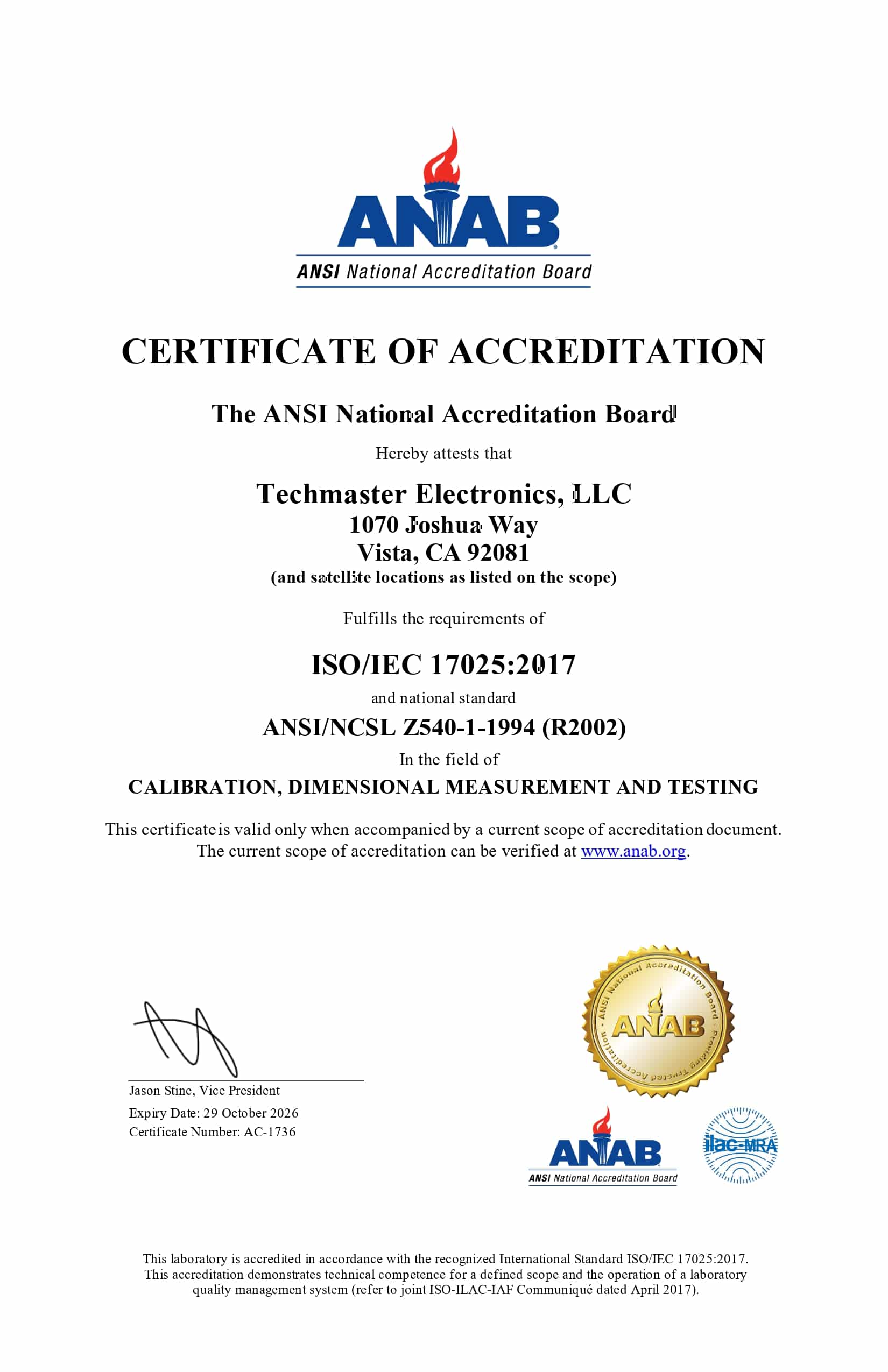
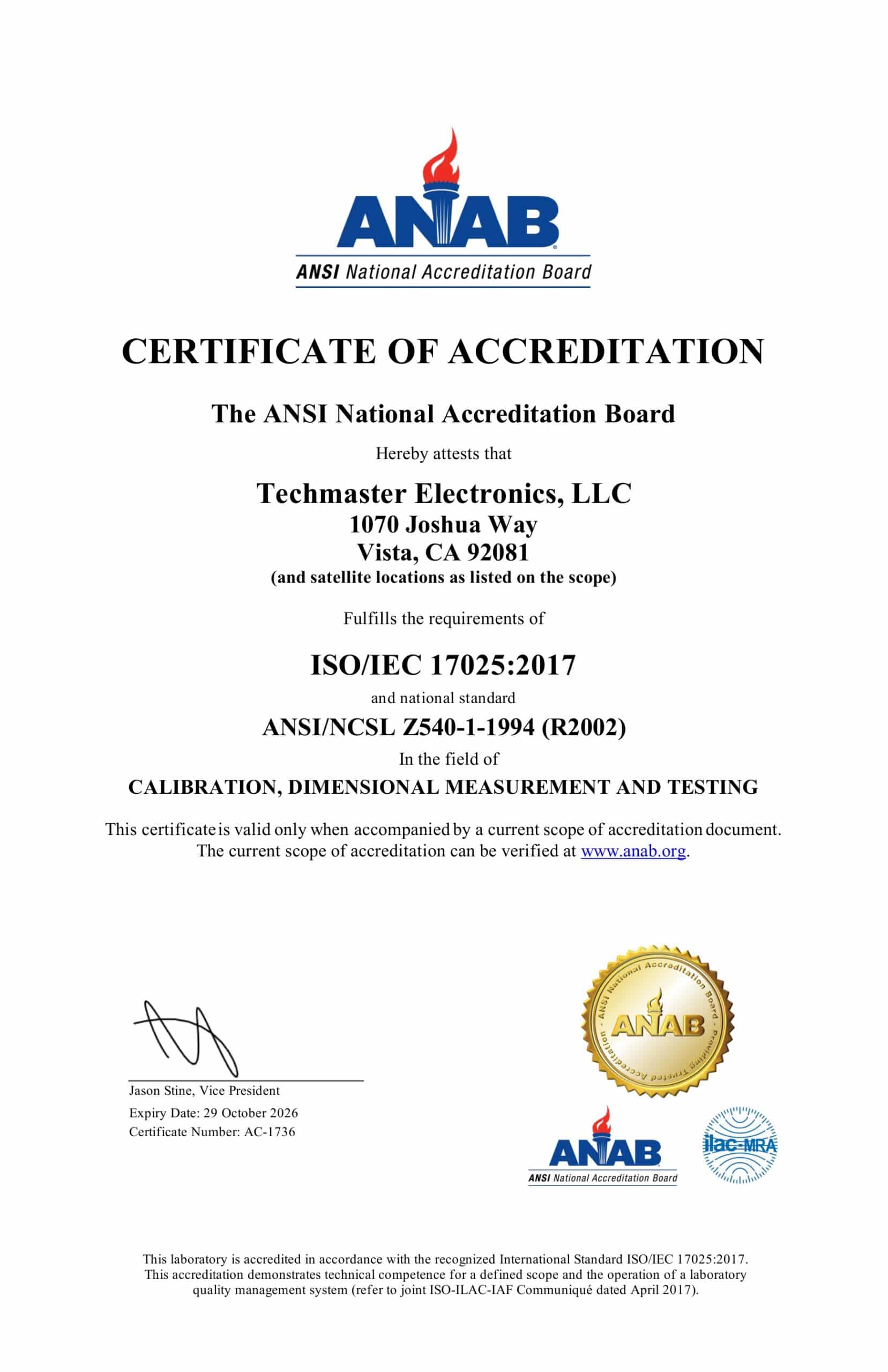
Yes. Techmaster Electronics is ISO/IEC 17025:2017 accredited by ANAB (Certificate AC-1736). Every DC power supply calibration is NIST-traceable and issued with a full measurement-uncertainty budget.
What is the turnaround for DC power supply calibration?
Standard turnaround is 5 business days, with 1–2 business-day expedite available. On-site calibration removes shipping time entirely for DC power supplys that can’t leave the floor.
Do you calibrate DC power supplys on-site or in-lab?
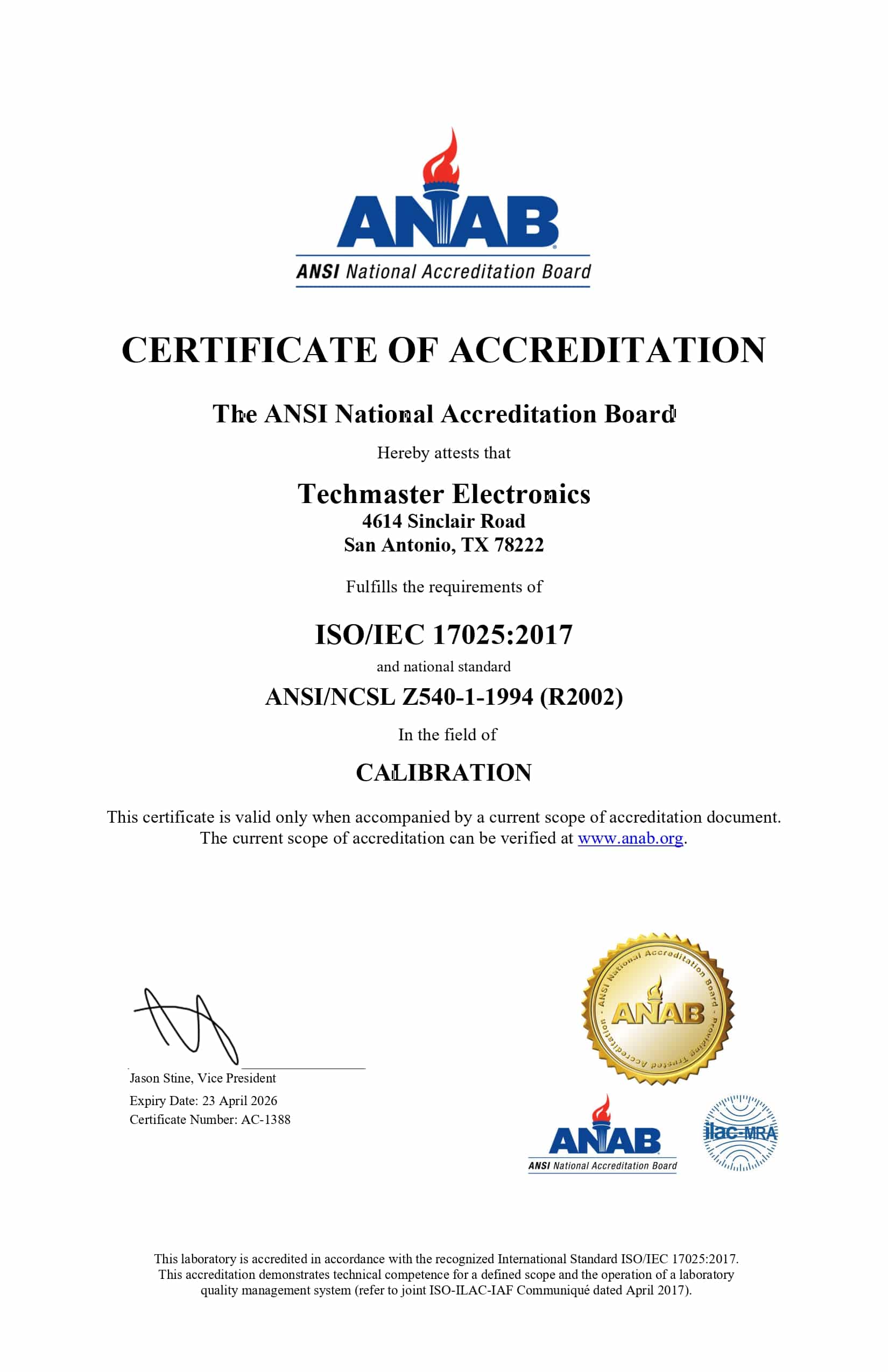
Both. Techmaster runs five US labs (Vista CA, Santa Clara CA, Orlando FL, San Antonio TX, Holly Springs NC) and offers nationwide on-site DC power supply calibration to minimize downtime.

Calibration engineer at Techmaster Electronics, ISO/IEC 17025 accredited laboratory with 35+ years of metrology expertise.