
TL;DR: LCR meter calibration verifies capacitance, inductance, resistance and complex impedance across ranges, plus the test frequency, signal level and DC bias, and derived D, Q and phase. The common misconception: fixture compensation is not calibration, open/short/load corrects your setup, not the meter, and leaves no traceable record. Typical interval: 12 months.
Impedance measurement has more variables than most bench work: a value, at a frequency, at a drive level, through a fixture. Calibration has to address all four, and the one people skip is the frequency itself.
What does LCR meter calibration verify?
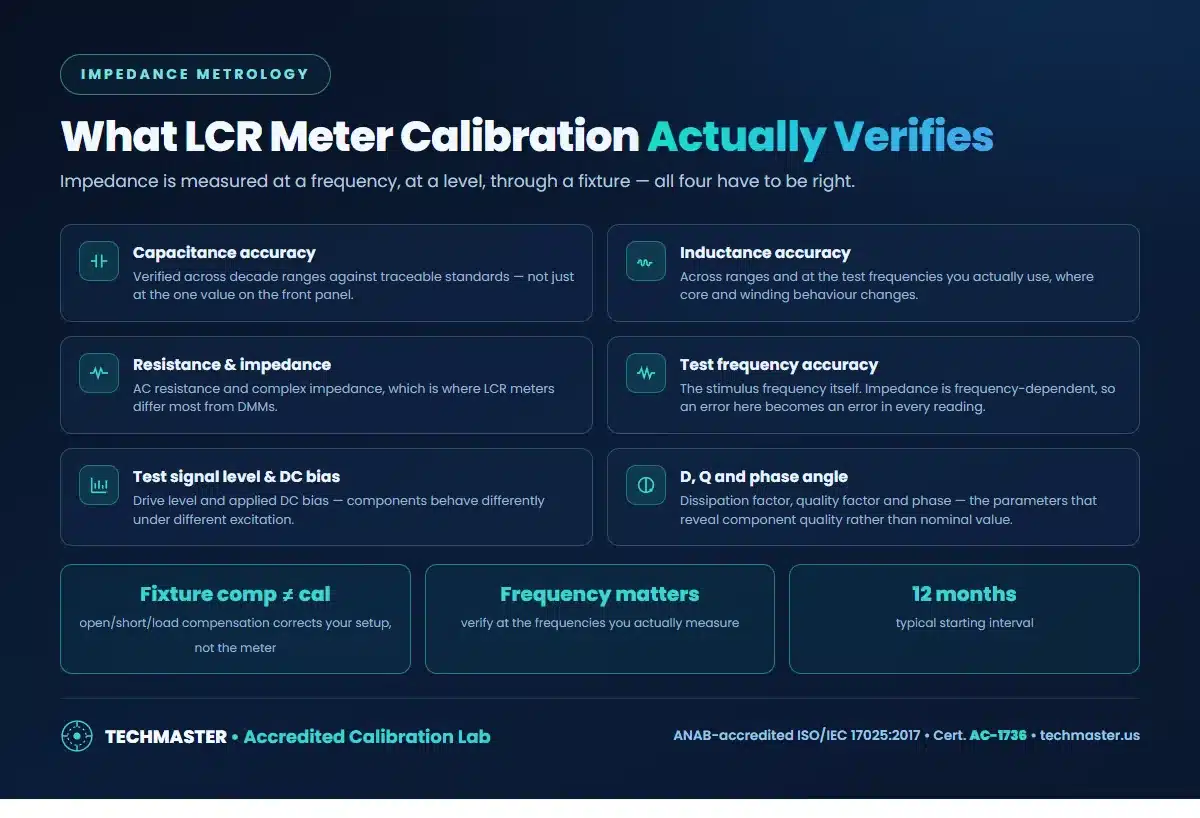
Capacitance, inductance and resistance are checked across decade ranges against traceable standards, not merely at one convenient value. Complex impedance and AC resistance are where LCR meters diverge most from multimeters, and where accuracy claims get subtle. Test frequency accuracy underpins everything, because impedance is defined at a frequency. Signal level and DC bias matter because real components behave differently under different excitation, a ceramic capacitor measured at the wrong bias reports the wrong value quite legitimately. And D, Q and phase are the parameters that reveal component quality rather than nominal value.
Fixture compensation is not calibration
This is the distinction worth internalizing. Open/short/load compensation characterizes your fixture, cables and probe geometry at that moment, so the meter can subtract them. Useful, necessary, and completely silent about whether the meter’s own circuitry has drifted. It generates no certificate, no as-found data, and no traceability, which means it cannot support an out-of-tolerance assessment or satisfy an auditor. It is the same category error as trusting an oscilloscope’s self-cal, discussed in the oscilloscope guide. Run compensation before every measurement session and calibrate the meter annually.
What to ask for
Ask for calibration at the frequencies you actually use, a certificate covering 1 kHz tells you little if your production test runs at 100 kHz. Ask for as-found data (why it matters: calibration vs verification), and confirm the lab’s accredited scope lists impedance parameters over your ranges using how to read a scope document. Certificate level should follow the risk, see certificate levels compared.
Frequently asked questions
Does fixture compensation replace LCR meter calibration?
No. Open, short and load compensation corrects for the fixture and leads in your setup at the moment you run it. It cannot detect or correct drift in the meter’s own measurement circuitry, and it produces no traceable record. Compensation is good practice before measuring; calibration is what makes the readings traceable.
What does LCR meter calibration verify?
Capacitance, inductance, resistance and complex impedance accuracy across decade ranges, the accuracy of the test frequency itself, test signal level and DC bias, and derived parameters such as dissipation factor, quality factor and phase angle.
Why does test frequency accuracy matter so much?
Because impedance is frequency-dependent by definition. If the meter’s stimulus is not at the frequency it claims, every capacitance and inductance reading inherits that error, and nothing on the display suggests a problem.
How often should an LCR meter be calibrated?
Twelve months is the standard starting interval, adjusted on documented as-found history. Meters used for incoming component inspection or production acceptance generally stay annual because their readings decide whether parts are used.
The bottom line
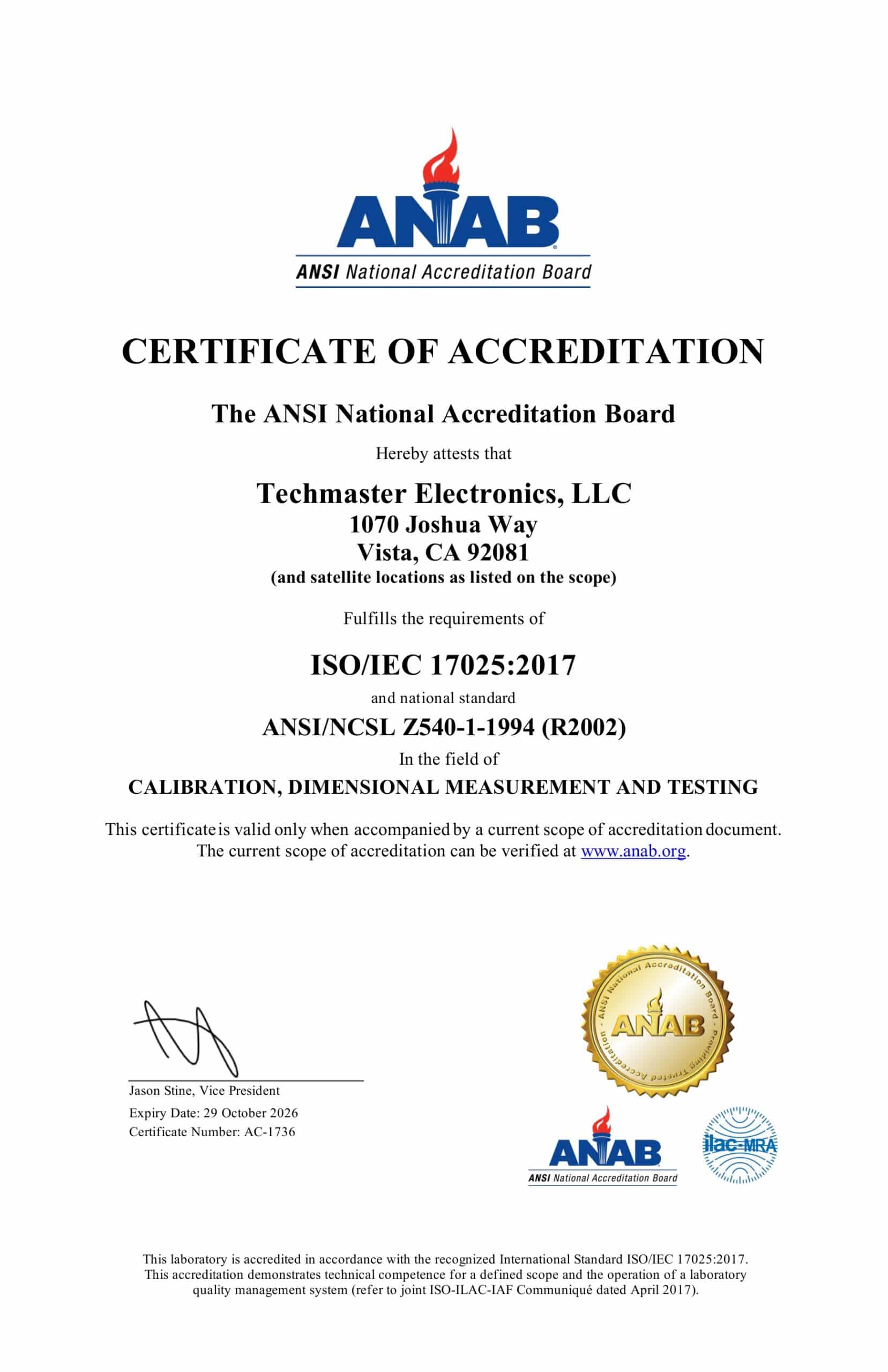
Compensate your fixture every session, calibrate the meter every year, and insist the certificate covers your test frequencies. Techmaster calibrates LCR meters and impedance analyzers under ANAB accreditation to ISO/IEC 17025:2017 (Cert. AC-1736).
Get an accredited calibration quote
ANAB-accredited ISO/IEC 17025:2017 (Cert. AC-1736) • 5 US labs • 5-day standard, 1–2 day expedite • in-lab or on-site.
Request a quote
Khanh Nguyen is the Marketing Manager at Techmaster Electronics, a B2B marketing leader covering the test, measurement, and ISO/IEC 17025 accredited calibration industry across the US and Vietnam markets.