
How to Calibrate a DC Power Supply: ISO/IEC 17025 Step-by-Step
Testing laboratories and manufacturing floors rely on benchtop power supplies every day. You must trust your power source when you evaluate a sensitive aerospace component or test a new semiconductor. If a power supply drifts from its display values, every downstream test result becomes a liability.
Understanding how to calibrate a dc power supply helps lab managers and quality engineers maintain strict measurement confidence. This guide outlines the core calibration process, common equipment issues, and the importance of strict traceability for your operational success.
1. What Is a Bench DC Power Supply?
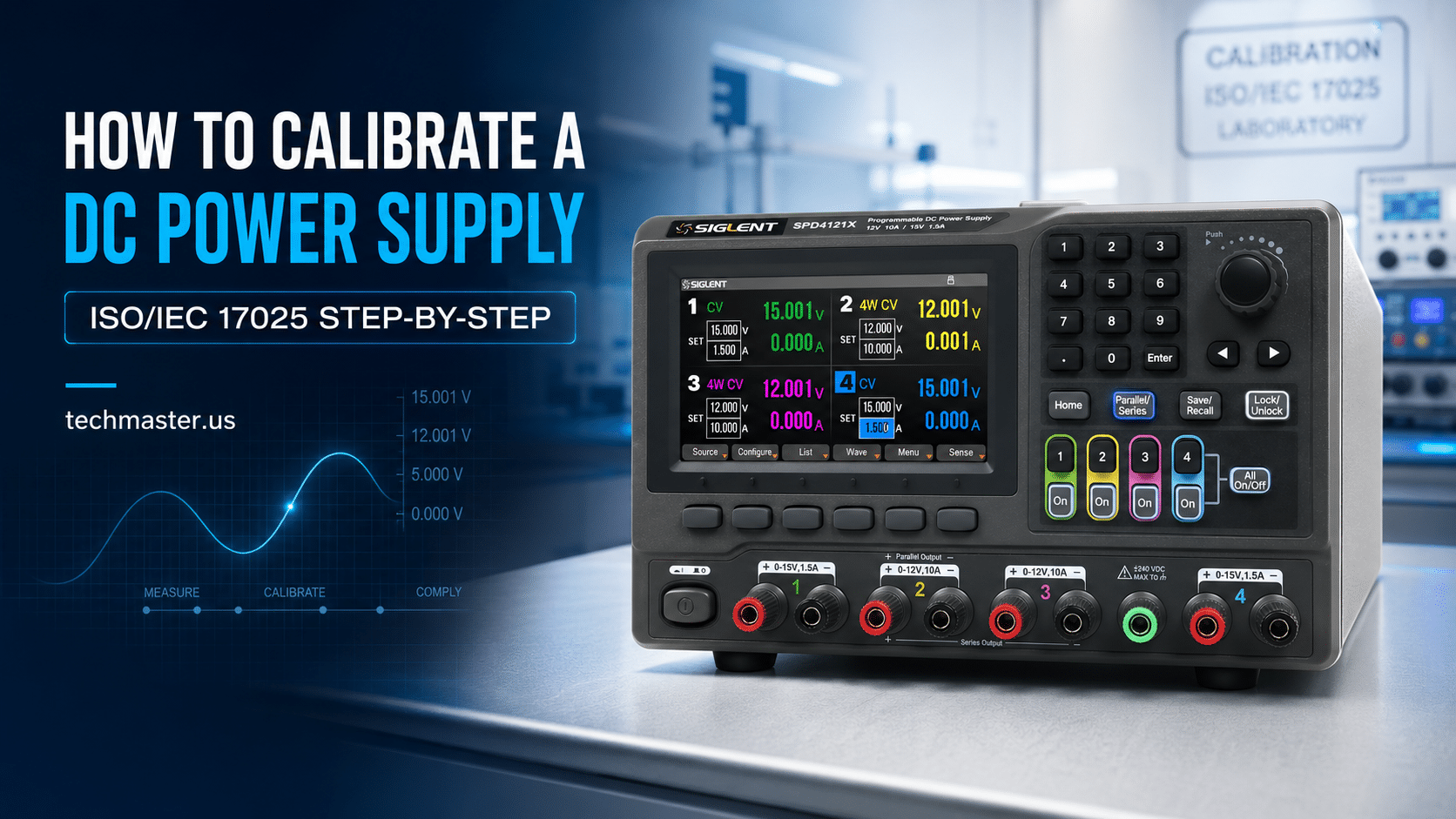
A bench DC power supply delivers stable, controlled direct current (DC) voltage and current to a device under test (DUT). These instruments generally operate in two main modes. In Constant Voltage (CV) mode, the unit holds the voltage steady while the current changes based on the load. In Constant Current (CC) mode, the unit holds the current steady while the voltage adjusts.
Modern programmable power supplies feature digital screens, digital-to-analog converters, and complex feedback loops. They supply power and actively measure their own output at the same time. Because they act as both a source and a meter, routine test and measurement equipment calibration keeps their internal components accurate.
2. The DC Power Supply Calibration Procedure
DC Power Supply Calibration Procedure
An accurate DC power supply calibration procedure requires high-precision reference standards. Metrologists typically use an 8.5-digit digital multimeter (DMM), precision current shunts, and an oscilloscope. Here is a step-by-step look at how professionals perform this calibration.
Warm-Up and Stabilization
The technician powers on the unit and all reference standards in a temperature-controlled lab. This warm-up phase usually lasts 30 to 60 minutes. It prevents thermal drift from skewing the data.
Voltage Output Verification
The metrologist connects the high-precision DMM to the power supply output terminals. They program the supply to specific voltage test points, such as 10%, 50%, and 90% of the maximum range. The technician records the DMM reading and compares it to the unit’s front-panel display.
Current Output Verification
Measuring high current requires precision current shunts. The technician connects the power supply across the shunt and applies a load. The DMM measures the tiny voltage drop across the shunt. The technician then uses Ohm’s Law to convert this voltage into a highly accurate current reading.
Safety Protection Testing
Power supplies feature over-voltage protection (OVP) and over-current protection (OCP) circuits. The metrologist sets a specific limit and slowly increases the output. They record the exact point where the unit trips and shuts down to confirm the safety circuits work.
Ripple and Noise Measurement
Technicians use a calibrated oscilloscope to check for AC ripple and noise on the DC output. High ripple can ruin sensitive analog circuits. Verifying this specification keeps research and development tests reliable.
3. Why Knowing How to Calibrate a DC Power Supply Matters
Guessing ruins quality control. You take significant risks when you rely on uncalibrated power supplies for your engineering processes.
-
Measurement Accuracy: Components tested at the wrong voltage might pass your factory test but fail in the real world. Calibration proves that a 12.00V setting actually outputs 12.00V.
-
Industry Compliance: Regulatory bodies govern aerospace, automotive, and pharmaceutical manufacturing. Using unverified equipment violates strict quality systems like ISO 9001 and AS9100.
-
Safety and Risk Reduction: Unexpected over-voltage events can destroy expensive prototypes. Routine testing ensures the built-in safety limits engage at the right time.
-
Product Quality: A verified power supply removes “ghost” errors during product testing. Engineers can stop wasting time troubleshooting product flaws that actually stem from a noisy power source.
4. Common Applications
Facilities use precision DC power supplies across many critical and demanding sectors.
-
Electronics Manufacturing: Technicians use these units to power printed circuit boards (PCBs) during end-of-line functional tests.
-
Aerospace and Defense: Engineers simulate aircraft battery voltages to test avionics, radar arrays, and communication gear.
-
Automotive: Developers test electric vehicle (EV) battery systems, internal sensors, and dashboard modules under various loads.
-
Pharmaceuticals and Medical Devices: Designers supply clean power to automated dispensing tools and medical monitors during early qualification stages.
5. Calibration Standards and Traceability
You must root your calibration data in international standards to guarantee measurement confidence.
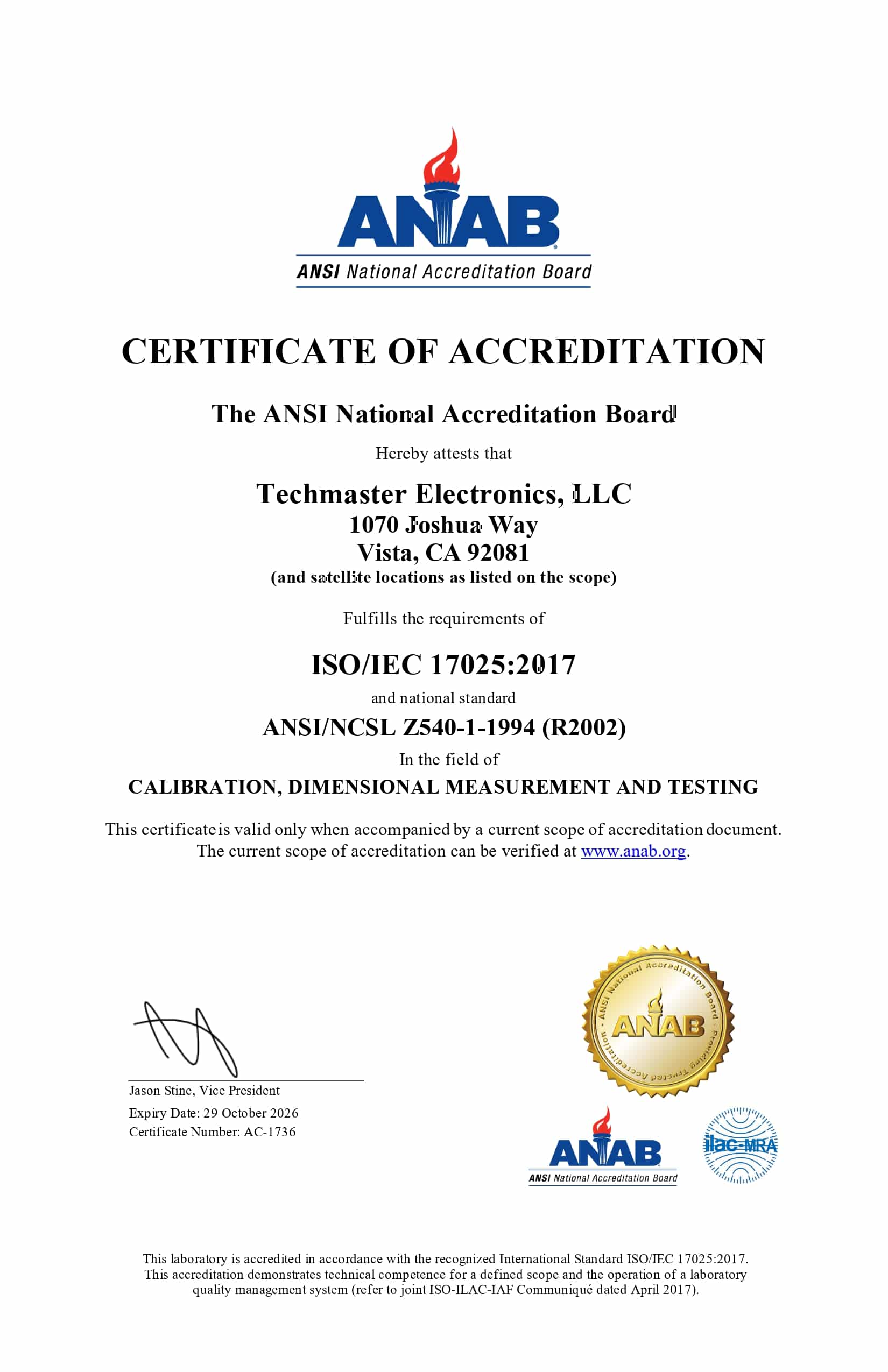
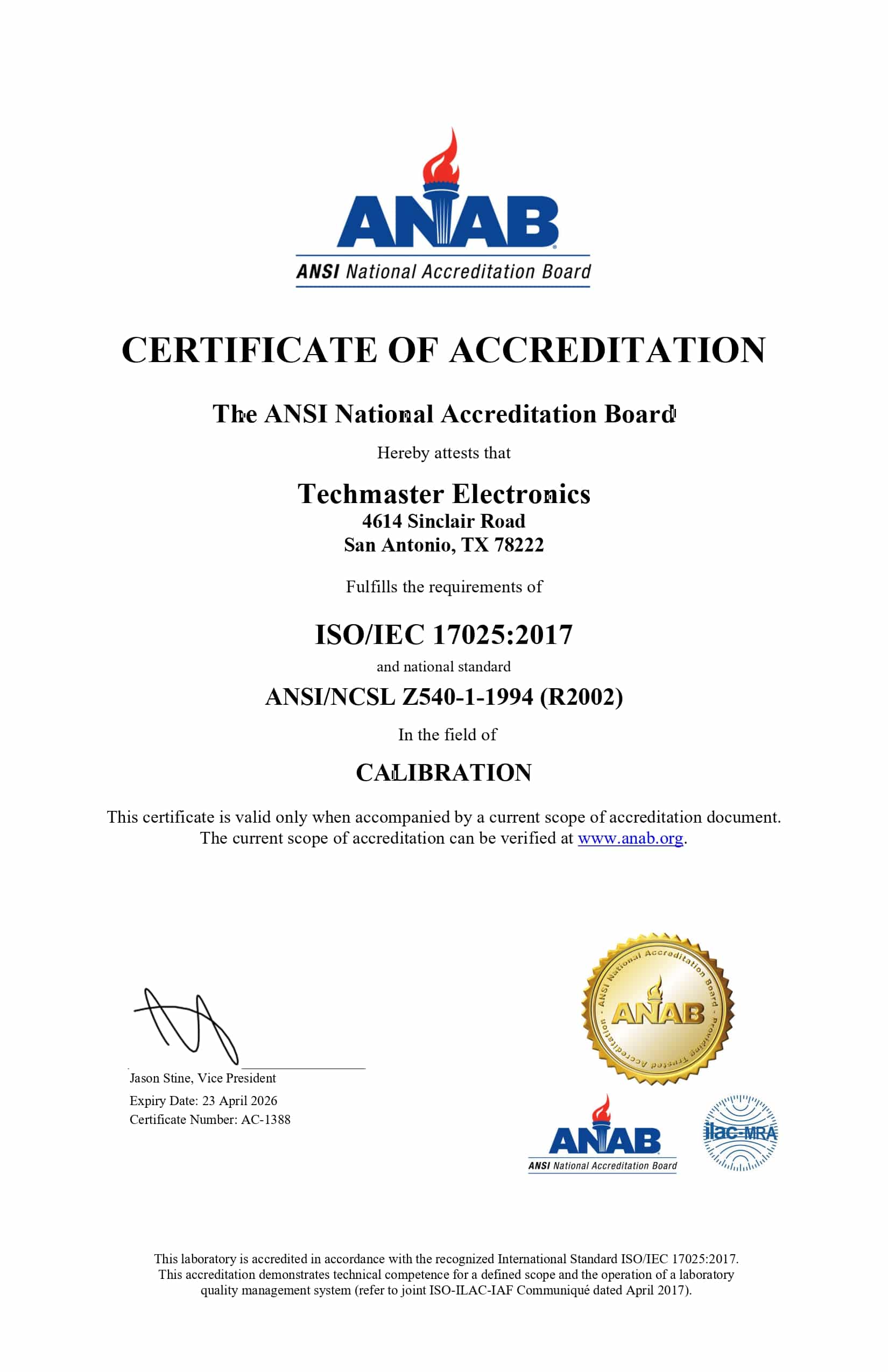
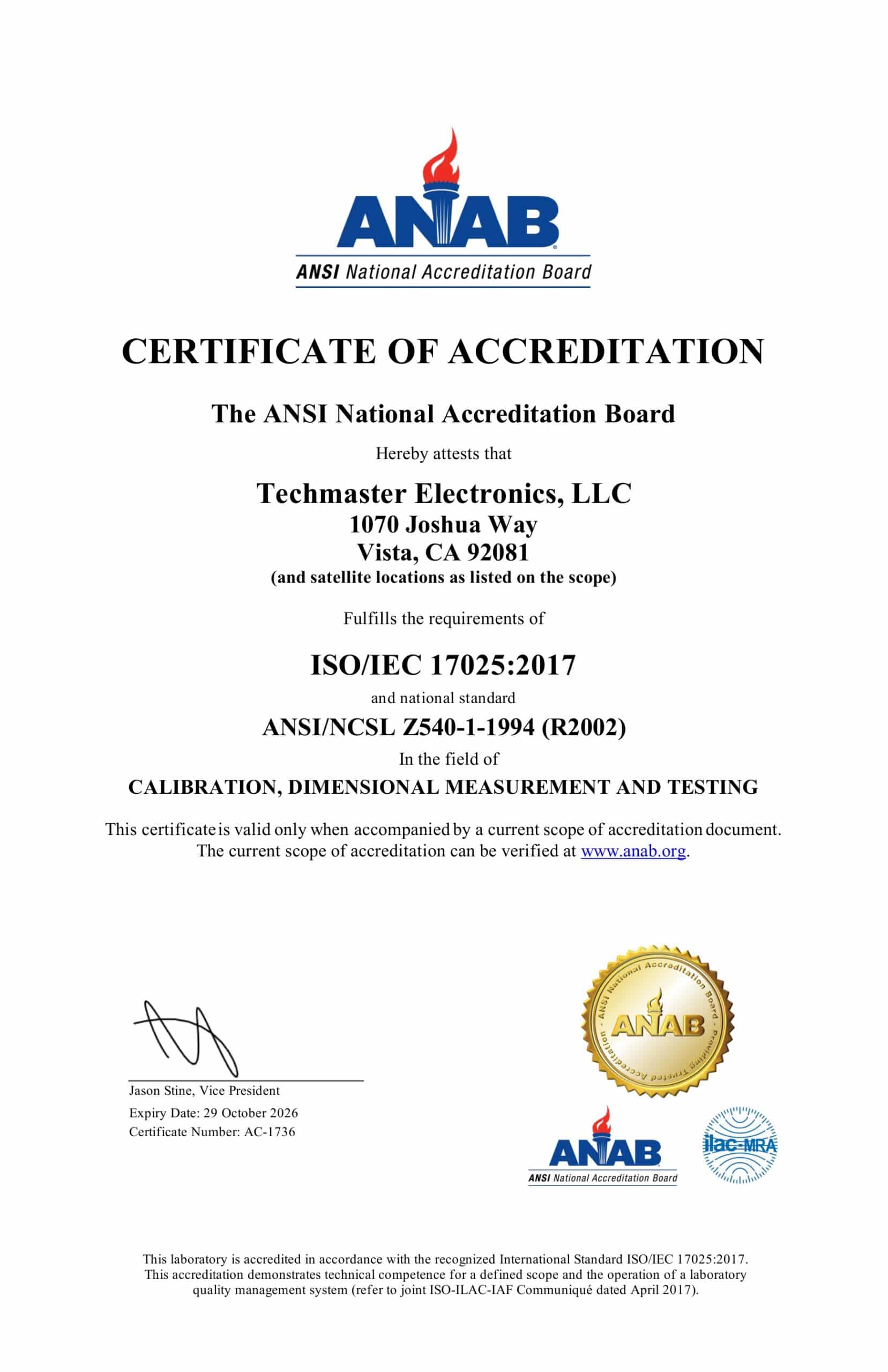
An ISO/IEC 17025 calibration serves as the highest global standard for testing laboratories. This accreditation proves the lab uses validated procedures, trained staff, and a strict quality system.
Furthermore, all reference tools used in the lab must feature NIST-traceable calibration data. This creates an unbroken chain of documentation linking your equipment back to the National Institute of Standards and Technology. A proper certificate will also list the measurement uncertainty for each test point. This statistical value proves the lab maintained an acceptable Test Uncertainty Ratio (TUR).
6. Common Issues Found During Calibration
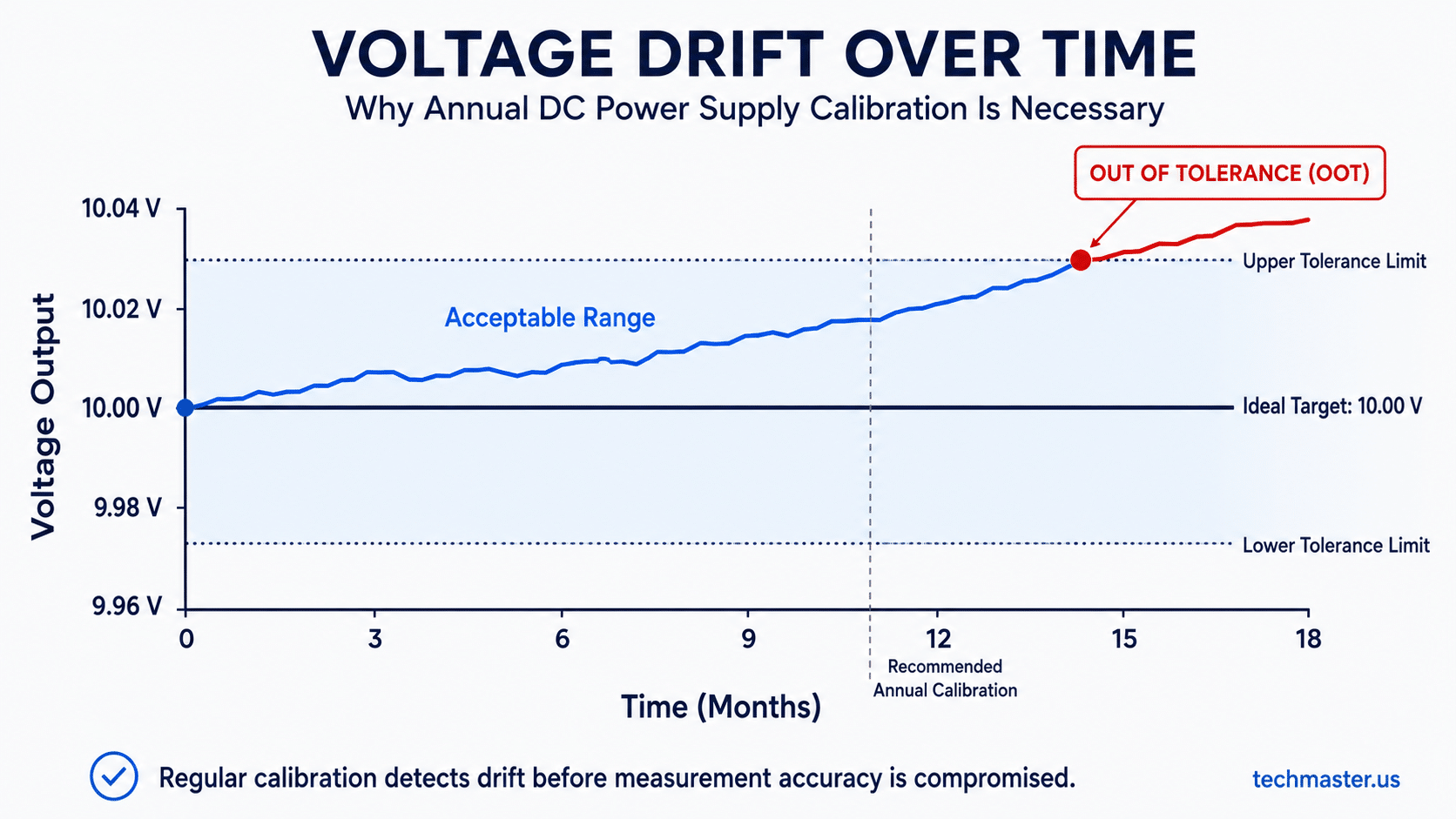
Metrologists frequently discover out-of-tolerance (OOT) conditions during routine service. Some of the most frequent problems include:
-
Zero Offset Drift: Analog parts age over time. This aging causes the unit to output a tiny voltage even when you program it to zero.
-
Display Mismatches: The front screen might show 5.00V, but the actual output sits at 4.92V. This error usually points to a degrading internal analog-to-digital converter.
-
Load Regulation Failures: The unit might push the correct voltage with no load attached. However, the voltage drops too far once a heavy load draws current from the system.
-
Environmental Damage: Dust, high heat, and vibration on a factory floor wear out internal electronic parts quickly. This leads to premature measurement drift.
7. How Often Should This Equipment Be Calibrated?
Determining the Ideal Calibration Frequency
Calibration schedules vary by industry. A 12-month interval serves as the standard baseline for most benchtop DC power supplies. However, your ideal frequency depends on several distinct factors.
OEM Suggestion
Most original equipment manufacturers (OEMs) suggest an annual check.
Heavy Usage
Running all day requires service. Check heavy-use units every six months.
Environment
Extreme temps and heavy vibrations shorten the reliable lifespan.
Quality Rules
Your specific quality manual or auditor will dictate the exact schedule.
8. What to Look for in a Calibration Provider
Choosing the right partner for calibration services for DC power supplies impacts your entire business. You should evaluate several criteria before you send your instruments out.
First, check the laboratory’s accreditation scope. Ensure their ISO/IEC 17025 certificate explicitly covers the specific voltage and current ranges of your devices. The lab must own high-level standards that achieve at least a 4:1 Test Uncertainty Ratio against your equipment.
Next, ask about their documentation. You need a detailed certificate that includes “As-Found” data, “As-Left” data, and clear uncertainty values. Finally, look for a provider with strong customer support and fast turnaround times. Delays in the metrology lab cause expensive delays on your production floor.
9. Keep Your Lab Running with Techmaster Rental Services
We know that sending test equipment away for service disrupts your production schedule. Downtime delays your critical research and development projects. Techmaster Electronics offers comprehensive equipment rental services to solve this exact problem.
While our metrology experts service your DC power supply, you can rent a fully certified, NIST-traceable replacement from our inventory. This seamless swap keeps your engineers working. You avoid production bottlenecks without sacrificing your strict quality compliance.
10. Why Choose Techmaster Electronics?
Techmaster Electronics stands as a leading provider of industrial metrology solutions. As an ISO/IEC 17025 accredited laboratory, we deliver precise data and excellent customer support.
We use advanced reference standards to test your electrical parameters thoroughly. Our technicians make sure your power supplies perform exactly to the manufacturer’s specifications. We offer fast in-lab service and dedicated on-site options for large facilities. When you need a reliable Calibration service, our team provides the transparent data and detailed certificates your quality management system requires.
11. Conclusion
A bench DC power supply only works as well as its last service date. Using uncalibrated equipment exposes your business to safety risks, bad products, and compliance failures. When you follow strict ISO/IEC 17025 guidelines and work with an accredited lab, you guarantee your test equipment delivers true precision.
12. FAQ Section
Frequently Asked Questions
Frequently asked questions
What is dc power supply calibration?
DC Power Supply Calibration is the documented comparison of a DC power supply against NIST-traceable reference standards under ISO/IEC 17025. It quantifies the DC power supply’s error and measurement uncertainty and confirms it performs within tolerance, with as-found and as-left data on the certificate.
How often should a DC power supply be calibrated?
Most quality systems calibrate a DC power supply every 12 months, or sooner after repair, overload, or before critical measurements. Set your interval from the manufacturer spec and your ISO 9001 / 13485 / AS9100 program and drift history.
Is Techmaster’s DC power supply calibration ISO 17025 accredited?
Yes. Techmaster Electronics is ISO/IEC 17025:2017 accredited by ANAB (Certificate AC-1736). Every DC power supply calibration is NIST-traceable and issued with a full measurement-uncertainty budget.
What is the turnaround for DC power supply calibration?
Standard turnaround is 5 business days, with 1–2 business-day expedite available. On-site calibration removes shipping time entirely for DC power supplys that can’t leave the floor.
Do you calibrate DC power supplys on-site or in-lab?
Both. Techmaster runs five US labs (Vista CA, Santa Clara CA, Orlando FL, San Antonio TX, Holly Springs NC) and offers nationwide on-site DC power supply calibration to minimize downtime.

Khanh Nguyen is the Marketing Manager at Techmaster Electronics, a B2B marketing leader covering the test, measurement, and ISO/IEC 17025 accredited calibration industry across the US and Vietnam markets.